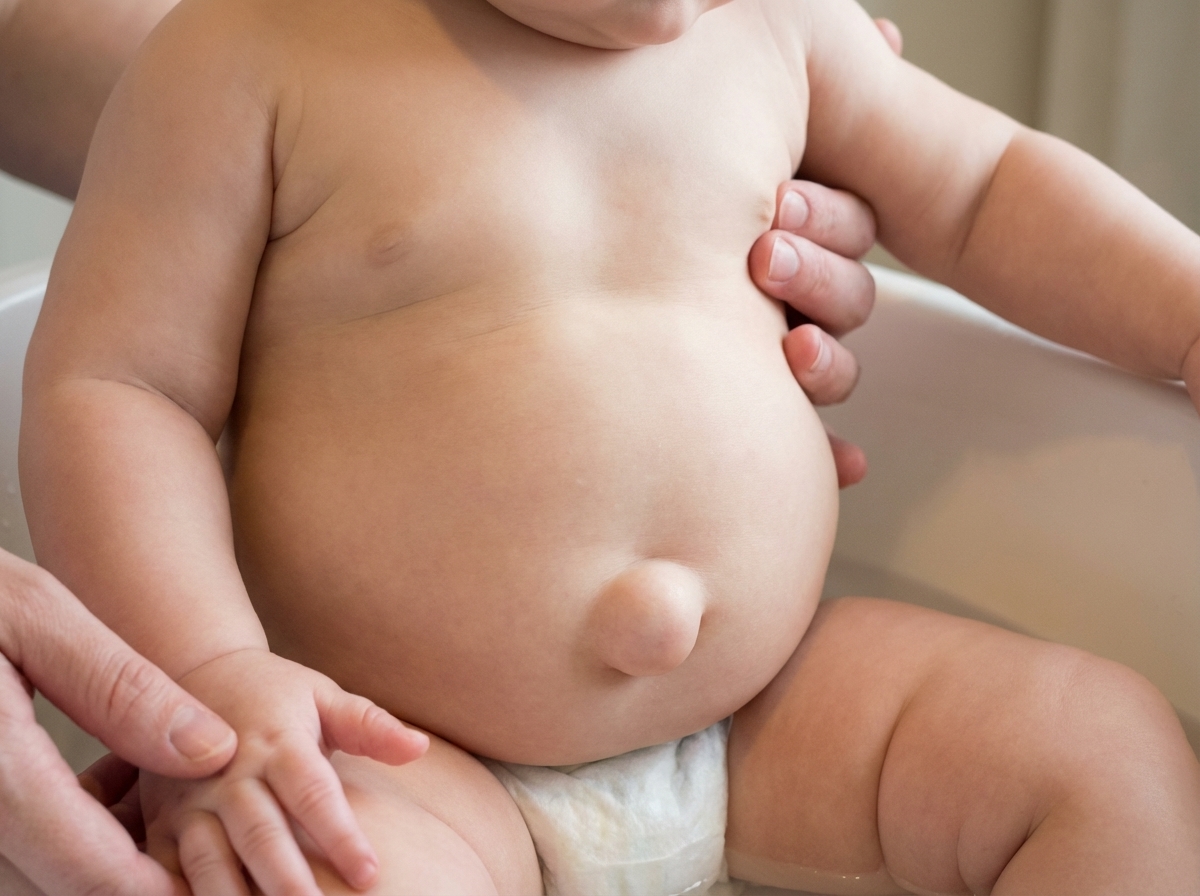
At what age should an asymptomatic umbilical hernia be repaired?
How is a hydrocele in a child typically managed?
What is the treatment of choice for duodenal atresia?
Multiple ileal atresias that have a "string of sausage" or "string of beads" appearance are classified as which type?
A 3-year-old male child diagnosed with acute UTI has left flank pain. Ultrasonogram shows a duplicated left ureter. What is the most probable site for the opening of an ectopic ureter?
Regarding cleft palate repair, which is the ideal age to repair the soft palate?
What is the treatment of choice for a 3-year-old child presenting with an irreducible lump in the right scrotum that is positive on transillumination?
Which marker is associated with sacrococcygeal teratoma?
What is the commonest type of cleft lip?
A child presents with swelling in the right groin region. Upon manual reduction, a gurgling sound is heard, and the swelling reduces. Which of the following statements is true regarding this presentation?
Explanation: **Explanation:** Umbilical hernias in children are common congenital defects caused by the failure of the umbilical ring to close after birth. Unlike inguinal hernias, most umbilical hernias undergo **spontaneous closure** as the abdominal wall muscles strengthen and the rectus abdominis muscles approximate in the midline. **Why 5 years is the correct answer:** Current surgical guidelines recommend observation for asymptomatic umbilical hernias because approximately 80–90% close spontaneously by age 3 or 4. If the defect persists beyond **age 5**, the likelihood of spontaneous closure is minimal, and elective surgical repair (umbilical herniorrhaphy) is indicated to prevent future complications like incarceration or strangulation, which, though rare in children, increase in incidence as the patient reaches adulthood. **Analysis of Incorrect Options:** * **A (1 year) & B (3 years):** These are too early for asymptomatic cases. Operating at these ages would result in unnecessary surgery for many children whose hernias would have closed naturally. * **D (Need not be repaired):** While many close on their own, persistent hernias carry a lifetime risk of bowel entrapment and cosmetic distress; therefore, they require surgical intervention if they do not resolve by school age. **High-Yield Clinical Pearls for NEET-PG:** * **Indications for early surgery (before age 5):** 1. Evidence of **incarceration** or strangulation (Absolute indication). 2. Defect size **>1.5 cm to 2 cm** (unlikely to close spontaneously). 3. Symptomatic hernias (pain or skin changes). * **Associated Conditions:** Umbilical hernias are more common in premature infants, infants with Low Birth Weight (LBW), and conditions like **Down syndrome, Trisomy 13/18, and Congenital Hypothyroidism.** * **Management:** Unlike umbilical hernias, **Inguinal Hernias** in children never close spontaneously and should be repaired soon after diagnosis.
Explanation: ### Explanation **1. Why Herniotomy is Correct:** In children, a hydrocele is almost always **communicating** in nature. It results from a **patent processus vaginalis (PPV)**—a failure of the peritoneal extension to obliterate. This creates a narrow channel allowing peritoneal fluid to track into the scrotum. Because the underlying pathology is a patent sac (identical to the mechanism of an indirect inguinal hernia), the definitive treatment is a **high ligation of the sac**, known as a **herniotomy**. This is typically performed via an inguinal approach, not a scrotal one. **2. Why Other Options are Incorrect:** * **Plication (Lord’s procedure), Eversion (Jaboulay’s procedure), and Inversion:** These are surgical techniques used for **primary vaginal hydroceles in adults**. In adults, the hydrocele is usually due to an imbalance between fluid secretion and absorption by the tunica vaginalis, rather than a patent canal. These procedures involve manipulating the sac itself rather than addressing a communication with the peritoneum. Using these in children would fail to address the PPV and carry a risk of recurrence or injury to inguinal structures. **3. Clinical Pearls for NEET-PG:** * **Observation:** Most congenital hydroceles resolve spontaneously by **1–2 years of age**. Surgery is indicated if it persists beyond this period or if it is associated with a clinically evident hernia. * **Surgical Approach:** Always **Inguinal** in children (to ligate the PPV) vs. **Scrotal** in adults. * **Association:** Right-sided hydroceles/hernias are more common due to the later descent of the right testis. * **Differential:** A hydrocele that changes in size (smaller in the morning, larger in the evening) is a classic sign of a communicating hydrocele.
Explanation: **Explanation:** **Duodenal atresia** is a common cause of neonatal intestinal obstruction, characterized by the "Double Bubble" sign on X-ray. The definitive treatment of choice is **Duodenoduodenostomy**, specifically the **Kimura’s Diamond-Shaped Duodenoduodenostomy**. This procedure involves a side-to-side anastomosis between the proximal dilated duodenum and the distal collapsed duodenum, effectively bypassing the atretic segment while maintaining a more physiological flow of bile and pancreatic enzymes compared to other bypasses. **Analysis of Options:** * **Gastrojejunostomy (A):** Historically used, but now obsolete for this condition as it leads to "blind loop syndrome," marginal ulcers, and poor nutritional outcomes. * **Duodenojejunostomy (B):** While it can bypass the obstruction, it is less physiological than duodenoduodenostomy and carries a higher risk of long-term complications like alkaline reflux. It is reserved only for cases where the distal duodenum is too short for a primary anastomosis. * **Bishop-Koop procedure (C):** This is a specialized "chimney" enterostomy used primarily in **Meconium Ileus** or distal ileal atresia, not for duodenal obstructions. **High-Yield Clinical Pearls for NEET-PG:** * **Association:** 30% of cases are associated with **Down Syndrome (Trisomy 21)**. * **Embryology:** Caused by a failure of **recanalization** of the duodenum during the 8th–10th week of gestation. * **Presentation:** Bilious vomiting (usually) within hours of birth and a scaphoid abdomen. * **X-ray:** The **Double Bubble Sign** (air in the stomach and proximal duodenum). * **Electrolyte Imbalance:** Hypokalemic, hypochloremic metabolic alkalosis (due to persistent vomiting).
Explanation: **Explanation:** The classification of intestinal atresia is based on the **Grosfeld (modified Louw)** system. The correct answer is **Type 4**, which is defined by **multiple segments of atresia** involving the small intestine. **Why Type 4 is correct:** In Type 4 atresia, there are multiple discontinuous stenotic or atretic segments. This creates a characteristic appearance where short segments of dilated bowel are separated by narrow, fibrous cords, resembling a **"string of sausages"** or **"string of beads."** This type often results in a significant loss of total intestinal length, increasing the risk of short bowel syndrome. **Analysis of Incorrect Options:** * **Type 1:** Characterized by an **intraluminal web or diaphragm** with an intact bowel wall and mesentery. There is no "string of beads" appearance. * **Type 3A:** A complete separation of the two ends of the bowel with a **V-shaped mesenteric defect**. It is a single atresia, not multiple. * **Type 3B:** Also known as **"Apple-peel" or "Christmas tree" atresia**. The distal bowel is coiled around a single perfusing artery (usually the ileocolic). While distinct, it is a single complex atresia rather than the multiple segments seen in Type 4. **High-Yield Clinical Pearls for NEET-PG:** * **Etiology:** Most jejunoileal atresias (Types 2 through 4) are caused by an **in utero vascular accident** (ischemic necrosis). * **Type 2:** Two blind ends connected by a fibrous cord (intact mesentery). * **Associated Conditions:** Unlike duodenal atresia (associated with Down syndrome), jejunoileal atresia is rarely associated with chromosomal anomalies but is linked to gastroschisis and malrotation. * **Radiology:** "Triple bubble appearance" is sometimes seen in jejunal atresia, while ileal atresia presents with multiple dilated loops and air-fluid levels.
Explanation: **Explanation:** The correct answer is **Prostatic urethra**. This question tests the understanding of the **Weigert-Meyer Law** and the embryology of the mesonephric duct. In a duplicated collecting system, the ureter draining the **upper pole** is the ectopic one. It opens **inferior and medial** to the normal ureteric orifice. In males, the ectopic ureter always drains **above the external urethral sphincter**, typically into the **prostatic urethra** (most common site), followed by the seminal vesicles, vas deferens, or ejaculatory ducts. Because these openings are proximal to the sphincter, males with ectopic ureters present with UTIs or flank pain, but **never with urinary incontinence**. **Analysis of Incorrect Options:** * **Vas deferens & Seminal vesicle:** While these are possible sites for ectopic insertion in males (due to their common origin from the mesonephric duct), they are statistically less common than the prostatic urethra. * **Trigone of bladder:** This is the site for the **orthotopic** (lower pole) ureter. An ectopic ureter, by definition, opens outside the lateral angle of the trigone. **High-Yield Clinical Pearls for NEET-PG:** * **Weigert-Meyer Law:** Upper pole ureter = Ectopic, prone to **obstruction** (Ureterocele). Lower pole ureter = Orthotopic, prone to **reflux** (VUR). * **Gender Difference in Incontinence:** Ectopic ureters in **females** can open below the sphincter (e.g., vestibule, vagina), causing pathognomonic **constant dribbling** despite normal voiding patterns. In **males**, they always open above the sphincter, so incontinence does not occur. * **Most common site in females:** Vestibule.
Explanation: ### Explanation: Cleft Palate Repair The primary goal of cleft palate repair is to facilitate normal **speech development** and prevent velopharyngeal insufficiency, while minimizing interference with maxillary growth. **Why 6 months is the correct answer:** Modern surgical protocols (such as the **Malek protocol**) advocate for the early repair of the **soft palate at 6 months**. The soft palate contains the musculature (levator veli palatini) necessary for speech. Repairing it by 6 months ensures that the anatomical mechanism for speech is functional before the child begins babbling and developing phonation. Early repair leads to significantly better long-term speech outcomes. **Analysis of Incorrect Options:** * **3 months (Option D):** This is the traditional age for **Cleft Lip** repair (Rule of 10s). Repairing the palate at this age is technically difficult due to the small size of the oral cavity and carries a higher anesthetic risk. * **9–12 months (Options A & B):** While many traditional textbooks (like Bailey & Love) previously suggested 9–12 months for palate repair, current pediatric surgical trends for the **soft palate** specifically have shifted earlier (6 months) to optimize speech. 12 months is often the upper limit for repairing the **hard palate** to prevent significant growth retardation of the midface. **High-Yield NEET-PG Pearls:** * **Rule of 10s (Millard):** Used for Cleft Lip repair (10 weeks old, 10 lbs weight, 10 g/dL Hemoglobin). * **Surgical Techniques:** * *Veau-Wardill-Kilner (V-Y pushback):* Common for lengthening the palate. * *Bardach Two-flap palatoplasty:* Used for wider clefts. * *Furlow Double Opposing Z-plasty:* Specifically used for soft palate/functional muscle repair. * **Complications:** The most common early complication is **bleeding**; the most common late complication is **velopharyngeal insufficiency** or **fistula formation**. * **Otitis Media:** Children with cleft palate are prone to **Otitis Media with Effusion** due to Eustachian tube dysfunction (dysfunction of the tensor veli palatini muscle).
Explanation: ### Explanation The clinical presentation of a 3-year-old child with a transilluminant scrotal lump describes a **Congenital Hydrocele**. In the pediatric age group, hydroceles are almost always **communicating**, resulting from a patent processus vaginalis (PPV). **Why "None of the above" is correct:** The definitive treatment for a pediatric (communicating) hydrocele is **Herniotomy** (High Ligation of the processus vaginalis). This involves ligating the sac at the level of the internal inguinal ring. The options provided (Jaboulay’s, Lord’s, and Sclerotherapy) are treatments for **primary vaginal hydroceles in adults**, which are non-communicating and caused by an imbalance in fluid secretion/absorption. **Analysis of Incorrect Options:** * **Jaboulay’s Procedure:** This involves eversion and suturing of the tunica vaginalis behind the testis. It is used for large, thin-walled adult hydroceles. * **Lord’s Plication:** This involves multiple plicating sutures to bunch up the tunica vaginalis. It is used for small to medium-sized adult hydroceles with a thin sac. * **Sclerotherapy:** This involves injecting sclerosing agents into the sac. It is generally avoided in children due to the risk of chemical peritonitis if the processus vaginalis is patent. **Clinical Pearls for NEET-PG:** * **Timing of Surgery:** Most congenital hydroceles resolve spontaneously by **1–2 years of age**. Surgery (Herniotomy) is indicated if it persists beyond age 2 or if it is associated with a clinical hernia. * **Surgical Approach:** In children, the approach is always **Inguinal** (to ligate the PPV). In adults, the approach is **Scrotal**. * **Differential Diagnosis:** Always rule out an incarcerated inguinal hernia in cases of "irreducible" lumps; however, transillumination strongly points toward hydrocele.
Explanation: **Explanation:** Sacrococcygeal Teratoma (SCT) is the most common newborn tumor. These tumors arise from the **totipotent cells of the primitive knot (Hensen’s node)** and can contain elements from all three germ layers (ectoderm, mesoderm, and endoderm). **Why b-HCG is the correct answer:** While many SCTs are benign (mature), they can contain malignant components, most commonly **Yolk Sac Tumor** (Endodermal Sinus Tumor) or **Choriocarcinoma**. * **Alpha-fetoprotein (AFP):** This is the most common marker elevated in SCT (specifically indicating Yolk Sac components). * **beta-HCG:** This is elevated if the teratoma contains **Choriocarcinoma** elements or syncytiotrophoblastic giant cells. In the context of this question, b-HCG is the specific germ cell marker provided that correlates with the malignant potential and monitoring of these tumors. **Analysis of Incorrect Options:** * **A. CEA (Carcinoembryonic Antigen):** Primarily used for colorectal carcinoma and other GI malignancies; not a standard marker for pediatric germ cell tumors. * **C. S100:** A marker for neural crest-derived tumors (like melanoma or Schwannoma) and some cartilaginous tumors. While SCT may contain neural tissue, S100 is not used for diagnosis or monitoring. * **D. CA-125:** A marker primarily associated with epithelial ovarian cancer and endometriosis. **High-Yield Clinical Pearls for NEET-PG:** * **Altman Classification:** Type I (mostly external) to Type IV (entirely internal/presacral). Type IV has the highest risk of malignancy. * **Gender Predominance:** More common in females (4:1 ratio). * **Surgical Management:** Complete excision including the **removal of the Coccyx** is mandatory to prevent recurrence. * **Complication:** Maternal "Mirror Syndrome" (hydrops fetalis) can occur in utero due to high-output cardiac failure in the fetus.
Explanation: **Explanation:** The correct answer is **C. Cleft lip combined with cleft palate.** In pediatric surgery, orofacial clefts are among the most common congenital anomalies. Statistically, a **combined cleft lip and palate** occurs more frequently than an isolated cleft lip. Approximately 45–50% of cases present as combined cleft lip and palate, while isolated cleft palate accounts for 30%, and isolated cleft lip accounts for only 20–25%. **Analysis of Options:** * **Option A (Bilateral cleft lip):** While significant, bilateral involvement is less common than unilateral involvement. Unilateral clefts occur in about 80% of cases, with a predilection for the **left side**. * **Option B (Midline cleft lip):** This is a rare entity often associated with holoprosencephaly or other midline craniofacial defects. It is not a common presentation. * **Option D (Unilateral cleft lip):** Although more common than bilateral cleft lip, it occurs less frequently as an isolated finding compared to the combined presentation with a cleft palate. **High-Yield Clinical Pearls for NEET-PG:** * **Rule of 10s (Millard’s Criteria for Repair):** Surgery for cleft lip is typically performed when the infant is **10 weeks** old, weighs **10 lbs**, and has a hemoglobin of **10 g/dL**. * **Timing of Repair:** Cleft lip repair (Cheiloplasty) is done at **3–6 months**, while Cleft palate repair (Palatoplasty) is ideally done at **6–12 months** (before the child develops speech). * **Gender Predilection:** Cleft lip (with or without palate) is more common in **males**, whereas isolated cleft palate is more common in **females**. * **Etiology:** Most cases are multifactorial; however, maternal intake of anticonvulsants (Phenytoin) or smoking increases the risk.
Explanation: **Explanation:** The clinical presentation of a reducible groin swelling associated with a **gurgling sound** (borborygmi) is pathognomonic for an **enterocele**, meaning the contents of the hernial sac include the **intestine** (Option D). When the bowel is manually reduced through the narrow neck of the hernia, the movement of gas and fluid within the loops produces this characteristic sound. **Analysis of Options:** * **Option A:** In the pediatric population, almost all inguinal hernias are **indirect**. Direct hernias are extremely rare in children as they result from acquired weakness in the Hesselbach’s triangle, whereas pediatric hernias are congenital. * **Option B:** Pediatric inguinal hernias occur due to the **failure of the processus vaginalis to obliterate**. A patent processus vaginalis (PPV) allows abdominal contents to enter the inguinal canal. * **Option C:** If the sac contained only omentum (omentocele), the reduction would feel "doughy" or granular and would **not** produce a gurgling sound. **NEET-PG High-Yield Pearls:** 1. **Most common type:** Indirect inguinal hernia is the most common hernia in both sexes and all age groups, but it is the standard in pediatrics. 2. **Side predilection:** More common on the **right side** (due to the later descent of the right testis and later closure of the right processus vaginalis). 3. **Gender:** Significantly more common in males (M:F ratio approx. 6:1). 4. **Management:** Unlike umbilical hernias, pediatric inguinal hernias **never resolve spontaneously** and carry a high risk of incarceration. The definitive treatment is **Herniotomy** (ligation and excision of the sac), not herniorrhaphy or hernioplasty.
Neonatal Physiology
Practice Questions
Congenital Anomalies Overview
Practice Questions
Neonatal Intestinal Obstruction
Practice Questions
Necrotizing Enterocolitis
Practice Questions
Hirschsprung's Disease
Practice Questions
Anorectal Malformations
Practice Questions
Pediatric Hernias
Practice Questions
Pyloric Stenosis
Practice Questions
Biliary Atresia
Practice Questions
Pediatric Tumors
Practice Questions
Congenital Diaphragmatic Hernia
Practice Questions
Pediatric Trauma
Practice Questions
Get full access to all questions, explanations, and performance tracking.
Start For Free