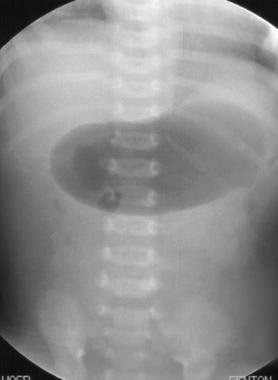
What are the primary criteria for considering operative treatment in Hirschsprung's disease?
A 10-year-old female presents with pain in the right hypochondrium, fever, jaundice, and a palpable mass. The probable diagnosis is?
The most common type of tracheoesophageal anomaly is
An infant presents with colicky pain and vomiting, along with a sausage-shaped lump in the abdomen, and the diagnosis is:
Which electrolyte imbalance should be corrected before surgery in a patient with hypertrophic pyloric stenosis?
Orchidopexy for undescended testis is recommended at what age?
A 12-year-old male is sent to your clinic from his new pediatrician's office for evaluation of left cryptorchidism. On examination, you cannot palpate a left testicle. You recommend which of the following options to the patient and his parents:
Explanation: ***Has failed to respond to conservative treatment*** - Children with **Hirschsprung's disease** who do not respond to initial **conservative management**, such as bowel irrigation and laxatives, require surgical intervention to remove the aganglionic segment. - **Persistent symptoms** like severe constipation, abdominal distension, and failure to thrive despite medical therapy indicate the need for operative treatment. *Is 2 years of age* - Age itself is **not a primary criterion** for deciding operative treatment in Hirschsprung's disease; the decision is based on clinical presentation and response to treatment. - While many cases are diagnosed and treated surgically in infancy, some present later, and the timing of surgery depends on symptom severity and the child's overall condition. *Has no distension of abdomen* - The presence of **abdominal distension** is a common symptom in Hirschsprung's disease, and its absence would suggest **less severe disease** or effective conservative management, rather than an indication for surgery. - If a child has no distension, it implies that obstruction is not significant or is being managed, making operative intervention less urgent. *Is at least 8 kg in weight and thriving* - Being **at least 8 kg in weight and thriving** generally indicates a child is in good health and a suitable candidate for surgery, but these are **preconditions for safe surgery** rather than the primary criteria for deciding *if* surgery is needed. - The decision to operate is driven by the failure of conservative treatment and the persistence of disease-related symptoms, not solely by the child's weight or general thriving status.
Explanation: ***Choledochal cyst*** - The classic triad of pain, jaundice, and a palpable abdominal mass in a child is highly suggestive of a **choledochal cyst**. - This condition involves congenital dilatation of the **bile ducts**, leading to bile stasis, potential infection, and obstruction. *Hepatitis* - While **jaundice** and **abdominal pain** can be present in hepatitis, a distinct palpable mass is not a typical feature unless there's severe hepatomegaly, and fever is also variable. - Hepatitis is primarily an inflammatory condition of the liver, not characterized by a mass resulting from ductal dilation. *Hepatoma* - **Hepatoma (liver cancer)** is rare in a 10-year-old and would more commonly present with a growing mass, weight loss, and possibly jaundice and pain, but the triad of symptoms strongly points away from it as the primary diagnosis. - While a mass would be present, the acute presentation with jaundice and fever is less typical for a primary liver tumor in this age group without other risk factors. *Mucocele gallbladder* - A **mucocele of the gallbladder** presents as a palpable mass due to gallbladder distension, but it is typically not associated with **jaundice** unless there is severe obstruction of the common bile duct, which is rarely primary. - The pain would be localized to the right hypochondrium, but the full triad including jaundice and fever (suggesting infection, e.g., cholangitis within the cyst) points away from a simple mucocele.
Explanation: ***Esophageal atresia with fistula to the distal esophagus*** - This is the **most common** presentation, accounting for approximately **85-90%** of all tracheoesophageal anomalies. - In this type, the **proximal esophagus** ends in a blind pouch, and the **distal esophagus** connects to the trachea via a fistula. *Esophageal atresia without fistula* - This is the **second most common** type, making up about 5-8% of cases. - Both the proximal and distal segments of the esophagus **end in blind pouches** without any connection to the trachea. *Esophageal atresia with fistula to the proximal esophagus* - This is an **uncommon configuration**, accounting for less than 1% of cases. - Here, the **proximal esophageal segment** connects to the trachea, while the distal segment ends in a blind pouch. *H-type fistula without esophageal atresia* - This type represents about 4% of tracheoesophageal anomalies and is characterized by a **fistula between the trachea and esophagus** without an interruption in the esophageal continuity. - It often presents with less severe symptoms and can be diagnosed later in life.
Explanation: ***Intussusception*** - This classic presentation of **colicky pain, vomiting, and a sausage-shaped abdominal lump** is highly indicative of intussusception, where one part of the intestine telescopes into another. - Most commonly occurs in **infants between 5-9 months of age**. - The symptoms are due to **bowel obstruction** and **ischemia**, which can progress to currant jelly stools. *Enterocolitis* - While enterocolitis can cause abdominal pain and vomiting, it typically presents with **diarrhea** and **fever**, and does not involve a palpable "sausage-shaped lump." - It involves **inflammation of the intestine** and colon, often due to infection. *Perforation of the abdomen* - Abdominal perforation would present with signs of **peritonitis**, severe acute pain, **abdominal distension**, and **rigidity**, often with signs of shock, and typically no palpable mass. - It is a severe condition that implies a hole in the gastrointestinal tract, leading to leakage of contents into the peritoneal cavity. *Acute appendicitis* - Though it causes abdominal pain and vomiting, acute appendicitis is **uncommon in infants** and typically localized to the **right lower quadrant**, not forming a "sausage-shaped lump." - Inflammation of the appendix is usually associated with **fever** and specific tenderness at **McBurney's point**.
Explanation: ***Chloride*** - Patients with **pyloric stenosis** lose gastric acid (HCl) due to repeated vomiting, leading to **hypochloremic metabolic alkalosis**. - Correcting **hypochloremia** is crucial for resolving the metabolic alkalosis and ensuring safe anesthesia and surgery. *Potassium* - While **hypokalemia** can occur secondary to the metabolic alkalosis and fluid shifts, it is not the primary electrolyte imbalance requiring immediate correction before surgery. - Correcting **chloride** levels often facilitates the renal reabsorption of potassium, helping to resolve hypokalemia indirectly. *Bicarbonate (HCO3)* - Elevated **bicarbonate** is a feature of the metabolic alkalosis in pyloric stenosis, but directly correcting it with bicarbonate administration is generally contraindicated. - The goal is to correct the underlying cause (**chloride deficit**), which will allow the kidneys to excrete excess bicarbonate. *Sodium* - **Hyponatremia** can occur in cases of severe dehydration or if excessive free water is administered, but it is not the primary or most critical electrolyte imbalance directly caused by pyloric stenosis itself. - The focus is often on fluid resuscitation and correcting the **chloride deficit** to stabilize the patient.
Explanation: **6 months** - The recommended age for **orchidopexy** is between 6 and 12 months, ideally closer to 6 months. - Delaying beyond this period increases the risk of **infertility** and **testicular germ cell tumors**. *3 months* - While some descent can still occur naturally by 6 months, surgery at 3 months is generally **too early**. - This age doesn't allow for sufficient time for potential **spontaneous descent** to occur. *5 years* - Performing orchidopexy at 5 years is considered significantly **delayed**. - This delay substantially increases the risk of **testicular damage**, **infertility**, and **malignancy**. *2 years* - While more optimal than 5 years, 2 years is still on the **later side** of the recommended window for surgery. - Delaying until 2 years may still carry some increased risk for long-term complications compared to surgery between 6-12 months.
Explanation: ***Surgical exploration and scrotal placement of the testicle*** - For **undescended testes**, especially after age 6-12 months, **surgical intervention** (orchiopexy) is the recommended management to prevent complications. - In a 12-year-old with a **non-palpable testis**, **laparoscopic exploration** is the preferred diagnostic and therapeutic approach. - This procedure aims to locate the testis and, if viable, bring it into the scrotum, reducing risks of **infertility** and **malignancy**. *Wait a few years to see if the testicle descends* - **Spontaneous descent** of cryptorchid testes rarely occurs after 6 months of age, and almost never after 1 year. - Delaying treatment beyond **6-12 months** increases the risks of infertility, malignancy, and testicular torsion. - At age 12, waiting is not appropriate management. *Orchiectomy* - **Orchiectomy** (removal of the testis) is typically reserved for cases where the testis is severely dysplastic, atrophic, or in certain situations where malignancy is highly suspected. - In a 12-year-old with **non-palpable undescended testis**, the primary goal is usually exploration first to assess viability before considering removal. *CT scan to look for the testicle* - **Imaging studies** such as CT or ultrasound are generally not recommended for localizing non-palpable testes because they are often unreliable and expose the child to unnecessary **radiation**. - **Laparoscopic exploration** is the preferred method for both diagnostic and therapeutic management of non-palpable testes.
Neonatal Physiology
Practice Questions
Congenital Anomalies Overview
Practice Questions
Neonatal Intestinal Obstruction
Practice Questions
Necrotizing Enterocolitis
Practice Questions
Hirschsprung's Disease
Practice Questions
Anorectal Malformations
Practice Questions
Pediatric Hernias
Practice Questions
Pyloric Stenosis
Practice Questions
Biliary Atresia
Practice Questions
Pediatric Tumors
Practice Questions
Congenital Diaphragmatic Hernia
Practice Questions
Pediatric Trauma
Practice Questions
Get full access to all questions, explanations, and performance tracking.
Start For Free