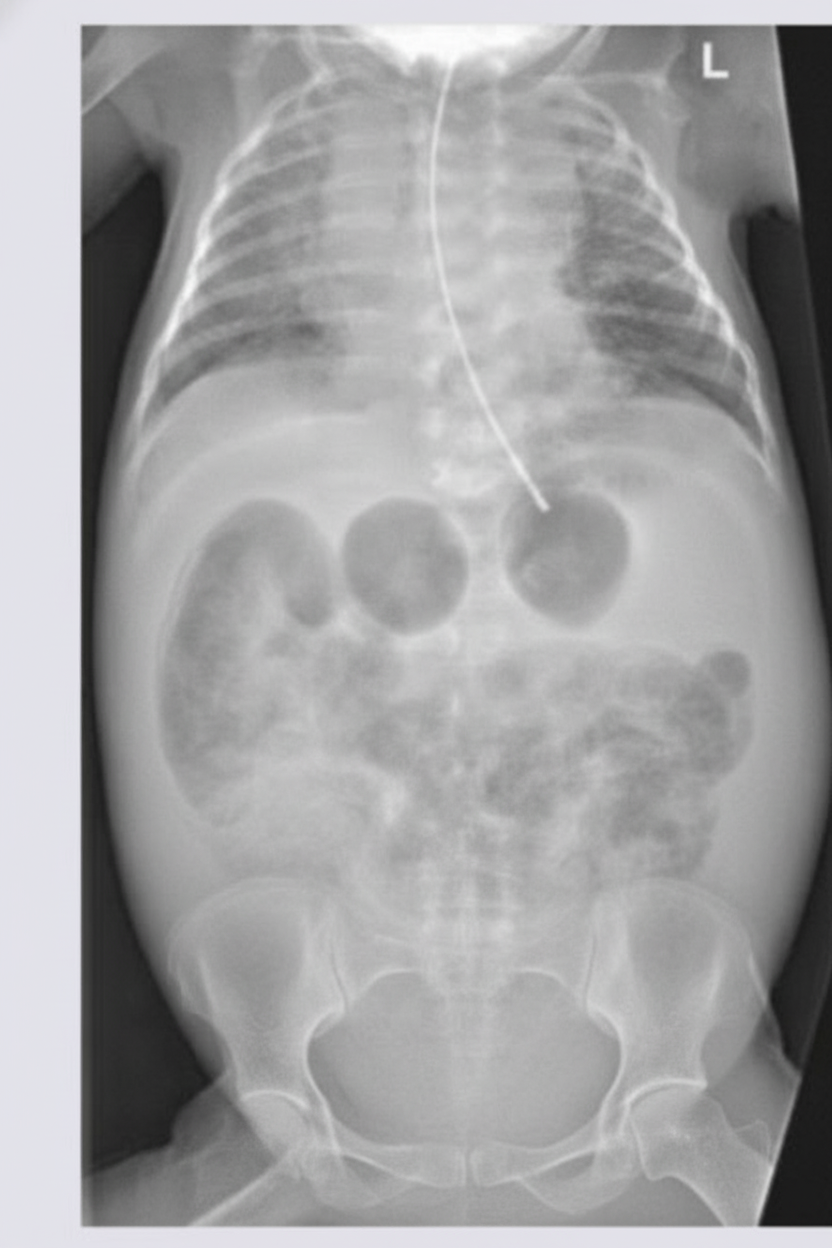
At what age should a patent vitello-intestinal duct preferably be operated on?
A child underwent surgery for a small intestine mass with intussusception. Histological examination of the resected tumor revealed the diagnosis. Which is the most likely tumor associated with this presentation?
A neonate presents with a history of not passing meconium. Examination reveals an anal dimple but no anal opening. What is the investigation of choice?
A newborn presents with discharge of urine from the umbilicus for 3 days. What is the most likely diagnosis?
What is the most sensitive investigation for the diagnosis of Meckel's diverticulum?
A neonate presents with a smooth, transparent, fluctuating inguinal swelling that extends into the inguinal canal and receives an impulse when the child coughs or struggles. Congenital hydrocele is diagnosed after examination. What is the suggested treatment modality in this case?
Exomphalos is a congenital condition involving which anatomical structure?
Which of the following statements is true regarding congenital hypertrophic pyloric stenosis?
Which of the following statements regarding hypertrophic pyloric stenosis is TRUE?
A meningomyelocele patient developed hydrocephalus after surgery. What is the most likely cause?
Explanation: **Explanation:** The **Vitello-intestinal duct (Omphalomesenteric duct)** is an embryonic structure that connects the primitive midgut to the yolk sac. It normally obliterates between the 5th and 8th weeks of gestation. Failure of this obliteration results in various anomalies, the most common being Meckel’s diverticulum. A **Patent Vitello-intestinal duct (PVID)** is a condition where the entire duct remains open, leading to a fecal discharge from the umbilicus. **Why 6 months is the correct age:** While a symptomatic PVID (causing intestinal obstruction, volvulus, or significant hemorrhage) requires **immediate** surgical intervention regardless of age, an asymptomatic or stable patent duct is ideally operated on at **6 months of age**. At this stage, the infant has better anesthetic tolerance, the abdominal wall is more developed, and the risks associated with neonatal surgery are significantly reduced. Waiting until 6 months balances the risk of potential complications (like intussusception) with the safety of elective anesthesia. **Analysis of Incorrect Options:** * **Birth:** Surgery at birth is reserved only for life-threatening emergencies (e.g., strangulated bowel). Routine neonatal surgery carries higher anesthetic risks and physiological stress. * **12 months / 3 years:** Delaying surgery beyond 6 months unnecessarily increases the risk of complications such as umbilical sepsis, prolapse of the ileum through the duct, or intestinal volvulus. **Clinical Pearls for NEET-PG:** * **Most common presentation:** Fecal discharge from the umbilicus. * **Investigation of choice:** Contrast study (Fistulogram) to confirm the connection with the ileum. * **Rule of 2s:** Associated with Meckel’s Diverticulum (2 inches long, 2 feet from ileocecal valve, 2% of population, 2 types of ectopic tissue—gastric and pancreatic). * **Management:** Formal wedge resection or segmental ileal resection with end-to-end anastomosis. Simple ligation is insufficient.
Explanation: **Explanation:** **1. Why Lymphoma is the Correct Answer:** In the pediatric population, **Non-Hodgkin Lymphoma (specifically Burkitt Lymphoma)** is the most common primary malignancy of the small intestine. The terminal ileum is the most frequent site due to the abundance of Peyer’s patches. These tumors often act as a **pathological lead point**, causing the bowel to invaginate, leading to **intussusception**. While idiopathic intussusception is common in infants (6–24 months), intussusception in older children (typically >5 years) should highly raise suspicion of a secondary cause like Lymphoma. **2. Why Other Options are Incorrect:** * **Carcinoid:** While the most common tumor of the appendix in children, it is rare in the small intestine of pediatric patients compared to adults. * **Villous Adenoma:** These are premalignant epithelial tumors primarily found in the colon of older adults; they are virtually non-existent in the pediatric small bowel. * **Smooth Muscle Tumor (Leiomyoma/Leiomyosarcoma):** These are rare mesenchymal tumors in children. While they can cause bleeding or obstruction, they are significantly less common than Lymphoma in this age group. **3. Clinical Pearls for NEET-PG:** * **Lead Points:** In children, the most common pathological lead point for intussusception is a **Meckel’s Diverticulum**, but the most common **malignant** lead point is **Lymphoma**. * **Age Factor:** Idiopathic intussusception usually occurs under age 2. If a child presents with intussusception over the age of 5, always look for a pathological lead point (Lymphoma or Meckel’s). * **Triad of Intussusception:** Colicky abdominal pain, "currant jelly" stools, and a sausage-shaped mass. * **Diagnosis:** Ultrasound is the gold standard (Target/Donut sign).
Explanation: **Explanation:** The clinical presentation of a neonate failing to pass meconium with an absent anal opening is diagnostic of **Anorectal Malformation (ARM)**. **1. Why Invertedogram is the Correct Answer:** The **Invertedogram (Wangensteen-Rice technique)** is the traditional investigation of choice to determine the level of the lesion (High vs. Low). The infant is held upside down for 3–5 minutes to allow bowel gas to rise to the distal-most end of the rectal pouch. A radio-opaque marker is placed on the anal dimple. The distance between the gas bubble and the marker helps categorize the defect: * **Low anomaly:** Gas bubble is <1 cm from the skin. * **High anomaly:** Gas bubble is >1 cm from the skin. * *Note:* This must be performed only after **18–24 hours of life** to allow gas to reach the rectum. **2. Why Other Options are Incorrect:** * **A & B (X-ray Erect/Supine):** These are useful for identifying intestinal obstruction or pneumoperitoneum but cannot localize the distal rectal pouch relative to the perineum. * **C (Gastrograffin study):** Contrast studies are generally used for Hirschsprung’s disease or meconium ileus, not for the initial classification of ARM. **3. Clinical Pearls for NEET-PG:** * **Modern Shift:** While Invertedogram is the classic "textbook" answer, **Cross-table Prone Lateral X-ray** is now often preferred clinically as it is less stressful for the neonate. * **VACTERL Association:** Always screen for other anomalies (Vertebral, Anal, Cardiac, Tracheo-Esophageal, Renal, Limb). * **Management:** Low anomalies usually require a **Primary Anoplasty**, while high anomalies require a **staged procedure** (Colostomy → PSARP/Pena’s procedure → Colostomy closure).
Explanation: ### Explanation **Correct Answer: C. Urachal fistula** **Mechanism and Pathophysiology:** The **urachus** is a developmental remnant of the **allantois**, which connects the dome of the bladder to the umbilicus during fetal life. Normally, this structure obliterates to form the **median umbilical ligament**. If the entire lumen of the urachus remains patent (fails to close), a direct communication persists between the urinary bladder and the umbilicus. This results in the continuous or intermittent discharge of **urine** from the umbilical site, especially during crying or straining (increased intra-abdominal pressure). **Analysis of Incorrect Options:** * **A. Meckel’s diverticulum:** This is a remnant of the **vitellointestinal duct** (omphalomesenteric duct). If the duct remains fully patent (Patent Vitellointestinal Duct), it results in the discharge of **fecal matter** or mucus, not urine. * **B. Mesenteric cysts:** These are rare intra-abdominal fluid-filled sacs. They typically present as a painless abdominal mass or intestinal obstruction, not with umbilical discharge. * **C. Omphalocele:** This is a midline ventral abdominal wall defect at the umbilicus where abdominal viscera herniate, covered by a sac (peritoneum and amnion). It is a structural defect of the wall, not a ductal patency issue. **High-Yield Clinical Pearls for NEET-PG:** * **Urachal Anomalies Spectrum:** 1. **Urachal Fistula:** Total patency (Urine discharge). 2. **Urachal Cyst:** Patency of the mid-segment (Palpable sub-umbilical mass). 3. **Urachal Sinus:** Patency at the umbilical end (Blind tract at the navel). 4. **Urachal Diverticulum:** Patency at the bladder end. * **Diagnosis:** Confirmed via **Ultrasound** or **VCUG** (Voiding Cystourethrogram) to demonstrate the tract. * **Management:** Surgical excision of the entire tract is required to prevent recurrent infections and the long-term risk of **Adenocarcinoma** of the urachus in adults.
Explanation: **Explanation:** Meckel’s diverticulum is the most common congenital anomaly of the gastrointestinal tract, resulting from the failure of the vitelline duct to obliterate. **Why the Correct Answer is Right:** The **99m-Tc pertechnetate scan (Meckel’s scan)** is the investigation of choice and the most sensitive test for diagnosing a symptomatic Meckel’s diverticulum. The underlying principle is that 99m-Tc pertechnetate has a high affinity for **gastric mucosa**. Since approximately 50-60% of symptomatic Meckel’s diverticula contain **ectopic gastric mucosa**, the isotope concentrates in the diverticulum, appearing as a "hot spot" on scintigraphy. Its sensitivity is further increased by using pharmacological adjuncts like H2 blockers (cimetidine), glucagon, or pentagastrin. **Why Other Options are Incorrect:** * **Ultrasonography (USG):** While useful for identifying complications like intussusception or inflammatory masses, it lacks the sensitivity to reliably visualize an uncomplicated Meckel’s diverticulum. * **CT Scan:** Often used in acute abdominal pain, it may show a "blind-ending pouch," but it is frequently non-specific and can miss the diverticulum unless it is inflamed (Meckel’s diverticulitis). * **Barium Enema:** This is primarily used for diagnosing large bowel pathologies or reducing intussusception. It rarely refluxes far enough into the ileum to visualize a Meckel’s diverticulum. **High-Yield Clinical Pearls for NEET-PG:** * **Rule of 2s:** 2% of the population, 2 inches long, 2 feet from the ileocecal valve, 2 types of ectopic tissue (Gastric > Pancreatic), and presents before age 2. * **Most common presentation:** Painless lower GI bleeding (hematochezia) in children; intestinal obstruction in adults. * **Treatment:** Surgical resection (diverticulectomy or wedge resection) is indicated for symptomatic cases.
Explanation: **Explanation:** The clinical presentation of a smooth, fluctuating inguinal swelling that increases with intra-abdominal pressure (coughing/struggling) in a neonate is characteristic of a **Congenital Hydrocele**. **1. Why Herniotomy is Correct:** Congenital hydrocele occurs due to a **patent processus vaginalis (PPV)**, which allows peritoneal fluid to track down into the scrotum. Unlike adult hydroceles, the underlying pathology is the communication with the peritoneal cavity. Therefore, the definitive treatment is a **Herniotomy** (typically via an inguinal approach), which involves high ligation and division of the patent processus vaginalis at the level of the internal inguinal ring. **2. Why other options are incorrect:** * **No treatment before 5 years:** While many congenital hydroceles resolve spontaneously, the standard observation period is usually **1 to 2 years**. If it persists beyond this age or is associated with a clinical hernia, surgery is indicated. Waiting until 5 years is unnecessarily long. * **Herniorraphy:** This involves repairing the posterior wall of the inguinal canal (e.g., Bassini’s repair). This is contraindicated in children as it can interfere with the growth of the inguinal canal and damage the vas deferens. * **Eversion of sac (Jaboulay’s procedure):** This is the treatment for **primary (acquired) hydrocele** in adults. In children, it fails to address the patent processus vaginalis and carries a high risk of recurrence and injury to cord structures. **Clinical Pearls for NEET-PG:** * **Gold Standard:** In pediatric surgery, the operation for both inguinal hernia and hydrocele is **Herniotomy**. * **Timing:** Surgery is usually deferred until **1–2 years of age** for hydroceles, but an **inguinal hernia** in a child should be operated on as soon as possible due to the high risk of incarceration. * **Differential:** If the swelling is transilluminant, it is a hydrocele; if it contains bowel sounds or is opaque, it is a hernia. Both share the same embryological defect (PPV).
Explanation: **Explanation:** **Exomphalos** (also known as **Omphalocele**) is a congenital **abdominal wall defect** occurring at the base of the umbilical cord. It results from the failure of the midgut to return to the abdominal cavity from the physiological herniation that occurs during the 6th to 10th weeks of gestation. The herniated viscera are covered by a three-layered sac consisting of amnion, Wharton’s jelly, and peritoneum. * **Why Option C is correct:** The defect is fundamentally a midline failure of the abdominal wall muscles and skin to close, allowing abdominal contents (bowel, and often the liver) to remain outside the body. * **Why Options A, B, and D are incorrect:** * **Umbilicus (A):** While the defect occurs *at* the umbilicus, it is classified as an abdominal wall defect. An umbilical hernia is a separate, less severe condition where the defect is covered by skin. * **Cervix (B):** This is part of the female reproductive system and is anatomically unrelated. * **Urinary bladder (D):** Bladder exstrophy is a different midline defect involving the lower abdominal wall and the bladder, but it is distinct from exomphalos. **High-Yield Clinical Pearls for NEET-PG:** * **Associations:** Exomphalos is frequently associated with chromosomal anomalies (Trisomy 13, 18, 21) and syndromes like **Beckwith-Wiedemann Syndrome** (macroglossia, gigantism, hypoglycemia). * **Diagnosis:** Elevated maternal serum alpha-fetoprotein (MSAFP) and prenatal ultrasound. * **Management:** Small defects (Exomphalos minor) can be closed primarily; large defects (Exomphalos major) may require staged closure using a "silo" or conservative management with escharotics (e.g., silver sulfadiazine) to allow epithelialization. * **Key Distinction:** Unlike Gastroschisis, Exomphalos is **midline**, has a **covering sac**, and the umbilical cord inserts **directly into the sac**.
Explanation: ### Explanation: Congenital Hypertrophic Pyloric Stenosis (CHPS) **Congenital Hypertrophic Pyloric Stenosis (CHPS)** is characterized by hypertrophy and hyperplasia of the circular muscle layers of the pylorus, leading to gastric outlet obstruction. #### Why Option B is Correct: The hallmark physical finding in CHPS is a firm, mobile, non-tender, olive-shaped mass (the hypertrophied pylorus). This mass is best palpated in the **right upper quadrant (RUQ)** or the right epigastrium, lateral to the rectus abdominis muscle. Crucially, the mass is most easily felt when the **stomach is empty** (after vomiting or via a nasogastric tube) and the abdominal wall is relaxed. During feeding, the stomach distends, obscuring the pylorus and making palpation difficult. #### Analysis of Incorrect Options: * **Option A:** While the mass is "olive-like," it is difficult to palpate **during** feeding because the distended stomach covers the pylorus. Palpation is traditionally performed from the left side while the infant is calm or being "sham fed" with sugar water to relax the musculature. * **Option C:** The umbilical region is too low; the pylorus is anatomically situated in the upper abdomen. * **Option D:** The right iliac fossa is the classic location for an appendix or an ileocecal mass (e.g., intussusception), not the pylorus. --- ### High-Yield Clinical Pearls for NEET-PG: * **Classic Presentation:** A 3–6 week-old male (first-born) with **non-bilious, projectile vomiting** immediately after feeds. * **Metabolic Profile:** Hypochloremic, hypokalemic, **metabolic alkalosis** with **paradoxical aciduria** (due to loss of HCl and subsequent renal compensation mechanisms). * **Diagnosis:** * **USG (Investigation of Choice):** Pyloric muscle thickness >4 mm or pyloric canal length >14 mm. * **Barium Swallow:** Shows the "String sign," "Beak sign," or "Mushroom sign." * **Management:** * Initial: Fluid resuscitation (Normal Saline) and correction of electrolytes. * Definitive: **Ramstedt’s Submucosal Pyloromyotomy.**
Explanation: ### Explanation **Hypertrophic Pyloric Stenosis (HPS)** is a common cause of gastric outlet obstruction in infants, characterized by hypertrophy of the circular muscle of the pylorus. **Why Option D is Correct:** **Ultrasonography (USG)** is the gold standard and diagnostic test of choice due to its high sensitivity and specificity. It is non-invasive and avoids radiation. Diagnostic criteria include a **pyloric muscle thickness >3 mm** and a **pyloric channel length >14 mm**. **Why the Other Options are Incorrect:** * **Option A:** Symptoms typically appear between **3 to 6 weeks of life**. It is rarely present at birth or within the first week, making "first week" clinically inaccurate. * **Option B:** While a "palpable olive-shaped mass" is a classic physical finding, it is **not always present** (palpable in about 60-80% of cases). Its absence does not rule out the diagnosis. * **Option C:** The surgical treatment of choice is **Ramstedt’s Pyloromyotomy** (longitudinal incision of the pylorus muscle while keeping the mucosa intact). Finney’s pyloroplasty is a reconstructive procedure used for different indications in adults. **High-Yield Clinical Pearls for NEET-PG:** * **Classic Presentation:** Non-bilious, projectile vomiting in a "hungry" infant. * **Metabolic Abnormality:** Hypochloremic, hypokalemic, metabolic alkalosis with **paradoxical aciduria** (a favorite MCQ topic). * **Radiology Sign:** On Barium swallow (if USG is inconclusive), look for the **"String sign"** or "Beak sign." * **Priority:** HPS is a **medical emergency**, not a surgical one. Electrolyte and fluid resuscitation (using Normal Saline) must be completed *before* the patient is taken to surgery.
Explanation: **Explanation:** The correct answer is **Arnold-Chiari malformation (specifically Type II)**. **1. Why Arnold-Chiari Malformation is correct:** There is a strong pathophysiological association between myelomeningocele and Chiari II malformation (seen in >90% of cases). In Chiari II, there is downward displacement of the medulla, pons, and cerebellar vermis through the foramen magnum. This anatomical defect leads to the obstruction of cerebrospinal fluid (CSF) flow at the level of the posterior fossa or the aqueduct of Sylvius. While hydrocephalus may be present at birth, it often becomes clinically apparent or worsens **after the surgical closure** of the myelomeningocele. This occurs because the open sac previously acted as a "vent" or decompression site for CSF; once closed, the intracranial pressure rises, unmasking the underlying obstructive effect of the Chiari malformation. **2. Why other options are incorrect:** * **Injury to the absorptive surface:** While subarachnoid hemorrhage or infection can damage arachnoid villi, it is not the primary mechanism linked to the surgical repair of a meningomyelocele. * **Central canal injury:** The central canal of the spinal cord is not the primary site for CSF drainage or absorption; its injury would lead to syringomyelia rather than generalized hydrocephalus. * **Arachnoidal block:** While adhesions can occur post-operatively, they are secondary complications. The most "likely" and classic association taught in pediatric surgery is the pre-existing Chiari malformation. **High-Yield Clinical Pearls for NEET-PG:** * **Chiari Type I:** Downward displacement of cerebellar tonsils only (associated with Syringomyelia). * **Chiari Type II:** Displacement of tonsils, vermis, and brainstem (associated with Myelomeningocele). * **Management:** Most patients (approx. 80%) will eventually require a **VP (Ventriculoperitoneal) shunt** after the repair of the spinal defect. * **Lemon Sign & Banana Sign:** Classic prenatal ultrasound findings associated with Chiari II and spina bifida.
Neonatal Physiology
Practice Questions
Congenital Anomalies Overview
Practice Questions
Neonatal Intestinal Obstruction
Practice Questions
Necrotizing Enterocolitis
Practice Questions
Hirschsprung's Disease
Practice Questions
Anorectal Malformations
Practice Questions
Pediatric Hernias
Practice Questions
Pyloric Stenosis
Practice Questions
Biliary Atresia
Practice Questions
Pediatric Tumors
Practice Questions
Congenital Diaphragmatic Hernia
Practice Questions
Pediatric Trauma
Practice Questions
Get full access to all questions, explanations, and performance tracking.
Start For Free