Pain relief in chronic pancreatitis can be obtained by destruction of which of the following structures?
A 48-year-old woman presents with severe recurrent peptic ulcer located in the proximal jejunum. Five years previously she underwent parathyroidectomy for hypercalcemia. Her brother was previously diagnosed as having Zollinger-Ellison syndrome. To confirm the diagnosis of Zollinger-Ellison syndrome, blood should be tested for levels of which of the following?
Ranson's score is associated with which of the following conditions?
In carcinoma of the head of the pancreas, nausea and vomiting are most commonly due to which of the following mechanisms?
A 43-year-old woman undergoes open cholecystectomy. Intraoperative cholangiogram reveals multiple stones in the common bile duct (CBD). Exploration of the CBD is performed to extract gallstones, and the CBD is drained with a T-tube. Ten days later, a T-tube cholangiogram reveals a retained CBD stone. How should this be managed?
What is the most common variety of pancreatic carcinoma?
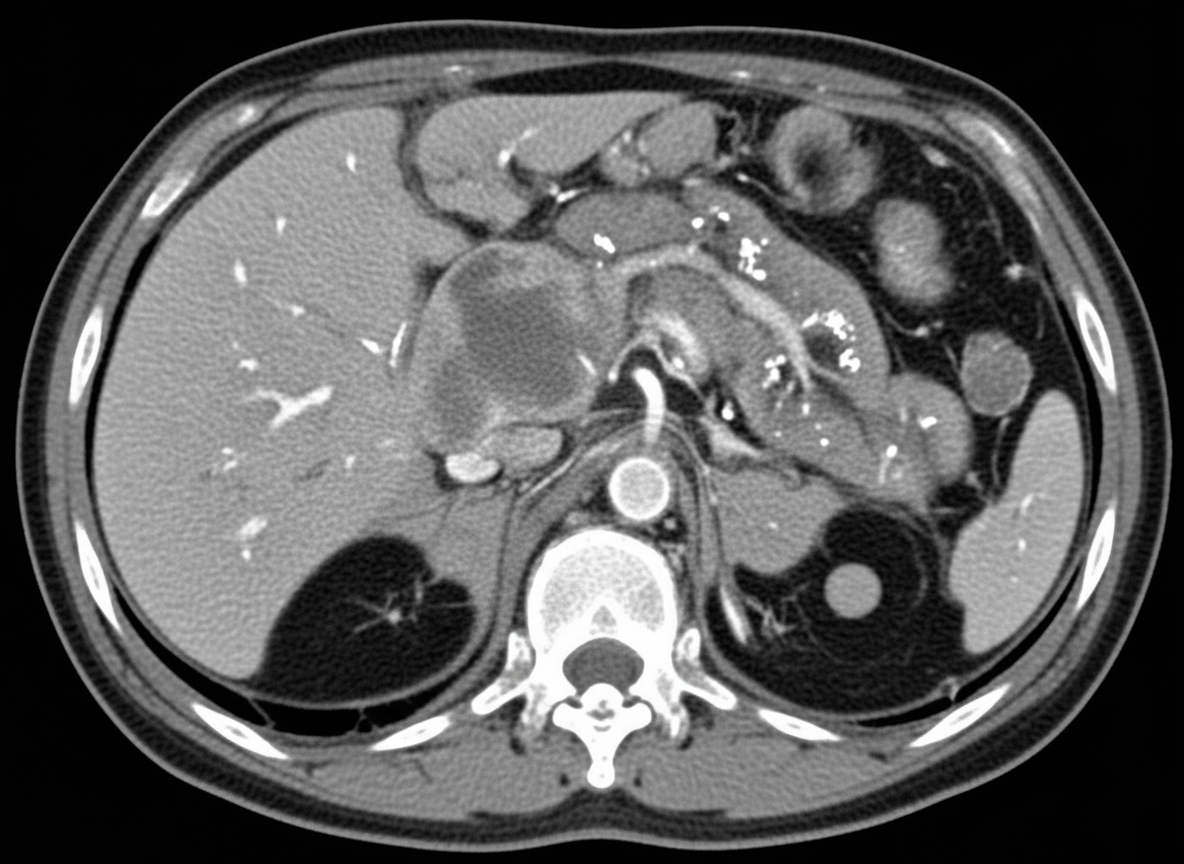
Which of the following CT scan findings indicate unresectable criteria for cancer of the pancreas?
What is the complication least likely to occur in a pseudocyst of the pancreas?
Which of the following statements regarding a pseudocyst of the pancreas is FALSE?
Beer's procedure is also known as?
Explanation: **Explanation:** The pain in chronic pancreatitis is primarily mediated by visceral afferent fibers that travel alongside sympathetic nerves. These fibers pass through the **celiac plexus (and celiac ganglia)** before reaching the spinal cord (T5–T9 levels). **1. Why Celiac Ganglia is Correct:** The celiac ganglia are the largest prevertebral ganglia and serve as the primary relay station for nociceptive (pain) signals from the upper abdominal viscera, including the pancreas. **Celiac Plexus Block (CPB)** or neurolysis (using alcohol or phenol) is a standard palliative procedure to interrupt these pain pathways in patients with chronic pancreatitis or pancreatic cancer who are refractory to medical management. **2. Why Incorrect Options are Wrong:** * **Vagus Nerve:** The vagus nerve carries parasympathetic fibers responsible for secretomotor functions and some sensory feedback, but it does not carry the somatic or visceral pain fibers from the pancreas. * **Anterolateral Column:** While the spinothalamic tract (located in the anterolateral column) does transmit pain to the brain, its surgical destruction (cordotomy) is a radical neurosurgical procedure rarely used for localized visceral pain like pancreatitis and carries significant risks of motor and sensory deficits. **Clinical Pearls for NEET-PG:** * **Anatomical Landmark:** The celiac plexus is located at the level of the **L1 vertebra**, surrounding the root of the celiac trunk and superior mesenteric artery. * **EUS-Guided Block:** Endoscopic Ultrasound (EUS)-guided celiac plexus neurolysis is currently the preferred technique due to its high precision and lower complication rate. * **Surgical Alternative:** For intractable pain in chronic pancreatitis with a dilated duct, the **Puestow procedure** (Lateral Pancreaticojejunostomy) is the surgical treatment of choice.
Explanation: ### Explanation **1. Why Gastrin is the Correct Answer:** The clinical presentation describes a classic case of **Zollinger-Ellison Syndrome (ZES)**, likely occurring as part of **Multiple Endocrine Neoplasia Type 1 (MEN-1)**. The patient has recurrent peptic ulcers in an atypical location (proximal jejunum), a history of parathyroid surgery (hyperparathyroidism), and a family history of ZES. ZES is caused by a **gastrinoma** (usually located in the Gastrinoma Triangle), which secretes excessive amounts of **gastrin**. This hormone stimulates parietal cells to produce massive amounts of hydrochloric acid, leading to refractory peptic ulcer disease. Measuring **fasting serum gastrin (FSG)** levels is the initial screening test of choice to confirm the diagnosis. **2. Why Other Options are Incorrect:** * **Parathyroid hormone (PTH):** While the patient likely has MEN-1 (Parathyroid, Pancreas, Pituitary tumors), PTH levels would confirm hyperparathyroidism, not ZES. * **Histamine:** Although histamine stimulates acid secretion, it is not the primary hormone secreted by pancreatic neuroendocrine tumors in ZES. * **Pepsin:** Pepsin is a digestive enzyme; its levels are not used as a diagnostic marker for gastrinomas or ZES. **3. High-Yield Clinical Pearls for NEET-PG:** * **MEN-1 (Wermer’s Syndrome):** Remember the **3 Ps**—Parathyroid (most common), Pancreas (Gastrinoma/Insulinoma), and Pituitary (Prolactinoma). * **Diagnostic Criteria for ZES:** Fasting serum gastrin **>1000 pg/mL** is diagnostic. If levels are 200–1000 pg/mL, perform a **Secretin Stimulation Test** (a rise in gastrin >200 pg/mL is positive). * **Passaro’s Triangle (Gastrinoma Triangle):** Boundaries include the junction of the cystic and common bile duct, the junction of the 2nd and 3rd parts of the duodenum, and the neck of the pancreas. * **Most common site for Gastrinoma:** Duodenum (especially in MEN-1 cases).
Explanation: **Explanation:** **Ranson’s Criteria** is a clinical prediction rule used to determine the severity and prognosis of **Acute Pancreatitis**. It assesses 11 parameters: 5 at the time of admission and 6 within the first 48 hours. A higher score correlates with increased mortality (e.g., a score of 0–2 has <1% mortality, while >6 indicates >50% mortality). * **Why Option B is Correct:** Ranson’s score is specifically designed to evaluate the systemic inflammatory response and metabolic derangements (like hypocalcemia and hyperglycemia) unique to acute pancreatitis. * **Why Options A & C are Incorrect:** * **Volvulus:** Diagnosis is primarily clinical and radiological (e.g., "coffee bean sign" on X-ray). Severity is assessed by signs of bowel ischemia or perforation. * **Appendicitis:** Diagnosis is clinical (Alvarado Score) or via imaging (CT/Ultrasound). Ranson’s parameters are not relevant to the pathophysiology of appendiceal inflammation. **High-Yield Clinical Pearls for NEET-PG:** * **Admission Criteria (GALAW):** **G**lucose (>200 mg/dL), **A**ge (>55 yrs), **L**DH (>350 IU/L), **A**ST (>250 U/L), **W**BC count (>16,000/mm³). * **48-Hour Criteria (C HOBBS):** **C**alcium (<8 mg/dL), **H**ematocrit drop (>10%), **O**xygen (PaO₂ <60 mmHg), **B**UN increase (>5 mg/dL), **B**ase deficit (>4 mEq/L), **S**equestration of fluid (>6L). * **Note:** Ranson’s score cannot be completed until 48 hours after admission. For immediate assessment, the **APACHE II** score or **BISAP** score is often preferred.
Explanation: **Explanation:** In patients with carcinoma of the head of the pancreas, nausea and vomiting are primarily clinical manifestations of **Gastric Outflow Obstruction (GOO)**. The anatomical location of the pancreatic head is within the C-loop of the duodenum. As the tumor grows, it exerts **external compression** on the second part of the duodenum, leading to mechanical narrowing of the lumen and subsequent proximal dilatation of the stomach. **Analysis of Options:** * **Option A (Correct):** External compression is the most common mechanism. The rigid, desmoplastic nature of pancreatic adenocarcinoma allows it to compress the thin-walled duodenum easily before it actually invades the mucosa. * **Option B:** Portal vein infiltration typically leads to portal hypertension, splenomegaly, or ascites, but does not directly cause mechanical vomiting. * **Option C:** While direct infiltration (mural invasion) can occur in advanced stages, external compression usually precedes it and is the more frequent cause of initial obstructive symptoms. * **Option D:** While chemotherapy causes nausea, the question asks for the mechanism related to the disease pathology itself. **High-Yield Clinical Pearls for NEET-PG:** * **Courvoisier’s Law:** In a patient with painless jaundice and a palpable gallbladder, the cause is unlikely to be gallstones and is more likely to be a malignancy (e.g., pancreatic head CA). * **Double Duct Sign:** On ERCP/MRCP, simultaneous dilatation of the common bile duct and the pancreatic duct is a classic sign of pancreatic head tumors. * **Trousseau Sign:** Migratory thrombophlebitis is a paraneoplastic syndrome associated with pancreatic cancer. * **Surgery of Choice:** Whipple’s procedure (Pancreaticoduodenectomy) is indicated for resectable tumors of the head.
Explanation: ### **Explanation** The management of a retained common bile duct (CBD) stone identified via a post-operative T-tube cholangiogram is a classic high-yield topic in surgical gastroenterology. **1. Why Option D is Correct:** When a T-tube is placed in the CBD, it induces an inflammatory response that leads to the formation of a **fibrous tract** (fistula) between the CBD and the skin. This tract takes approximately **4 to 6 weeks** to mature and become firm enough to allow instruments to pass through without rupturing into the peritoneal cavity. Once the tract is mature, the T-tube is removed, and a **Burhenne technique** (percutaneous extraction using a Dormia basket under fluoroscopic guidance) is performed. This is the preferred non-operative approach for retained stones in patients who already have a T-tube in situ. **2. Why Other Options are Incorrect:** * **Option A (Laparotomy):** Re-operation is avoided as a first-line treatment due to increased morbidity and the presence of fresh adhesions. It is reserved only if minimally invasive methods (Burhenne technique or ERCP) fail. * **Option B (Heparinization):** While some historical "chemical dissolution" methods existed (using monooctanoin), heparin has no role in dissolving cholesterol or pigment stones. * **Option C (Antibiotics):** Antibiotics treat cholangitis (infection) but do not address the mechanical obstruction caused by the stone. Waiting 6 months is unnecessary and risks complications like biliary colic or pancreatitis. **3. Clinical Pearls for NEET-PG:** * **Burhenne Technique:** The gold standard for extracting stones through a T-tube tract. * **Tract Maturation:** Always wait **6 weeks** before attempting extraction to ensure the tract is "mature." * **ERCP vs. T-tube Extraction:** If a T-tube is already present, the Burhenne technique is often preferred. If no T-tube is present, **ERCP with Sphincterotomy** is the treatment of choice for retained CBD stones. * **T-tube Removal:** In a normal post-op course (no stones), a T-tube is typically removed after **10–14 days** once a trial of clamping is tolerated.
Explanation: **Explanation:** **Adenocarcinoma** (specifically ductal adenocarcinoma) is the most common variety of pancreatic carcinoma, accounting for approximately **85–90%** of all pancreatic malignancies. It originates from the epithelial cells lining the pancreatic ducts. The most frequent location is the **head of the pancreas (60–70%)**, often presenting with the classic triad of painless progressive jaundice, weight loss, and a palpable gallbladder (Courvoisier’s Law). **Analysis of Incorrect Options:** * **Neuroendocrine Tumors (NETs):** These arise from the islet cells (e.g., Insulinoma, Gastrinoma). While they are the second most common group, they represent only about 1–5% of pancreatic tumors. * **Mucous Secreting Tumors:** These include Intraductal Papillary Mucinous Neoplasms (IPMN) and Mucinous Cystadenocarcinomas. While important precursors or variants, they are significantly less common than ductal adenocarcinoma. * **Acinar Cell Cystadenocarcinoma:** This is a very rare subtype (approx. 1%) arising from the exocrine acinar cells rather than the ductal epithelium. **High-Yield Clinical Pearls for NEET-PG:** * **Risk Factors:** Smoking (strongest environmental factor), chronic pancreatitis, obesity, and DM. * **Tumor Marker:** **CA 19-9** is the most specific marker (used for monitoring, not screening). * **Genetic Mutations:** **K-ras** (most common, >90%), CDKN2A (p16), TP53, and SMAD4. * **Surgery:** **Whipple’s Procedure** (Pancreaticoduodenectomy) is the treatment of choice for resectable tumors of the head. * **Double Duct Sign:** On imaging (ERCP/MRCP), simultaneous dilatation of the common bile duct and the pancreatic duct is highly suggestive of a head of pancreas malignancy.
Explanation: In pancreatic surgery, determining resectability is crucial to avoid unnecessary laparotomy. The criteria for **unresectability** are generally divided into distant metastasis and local vascular invasion. [1] **Explanation of the Correct Answer:** The correct answer is **D (All the above)** because each finding represents a stage of disease where curative (R0) resection is no longer possible: * **Metastatic deposits in vertebra (Option A):** This signifies **M1 (Stage IV) disease**. Any distant metastasis—whether to the liver, peritoneum, lungs, or bone (vertebra)—categorizes the tumor as unresectable. [1] * **Invasion of duodenum (Option B):** While localized duodenal involvement is technically removed during a Whipple procedure, extensive invasion often implies advanced local spread. [1] In the context of this specific question's structure, it serves as a marker of locally advanced disease. * **Irregular increase in fat density of omentum (Option C):** This is a classic CT sign of **omental caking** or peritoneal carcinomatosis. The presence of peritoneal seeding is an absolute contraindication to resection. [1] **High-Yield Clinical Pearls for NEET-PG:** 1. **Vascular Criteria:** * **Unresectable:** >180° involvement (encasement) of the Superior Mesenteric Artery (SMA) or Celiac Axis. * **Borderline Resectable:** <180° involvement (abutment) of the SMA or reconstructible involvement of the SMV/Portal Vein. 2. **Imaging Gold Standard:** Triphasic Pancreatic Protocol CT (MDCT) is the investigation of choice for staging. [1] 3. **CA 19-9:** While used for monitoring, very high levels (>1000 U/mL) often correlate with occult metastatic disease even if the CT appears "resectable." 4. **Double Duct Sign:** Dilatation of both the common bile duct and the pancreatic duct on imaging, highly suggestive of a head of pancreas tumor.
Explanation: **Explanation:** A **pseudocyst of the pancreas** is a localized collection of fluid, pancreatic enzymes, and debris, surrounded by a wall of fibrous or granulation tissue. Crucially, it lacks an epithelial lining, which is why it is termed a "pseudo" cyst. **1. Why "Carcinomatous change" is the correct answer:** Since a pseudocyst is composed of non-epithelialized fibrous tissue and is essentially a reactive inflammatory collection, it has **no malignant potential**. It cannot undergo carcinomatous transformation because there are no epithelial cells to undergo dysplasia. In contrast, true cystic neoplasms of the pancreas (like Mucinous Cystic Neoplasms or IPMNs) do have epithelial linings and carry a risk of malignancy. **2. Analysis of incorrect options:** * **A. Hemorrhage:** A common and life-threatening complication. It occurs when the cyst’s proteolytic enzymes erode into adjacent major vessels (e.g., splenic artery), leading to a **hemosuccus pancreaticus** or a pseudoaneurysm. * **B. Torsion:** While rare, torsion can occur if the pseudocyst is pedunculated or mobile. Though less common than infection or hemorrhage, it remains a documented mechanical complication, unlike malignancy. * **C. Infection:** This is a frequent complication where the sterile fluid becomes secondary infected, transforming the pseudocyst into a **pancreatic abscess**, requiring drainage and antibiotics. **Clinical Pearls for NEET-PG:** * **Definition:** A pseudocyst usually forms **4 weeks** after an episode of acute pancreatitis. * **Most common site:** The lesser sac. * **Management:** Most resolve spontaneously. Intervention (e.g., endoscopic cystogastrostomy) is indicated only if the cyst is symptomatic, enlarging, or complicated. * **Gold Standard Investigation:** Contrast-Enhanced CT (CECT) scan. * **Key Distinction:** If a "cyst" is found to have internal septations or solid components, suspect a **Cystic Neoplasm** rather than a pseudocyst.
Explanation: ### Explanation **1. Why Option B is the Correct (False) Statement:** A **pseudocyst** of the pancreas is defined by the absence of an epithelial lining. True cysts (like congenital or neoplastic cysts) are lined by epithelium (e.g., mucous or serous). In contrast, a pseudocyst is a collection of amylase-rich fluid enclosed by a wall of **granulation and fibrous tissue**. Because it lacks this epithelial lining, it is termed a "pseudo" (false) cyst. **2. Analysis of Other Options:** * **Option A (Fibrous coat):** This is **true**. The wall of a pseudocyst is formed by the inflammatory response of surrounding organs (stomach, duodenum, pancreas) and the deposition of fibrous tissue. * **Option C (Not a true cyst):** This is **true**. By definition, a true cyst must have an internal epithelial lining. Since pseudocysts lack this, they are not true cysts. * **Option D (Epigastric mass):** This is **true**. Pseudocysts most commonly occur in the lesser sac. As they enlarge, they typically present as a smooth, firm, palpable mass in the epigastrium. **3. NEET-PG High-Yield Clinical Pearls:** * **Timeline:** A pseudocyst typically takes **4–6 weeks** to form following an episode of acute pancreatitis. * **Most Common Site:** The **Lesser Sac** (behind the stomach). * **Diagnosis:** **Contrast-Enhanced CT (CECT)** is the gold standard for diagnosis and monitoring. * **Management:** Many resolve spontaneously. Intervention (like **Endoscopic Cystogastrostomy**) is indicated if the cyst is symptomatic, enlarging, or complicated (infection/hemorrhage). * **Biochemical Marker:** High fluid **amylase** levels are characteristic.
Explanation: **Explanation:** **Beger’s procedure** (often referred to in surgical literature as the Beger procedure or DPPHR) is a specialized surgical technique used primarily for the management of **chronic pancreatitis** with an inflammatory mass in the head of the pancreas. 1. **Why A is correct:** **DPPHR** stands for **Duodenum-Preserving Pancreatic Head Resection**. In this procedure, the head of the pancreas is resected while maintaining the continuity of the duodenum and the common bile duct. It is indicated when there is severe pain or complications (like duodenal or biliary stenosis) caused by an inflammatory head mass, offering better functional outcomes (endocrine/exocrine preservation) compared to a Whipple’s procedure. 2. **Why incorrect options are wrong:** * **LRLPJ (Frey’s Procedure):** This stands for Local Resection of the Head of the Pancreas with Longitudinal Pancreaticojejunostomy. It combines a Beger-like excavation with a Puestow-like longitudinal ductal drainage. * **Caudal Pancreaticojejunostomy (DuVal Procedure):** This involves resecting the tail of the pancreas and anastomosing the body to a Roux-en-Y loop. It is rarely performed now due to high failure rates. * **Longitudinal Pancreaticojejunostomy (Puestow Procedure):** This involves opening the main pancreatic duct longitudinally and anastomosing it to the jejunum. It is used for "chain of lakes" ductal dilatation without a head mass. **Clinical Pearls for NEET-PG:** * **Beger Procedure:** Duodenum-preserving; best for inflammatory head mass. * **Frey Procedure:** Hybrid procedure (Beger + Puestow); currently the most common surgery for chronic pancreatitis. * **Whipple Procedure:** Used if malignancy cannot be ruled out in the pancreatic head. * **Partington-Rochelle:** A modification of the Puestow procedure where the tail is not resected.
Pancreatic Anatomy and Physiology
Practice Questions
Acute Pancreatitis
Practice Questions
Chronic Pancreatitis
Practice Questions
Pancreatic Pseudocysts
Practice Questions
Pancreatic Adenocarcinoma
Practice Questions
Cystic Neoplasms of Pancreas
Practice Questions
Neuroendocrine Tumors of Pancreas
Practice Questions
Pancreatic Trauma
Practice Questions
Pancreatectomy Techniques
Practice Questions
Whipple Procedure
Practice Questions
Pancreatic Anastomosis
Practice Questions
Complications of Pancreatic Surgery
Practice Questions
Get full access to all questions, explanations, and performance tracking.
Start For Free