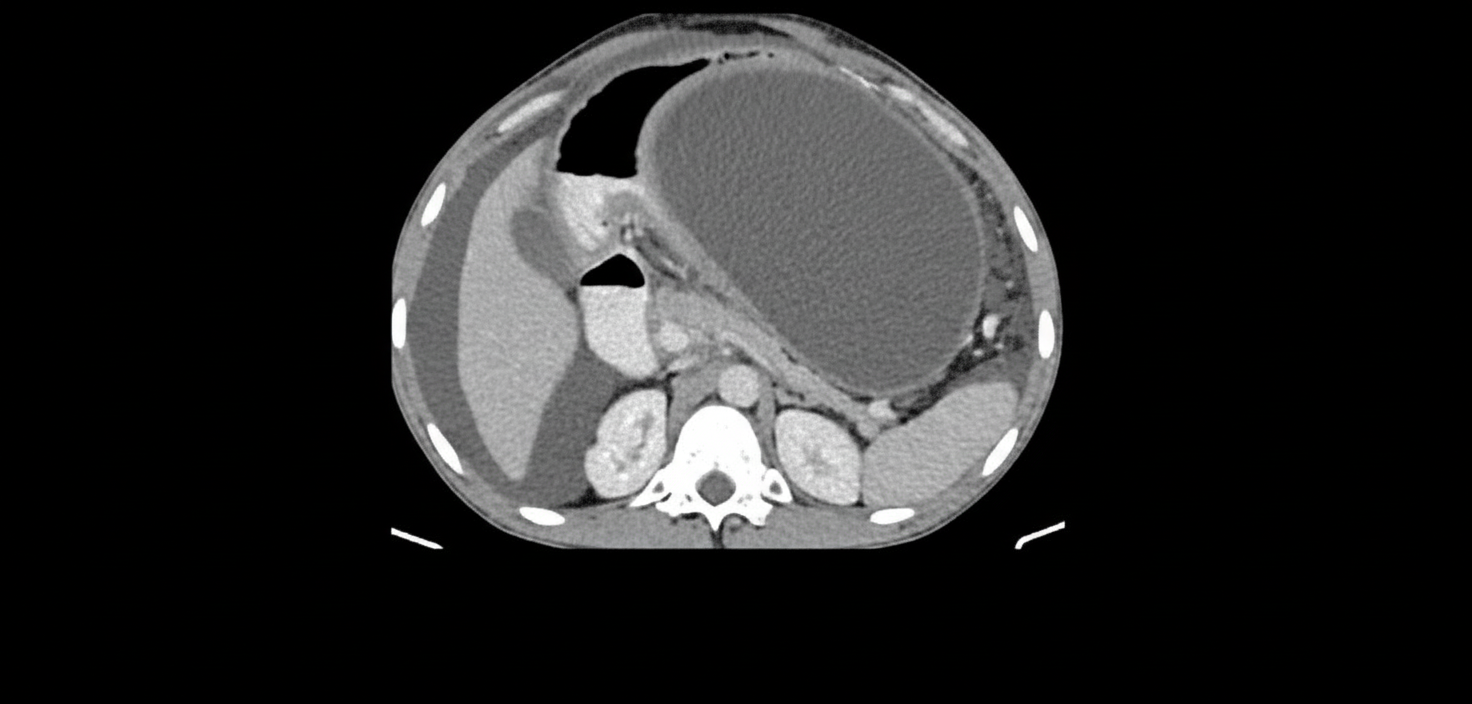
A 60-year-old female presents with a history of recurrent abdominal pain. Imaging shows multiple small cystic lesions resembling a bunch of grapes in the head of the pancreas, along with a grossly dilated main pancreatic duct. What is the most likely diagnosis?
A 30-year-old man presents with anemia, clinical jaundice, and splenomegaly. He has an autosomal dominant disorder for which splenectomy is the only treatment. What is the most likely diagnosis?
An infected pancreatic necrosis is treated with?
Which of the following is true regarding the diagnosis of pancreatitis?
In attempting to minimize complications during cholecystectomy, the surgeon defines the triangle of Calot. The boundaries of the triangle of Calot (modified) are the common hepatic duct medially, the cystic duct inferiorly, and the liver superiorly. Which structure courses through this triangle?
What is true about acute pancreatitis?
A 50-year-old male presented with an epigastric mass and a history of frequent epigastric pain radiating to the back. Records show chronically raised serum amylase and lipase levels. Following USG and CT abdomen studies, which of the following complications may occur if the involved structure ruptures?
A symptomatic patient has a 7 cm pancreatic cyst. What is the treatment of choice for this patient?
What is the investigation of choice for a pancreatic islet cell tumor?
The "chain of lakes" appearance on ERCP is characteristic of which condition?
Explanation: ### Explanation **Correct Answer: C. Intraductal Papillary Mucinous Neoplasm (IPMN)** The clinical presentation and imaging findings are classic for **Intraductal Papillary Mucinous Neoplasm (IPMN)**. The key diagnostic features here are the **"bunch of grapes"** appearance (representing dilated branch ducts) and the **grossly dilated main pancreatic duct**. IPMNs arise from the pancreatic ductal epithelium and produce thick mucin, which leads to progressive ductal obstruction and dilation. When the main duct is involved (Main-duct IPMN), the risk of malignancy is significantly higher compared to the branch-duct type. **Why the other options are incorrect:** * **A. Serous Cystadenoma:** Typically presents with a **"honeycomb"** or "sunburst" appearance due to central stellate scarring and calcification. It consists of numerous microcysts but does **not** communicate with or cause gross dilation of the main pancreatic duct. * **B. Mucinous Cystadenoma:** These are usually large, unilocular or multilocular thick-walled cysts, often found in the **body or tail** of the pancreas in middle-aged women. They do not typically communicate with the pancreatic duct. * **D. Pancreatic Pseudocyst:** While these can cause ductal compression, they are usually a sequela of acute or chronic pancreatitis. They are unilocular collections of fluid outside the ductal system, lacking an epithelial lining. **NEET-PG High-Yield Pearls:** * **Pathognomonic Sign:** The "Fish-mouth" appearance of the Ampulla of Vater (mucin extruding from the papilla during endoscopy) is diagnostic for IPMN. * **Location:** IPMN is most commonly found in the **head** of the pancreas. * **Malignancy Risk:** Main-duct IPMN has a high malignant potential (>60%), necessitating surgical resection (e.g., Whipple’s procedure). * **Rule of Thumb:** "Mother" (Mucinous Cystadenoma - middle-aged females), "Grandmother" (Serous Cystadenoma - elderly females), "Daughter" (Solid Pseudopapillary Tumor - young females).
Explanation: ### Explanation **Correct Option: B. Hereditary Spherocytosis (HS)** The clinical triad of **anemia, jaundice, and splenomegaly** in a young patient suggests chronic hemolysis. Hereditary Spherocytosis is an **autosomal dominant** disorder (most common inheritance) caused by defects in red blood cell membrane proteins (Ankyrin, Spectrin, or Band 3). This leads to the formation of spherical RBCs that are prematurely destroyed in the splenic cords. **Splenectomy** is considered the definitive treatment for HS as it stops the site of hemolysis, corrects the anemia, and prevents gallstone formation. **Why other options are incorrect:** * **A. Thalassemia:** This is an **autosomal recessive** disorder. While splenectomy may be performed for hypersplenism or to reduce transfusion requirements, it is not the "only" or definitive treatment; the mainstay is blood transfusion and iron chelation. * **C. Sickle Cell Disease:** This is also **autosomal recessive**. Splenectomy is rarely indicated because these patients usually undergo "autosplenectomy" (splenic infarction) by early childhood. * **D. Idiopathic Autoimmune Hemolytic Anemia (AIHA):** This is an **acquired** condition, not an autosomal dominant genetic disorder. The first-line treatment is typically corticosteroids, not surgery. **NEET-PG High-Yield Pearls:** * **Diagnosis of HS:** Increased MCHC (highly specific), positive Osmotic Fragility Test, and Eosin-5-maleimide (EMA) binding test (Gold Standard). * **Surgical Timing:** Splenectomy is ideally delayed until after age 5–6 to reduce the risk of OPSI (Overwhelming Post-Splenectomy Infection). * **Prophylaxis:** Post-splenectomy patients must receive vaccinations against *S. pneumoniae*, *H. influenzae*, and *N. meningitidis* (ideally 2 weeks before elective surgery). * **Associated Finding:** Pigmented (calcium bilirubinate) gallstones are common in HS; always check the gallbladder before splenectomy.
Explanation: **Explanation:** The management of acute pancreatitis depends on the presence of complications. **Infected pancreatic necrosis (IPN)** is a life-threatening condition characterized by the infection of devitalized pancreatic tissue, typically occurring 2–4 weeks after the onset of acute pancreatitis. **Why Option B is Correct:** The gold standard treatment for infected pancreatic necrosis has traditionally been **surgical necrosectomy (debridement)**. The goal is to remove the dead, infected tissue that acts as a nidus for sepsis. While modern practice often follows a "step-up approach" (starting with percutaneous drainage), **Laparotomy and surgical debridement** remains the definitive surgical answer in standard textbooks and exams when infection is established and conservative measures are insufficient. **Analysis of Incorrect Options:** * **Option A (IV Antibiotics):** While antibiotics (like Carbapenems) are essential adjuncts, they cannot penetrate necrotic tissue effectively to clear the infection. They are not a definitive treatment for IPN. * **Option C (USG Guided Drainage):** This is often the first step in the "step-up approach" to stabilize a patient, but it only drains fluid (pus) and cannot remove solid necrotic debris. * **Option D (TPN):** Nutrition is vital, but **Enteral nutrition** is preferred over TPN in pancreatitis to maintain the gut barrier and prevent bacterial translocation. **High-Yield Clinical Pearls for NEET-PG:** * **Diagnosis:** The presence of **extraluminal gas** on a CT scan is pathognomonic for infected necrosis. * **Timing:** Surgery should ideally be delayed until **3–4 weeks** after onset to allow the necrosis to become "walled off" (Walled-off Pancreatic Necrosis - WON), making debridement safer and easier. * **Step-up Approach:** The current clinical trend (PANTER trial) favors minimally invasive drainage first, followed by video-assisted retroperitoneal debridement (VARD) if needed.
Explanation: **Explanation:** The diagnosis and management of acute pancreatitis rely on clinical, biochemical, and radiological criteria. **Why Option B is Correct:** Contrast-Enhanced Computed Tomography (CECT) is the gold standard for assessing the severity of pancreatitis and identifying complications like necrosis. However, it is **not** recommended immediately upon admission. Performing a CECT before **72 hours** of symptom onset often underestimates the extent of pancreatic necrosis, as the inflammatory process takes time to fully manifest radiologically. Waiting 72 hours ensures maximum diagnostic yield for staging severity (e.g., using the Balthazar score). **Why Other Options are Incorrect:** * **Option A:** While serum lipase is more specific and remains elevated longer than amylase, the **investigation of choice** for diagnosis is clinical assessment combined with biochemical markers. For *severity* and *complications*, CECT is the investigation of choice. * **Option C:** According to RANSON’s criteria, a score of **3 or more** (not >2) indicates severe acute pancreatitis. A score of <3 is associated with low mortality (<1%), while a score ≥3 indicates a significant risk of systemic complications and higher mortality. **High-Yield Clinical Pearls for NEET-PG:** * **Diagnosis:** Requires 2 out of 3: (1) Typical epigastric pain, (2) Serum amylase/lipase >3x normal, (3) Characteristic findings on imaging. * **Most Specific Marker:** Serum Lipase. * **Early Prognostic Markers:** CRP >150 mg/L at 48 hours is a reliable indicator of severity. * **Atlanta Classification:** Defines "Severe" as the presence of persistent organ failure (>48 hours).
Explanation: **Explanation:** The **Triangle of Calot** (specifically the modified version used in modern surgery) is a critical anatomical landmark used during cholecystectomy to achieve the "Critical View of Safety." **1. Why the Correct Answer is Right:** The boundaries of the triangle are the **cystic duct** (inferiorly), the **common hepatic duct** (medially), and the **inferior surface of the liver** (superiorly). The primary structure found within this triangle is the **cystic artery**, which typically arises from the right hepatic artery. Identifying this artery within the triangle is essential for safe ligation and to prevent accidental injury to the biliary tree. **2. Why the Incorrect Options are Wrong:** * **Left hepatic artery:** This artery supplies the left lobe of the liver and is located well to the left of the common hepatic duct, far outside the boundaries of Calot’s triangle. * **Right renal vein:** This is a retroperitoneal structure located posterior to the duodenum and head of the pancreas; it is not involved in the anatomy of the gallbladder or the hepatobiliary triangle. * **Right hepatic artery:** While the right hepatic artery usually gives rise to the cystic artery, it typically passes **posterior** to the common hepatic duct before entering the triangle or stays just outside its medial boundary. However, the cystic artery is the definitive structure *traversing* the space to reach the gallbladder. **3. NEET-PG High-Yield Pearls:** * **Original vs. Modified Calot’s:** The *original* description by Calot (1891) used the **cystic artery** as the superior boundary. In modern surgical practice, the **liver edge** is used as the superior boundary (Hepatocystic Triangle). * **Moynihan’s Hump:** A tortuous right hepatic artery may loop into the triangle, making it vulnerable to accidental clamping. * **Lund’s Node:** The cystic lymph node (sentinel node of cholecystitis) is also found within this triangle and is a helpful landmark for locating the cystic artery.
Explanation: **Explanation:** **Why Option C is Correct:** Contrast-Enhanced Computed Tomography (CECT) is the **gold standard** for diagnosing acute pancreatitis and its complications (like necrosis or pseudocysts). While Ultrasound (USG) is the initial screening tool to look for gallstones, it is often limited by overlying bowel gas (ileus) which obscures the pancreas. CECT provides superior anatomical detail, helps in staging severity (Balthazar score), and is essential for identifying pancreatic necrosis. **Analysis of Incorrect Options:** * **Option A:** Globally and in India, **Gallstones** are the most common cause of acute pancreatitis (approx. 40-50%), followed by alcohol. * **Option B:** Most cases (80-85%) are mild and managed conservatively with aggressive fluid resuscitation and analgesia. Only **5-10%** of cases (typically those with infected necrosis or complications) require surgical intervention. * **Option D:** Serum amylase is sensitive but **not specific**. It can be elevated in perforated peptic ulcers, mesenteric ischemia, or ectopic pregnancy. Furthermore, amylase levels do not correlate with the severity of the disease and return to normal within 3-5 days. Serum **Lipase** is considered a more specific and reliable biochemical marker. **Clinical Pearls for NEET-PG:** * **Diagnosis:** Requires 2 out of 3 criteria: (1) Characteristic abdominal pain, (2) Serum amylase/lipase >3x upper limit, (3) Characteristic findings on imaging. * **Timing of CECT:** Ideally performed **72-96 hours** after symptom onset to accurately assess the extent of necrosis. * **Sentinel Loop Sign:** A localized ileus of a jejunal loop seen on X-ray, indicating underlying inflammation. * **Cullen’s/Grey Turner’s signs:** Indicate retroperitoneal hemorrhage and signify severe necrotizing pancreatitis.
Explanation: ### Explanation **Diagnosis:** The clinical presentation of a chronic epigastric mass, pain radiating to the back, and persistently elevated pancreatic enzymes in a 50-year-old male strongly suggests a **Pancreatic Pseudocyst**. **Why Intestinal Hemorrhage is Correct:** The most dreaded vascular complication of a pancreatic pseudocyst is the formation of a **pseudoaneurysm**. The proteolytic enzymes (especially elastase) within the cyst fluid erode the walls of adjacent major arteries—most commonly the **splenic artery** (followed by the gastroduodenal and pancreaticoduodenal arteries). If this pseudoaneurysm ruptures into the pseudocyst, it converts into a "hemosuccus pancreaticus." If the cyst then ruptures into the GI tract (stomach or duodenum), it results in massive, life-threatening **intestinal hemorrhage**. **Why Other Options are Incorrect:** * **A. Carcinomatosis:** This is associated with the seeding of malignant cells (e.g., ovarian or gastric cancer). A pseudocyst is a benign inflammatory collection. * **C. Disseminated infection:** While a pseudocyst can become infected (forming a pancreatic abscess), rupture typically leads to pancreatic ascites or peritonitis rather than immediate systemic dissemination. * **D. Anaphylactic shock:** This is the classic complication of a ruptured **Hydatid cyst** (Echinococcus), not a pancreatic pseudocyst. **High-Yield Clinical Pearls for NEET-PG:** * **Definition:** A pseudocyst lacks an epithelial lining (lined by granulation tissue); it usually forms 4–6 weeks after an episode of acute pancreatitis. * **Most common site of pseudoaneurysm:** Splenic artery. * **Indications for surgery:** Size >6 cm, persistence >6 weeks, or complications (infection, hemorrhage, or gastric outlet obstruction). * **Treatment of choice for pseudoaneurysm:** Angiographic embolization (if stable) or surgical ligation.
Explanation: **Explanation:** The management of a pancreatic cyst depends on its size, symptoms, and etiology (pseudocyst vs. cystic neoplasm). In this clinical scenario, the patient has a **symptomatic, large (7 cm) pancreatic cyst**, which most commonly refers to a **pancreatic pseudocyst** in the context of surgical exams. **Why Internal Drainage is Correct:** For pseudocysts larger than 6 cm or those that are symptomatic/persistent, intervention is required. **Internal drainage** is the treatment of choice because it allows the cyst fluid to drain into the gastrointestinal tract, preventing external fluid loss and electrolyte imbalance. Common procedures include **Cystogastrostomy** (most common), Cystoduodenostomy, or Roux-en-Y Cystojejunostomy. It is performed only after the cyst wall has "matured" (usually 6 weeks), ensuring it can hold sutures. **Why Other Options are Incorrect:** * **External Drainage:** This is generally avoided as it carries a high risk of forming a **pancreaticocutaneous fistula**. It is reserved only for infected pseudocysts with unstable hemodynamics or thin-walled cysts that cannot hold sutures. * **Resection of Head of Pancreas:** This (e.g., Whipple’s procedure) is an over-treatment for a simple pseudocyst. Resection is reserved for suspected **cystic neoplasms** (like MCN or IPMN) or cysts located in the tail (distal pancreatectomy). * **Antibiotics:** While useful if a cyst becomes infected (pancreatic abscess), antibiotics alone will not resolve a 7 cm structural collection. **High-Yield Clinical Pearls for NEET-PG:** * **Rule of 6:** Many pseudocysts <6 cm or <6 weeks old resolve spontaneously with conservative management. * **Maturity:** Internal drainage requires a mature cyst wall (takes ~6 weeks). * **Gold Standard:** Endoscopic ultrasound (EUS)-guided internal drainage is now preferred over open surgery when anatomically feasible.
Explanation: **Explanation:** The investigation of choice for pancreatic islet cell tumors (Neuroendocrine Tumors - NETs) is a **Nuclear Scan**, specifically **Somatostatin Receptor Scintigraphy (SRS)** or the more modern **68Ga-DOTATATE PET/CT**. **Why Nuclear Scan is Correct:** Most pancreatic islet cell tumors (like gastrinomas, glucagonomas, and somatostatinomas) overexpress **Somatostatin Receptors (SSTR)**, particularly subtype 2. Nuclear imaging uses radiolabeled somatostatin analogs (e.g., Octreotide or DOTATATE) that bind specifically to these receptors. This provides high sensitivity for detecting both the primary tumor and occult metastatic disease, which anatomical imaging often misses. **Why Other Options are Incorrect:** * **CT Scan (A) & MRI (B):** While multiphasic (triple-phase) CT and MRI are excellent for localization and assessing resectability, they are **anatomical** studies. They may fail to detect small tumors (<1 cm) or differentiate them from non-functional nodules. * **USG (D):** Transabdominal ultrasound has very low sensitivity for the pancreas due to overlying bowel gas and the small size of these tumors. (Note: *Endoscopic* Ultrasound is highly sensitive but is invasive and usually secondary to non-invasive imaging). **High-Yield Clinical Pearls for NEET-PG:** 1. **The Exception:** **Insulinomas** are often SSTR-negative. Therefore, the investigation of choice for localizing an insulinoma is **Endoscopic Ultrasound (EUS)** or **Selective Arterial Calcium Stimulation Test (SACST)** if non-invasive imaging is negative. 2. **Gastrinoma Triangle:** Most gastrinomas are found in the area bounded by the junction of the cystic/common duct, the 2nd/3rd part of the duodenum, and the neck/body of the pancreas. 3. **Gold Standard for Metastasis:** 68Ga-DOTATATE PET/CT is now considered superior to the older 111In-Pentetreotide (OctreoScan).
Explanation: **Explanation:** The **"chain of lakes"** appearance is a classic radiological sign of **Chronic Pancreatitis**. This pattern occurs due to the progressive destruction of the pancreatic parenchyma and subsequent fibrosis, leading to alternating areas of **strictures and dilatations** within the main pancreatic duct. On an ERCP (Endoscopic Retrograde Cholangiopancreatography), this irregular, beaded appearance resembles a series of interconnected lakes. **Analysis of Options:** * **Chronic Pancreatitis (Correct):** Long-term inflammation leads to ductal distortion, calcifications, and the characteristic "chain of lakes" morphology. * **Acute Pancreatitis:** This is an inflammatory process where the duct is typically normal or mildly compressed due to edema; it does not feature the chronic structural remodeling seen in this sign. * **Carcinoma of the Pancreas:** Typically presents with a **"Double Duct Sign"** (simultaneous obstruction/dilatation of both the common bile duct and the pancreatic duct) or a solitary, abrupt "cutoff" of the duct, rather than alternating beads. * **Ductal Adenoma:** These are rare and usually present as localized filling defects or focal obstructions rather than diffuse, beaded dilatation. **High-Yield Pearls for NEET-PG:** * **Puestow Procedure:** The surgical treatment for chronic pancreatitis with a dilated duct (>6mm) is a Lateral Pancreaticojejunostomy, which "unroofs" the chain of lakes. * **Most common cause:** Alcohol (Adults), Cystic Fibrosis (Children). * **Classic Triad:** Steatorrhea, Diabetes Mellitus, and Pancreatic Calcifications. * **Investigation of Choice:** MRCP is now the non-invasive gold standard for diagnosis, though ERCP was historically used.
Pancreatic Anatomy and Physiology
Practice Questions
Acute Pancreatitis
Practice Questions
Chronic Pancreatitis
Practice Questions
Pancreatic Pseudocysts
Practice Questions
Pancreatic Adenocarcinoma
Practice Questions
Cystic Neoplasms of Pancreas
Practice Questions
Neuroendocrine Tumors of Pancreas
Practice Questions
Pancreatic Trauma
Practice Questions
Pancreatectomy Techniques
Practice Questions
Whipple Procedure
Practice Questions
Pancreatic Anastomosis
Practice Questions
Complications of Pancreatic Surgery
Practice Questions
Get full access to all questions, explanations, and performance tracking.
Start For Free