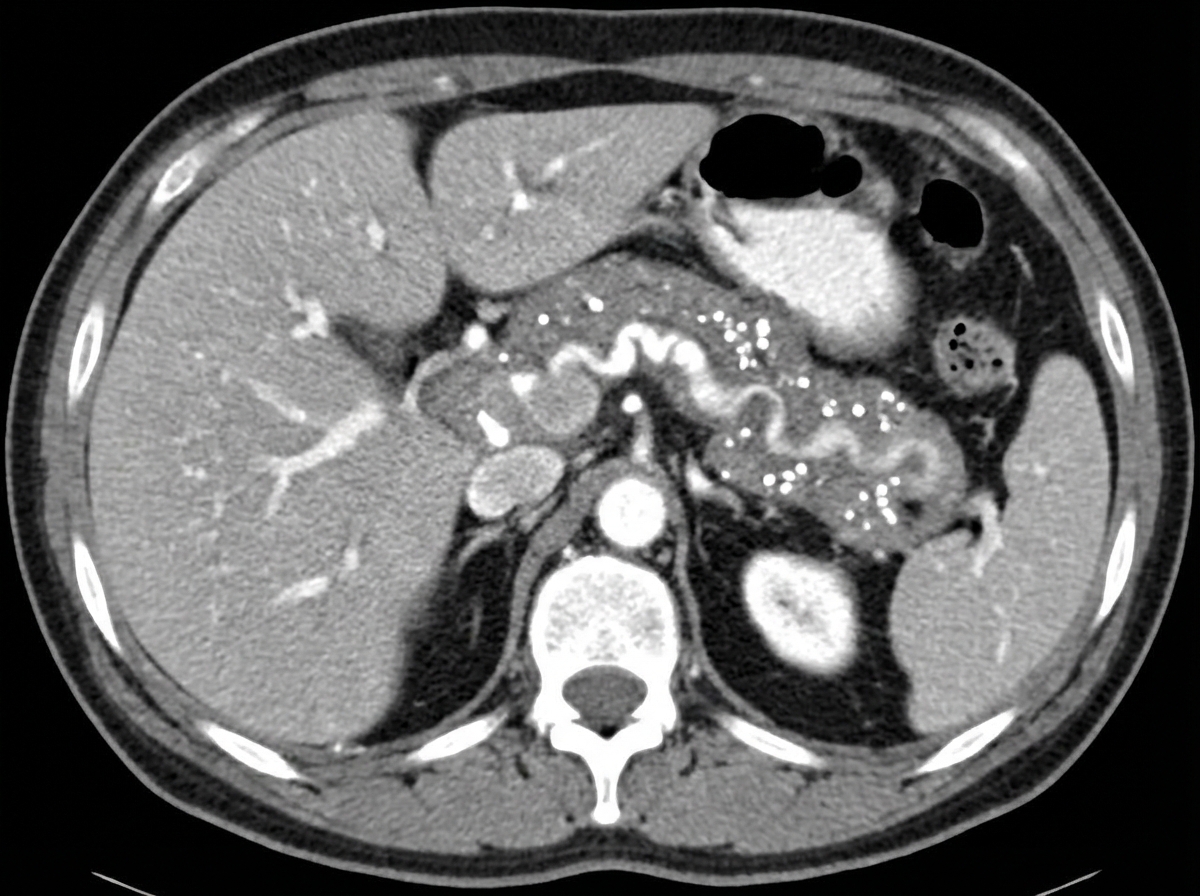
Which of the following is NOT a component of Whipple's surgery?
Extra-adrenal pheochromocytomas are most commonly located in which region?
A patient presents with a 3-day history of epigastric pain radiating to the back. Serum amylase levels are normal, but an ultrasound of the abdomen reveals gall bladder stones and an enlarged pancreas. A CT scan confirmed the diagnosis. What is the diagnosis?
Which of the following is true about a pseudocyst of the pancreas?
All of the following are examples of familial multiorgan cancer syndromes associated with pancreatic cancer, EXCEPT:
Which of the following statements about acute pancreatitis is true?
Which of the following is true regarding the diagnosis of pancreatitis?
What is the correct order of anastomosis in a Whipple's procedure?
If the parathyroid gland is accidentally removed during surgery, in which location is it typically implanted for potential recovery?
A 30-year-old female with a history of chronic alcoholism presents with sudden onset of epigastric pain radiating to the back. What laboratory findings would NOT be expected in this scenario?
Explanation: **Explanation:** Whipple’s procedure, or **Pancreaticoduodenectomy**, is the definitive surgical treatment for periampullary carcinomas and tumors of the head of the pancreas. The procedure involves two main phases: **Resection** and **Reconstruction**. **Why Duodenojejunostomy is the correct answer:** In a standard Whipple’s procedure, the entire duodenum (along with the head of the pancreas and the gallbladder) is **resected**. Since the duodenum is removed, it cannot be used for an anastomosis. Therefore, a **Duodenojejunostomy** is not a component of a standard Whipple’s surgery. *(Note: A Duodenojejunostomy is, however, performed in a "Pylorus-Preserving Pancreaticoduodenectomy" (PPPD), but the question refers to the standard Whipple’s procedure where the distal stomach/pylorus is removed).* **Analysis of Incorrect Options:** * **Pancreaticoduodenectomy (D):** This is the formal name for the resection phase of the procedure. * **Choledochojejunostomy (C):** This is a mandatory reconstructive step where the common bile duct is anastomosed to the jejunum to restore biliary drainage. * **Gastrojejunostomy (A):** In a standard Whipple’s, the distal stomach (antrum) is resected, and the remaining stomach is joined to the jejunum to restore gastrointestinal continuity. **High-Yield NEET-PG Pearls:** 1. **Sequence of Reconstruction:** The standard order of anastomosis (from proximal to distal) is **Pancreaticojejunostomy** (the "Achilles heel" of the surgery due to leak risk) → **Choledochojejunostomy** → **Gastrojejunostomy**. 2. **Most Common Complication:** Delayed gastric emptying. 3. **Most Serious Complication:** Pancreatic fistula/leak from the pancreaticoenteric anastomosis. 4. **Artery of Concern:** The **replaced right hepatic artery** (originating from the Superior Mesenteric Artery) must be identified to avoid accidental ligation.
Explanation: **Explanation:** Extra-adrenal pheochromocytomas (also known as **paragangliomas**) arise from the chromaffin cells of the sympathetic or parasympathetic nervous system. While the majority of extra-adrenal tumors occur in the abdomen (specifically the Organ of Zuckerkandl), when they occur within the thorax, the **posterior mediastinum** is the most common site. * **Why Posterior Mediastinum is Correct:** The sympathetic chain, from which these tumors originate, is located in the paravertebral gutters within the posterior mediastinum. Therefore, neurogenic tumors, including paragangliomas, are characteristically found in this compartment. * **Why Other Options are Incorrect:** * **Anterior Mediastinum:** This region is the site for the "4 Ts": Thymoma, Teratoma, Thyroid (retrosternal goiter), and "Terrible" Lymphoma. * **Middle Mediastinum:** This compartment typically contains lymphadenopathy, pericardial cysts, and bronchogenic cysts. * **Superior Mediastinum:** While some tumors can extend here, it is not the primary site for sympathetic chain-derived tumors. **High-Yield Clinical Pearls for NEET-PG:** * **Rule of 10s:** Traditionally, 10% of pheochromocytomas are extra-adrenal, 10% are bilateral, 10% are malignant, and 10% occur in children. (Note: Modern genetics show up to 25-30% may be familial). * **Organ of Zuckerkandl:** The most common extra-adrenal site overall (located at the origin of the inferior mesenteric artery). * **Clinical Triad:** Episodic headache, sweating, and tachycardia in a hypertensive patient. * **Diagnosis:** Best initial test is 24-hour urinary fractionated metanephrines or plasma free metanephrines. * **Localization:** **MIBG Scan** (I-123) is highly specific for locating extra-adrenal tumors.
Explanation: ### Explanation **Correct Option: A. Acute pancreatitis** The clinical presentation of epigastric pain radiating to the back is a classic hallmark of acute pancreatitis. While serum amylase is a common marker, its levels peak early and often return to normal within 3–5 days (the patient presented on day 3). In such cases, imaging becomes crucial. The ultrasound findings of an enlarged (edematous) pancreas and the presence of gallstones (the most common etiology of pancreatitis) combined with CT confirmation establish the diagnosis. **Why incorrect options are wrong:** * **B. Acute cholecystitis:** While gallstones are present, the pain typically localizes to the right upper quadrant (Murphy’s sign) rather than radiating to the back, and it would not explain the pancreatic enlargement on CT. * **C. Acute peritonitis:** This presents with generalized abdominal rigidity, guarding, and rebound tenderness, usually secondary to a perforated viscus. It is a clinical sign rather than a primary diagnosis in this context. * **D. Acute appendicitis:** Pain typically starts periumbilically and migrates to the right iliac fossa (McBurney’s point). It does not correlate with pancreatic enlargement or back radiation. **High-Yield Clinical Pearls for NEET-PG:** * **Enzymes:** Serum **Lipase** is more specific than Amylase and remains elevated longer (7–14 days), making it more reliable for late presentations. * **Imaging:** Contrast-Enhanced CT (CECT) is the gold standard for assessing the severity and complications (like necrosis) but is ideally performed after 72 hours of symptom onset. * **Etiology:** Gallstones (most common) and Alcohol are the top two causes. * **Sentinel Loop:** A localized ileus of the jejunum seen on X-ray is a classic sign of acute pancreatitis.
Explanation: A **Pancreatic Pseudocyst** is a circumscribed collection of fluid rich in pancreatic enzymes (primarily amylase) that occurs as a complication of acute or chronic pancreatitis or pancreatic trauma. ### **Explanation of Options:** * **Option A (Collection of pancreatic fluid):** A pseudocyst consists of leaked pancreatic secretions. Unlike a true cyst, its wall is formed by **granulation tissue and fibrosis** (typically involving the lesser sac) rather than an epithelial lining—hence the term "pseudo." * **Option B (May be asymptomatic):** While many patients present with epigastric pain, early satiety, or a palpable mass, small pseudocysts are frequently found incidentally on imaging and remain asymptomatic. * **Option C (Amylase levels are typically elevated):** Because the cyst communicates with or originates from the pancreatic ductal system, the fluid contains extremely high concentrations of amylase (often >1000 U/L), which is a diagnostic hallmark during aspiration. ### **High-Yield Clinical Pearls for NEET-PG:** * **Timing:** It typically takes **4 to 6 weeks** for the granulation wall to mature. * **Management:** * Asymptomatic cysts of any size can often be observed. * Symptomatic or enlarging cysts require drainage. **Endoscopic Cystogastrostomy** is currently the preferred treatment. * **Complications:** The most dreaded complication is hemorrhage due to erosion into a nearby vessel (most commonly the **Splenic Artery**), leading to a **hemosuccus pancreaticus**. * **Imaging:** Contrast-Enhanced CT (CECT) is the gold standard for diagnosis and monitoring.
Explanation: **Explanation:** The correct answer is **D. Familial multiple pancreatic adenoma syndrome otherwise specified**. This is because pancreatic cancer (adenocarcinoma) is associated with specific genetic mutations and inherited cancer syndromes, but "Familial multiple pancreatic adenoma syndrome" is not a recognized clinical entity associated with pancreatic malignancy. Pancreatic cancer typically arises from **Pancreatic Intraepithelial Neoplasia (PanIN)**, not from multiple adenomas. **Analysis of Options:** * **Peutz-Jeghers Syndrome (STK11 mutation):** Characterized by hamartomatous polyps and mucocutaneous pigmentation. It carries one of the highest relative risks (up to 132-fold) for developing pancreatic adenocarcinoma. * **Hereditary Nonpolyposis Colorectal Cancer (HNPCC/Lynch Syndrome):** Caused by mutations in mismatch repair genes (MLH1, MSH2, etc.). While primarily associated with colon and endometrial cancer, it significantly increases the risk of pancreatic cancer. * **Li-Fraumeni Syndrome (TP53 mutation):** A multi-organ cancer syndrome predisposing individuals to sarcomas, breast cancer, and various epithelial tumors, including pancreatic carcinoma. **High-Yield Clinical Pearls for NEET-PG:** * **Most common genetic mutation** in sporadic pancreatic cancer: **KRAS** (found in >90% of cases). * **Familial Atypical Multiple Mole Melanoma (FAMMM) syndrome:** Caused by **CDKN2A (p16)** mutation; it is a high-yield association with pancreatic cancer. * **BRCA2 mutations:** The most common cause of inherited pancreatic cancer in the general population. * **Hereditary Pancreatitis (PRSS1 mutation):** Carries a 40% lifetime risk of pancreatic adenocarcinoma.
Explanation: ### Explanation **Correct Option: C. It is common in alcoholics.** Alcohol consumption is the second most common cause of acute pancreatitis worldwide (after gallstones). Alcohol induces the synthesis of digestive and lysosomal enzymes by pancreatic acinar cells and increases the permeability of ductules, leading to premature enzyme activation and autodigestion of the gland. **Analysis of Incorrect Options:** * **A. Pain lasts for several hours:** This is misleading. In acute pancreatitis, the pain is typically constant, severe, and lasts for **several days**, not just hours. It characteristically radiates to the back and is partially relieved by leaning forward (knee-chest position). * **B. Serum amylase levels correlate with severity:** This is a classic "trap" fact. While amylase is used for diagnosis (rising within 2–12 hours), the **magnitude of the elevation does not correlate** with the clinical severity or prognosis. A patient with mild disease may have very high levels, while a patient with severe necrotizing pancreatitis may have near-normal levels due to parenchymal destruction. * **D. Low serum calcium levels indicate a good prognosis:** On the contrary, hypocalcemia (Serum Calcium <8 mg/dL) is a sign of **poor prognosis**. It occurs due to "saponification," where calcium soaps form in areas of fat necrosis. It is a key component of the **Ranson Criteria** and **Modified Glasgow Score** for predicting severity. **High-Yield NEET-PG Pearls:** * **Most common cause:** Gallstones (Overall); Alcohol (in men). * **Most specific enzyme:** Serum Lipase (remains elevated longer than amylase). * **Gold standard imaging:** Contrast-Enhanced CT (CECT) scan (best done after 72 hours to assess necrosis). * **Cullen’s sign:** Periumbilical ecchymosis (indicates hemoperitoneum/severe pancreatitis). * **Grey Turner’s sign:** Flank ecchymosis.
Explanation: ### Explanation **1. Why Option C is Correct:** The **Balthazar Score** is a CT-based grading system used to assess the severity of acute pancreatitis. It evaluates the degree of pancreatic inflammation (Grades A–E) and is often combined with the degree of pancreatic necrosis to calculate the **CT Severity Index (CTSI)**. This score is a crucial predictor of morbidity and mortality in clinical practice. **2. Why Other Options are Incorrect:** * **Option A:** This is incorrect because **Lipase is more specific** than Amylase. Amylase can be elevated in various non-pancreatic conditions (e.g., salivary gland disease, ectopic pregnancy, perforated peptic ulcer). Lipase also remains elevated longer (7–14 days) compared to Amylase (3–5 days). * **Option B:** This is a common misconception. The absolute serum levels of Amylase and Lipase **do not correlate** with the clinical severity or prognosis of the disease. A patient with mild pancreatitis may have very high levels, while a patient with severe necrotizing pancreatitis may have near-normal levels due to extensive parenchymal destruction. **3. High-Yield Clinical Pearls for NEET-PG:** * **Diagnosis:** Requires 2 out of 3 criteria: (1) Typical epigastric pain, (2) Serum Amylase/Lipase >3x upper limit of normal, (3) Characteristic findings on imaging (CECT). * **Imaging Timing:** CECT is the gold standard but is most accurate **48–72 hours** after symptom onset to assess necrosis. * **Prognostic Scores:** * **Ranson’s Criteria:** Assessed at admission and 48 hours. * **APACHE II:** Can be used daily (most accurate but cumbersome). * **BISAP Score:** Simple bedside tool (BUN, Impaired mental status, SIRS, Age >60, Pleural effusion). * **Most common cause:** Gallstones (Global/India), followed by Alcohol.
Explanation: **Explanation:** In a Whipple’s procedure (Pancreaticoduodenectomy), the reconstruction phase follows a specific sequence to ensure surgical ergonomics and minimize complications. The standard order is **Pancreaticojejunostomy (PJ) → Hepaticojejunostomy (HJ) → Gastrojejunostomy (GJ)**. **Why this order is correct:** 1. **Pancreaticojejunostomy (PJ):** This is the most technically demanding and "deepest" anastomosis. It is performed first because it requires maximum mobility of the jejunal limb and unobstructed access to the retroperitoneum. 2. **Hepaticojejunostomy (HJ):** Performed second, distal to the PJ. This allows bile to flow into the jejunum to mix with pancreatic enzymes. 3. **Gastrojejunostomy (GJ):** Performed last and most distally. This ensures that the biliary and pancreatic secretions are upstream of the food bolus, preventing alkaline reflux gastritis and ensuring proper mixing for digestion. **Analysis of Incorrect Options:** * **Options A, B, and C:** These are incorrect because placing the GJ before the PJ or HJ would tether the jejunal loop distally, making the deeper, more critical pancreatic and biliary anastomoses technically difficult and prone to tension. **Clinical Pearls for NEET-PG:** * **The "Achilles Heel":** Pancreaticojejunostomy is considered the "Achilles heel" of the Whipple’s procedure due to the risk of pancreatic fistula. * **Child’s Reconstruction:** This is the classic "end-to-side" sequence described above. * **Whipple’s Triad:** Used for Insulinoma (Symptoms of hypoglycemia, low blood glucose, relief upon glucose administration), not to be confused with the surgery. * **Modified Whipple’s (PPPD):** The Pylorus-Preserving Pancreaticoduodenectomy avoids gastric resection, potentially reducing post-operative dumping syndrome.
Explanation: **Explanation:** The correct answer is **C. Brachioradialis muscle**. When a parathyroid gland is accidentally devascularized or removed during thyroid or parathyroid surgery, it can be salvaged through **autotransplantation**. The gland is minced into 1–2 mm fragments and implanted into a muscular pocket. The **brachioradialis muscle** of the non-dominant forearm is the preferred site for several clinical reasons: 1. **Accessibility:** It is easily accessible and allows for the procedure to be performed under local anesthesia if necessary. 2. **Monitoring:** If the patient develops recurrent hyperparathyroidism, the forearm site allows for easy differentiation between systemic recurrence and local graft hyperplasia. A **Casanova test** (selective venous sampling from both arms) can confirm if the implanted graft is the source of excess Parathyroid Hormone (PTH). 3. **Ease of Re-exploration:** If the graft becomes overactive, it can be partially resected easily without the risks associated with re-entering the neck (e.g., laryngeal nerve injury). **Why other options are incorrect:** * **Sartorius, Biceps, and Triceps:** While autotransplantation can technically occur in any well-vascularized muscle (including the Sternocleidomastoid if the forearm is not used), these muscles are not standard practice. They do not offer the same diagnostic advantage for venous sampling or the ease of surgical access for revision that the brachioradialis provides. **High-Yield Clinical Pearls for NEET-PG:** * **Confirmation of Tissue:** Before implantation, a small fragment should be sent for a **frozen section** to confirm it is indeed parathyroid tissue and not a lymph node. * **Alternative Site:** If the forearm is not used, the **Sternocleidomastoid (SCM)** is the most common alternative site. * **Cryopreservation:** If immediate reimplantation is not feasible, parathyroid tissue can be cryopreserved for future use.
Explanation: In the context of the NEET-PG exam, this question tests the specific diagnostic nuances of **Chronic Pancreatitis** versus Acute Pancreatitis. ### **Explanation of the Correct Answer** The patient presents with a history of **chronic alcoholism** and epigastric pain radiating to the back. While these symptoms suggest an acute-on-chronic exacerbation, the hallmark of advanced chronic pancreatitis is **pancreatic exocrine insufficiency**. Over time, the progressive destruction and fibrosis of the pancreatic parenchyma lead to a depletion of enzyme-producing acinar cells. Consequently, during an inflammatory flare, the pancreas may be unable to produce or release significant amounts of enzymes. Therefore, **Elevated Lipase** (and Amylase) is frequently **NOT** seen in chronic pancreatitis patients, even during symptomatic episodes. ### **Analysis of Incorrect Options** * **Elevated Amylase (A):** Similar to lipase, amylase levels often remain normal or low in chronic cases due to parenchymal burnout. However, in a "not expected" format, lipase is the more specific marker that typically fails to rise. * **Elevated ALT (C):** In alcoholic patients, or those where chronic pancreatitis causes a stricture of the intrapancreatic portion of the Common Bile Duct (CBD), transient elevations in ALT/AST or alkaline phosphatase are common. * **Hyperglycemia (D):** This is a classic finding. Chronic inflammation destroys the Islets of Langerhans, leading to **Type 3c Diabetes Mellitus** (endocrine insufficiency). ### **High-Yield Clinical Pearls for NEET-PG** * **Most sensitive/specific enzyme:** Lipase is generally more specific than amylase for acute pancreatitis, but both can be normal in "burnt-out" chronic pancreatitis. * **Classic Triad of Chronic Pancreatitis:** Pancreatic calcifications (most specific), Steatorrhea (exocrine failure), and Diabetes (endocrine failure). * **Imaging Gold Standard:** MRCP is the investigation of choice for visualizing ductal morphology; CT is best for detecting calcifications. * **Alcohol:** The most common cause of chronic pancreatitis in adults worldwide.
Pancreatic Anatomy and Physiology
Practice Questions
Acute Pancreatitis
Practice Questions
Chronic Pancreatitis
Practice Questions
Pancreatic Pseudocysts
Practice Questions
Pancreatic Adenocarcinoma
Practice Questions
Cystic Neoplasms of Pancreas
Practice Questions
Neuroendocrine Tumors of Pancreas
Practice Questions
Pancreatic Trauma
Practice Questions
Pancreatectomy Techniques
Practice Questions
Whipple Procedure
Practice Questions
Pancreatic Anastomosis
Practice Questions
Complications of Pancreatic Surgery
Practice Questions
Get full access to all questions, explanations, and performance tracking.
Start For Free