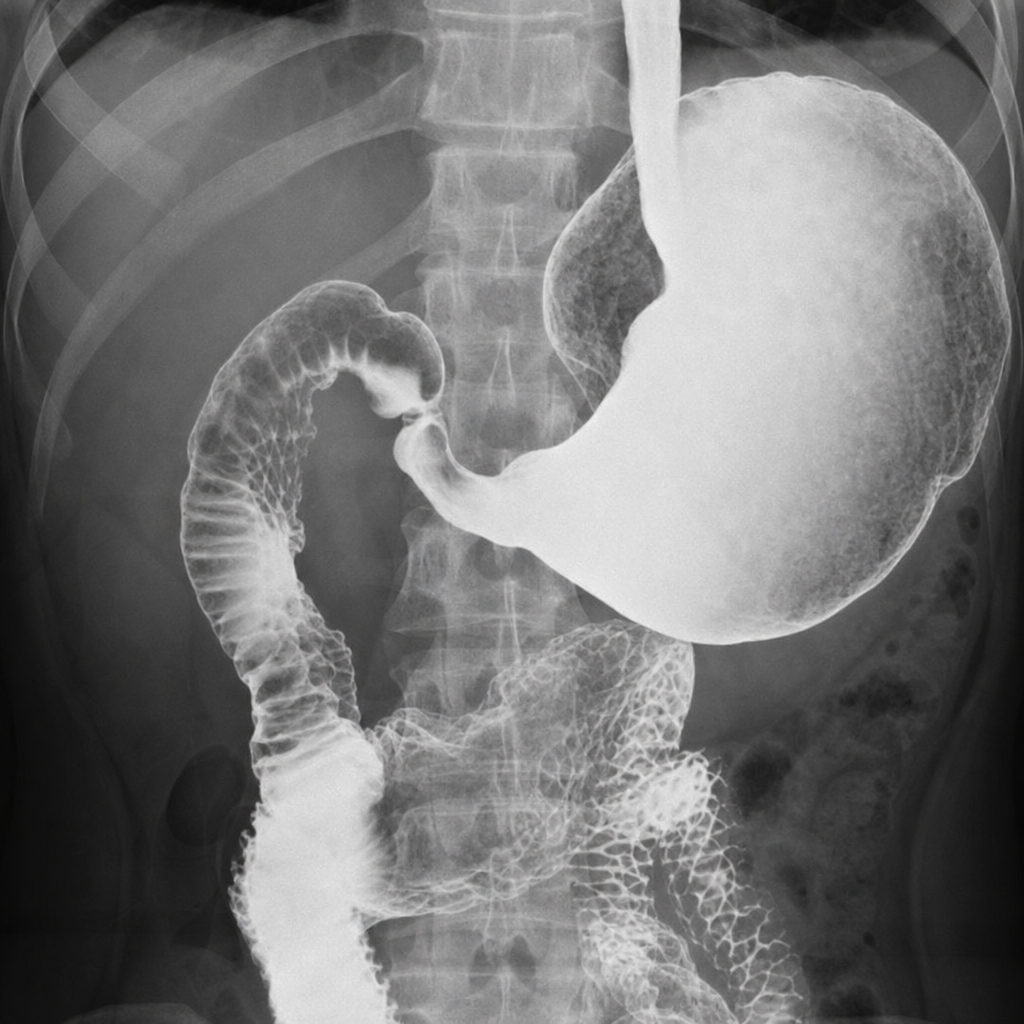
In VIPoma, which of the following is not seen?
What is the most common location for pancreatic pseudocysts?
Which of the following is NOT true about mucinous cystadenoma of the pancreas?
Which of the following is true regarding insulinoma?
An 85-year-old man presents with a 2-day history of nausea and vomiting. He has not passed gas or moved his bowels for the last 5 days. Abdominal films show dilated small bowel, no air in the rectum, and air in the biliary tree. Which of the following statements is true?
Which is the best investigation for metastatic gastrinoma?
Elevated serum amylase usually returns to normal after 7 days of acute pancreatitis. If it remains elevated after 7 days, what are the possible causes, excluding one option?
Which of the following is FALSE regarding cystadenoma?
Contraindications for pancreaticoduodenectomy for carcinoma of the head of the pancreas would include all of the following EXCEPT:
Which of the following statements about pancreatic fistula is false?
Explanation: **Explanation:** **VIPoma** (also known as Verner-Morrison syndrome or WDHA syndrome) is a rare neuroendocrine tumor, usually located in the pancreas, that secretes excessive amounts of Vasoactive Intestinal Peptide (VIP). **Why "Increased acid secretion" is the correct answer:** VIP is a potent inhibitor of gastric acid secretion. It acts as an "anti-gastrin" by inhibiting parietal cell activity. Therefore, patients with VIPoma typically present with **hypochlorhydria or achlorhydria** (low or absent stomach acid), not increased acid secretion. Increased acid secretion is characteristic of Zollinger-Ellison Syndrome (Gastrinoma). **Analysis of incorrect options:** * **Watery diarrhea (A):** VIP stimulates intestinal secretion of water and electrolytes and inhibits absorption, leading to massive, tea-colored secretory diarrhea (often >3L/day) that persists even during fasting. * **Hypokalemia (B):** The profound diarrhea leads to significant fecal loss of potassium, resulting in severe muscle weakness and cardiac arrhythmias. * **Hypercalcemia & Hyperglycemia (C):** VIP promotes glycogenolysis in the liver, leading to hyperglycemia. Hypercalcemia occurs in about 25-50% of cases due to the direct effect of VIP on bone resorption or co-existing MEN-1 syndrome. **Clinical Pearls for NEET-PG:** * **WDHA Syndrome mnemonic:** **W**atery **D**iarrhea, **H**ypokalemia, **A**chlorhydria. * **Diagnosis:** Elevated fasting plasma VIP levels (>200 pg/mL). * **Localization:** Most are found in the **tail of the pancreas**; 10% are extrapancreatic (especially in children, where they arise from sympathetic chains like ganglioneuromas). * **Management:** Initial stabilization requires aggressive fluid resuscitation and **Octreotide** (somatostatin analog) to control diarrhea before surgical resection.
Explanation: **Explanation:** A **pancreatic pseudocyst** is a localized collection of fluid, rich in pancreatic enzymes, surrounded by a wall of fibrous or granulation tissue (lacking an epithelial lining). It typically occurs as a complication of acute pancreatitis, chronic pancreatitis, or pancreatic trauma. **1. Why the Body is Correct:** Statistically, the **body of the pancreas** is the most frequent site for pseudocyst formation. This is primarily because the body and tail are the most common sites for parenchymal inflammation and ductal disruption in chronic pancreatitis. Furthermore, the anatomical relationship of the body to the **lesser sac (omental bursa)** provides a potential space where leaked secretions can easily accumulate and become walled off. **2. Analysis of Incorrect Options:** * **Head:** While pseudocysts can occur in the head, they are less common than in the body. Head-located cysts are clinically significant as they are more likely to cause biliary obstruction or gastric outlet obstruction. * **Neck:** The neck is a small, narrow segment of the pancreas; while cysts can involve this area, it is not the primary or most frequent site of origin. * **Outside the pancreas:** By definition, a pancreatic pseudocyst originates from the pancreas. While they can *extend* into extrapancreatic spaces (like the mediastinum or pelvis), the primary location of the collection is within or adjacent to the pancreatic substance. **Clinical Pearls for NEET-PG:** * **Timing:** A pseudocyst typically takes **4–6 weeks** to develop a mature wall (fibrous capsule). * **Most common location (Space):** The **lesser sac** is the most common anatomical space where pseudocysts are found. * **Management:** The "Rule of 6" (6 cm size, 6 weeks duration) was traditionally used for drainage, but current practice focuses on symptoms. If drainage is required, **Endoscopic Cystogastrostomy** is now the preferred approach over open surgery. * **Complication:** The most dreaded complication is hemorrhage into the cyst due to erosion of the **splenic artery** (forming a pseudoaneurysm).
Explanation: **Explanation:** The correct answer is **A (Microcystic adenoma)** because this term refers to **Serous Cystadenoma**, which is a distinct clinical entity from Mucinous Cystadenoma. **1. Why Option A is the correct answer (False statement):** Mucinous Cystadenomas are typically **macrocystic** (containing fewer, larger cysts >2cm). In contrast, **Serous Cystadenomas** are characterized by a "honeycomb" appearance of numerous small cysts, earning them the name "microcystic adenoma." Serous lesions are almost always benign, whereas mucinous lesions have significant malignant potential. **2. Why the other options are true (Incorrect for this question):** * **Option B (Lined by columnar epithelium):** Histologically, mucinous cystadenomas are lined by tall, mucin-producing columnar epithelium. * **Option C (Pre-malignant):** Unlike serous cystadenomas, mucinous cystadenomas are considered **premalignant** (or potentially malignant) and generally require surgical resection (e.g., Distal Pancreatectomy). * **Option D (Focus of ovarian stroma):** A pathognomonic feature of mucinous cystadenoma is the presence of **"ovarian-like" subepithelial stroma**. This is why the disease is seen almost exclusively in females (95% of cases). **Clinical Pearls for NEET-PG:** * **Demographics:** Often called the "Mother tumor" (seen in middle-aged women), typically located in the **body or tail** of the pancreas. * **Imaging:** Look for a thick-walled unilocular or multilocular cyst; peripheral **"eggshell calcification"** is highly suggestive of malignancy. * **Tumor Markers:** High **CEA levels** (>192 ng/mL) in the cyst fluid aspirate help differentiate mucinous from serous lesions.
Explanation: **Explanation:** **Insulinoma** is the most common functional neuroendocrine tumor (NET) of the pancreas. It arises from the beta cells of the islets of Langerhans and is characterized by the autonomous secretion of insulin, leading to fasting hypoglycemia. * **Why Option A is correct:** Insulinomas are almost exclusively located within the **pancreas**. They are distributed equally across the head, body, and tail of the organ. Unlike gastrinomas, which are often found in the "gastrinoma triangle" (extrapancreatic), insulinomas are intrapancreatic. * **Why Option B is incorrect:** Approximately **90% of insulinomas are benign** and solitary. Only about 10% are malignant (defined by the presence of metastases, usually to the liver or regional lymph nodes). * **Why Option C is incorrect:** While surgery is the definitive treatment, the statement "surgical therapy indicated if diagnosed" is technically less "true" as an absolute rule compared to its anatomical location. Medical management (e.g., Diazoxide, Octreotide, or frequent small meals) is often used to stabilize the patient preoperatively or in cases where surgery is contraindicated. **High-Yield Clinical Pearls for NEET-PG:** * **Whipple’s Triad:** 1. Symptoms of hypoglycemia during fasting/exercise; 2. Documented low blood glucose (<50 mg/dL); 3. Relief of symptoms after glucose administration. * **Diagnosis:** The gold standard is the **72-hour supervised fast** showing elevated insulin (>3 μU/mL) and C-peptide (≥0.6 ng/mL) levels during hypoglycemia. * **Localization:** Endoscopic Ultrasound (EUS) is the most sensitive preoperative imaging. * **Association:** 10% are associated with **MEN-1 syndrome** (these are more likely to be multiple and recurrent).
Explanation: ### Explanation This clinical presentation describes **Gallstone Ileus**, a mechanical small-bowel obstruction caused by a large gallstone impacting the intestinal lumen (usually at the **ileocecal valve**). **1. Why Option A is Correct:** The patient presents with the classic **Rigler’s Triad**, which is pathognomonic for gallstone ileus on imaging: * **Pneumobilia** (air in the biliary tree) * **Small bowel obstruction** (dilated loops) * **Ectopic gallstone** (often in the right iliac fossa) The air enters the biliary tree via a **cholecystoenteric fistula** (most commonly between the gallbladder and the duodenum), which allowed the stone to escape the biliary system and enter the GI tract. **2. Why the Other Options are Incorrect:** * **Option B:** The enterotomy should be performed **proximal** to the site of obstruction. The stone is milked proximally into a healthy segment of the bowel to avoid performing an incision on the edematous, inflamed wall at the site of impaction. * **Option C:** Gallstone ileus is a disease of the **elderly** (typically >65 years), often with multiple comorbidities. It is a rare complication of chronic cholecystitis. * **Option D:** Cholecystectomy is **not contraindicated**, but it is usually deferred. In the emergency setting, the standard of care is an **enterolithotomy alone**. A simultaneous cholecystectomy and fistula repair are only considered in stable, younger patients due to high perioperative mortality in the elderly. **High-Yield Clinical Pearls for NEET-PG:** * **Most common site of impaction:** Terminal ileum (narrowest part). * **Most common fistula:** Cholecystoduodenal. * **Bouveret Syndrome:** A variant where the gallstone impacts the duodenum, causing gastric outlet obstruction. * **Initial Management:** Fluid resuscitation and nasogastric decompression, followed by emergency enterolithotomy.
Explanation: **Explanation:** **Gastrinoma** (Zollinger-Ellison Syndrome) is a neuroendocrine tumor (NET) that frequently metastasizes to the liver and lymph nodes. The management of gastrinoma depends heavily on accurate localization of both the primary tumor and its metastases. **Why Octreoscan is the correct answer:** Most gastrinomas (over 90%) express a high density of **Somatostatin Receptors (SSTR)**, specifically subtypes 2 and 5. **Octreoscan** (Somatostatin Receptor Scintigraphy using Indium-111 labeled octreotide) is the investigation of choice for identifying metastatic disease because it is a whole-body functional imaging technique. It has a higher sensitivity (approx. 70-90%) than conventional imaging (CT/MRI) for detecting occult primary tumors and distant metastases. *Note: In modern practice, **68Ga-DOTATATE PET/CT** is even more sensitive than Octreoscan, but Octreoscan remains the classic "best" answer in standard MCQ formats.* **Why other options are incorrect:** * **A. Selective arterial secretin injection (SASI):** This is an invasive regionalization test used to localize the primary tumor within the "Gastrinoma Triangle" when non-invasive imaging is negative. It does not screen for distant metastases. * **C. BAO/MAO ratio:** This is a biochemical test used for the **diagnosis** of ZES (BAO >15 mEq/hr), not for the anatomical localization or staging of metastases. * **D. Ultrasound:** Transabdominal ultrasound has very low sensitivity for detecting small pancreatic NETs or lymph node metastases. **High-Yield Clinical Pearls for NEET-PG:** * **Gastrinoma Triangle (Passaro’s Triangle):** Junction of cystic/common bile duct, junction of 2nd/3rd part of duodenum, and neck/body of pancreas. * **Most common site:** Duodenum (more common than the pancreas). * **Rule of 1/3rds:** 1/3rd are multiple, 1/3rd are associated with MEN-1, and 1/3rd are metastatic at presentation. * **Screening:** Always screen for **MEN-1** (3 Ps: Parathyroid, Pancreas, Pituitary) in gastrinoma patients.
Explanation: In acute pancreatitis, serum amylase typically rises within 6–12 hours and returns to baseline within **3 to 5 days** due to its short half-life and renal clearance. Persistent elevation beyond 7 days indicates ongoing inflammation, leakage, or localized complications. **Why Chronic Calcific Pancreatitis is the Correct Answer:** In **Chronic Calcific Pancreatitis**, the pancreatic parenchyma undergoes progressive fibrosis and atrophy. This leads to "burned-out" exocrine function. Consequently, these patients usually have **low or normal** serum amylase levels because there is insufficient healthy tissue left to produce the enzyme. It is not a cause of prolonged elevation following an acute episode. **Explanation of Incorrect Options (Causes of Persistent Elevation):** * **Pancreatic Pseudocyst (Option C):** This is the most common cause of persistent hyperamylasemia. The cyst acts as a reservoir for enzyme-rich fluid which continuously leaks into the bloodstream. * **Pancreatic Ductal Disruption (Option A):** A leak in the ductal system (often leading to pancreatic ascites or pleural effusion) causes enzymes to be absorbed across the peritoneal or pleural surface, maintaining high serum levels. * **Pancreatic Ductal Obstruction (Option B):** Obstruction due to stones, strictures, or tumors prevents the normal drainage of pancreatic juice, causing "back-pressure" and continued leakage into the systemic circulation. **NEET-PG High-Yield Pearls:** * **Amylase vs. Lipase:** Lipase is more specific and remains elevated longer (8–14 days) than amylase. * **Magnitude:** The level of amylase elevation does **not** correlate with the severity of the pancreatitis. * **Hypertriglyceridemia:** Can cause a "falsely normal" amylase level due to interference with the laboratory assay. * **Other causes of persistent elevation:** Pancreatic necrosis, pancreatic abscess, and macroamylasemia.
Explanation: ### Explanation **1. Why Option A is the correct (False) statement:** While **Serous Cystadenomas (SCA)** and **Mucinous Cystadenomas (MCA)** are significantly more common in females (female-to-male ratio up to 9:1 for MCA), there is **no established causal link with oral contraceptive (OCP) use**. This is a common distractor; OCP use is strongly associated with **Hepatic Adenomas**, not pancreatic cystadenomas. **2. Analysis of other options:** * **Option B (Cystadenocarcinoma):** Malignant transformation (especially in Mucinous Cystadenocarcinoma) often leads to rapid growth, erosion of internal vessels, and subsequent **hemorrhagic fluid** within the cyst. * **Option C (Ultrasound vs. CT):** Ultrasound has superior spatial resolution for fluid-filled structures. It is more sensitive than CT for detecting fine **internal septations** and small mural nodules, which are critical for differentiating serous from mucinous lesions. * **Option D (Symptomatic):** Most patients with pancreatic cystadenomas present with symptoms such as vague abdominal pain, a palpable mass, or weight loss. While incidental findings are increasing due to imaging, the majority of clinically diagnosed cases are symptomatic. **3. NEET-PG High-Yield Pearls:** * **Serous Cystadenoma (SCA):** "Grandmother lesion" (older age), benign, "honeycomb" appearance on CT, and a **central stellate scar** with calcification. * **Mucinous Cystadenoma (MCA):** "Mother lesion" (middle-aged), **premalignant**, usually in the body/tail, contains thick mucoid fluid with high CEA levels (>192 ng/mL). * **Surgical Rule:** All Mucinous Cystadenomas should be resected due to malignant potential, whereas Serous Cystadenomas are managed conservatively unless symptomatic.
Explanation: In pancreatic surgery, determining **resectability** is the most critical step. A pancreaticoduodenectomy (Whipple’s procedure) is indicated for resectable tumors of the pancreatic head, periampullary region, and distal common bile duct. ### **Why "Infiltration of the second part of the duodenum" is the correct answer:** Infiltration of the duodenum is **not** a contraindication; in fact, it is an **indication** for the procedure. The Whipple’s operation inherently involves the en-bloc resection of the head of the pancreas along with the entire duodenum (1st, 2nd, and 3rd parts). Therefore, duodenal involvement is expected and managed by the standard surgical protocol. ### **Analysis of Incorrect Options (Contraindications):** * **Infiltration of Portal Vein (Option A):** While limited involvement can sometimes be managed with vein resection and reconstruction, extensive infiltration or occlusion of the portal vein or superior mesenteric vein (SMV) often renders the tumor unresectable (Borderline/Unresectable). * **Metastases to Celiac Lymph Nodes (Option B):** Celiac (and para-aortic) lymph node involvement is considered **M1 (distant metastatic) disease**. Surgery is generally contraindicated as it does not offer a survival benefit in the presence of systemic spread. * **Tumor measuring 6 cm (Option D):** While size alone isn't an absolute contraindication, a 6 cm pancreatic head tumor is very likely to have invaded major vascular structures (SMA/Celiac axis), making it technically unresectable in most clinical scenarios. ### **High-Yield Clinical Pearls for NEET-PG:** * **Absolute Contraindications:** Distant metastases (liver, peritoneum), involvement of the **Superior Mesenteric Artery (SMA)** or **Celiac Axis** (>180° encasement), and distant lymph node spread. * **Whipple’s Resection Limits:** The procedure removes the pancreatic head, duodenum, gallbladder, distal CBD, and sometimes the gastric antrum. * **Vascular Involvement:** Involvement of the **SMV/Portal Vein** is often "Borderline Resectable," whereas **SMA** involvement is usually "Unresectable."
Explanation: **Explanation:** Pancreatic fistulae are abnormal communications between the pancreatic ductal system and another epithelial surface (internal or external). They typically occur as a complication of acute/chronic pancreatitis, trauma, or surgery. **Why Option D is the Correct (False) Statement:** Pancreatic fistulae **can and do erode into the duodenum**. In fact, the duodenum is one of the most common sites for internal pancreatic fistulae due to its close anatomical proximity to the head of the pancreas. Erosion into the duodenum can occur spontaneously during the natural history of a pseudocyst or as a result of necrotizing pancreatitis. **Analysis of Other Options:** * **Option A:** Internal drainage of a pancreatic pseudocyst into a hollow viscus (like the stomach or duodenum) via a fistula can lead to the **spontaneous resolution** of the pseudocyst. * **Option B:** Fistulae are often associated with **severe bleeding**. This occurs because pancreatic enzymes (especially trypsin) can digest the walls of adjacent major blood vessels, leading to the formation of **pseudoaneurysms** (commonly of the splenic artery), which may rupture into the fistula. * **Option C:** Management is highly dependent on the **organ involved**. For example, a pancreatico-pleural fistula may require thoracocentesis and ERCP, while a pancreatico-enteric fistula might be managed conservatively or surgically depending on the patient's stability and the specific segment of the GI tract involved. **High-Yield Clinical Pearls for NEET-PG:** * **Classification:** External (to skin) vs. Internal (to organs/pleura/peritoneum). * **Most Common Cause:** Post-operative complication (e.g., after Whipple’s procedure or distal pancreatectomy). * **Biochemical Marker:** Fluid from a pancreatic fistula will have a **high amylase content** (typically >3 times the upper limit of normal serum amylase). * **Management:** Most external fistulae (up to 70-80%) close spontaneously with conservative management (NPO, TPN, and **Octreotide/Somatostatin** to decrease pancreatic secretions).
Pancreatic Anatomy and Physiology
Practice Questions
Acute Pancreatitis
Practice Questions
Chronic Pancreatitis
Practice Questions
Pancreatic Pseudocysts
Practice Questions
Pancreatic Adenocarcinoma
Practice Questions
Cystic Neoplasms of Pancreas
Practice Questions
Neuroendocrine Tumors of Pancreas
Practice Questions
Pancreatic Trauma
Practice Questions
Pancreatectomy Techniques
Practice Questions
Whipple Procedure
Practice Questions
Pancreatic Anastomosis
Practice Questions
Complications of Pancreatic Surgery
Practice Questions
Get full access to all questions, explanations, and performance tracking.
Start For Free