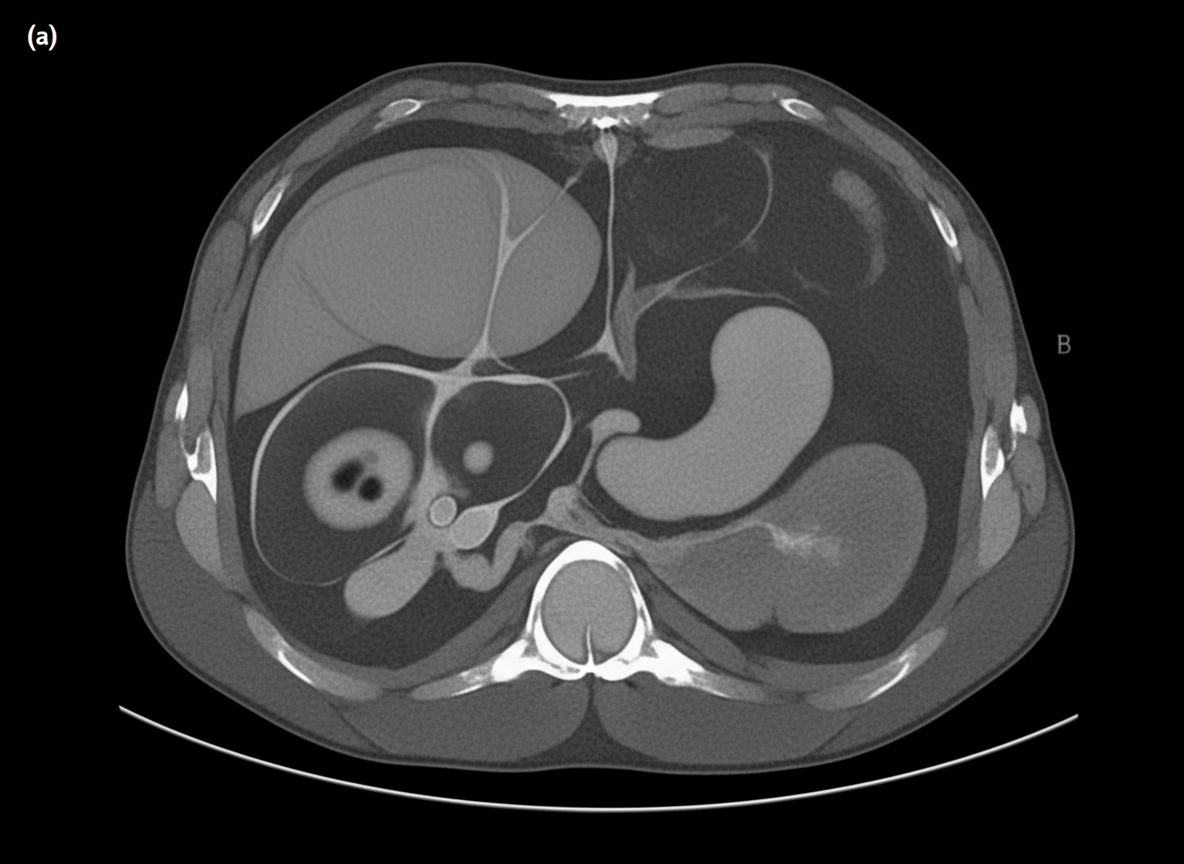
Choledochal cyst develops due to which of the following?
According to the Strasberg classification of bile duct injury, what does type C represent?
What is a cause of acalculous cholecystitis?
Which diagnostic imaging modality is most effective for diagnosing choledocholithiasis (CBD microliths)?
A 43-year-old patient has undergone cholecystectomy and has developed a bile leak. What is the preferred next step?
A 40-year-old patient presents with high-grade fever, right upper quadrant abdominal pain, hepatomegaly, and increased liver dullness on percussion. There is a history of recent travel. What is the most likely clinical diagnosis?
Which of the following is NOT true regarding the prognosis of cholangiocarcinoma?
After exploration of the common bile duct, on which of the following postoperative days is the T-tube typically removed?
What is the true statement regarding the treatment of hepatic amoebiasis?
Which of the following is NOT a feature of choledocholithiasis?
Explanation: **Explanation:** **Choledochal cysts** are rare, **congenital cystic dilatations** of the biliary tree. The most widely accepted theory for their development is the **Babbitt’s Hypothesis**, which suggests an **anomalous pancreaticobiliary ductal junction (APBDJ)**. In this condition, the pancreatic duct joins the common bile duct (CBD) outside the duodenal wall, resulting in a long common channel (>1.5 cm). This allows the reflux of pancreatic enzymes into the biliary tree, causing inflammation, weakening of the ductal wall, and subsequent cystic dilatation. **Analysis of Options:** * **Option C (Correct):** It is a congenital anomaly arising from abnormal embryological development of the pancreaticobiliary system. * **Option A & B (Incorrect):** While stenosis or sphincter dysfunction can cause biliary stasis or proximal dilatation (like in Sphincter of Oddi dysfunction), they do not result in the specific structural cystic malformations defined as choledochal cysts. * **Option D (Incorrect):** Iatrogenic causes refer to injuries during surgery (e.g., cholecystectomy). These lead to biliary strictures or leaks, not congenital cystic dilatations. **NEET-PG High-Yield Pearls:** * **Todani Classification:** The most common type is **Type I** (Saccular or fusiform dilatation of the CBD). **Type V** is known as **Caroli’s Disease** (intrahepatic cysts). * **Clinical Triad:** Jaundice, right upper quadrant pain, and a palpable mass (present in only 20% of cases, mostly children). * **Gold Standard Investigation:** MRCP (Magnetic Resonance Cholangiopancreatography). * **Risk of Malignancy:** There is a high risk of **Cholangiocarcinoma**; therefore, the treatment of choice is complete cyst excision with Roux-en-Y Hepaticojejunostomy.
Explanation: The **Strasberg Classification** is the most widely used system for categorizing laparoscopic bile duct injuries, expanding upon the earlier Bismuth classification to include minor leaks and sectoral injuries. ### **Explanation of the Correct Answer** **Option C** is correct because **Strasberg Type C** specifically refers to a leak from a **transected aberrant (sectoral) right hepatic duct** that is no longer in communication with the Common Bile Duct (CBD). In this scenario, the duct is cut and left open, leading to a persistent intraperitoneal bile leak, but the main biliary tree remains intact. ### **Analysis of Incorrect Options** * **Option A (Type A):** Represents a bile leak from a minor duct (like the cystic duct or Duct of Luschka) that is still **in continuity** with the CBD. This is the most common type of injury. * **Option B (Type B):** Represents the **occlusion** (usually by a clip) of a sectoral/aberrant right hepatic duct. Unlike Type C, there is no leak because the duct is blocked. * **Option D (Types E1-E5):** These represent major circumferential injuries or strictures of the main bile ducts (CBD/CHD), categorized based on their distance from the biliary confluence (Bismuth criteria). ### **NEET-PG High-Yield Pearls** * **Type A:** Most common; usually involves the cystic duct stump. * **Type D:** Lateral wall injury to the CBD (in continuity). * **Type E:** The most severe; involves the main hepatic duct and is subdivided E1 through E5 based on the level of the hilum. * **Management:** Minor leaks (Type A) are often managed with ERCP and stenting, whereas major transections (Type E) usually require surgical reconstruction (Roux-en-Y Hepaticojejunostomy).
Explanation: **Explanation:** Acalculous cholecystitis (AC) is the inflammation of the gallbladder in the absence of gallstones. It typically occurs in critically ill patients due to **gallbladder stasis** and **ischaemia**, leading to bile inspissation (sludge) and subsequent mucosal injury. * **Total Parenteral Nutrition (TPN):** This is a classic cause. TPN leads to a lack of enteral stimulation, which decreases the release of Cholecystokinin (CCK). This results in gallbladder stasis and the formation of thick biliary sludge, which obstructs the cystic duct. * **Diabetes Mellitus:** Diabetic patients are predisposed to AC due to autonomic neuropathy (causing gallbladder dysmotility/stasis) and microangiopathy (causing localized ischaemia). * **Tuberculosis:** While rare, systemic infections like TB or Salmonellosis can cause secondary inflammation of the gallbladder wall or cystic duct lymphadenopathy, leading to acalculous obstruction. **Clinical Pearls for NEET-PG:** * **Risk Factors:** Major trauma, severe burns, prolonged fasting, post-cardiac surgery, and sepsis. * **Pathophysiology:** The "Two-Hit" hypothesis—bile stasis + ischaemia. * **Diagnosis:** Ultrasound is the initial investigation (look for wall thickening >4mm and pericholecystic fluid). **HIDA scan** is the most sensitive imaging modality (shows non-visualization of the gallbladder). * **Management:** In critically ill patients, **percutaneous cholecystostomy** is often the preferred initial treatment over cholecystectomy.
Explanation: **Explanation:** The diagnosis of choledocholithiasis, particularly **microliths** (stones <3 mm), requires high spatial resolution. **Endoscopic Ultrasound (EUS)** is currently considered the most sensitive and specific non-invasive/minimally invasive test for detecting small CBD stones. Because the transducer is placed in the duodenum, directly adjacent to the common bile duct, it eliminates interference from bowel gas and body fat, allowing for the detection of stones as small as 1–2 mm. **Analysis of Options:** * **ERCP (Option A):** While historically the "gold standard," it is now reserved for **therapeutic intervention** rather than diagnosis due to its invasive nature and risk of complications like post-ERCP pancreatitis (5-10%). * **HIDA Scan (Option C):** This is a functional nuclear medicine study. It is the most sensitive test for **Acute Cholecystitis** (demonstrating cystic duct obstruction) but is poor at visualizing specific stones in the CBD. * **CT Scan (Option D):** CT has low sensitivity for gallstones because many stones are iso-attenuating (radiolucent) to bile. It is better suited for detecting complications like pancreatitis or malignancy. **NEET-PG High-Yield Pearls:** * **Best Initial Test** for suspected CBD stones: Transabdominal Ultrasound (often shows ductal dilation but frequently misses the stone itself). * **Most Sensitive Non-invasive Test:** Magnetic Resonance Cholangiopancreatography (MRCP). * **Most Sensitive Overall (especially for microliths):** Endoscopic Ultrasound (EUS). * **Gold Standard for Treatment:** ERCP with sphincterotomy and stone extraction.
Explanation: **Explanation:** Post-cholecystectomy bile leaks typically occur from the cystic duct stump, the Duct of Luschka, or minor injuries to the common bile duct (CBD). **Why ERCP is the Correct Answer:** ERCP (Endoscopic Retrograde Cholangiopancreatography) is the **gold standard** for both the diagnosis and management of post-operative bile leaks. It serves a dual purpose: 1. **Diagnostic:** It identifies the exact site and severity of the leak. 2. **Therapeutic:** By performing a sphincterotomy or placing a biliary stent, ERCP reduces the pressure gradient across the Sphincter of Oddi. This promotes preferential flow of bile into the duodenum rather than through the leak site, allowing the injury to heal spontaneously. **Why Other Options are Incorrect:** * **HIDA Scan:** While highly sensitive for detecting the *presence* of a leak (demonstrated by tracer extravasation), it cannot pinpoint the exact anatomical site or provide treatment. It is often a first-line non-invasive screening tool, but ERCP is the "preferred next step" for definitive management. * **Open CBD Exploration:** This is an invasive surgical procedure. In the modern era, surgery is reserved only for major ductal transections or when endoscopic/percutaneous methods fail. * **Observation:** Bile leaks can lead to biliary peritonitis, sepsis, and electrolyte imbalances. Active intervention is required to drain the collection and stop the leak. **Clinical Pearls for NEET-PG:** * **Most common site of leak:** Cystic duct stump (due to clip displacement or necrosis). * **Initial Investigation of choice (Non-invasive):** MRCP or HIDA scan. * **Definitive Management of choice:** ERCP with stenting. * **Strasberg Classification:** Used to categorize laparoscopic bile duct injuries (Type A is most common, involving the cystic duct or minor ducts).
Explanation: **Explanation:** The clinical presentation of high-grade fever, right upper quadrant (RUQ) pain, and hepatomegaly constitutes the classic triad of a liver abscess. The specific finding of **increased liver dullness on percussion** (upward enlargement of the liver) and a history of **recent travel** (suggesting endemic exposure) strongly point toward **Amoebic Liver Abscess (ALA)**, caused by *Entamoeba histolytica*. * **Why Option B is correct:** ALA is the most common extra-intestinal manifestation of amoebiasis. It typically affects the right lobe of the liver. The "upward" shift of liver dullness occurs because the abscess often pushes the diaphragm superiorly. * **Why Option A is incorrect:** While Pyogenic Liver Abscess (PLA) presents similarly, it is more common in older patients with underlying biliary tract disease or diabetes. ALA is more likely in young-to-middle-aged males with a travel history. * **Why Option B is incorrect:** Hydatid cysts (Echinococcus) are usually slow-growing and asymptomatic unless they rupture or become superinfected. They typically do not present with acute high-grade fever. * **Why Option D is incorrect:** Neoplastic growths (like HCC) usually present with weight loss, chronic malaise, and a hard, nodular liver rather than an acute febrile illness. **High-Yield Clinical Pearls for NEET-PG:** 1. **Anchovy Sauce Pus:** The characteristic aspirate of ALA (sterile, odorless, chocolate-colored). 2. **Investigation of Choice:** Contrast-Enhanced CT (CECT) or Ultrasound. 3. **Serology:** The most sensitive test for ALA is the Amoebic Serology (IHA/ELISA). 4. **Management:** Drug of choice is **Metronidazole**. Aspiration is only indicated if the abscess is large (>10cm), at risk of rupture (left lobe), or fails to respond to medical therapy.
Explanation: **Explanation:** The prognosis of cholangiocarcinoma is heavily influenced by its morphological growth pattern. **1. Why Option A is the correct answer (The False Statement):** In cholangiocarcinoma, the **papillary type** has a significantly **better prognosis** than the scirrhous (nodular/infiltrative) type. Papillary tumors tend to grow intraluminally, are often diagnosed earlier due to obstructive symptoms, and have a lower incidence of lymph node metastasis and vascular invasion compared to the scirrhous type, which is characterized by dense fibrosis and early transmural spread. **2. Analysis of other options:** * **Option B:** Margin status (R0 vs. R1/R2 resection) and TNM stage (especially lymph node involvement) are the most critical predictors of long-term survival. * **Option C:** Simple bile duct resection is rarely sufficient because these tumors exhibit significant submucosal extension. High recurrence rates occur if wide margins are not achieved. * **Option D:** For Hilar Cholangiocarcinoma (Klatskin tumors), the standard of care for cure is an aggressive "en-bloc" resection including the involved bile duct, major hepatic resection (usually a hemihepatectomy), and regional lymphadenectomy to ensure R0 margins. **Clinical Pearls for NEET-PG:** * **Most common site:** Perihilar (Klatskin tumor), located at the confluence of the hepatic ducts. * **Bismuth-Corlette Classification** is used to categorize the anatomical extent of hilar tumors. * **Risk Factors:** Primary Sclerosing Cholangitis (most common in West), *Clonorchis sinensis* (liver fluke), and Choledochal cysts. * **Tumor Marker:** CA 19-9 is the most commonly used marker for monitoring.
Explanation: ### Explanation **Correct Answer: C. 12th postoperative day** The primary purpose of a T-tube after Common Bile Duct (CBD) exploration is to provide external drainage of bile while the inflammatory edema of the Sphincter of Oddi subsides, ensuring the duct remains decompressed. **Why 12 days?** The T-tube is removed only after a **fibrous tract** has formed around the tube. This tract prevents bile from leaking into the peritoneal cavity (biliary peritonitis) once the tube is pulled. In a healthy individual, it takes approximately **10 to 14 days** for this tract to become sufficiently mature. Therefore, the 12th postoperative day is the standard clinical window for removal. **Analysis of Incorrect Options:** * **A, B, and D (3rd, 4th, and 6th days):** These timeframes are too early. Removing the T-tube within the first week carries a high risk of bile leak because the granulation tissue has not yet organized into a solid tract. **Clinical Pearls for NEET-PG:** 1. **Prerequisite for Removal:** Before removal, a **T-tube Cholangiogram** (usually done on Day 7–10) is mandatory. It must show: * Free flow of dye into the duodenum. * No retained stones in the CBD. 2. **Clamping Test:** Before removal, the tube is clamped for 24 hours. If the patient develops pain, fever, or jaundice, it suggests distal obstruction (e.g., a retained stone), and the tube should not be removed. 3. **Delayed Removal:** In patients on steroids, those with malnutrition, or uncontrolled diabetes, tract formation is delayed; removal should be postponed to **3–4 weeks**. 4. **Indication:** The most common reason for T-tube insertion is to prevent bile stasis and monitor the duct after a choledochotomy.
Explanation: **Explanation:** Amoebic Liver Abscess (ALA), caused by *Entamoeba histolytica*, is the most common extra-intestinal manifestation of amoebiasis. **Why Option C is correct:** The mainstay of treatment for ALA is **medical management**. Over 90-95% of patients respond dramatically to nitroimidazoles (e.g., **Metronidazole** 750 mg TID for 7-10 days). Surgical intervention or aspiration is rarely required and is reserved for specific complications like imminent rupture, lack of clinical response within 48-72 hours, or very large left-lobe abscesses. **Why other options are incorrect:** * **Option A:** ALA is significantly **more common in males** (ratio approx. 10:1), likely due to the protective effect of menstrual blood loss (iron deficiency inhibits amoebic growth) and higher alcohol consumption in men. * **Option B:** In approximately 70-80% of cases, ALA presents as a **solitary lesion**, most commonly located in the **right lobe** (posterosuperior segment) due to the bulk of the liver and the streaming effect of portal blood flow. * **Option C:** Jaundice is **uncommon** in uncomplicated ALA. If present, it usually indicates a massive abscess compressing the biliary tree or secondary bacterial infection. **Clinical Pearls for NEET-PG:** * **Classic Presentation:** Fever with right upper quadrant pain and "anchovy sauce" (chocolate brown) pus on aspiration. * **Diagnosis:** Ultrasound is the initial investigation; Serology (IHA/ELISA) is highly sensitive. * **Indications for Aspiration:** Large size (>10 cm), failure of medical therapy, left lobe abscess (risk of rupture into the pericardium), or to rule out a pyogenic abscess.
Explanation: **Explanation:** Choledocholithiasis refers to the presence of gallstones within the Common Bile Duct (CBD). The clinical presentation of this condition is classically defined by **Charcot’s Triad**, which consists of **Pain, Fever, and Jaundice**. 1. **Why "None of the above" is correct:** The question asks which feature is *NOT* a feature of choledocholithiasis. Since Pain (A), Fever (B), and Jaundice (C) are the three hallmark clinical manifestations of symptomatic CBD stones, all listed options are indeed features of the disease. Therefore, none of them can be excluded. 2. **Analysis of Options:** * **Pain (A):** Typically manifests as biliary colic or epigastric pain. It occurs due to increased intraductal pressure and smooth muscle contraction against the obstruction. * **Fever (B):** Indicates the development of **ascending cholangitis** (infection of the bile duct) due to stasis caused by the stone. * **Jaundice (C):** Obstructive jaundice occurs when the stone blocks the flow of conjugated bilirubin into the duodenum, leading to its regurgitation into the bloodstream. **High-Yield Clinical Pearls for NEET-PG:** * **Charcot’s Triad:** Pain + Fever + Jaundice (seen in 50-70% of cases of acute cholangitis). * **Reynold’s Pentad:** Charcot’s Triad + Hypotension (Shock) + Altered Mental Status. This indicates a surgical emergency (suppurative cholangitis). * **Gold Standard Investigation:** MRCP (Non-invasive) or ERCP (Invasive/Therapeutic). * **Courvoisier’s Law:** In the presence of jaundice, a palpable gallbladder is usually NOT due to gallstones (as the gallbladder is often fibrotic), but rather due to malignant obstruction (e.g., Periampullary carcinoma).
Liver Anatomy and Physiology
Practice Questions
Benign Liver Lesions
Practice Questions
Liver Abscess
Practice Questions
Hepatocellular Carcinoma
Practice Questions
Metastatic Liver Disease
Practice Questions
Cirrhosis and Portal Hypertension
Practice Questions
Liver Trauma
Practice Questions
Cholelithiasis and Cholecystitis
Practice Questions
Choledocholithiasis
Practice Questions
Biliary Tract Tumors
Practice Questions
ERCP and Its Complications
Practice Questions
Liver Transplantation Basics
Practice Questions
Get full access to all questions, explanations, and performance tracking.
Start For Free