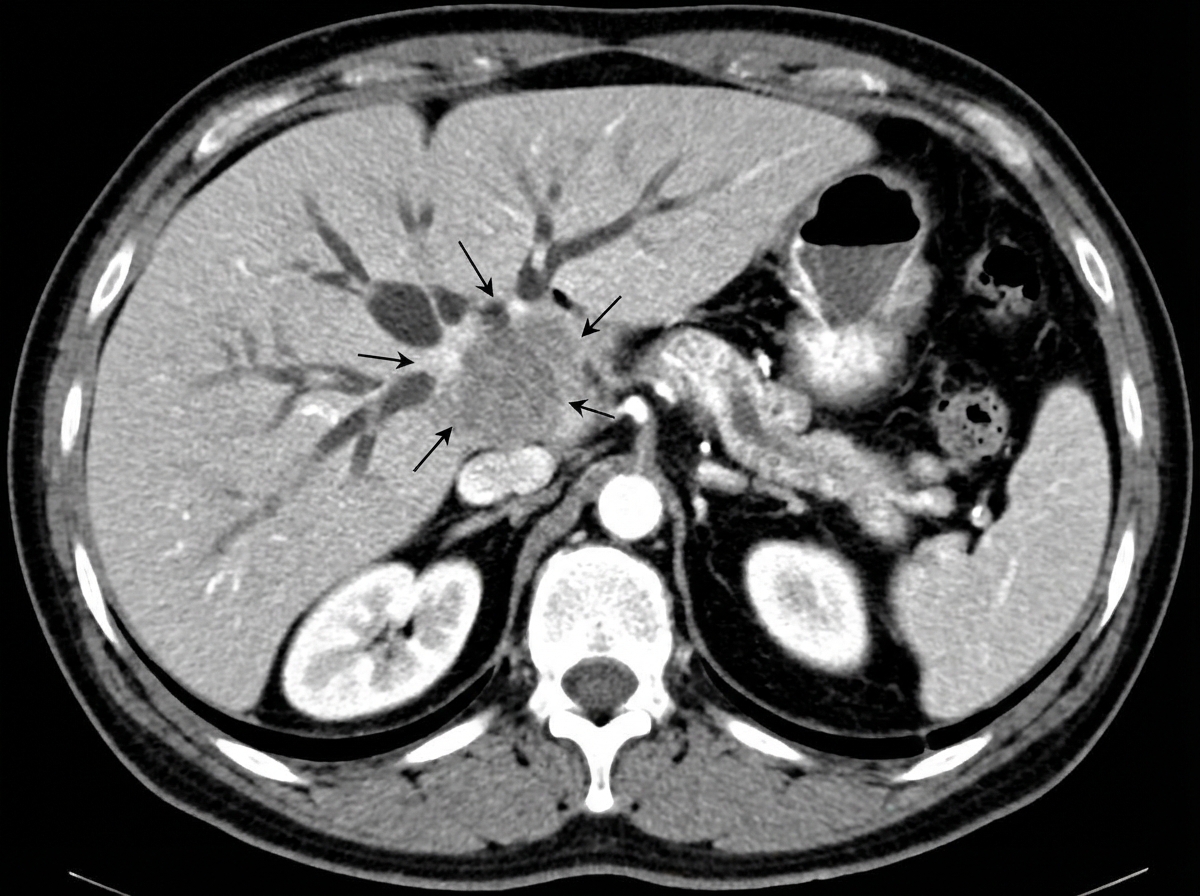
A 45-year-old female patient presents for a regular health checkup. Ultrasound reveals gallstones. She has a family history of gallstones. What is the most appropriate treatment option?
A patient with symptomatic gallstone disease undergoes laparoscopic cholecystectomy. Histopathology reveals T2 adenocarcinoma of the gallbladder. What is the recommended next line of treatment?
Which is the most common cause of liver abscess in adults?
Medical management of hydatid disease is indicated in which of the following situations?
In case of choledochal cyst, bile diversion into the small intestine is not done because of the risk of?
Which of the following statements about hydatid cyst of the liver is false?
A patient with a post-cholecystectomy biliary stricture underwent ERCP three days ago and subsequently developed acute cholangitis. Which of the following is the most likely organism causing acute cholangitis?
What is the primary source of 'stas' (stasis) in an antegrade cholecystectomy?
What is the best investigation for the diagnosis of an ampullary gallstone causing obstructive jaundice?
Which of the following is NOT a risk factor for carcinoma of the gallbladder?
Explanation: **Explanation:** The core clinical dilemma in this question is the management of **asymptomatic gallstones (silent stones)**. While the standard teaching is that asymptomatic gallstones do not require surgery, there are specific high-yield exceptions where prophylactic cholecystectomy is indicated. **Why Cholecystectomy is Correct:** In this patient, the presence of a **family history of gallstones** (especially if associated with gallbladder carcinoma) or specific risk factors necessitates surgical intervention. In the context of NEET-PG, prophylactic cholecystectomy is indicated for asymptomatic stones in the following scenarios: 1. **Gallbladder wall calcification (Porcelain Gallbladder):** High risk of malignancy. 2. **Large stones (>3 cm):** Increased risk of gallbladder cancer. 3. **Stones associated with gallbladder polyps (>10 mm).** 4. **Congenital hemolytic anemias** (e.g., Hereditary Spherocytosis) to prevent future pigment stone complications. 5. **Anomalous pancreaticobiliary ductal union.** 6. **Family history of Gallbladder Cancer.** **Why other options are incorrect:** * **Conservative management:** Usually the treatment of choice for truly asymptomatic patients without risk factors. However, given the options and the specific mention of family history, the examiner is testing the indications for surgery. * **Antibiotics alone:** These are used for acute cholecystitis (inflammation), not for the management of asymptomatic stones. * **Tube cholecystectomy (Cholecystostomy):** This is a temporizing procedure reserved for critically ill patients with acute cholecystitis who are unfit for definitive surgery. **NEET-PG High-Yield Pearls:** * **Gold Standard Investigation:** Ultrasound (USG) is the initial and best investigation for gallstones (sensitivity >95%). * **Most common type of stone:** Cholesterol stones (Western world); Pigment stones (common in Asia/hemolysis). * **Saint’s Triad:** Gallstones, Diverticulosis, and Hiatus Hernia. * **Treatment of choice:** Laparoscopic Cholecystectomy is the gold standard for symptomatic cholelithiasis.
Explanation: **Explanation:** The management of incidentally discovered gallbladder cancer (GBC) depends entirely on the **T-stage** determined by histopathology. **1. Why Option C is Correct:** For **T2 tumors** (invasion into the perimuscular connective tissue), a simple cholecystectomy is oncologically inadequate. The standard of care is a **Radical Cholecystectomy**. This involves: * **Liver Resection:** Formal resection of **Segments IVb and V** (the gallbladder bed) to ensure clear parenchymal margins. * **Lymphadenectomy:** Clearance of cystic, pericholedochal, and hilar lymph nodes (N1 nodes). * **Port Site Excision:** Historically recommended to prevent seeding, though its routine use is now debated, it remains a standard textbook answer for NEET-PG. **2. Why Other Options are Incorrect:** * **Option A (Observation):** Only appropriate for **T1a** tumors (limited to the lamina propria), where simple cholecystectomy is curative. * **Option B & D (Wedge Excision):** While a 2-cm wedge excision was previously common, anatomical resection of **Segments IVb and V** is now preferred as it provides better oncological clearance of the venous drainage of the gallbladder. Option D also misses port site excision. **Clinical Pearls for NEET-PG:** * **T1a:** Simple Cholecystectomy is sufficient. * **T1b, T2, T3:** Radical Cholecystectomy (Segments IVb/V resection + Lymphadenectomy). * **Most common site of GBC:** Fundus. * **Most common histological type:** Adenocarcinoma. * **Nodal Clearance:** Should include at least 6 lymph nodes for accurate staging. * **Contraindication to Radical Surgery:** Presence of distant metastasis (M1) or extensive N2 nodal involvement (e.g., para-aortic).
Explanation: **Explanation:** Pyogenic liver abscess (PLA) is the most common type of liver abscess in developed countries and among adults. The liver receives blood from both the systemic circulation (via the hepatic artery) and the mesenteric circulation (via the portal vein). **1. Why Escherichia coli is correct:** The most common route of infection for a pyogenic liver abscess is the **biliary tract** (ascending cholangitis due to stones or strictures), followed by **portal vein seeding** (pylephlebitis) from intra-abdominal infections like appendicitis or diverticulitis. Since these sources are predominantly colonized by enteric flora, **Gram-negative aerobes** are the most frequent isolates. **Escherichia coli** is the single most common organism isolated globally. However, it is important to note that many abscesses are polymicrobial, often involving *Klebsiella pneumoniae* and *Bacteroides*. **2. Why the other options are incorrect:** * **Streptococcus pyogenes & Staphylococcus aureus:** These are Gram-positive organisms typically associated with **hematogenous spread** via the hepatic artery (e.g., from endocarditis or skin infections). While common in the pediatric population or in cases of sepsis, they are less frequent causes in adults compared to enteric organisms. * **Proteus:** While *Proteus* species are enteric organisms and can cause liver abscesses, they are significantly less common than *E. coli*. **Clinical Pearls for NEET-PG:** * **Most common route:** Biliary tract (Ascending cholangitis). * **Most common organism (Global/Adults):** *Escherichia coli*. * **Emerging Trend:** *Klebsiella pneumoniae* is now the leading cause in Southeast Asia and is associated with "Invasive Liver Abscess Syndrome" (metastatic endophthalmitis). * **Triad:** Charcot’s triad (Fever, Jaundice, RUQ pain) is seen if the cause is biliary. * **Investigation of choice:** Contrast-Enhanced CT (CECT). * **Management:** Percutaneous drainage + Antibiotics (Metronidazole + 3rd Gen Cephalosporin).
Explanation: **Explanation:** The medical management of hydatid disease (caused by *Echinococcus granulosus*) primarily involves the use of benzimidazoles, such as **Albendazole**. **Why Option D is Correct:** Medical therapy is the treatment of choice for **multiple peritoneal cysts** and disseminated disease where surgical intervention is technically difficult or carries a high risk of recurrence. It is also indicated for small, deep-seated cysts, patients with multiple cysts in multiple organs, and as a perioperative adjunct to prevent secondary hydatidosis due to intraoperative spillage. **Why Other Options are Incorrect:** * **A. Pregnancy:** Albendazole is **teratogenic** (Category D) and is generally contraindicated during the first trimester of pregnancy. * **B. Infected Hydatid Cyst:** An infected cyst mimics a pyogenic liver abscess. Medical therapy alone is insufficient; these require **surgical drainage** or percutaneous intervention along with antibiotics. * **C. Moribund Patients:** In extremely unstable or moribund patients, active treatment (medical or surgical) may be deferred in favor of palliative care, or if the cyst is inactive (WHO Stage CE4/CE5), a "watch and wait" approach is adopted. **High-Yield Clinical Pearls for NEET-PG:** * **Drug of Choice:** Albendazole (10–15 mg/kg/day). It is superior to Mebendazole due to better systemic absorption. * **PAIR Technique:** (Puncture, Aspiration, Injection, Re-aspiration) is indicated for type CE1 and CE3a cysts >5 cm. It is contraindicated for superficial cysts (risk of rupture) and biliary communications. * **WHO Classification:** Remember that **CE4 and CE5** are inactive/calcified cysts and generally do not require medical or surgical treatment. * **Scolicidal Agents:** Hypertonic saline (20%) is the most commonly used agent during surgery to kill the protoscolices.
Explanation: **Explanation:** The management of choledochal cysts has evolved significantly. Historically, **internal drainage** (cystoenterostomy), where the cyst was left in situ and connected directly to the small intestine, was practiced. However, this is now **strictly contraindicated**. **1. Why Recurrent Cholangitis is the Correct Answer:** When a cyst is diverted into the small intestine without being excised, it creates a "stagnant pool" of bile. The wide anastomosis allows for the **reflux of enteric contents and bacteria** into the dilated, non-contractile cyst. This leads to stasis, bacterial overgrowth, and stone formation, resulting in **recurrent bouts of ascending cholangitis**. This is the most immediate and frequent complication of simple diversion procedures. **2. Analysis of Other Options:** * **Malignancy (Option A):** While leaving the cyst wall in situ carries a long-term risk of **cholangiocarcinoma** (due to chronic inflammation and exposure to mutagenic bile), the primary reason diversion is avoided in clinical practice is the immediate morbidity associated with infection/cholangitis. * **Pancreatitis (Option B):** Pancreatitis in choledochal cysts is usually due to an **Anomalous Pancreaticobiliary Duct Junction (APBDJ)**. While diversion doesn't fix this, it is not the primary reason the procedure is avoided compared to the risk of sepsis. **3. High-Yield Clinical Pearls for NEET-PG:** * **Standard of Care:** The current gold standard is **Complete Cyst Excision** followed by biliary reconstruction via **Roux-en-Y Hepaticojejunostomy**. * **Todani Classification:** Type I (Saccular/Fusiform) is the most common; Type V is Caroli’s Disease. * **Triad:** The classic triad (seen in only 20% of cases) includes abdominal pain, jaundice, and a palpable right upper quadrant mass. * **Malignancy Risk:** The risk of cancer increases with age; hence, early excision is mandatory.
Explanation: ### Explanation **1. Why Option B is the Correct Answer (False Statement):** Casoni’s test is an immediate hypersensitivity skin test that was historically used for diagnosing hydatid disease. However, it is **no longer the investigation of choice** due to its low sensitivity (60-90%) and poor specificity (frequent cross-reactivity with other helminths). In modern practice, the **Investigation of Choice is Ultrasonography (USG)**, which allows for Gharbi/WHO classification. For screening and confirmation, **ELISA (Serology)** is the preferred immunological test due to its high sensitivity. **2. Analysis of Other Options:** * **Option A:** *Echinococcus granulosus* (dog tapeworm) is indeed the most common cause of cystic echinococcosis worldwide. *E. multilocularis* causes the rarer, more aggressive alveolar form. * **Option C:** Albendazole is the primary medical treatment. It acts as a scolicidal agent by inhibiting microtubule synthesis in the parasite, leading to its death. It is often given perioperatively to reduce the risk of secondary hydatidosis from accidental spillage. * **Option D:** PAIR is a minimally invasive procedure indicated for active cysts (WHO Class CE1 and CE3a) that are typically **>5 cm** in diameter or in patients who are poor surgical candidates. **3. High-Yield Clinical Pearls for NEET-PG:** * **Gold Standard Imaging:** Contrast-Enhanced CT (CECT) is the most accurate for detecting daughter cysts and "Water Lily sign" (detached endocyst). * **Surgical Safety:** During surgery, scolicidal agents like **Hypertonic saline (20%)** or **Povidone-iodine** are used to pack the area to prevent anaphylaxis and recurrence. * **Contraindication for PAIR:** Never perform PAIR on superficial cysts (risk of rupture) or inactive/calcified cysts (CE4/CE5). * **Pathognomonic sign:** Presence of "Hydatid sand" (hooklets and scolices) in the aspirated fluid.
Explanation: **Explanation:** Acute cholangitis is a clinical syndrome characterized by inflammation and infection of the bile ducts, typically occurring due to a combination of **biliary obstruction** (in this case, a post-cholecystectomy stricture) and the **presence of bacteria** in the bile (bactibilia). **1. Why Escherichia coli is correct:** The biliary tract is normally sterile. However, when obstruction occurs, bacteria often ascend from the duodenum. **Escherichia coli** is the most common organism isolated from bile in patients with acute cholangitis (found in 25–50% of cases). It is a Gram-negative aerobe that thrives in the enteric environment. Other common isolates include *Klebsiella* and *Enterococcus*. **2. Analysis of Incorrect Options:** * **Bacillus fragilis (Bacteroides fragilis):** While anaerobic bacteria are often present in polymicrobial biliary infections (especially in patients with prior biliary-enteric anastomoses), they are rarely the primary or most common isolate compared to *E. coli*. * **Streptococcus viridans:** These are commensals of the oral cavity and are rarely implicated in primary biliary tract infections. * **Pseudomonas aeruginosa:** This is typically a healthcare-associated (nosocomial) pathogen. While it can occur after instrumentation like ERCP, it is significantly less common than *E. coli*. **Clinical Pearls for NEET-PG:** * **Charcot’s Triad:** Fever, Jaundice, and Right Upper Quadrant (RUQ) pain. * **Reynold’s Pentad:** Charcot’s Triad + Hypotension + Altered Mental Status (indicates obstructive suppurative cholangitis). * **Management:** The priority is **biliary decompression** (via ERCP or PTC) and intravenous antibiotics. * **Most common Gram-positive isolate:** *Enterococcus* species. * **Most common Anaerobe isolate:** *Bacteroides fragilis*.
Explanation: **Explanation:** In an **antegrade cholecystectomy** (also known as the "fundus-first" or "top-down" approach), the gallbladder is dissected starting from the fundus and moving toward the cystic duct and artery. This is the opposite of the standard retrograde (Calot’s triangle first) approach. **Why Option A is correct:** The term "stasis" in this surgical context refers to the **point of origin or the initiation of the dissection**. In an antegrade procedure, the surgeon begins by mobilizing the gallbladder from its liver bed starting at the **fundus**. This approach is typically reserved for cases where severe inflammation, dense adhesions, or a "frozen porta hepatis" make the safe identification of the cystic duct and artery at Calot’s triangle impossible. **Analysis of Incorrect Options:** * **Option B & C:** In a standard retrograde cholecystectomy, the "stasis" or starting point is the identification of the cystic duct and hilar structures. In the antegrade method, these are the *final* structures addressed to avoid accidental injury to the common bile duct (CBD) when anatomy is obscured. * **Option D:** While the retrograde approach is the "Gold Standard" because it allows for early vascular control, the antegrade approach is **not** considered unsafe. In fact, it is a recognized "bail-out" technique used to increase safety when the anatomy at the cystic pedicle is distorted. **NEET-PG High-Yield Pearls:** * **Retrograde Cholecystectomy:** Standard technique; dissection starts at Calot’s triangle. * **Antegrade (Fundus-first):** Used in difficult gallbladders to prevent CBD injury. * **Critical View of Safety (CVS):** The goal of dissection, requiring the lower third of the gallbladder to be separated from the liver and only two structures (cystic duct and artery) to be seen entering the gallbladder. * **Rouviere’s Sulcus:** An important landmark on the liver surface used to identify the plane of the CBD and prevent bile duct injury.
Explanation: ### Explanation **Correct Answer: D. Endoscopic retrograde cholangiopancreatography (ERCP)** **Why it is the correct answer:** ERCP is considered the gold standard for diagnosing and managing ampullary or common bile duct (CBD) stones. In the context of obstructive jaundice caused by an ampullary stone, ERCP provides direct visualization of the ampulla of Vater and allows for a retrograde injection of contrast to delineate the biliary anatomy. Its primary advantage is that it is both **diagnostic and therapeutic**; once the stone is identified, a sphincterotomy can be performed followed by stone extraction (using a Dormia basket or balloon). **Why the other options are incorrect:** * **A & B (Intravenous and Oral Cholecystography):** These are largely obsolete historical tests. They rely on the liver's ability to excrete contrast into the bile. In the presence of obstructive jaundice (bilirubin >2–3 mg/dL), the liver cannot excrete the contrast effectively, making these tests useless for diagnosis. * **C (Percutaneous Transhepatic Cholangiography - PTC):** PTC involves needle puncture through the liver into the biliary tree. While useful for proximal (hilar) obstructions, it is more invasive than ERCP and carries a higher risk of bile leak and hemorrhage. It is generally reserved for cases where ERCP is technically impossible (e.g., altered gastric anatomy). **Clinical Pearls for NEET-PG:** * **Initial Investigation of Choice:** For any suspected obstructive jaundice, the first-line investigation is always an **Ultrasound (USG) abdomen** to look for ductal dilatation. * **Most Sensitive Non-invasive Test:** **MRCP** is the most sensitive diagnostic tool for CBD stones but lacks therapeutic capability. * **Gold Standard:** ERCP remains the gold standard for distal biliary obstructions due to its therapeutic potential. * **Charcot’s Triad:** Fever, jaundice, and RUQ pain suggest ascending cholangitis, a surgical emergency often requiring urgent ERCP.
Explanation: **Explanation** The correct answer is **C (Multiple 2cm gallstones)**. While cholelithiasis is the most common risk factor for gallbladder carcinoma (GBC), the risk is directly proportional to the **size** of the stones, not necessarily the number. Stones larger than **3 cm** increase the risk of GBC by 10-fold compared to smaller stones. Therefore, 2 cm stones, while significant, do not carry the same high-risk threshold as the other options listed. **Analysis of Incorrect Options:** * **Primary Sclerosing Cholangitis (PSC):** PSC is a well-established risk factor for both cholangiocarcinoma and gallbladder cancer. Patients with PSC and gallbladder polyps of any size are usually recommended for cholecystectomy due to high malignancy risk. * **Porcelain Gallbladder:** This refers to intramural calcification of the gallbladder wall. Historically cited as having a 25% risk, modern studies suggest a lower but still significant risk (approx. 7-15%), particularly when the calcification is selective or punctate. * **Choledochal Cyst:** Congenital biliary cysts (especially Type I and IV) are associated with an anomalous pancreaticobiliary ductal junction (APBDJ). This leads to the reflux of pancreatic enzymes, causing chronic inflammation and a significantly higher incidence of biliary tract cancers. **High-Yield Clinical Pearls for NEET-PG:** * **Most common risk factor for GBC:** Cholelithiasis (present in 70-90% of cases). * **Size Threshold:** Gallstones **>3 cm** and gallbladder polyps **>1 cm** are definitive indications for prophylactic cholecystectomy to prevent GBC. * **Salmonella typhi:** Chronic carriers of *S. typhi* have a significantly increased risk of GBC. * **Demographics:** GBC is more common in females (3:1) and shows high prevalence in North India (Gangetic plains).
Liver Anatomy and Physiology
Practice Questions
Benign Liver Lesions
Practice Questions
Liver Abscess
Practice Questions
Hepatocellular Carcinoma
Practice Questions
Metastatic Liver Disease
Practice Questions
Cirrhosis and Portal Hypertension
Practice Questions
Liver Trauma
Practice Questions
Cholelithiasis and Cholecystitis
Practice Questions
Choledocholithiasis
Practice Questions
Biliary Tract Tumors
Practice Questions
ERCP and Its Complications
Practice Questions
Liver Transplantation Basics
Practice Questions
Get full access to all questions, explanations, and performance tracking.
Start For Free