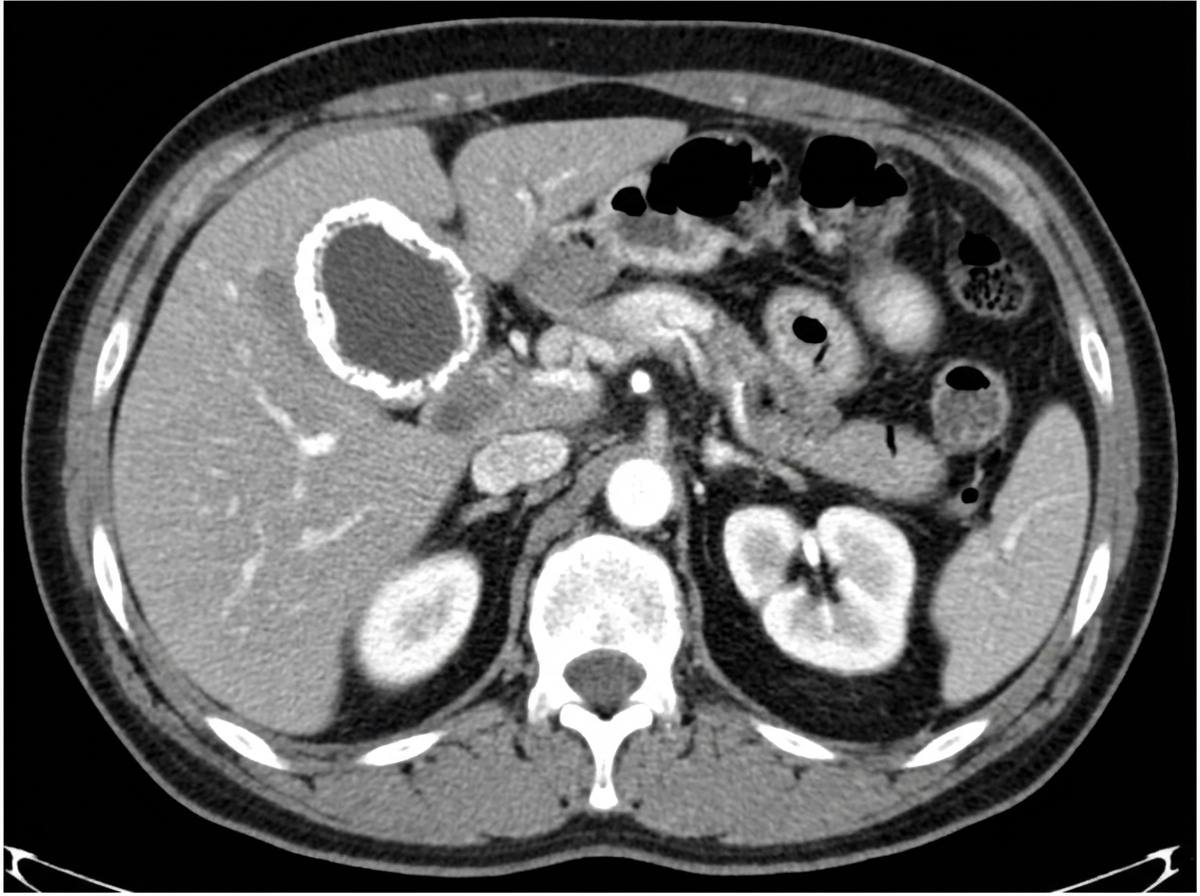
What is the most common type of choledochal cyst?
What is true about simple hepatic cysts?
What is the most common type of gallbladder cancer associated with gallstones?
A 23-year-old male has presented with repeated episodes of hematemesis. There is no history of jaundice or liver decompensation. On examination, significant findings include splenomegaly (8 cm below costal margin) and the presence of esophageal varices. There is no ascites or peptic ulceration. The liver function tests are normal. What is the most likely diagnosis?
The origin of Klatskin tumors is from which anatomical location?
An otherwise normal female presents with symptoms of flatulent dyspepsia. She was started on proton pump inhibitors, which controlled her symptoms. What is the next step in the management of this condition?
Child's criteria is used in which of the following conditions?
In Bouveret syndrome, a gallstone is impacted in which part of the gastrointestinal tract?
A 45-year-old patient presents with acute cholecystitis. Blood investigations showed raised bilirubin. The pain resolved over the period, but the raised bilirubin persisted. ERCP showed a cholecystocholedochal fistula. What is the probable diagnosis?
Which of the following segments are not removed in right hepatectomy?
Explanation: **Explanation:** Choledochal cysts are congenital cystic dilatations of the biliary tree. The most widely used classification system is the **Todani Classification**, which categorizes these cysts into five types based on their location and morphology. **Correct Answer: Type 1** * **Type 1 (Fusiform/Saccular):** This involves the cystic dilatation of the extrahepatic bile duct. It is the **most common type**, accounting for approximately **75–85%** of all cases. It is further subdivided into 1a (diffuse), 1b (focal), and 1c (fusiform). The underlying pathophysiology is often linked to an "Anomalous Pancreaticobiliary Duct Junction" (APBDJ), leading to the reflux of pancreatic enzymes into the bile duct. **Incorrect Options:** * **Type 2 (Diverticulum):** Represents a true diverticulum protruding from the common bile duct wall. It is very rare (approx. 2–3%). * **Type 3 (Choledochocele):** A cystic dilatation of the intraduodenal portion of the distal common bile duct. It often presents with pancreatitis. * **Type 4 (Multiple cysts):** The second most common type. **Type 4a** involves both intrahepatic and extrahepatic ducts, while **Type 4b** involves multiple extrahepatic cysts only. **High-Yield Clinical Pearls for NEET-PG:** * **Classic Triad:** Jaundice, right upper quadrant pain, and a palpable mass (present in only 20% of cases, mostly children). * **Gold Standard Investigation:** MRCP is the diagnostic tool of choice. * **Malignancy Risk:** The most feared complication is **Cholangiocarcinoma**. Due to this risk, the surgical treatment of choice for Type 1 is **complete cyst excision** with Roux-en-Y Hepaticojejunostomy. * **Caroli’s Disease:** This is **Type 5**, characterized by multiple *intrahepatic* ductal dilatations. If associated with congenital hepatic fibrosis, it is called Caroli’s Syndrome.
Explanation: **Explanation:** Simple hepatic cysts are benign, fluid-filled lesions of the liver. While often incidental, their management and pathology are high-yield topics for NEET-PG. **Why Option C is Correct:** While most simple cysts are stable, **intracystic hemorrhage** is a recognized complication that leads to sudden-onset right upper quadrant pain. When a simple cyst becomes symptomatic (due to bleeding, rupture, or mass effect), surgical intervention is required. **Laparoscopic deroofing** (unroofing) is the gold standard treatment because it has a lower recurrence rate compared to simple aspiration. **Analysis of Incorrect Options:** * **Option A:** While many are asymptomatic, the question asks for the "true" statement in a clinical context where complications are being highlighted. (Note: In many textbooks, "typically asymptomatic" is true, but in the context of surgical management questions, the necessity of deroofing for complications is a primary focus). * **Option B:** Simple hepatic cysts are lined by a **single layer of cuboidal or flattened biliary-type epithelium**, not columnar epithelium. Columnar epithelium is more characteristic of biliary cystadenomas. * **Option D:** Simple cysts are generally considered **acquired** rather than congenital, likely arising from aberrant bile ductules that have lost connection to the biliary tree. **Clinical Pearls for NEET-PG:** * **Diagnosis:** Ultrasound is the first-line investigation (shows anechoic, thin-walled lesions with posterior acoustic enhancement). * **Management:** Asymptomatic cysts require **no treatment**. * **Differentiating Feature:** Unlike Hydatid cysts, simple cysts do not have a pericyst/ectocyst and have negative serology. * **Aspiration:** Simple needle aspiration is associated with nearly **100% recurrence**; hence, deroofing or sclerotherapy (using alcohol) is preferred for symptomatic cases.
Explanation: **Explanation:** **1. Why Adenocarcinoma is Correct:** Adenocarcinoma is the most common histological type of gallbladder cancer, accounting for approximately **90-95%** of all cases. Gallbladder cancer is strongly associated with chronic inflammation, most frequently caused by **gallstones (cholelithiasis)**, which are present in 70-90% of patients. The chronic irritation of the gallbladder mucosa by stones leads to glandular metaplasia and dysplasia, eventually progressing to adenocarcinoma. **2. Why Other Options are Incorrect:** * **Anaplastic Carcinoma:** This is a rare, highly aggressive variant (approx. 2-7%) characterized by rapid growth and a very poor prognosis. * **Squamous Cell Carcinoma:** Pure squamous cell carcinoma is rare (approx. 1-2%). While it can be associated with stones, it is significantly less common than adenocarcinoma. * **Transitional Cell Carcinoma:** This type is extremely rare in the gallbladder as the organ is lined by columnar epithelium, not transitional epithelium (urothelium). **3. Clinical Pearls for NEET-PG:** * **Risk Factors:** Gallstones (especially >3cm), Porcelain gallbladder (intramural calcification), and Choledochal cysts. * **Nevin Staging & TNM:** Most common site of metastasis is the **liver** (direct extension). * **Demographics:** Most common in elderly females (F:M ratio 3:1); high incidence in North India (Gangetic belt). * **Tumor Marker:** **CA 19-9** is frequently elevated. * **Treatment:** Simple cholecystectomy for T1a; Radical cholecystectomy (wedge resection of liver bed + lymphadenectomy) for T1b and above.
Explanation: ### Explanation The clinical presentation of a young patient with **recurrent hematemesis, massive splenomegaly, and esophageal varices** in the presence of **normal liver function tests (LFTs)** and no history of jaundice or ascites points toward **Pre-sinusoidal Portal Hypertension**. #### Why Non-cirrhotic Portal Fibrosis (NCPF) is Correct: NCPF is a common cause of portal hypertension in developing countries like India. It is characterized by **obliterative venopathy** of the intrahepatic portal vein branches. * **Key features:** Preserved liver function (normal LFTs), absence of cirrhosis (no stigmata of chronic liver disease), and massive splenomegaly. * **Clinical Clue:** Patients typically present with well-tolerated upper GI bleeds because their liver function is excellent, unlike cirrhotic patients who decompensate after a bleed. #### Why Other Options are Incorrect: * **Extrahepatic Portal Venous Obstruction (EHPVO):** While EHPVO also presents with pre-sinusoidal portal hypertension and normal LFTs, it is most common in **children** and often associated with a history of neonatal umbilical sepsis. Imaging would show a "Portal Cavernoma," which is not mentioned here. * **Cirrhosis:** This is ruled out by the **normal LFTs** and the absence of jaundice, ascites, or stigmata of liver failure (e.g., spider nevi, caput medusae). * **Hepatic Venous Outflow Tract Obstruction (Budd-Chiari Syndrome):** This is a **post-sinusoidal** cause. It typically presents with a triad of abdominal pain, hepatomegaly, and **ascites**. LFTs are usually deranged. #### NEET-PG High-Yield Pearls: * **NCPF vs. EHPVO:** In NCPF, the portal vein is patent but shows intrahepatic branch sclerosis. In EHPVO, the main portal vein is thrombosed/replaced by a cavernoma. * **Schistosomiasis:** The most common cause of pre-sinusoidal portal hypertension worldwide (though NCPF is more common in India). * **Management:** Since liver function is preserved, these patients have a much better prognosis than cirrhotics and respond well to endoscopic variceal ligation (EVL) or proximal splenorenal shunts (PSRS).
Explanation: ### Explanation **Correct Answer: D. Confluence of right and left hepatic ducts** **1. Understanding Klatskin Tumors** A Klatskin tumor is a specific type of **Hilar Cholangiocarcinoma**. By definition, it is an adenocarcinoma arising from the mucosal epithelium of the bile duct at the **junction (confluence) of the right and left hepatic ducts**. Because of their location at the hepatic hilum, these tumors typically present early with obstructive jaundice but are surgically challenging due to their proximity to major vascular structures (portal vein and hepatic artery). **2. Analysis of Incorrect Options** * **A. Liver:** While these tumors involve the liver hilum, tumors originating within the liver parenchyma are classified as *Intrahepatic Cholangiocarcinoma* or *Hepatocellular Carcinoma*. * **B. Gall bladder:** Tumors here are *Gallbladder Carcinomas*. While they can spread to the ducts, they do not originate at the confluence. * **C. Confluence of cystic duct and hepatic duct:** This is the site of the *Common Hepatic Duct*. Tumors located between the cystic duct junction and the ampulla of Vater are classified as *Distal Cholangiocarcinomas*. **3. Clinical Pearls for NEET-PG** * **Bismuth-Corlette Classification:** This is the gold standard for staging Klatskin tumors based on the extent of ductal involvement (Type I to IV). * **Clinical Presentation:** Characterized by **painless, progressive jaundice** and a "shrunken" gallbladder (unlike distal tumors where the gallbladder is distended—Courvoisier’s Law). * **Imaging:** Magnetic Resonance Cholangiopancreatography (**MRCP**) is the investigation of choice to visualize the biliary anatomy. * **Risk Factors:** Primary Sclerosing Cholangitis (PSC) is the most common predisposing factor in the West; Choledochal cysts and Liver flukes (*Clonorchis sinensis*) are also significant.
Explanation: ### Explanation **Concept:** The patient presents with **flatulent dyspepsia**, which is a non-specific symptom often associated with functional dyspepsia or GERD rather than biliary disease. The fact that her symptoms were **controlled by Proton Pump Inhibitors (PPIs)** strongly suggests that the underlying cause is acid-peptic in nature (e.g., gastritis or GERD) and not symptomatic gallstones. In clinical practice, if a patient has incidental gallstones but their symptoms are relieved by PPIs, the stones are considered **asymptomatic**. **Why "Wait and Watch" is correct:** Current surgical guidelines (SAGES/IHPBA) state that **asymptomatic gallstones do not require prophylactic cholecystectomy**. The risk of developing complications (cholecystitis, pancreatitis) is only about 1–2% per year. Since the patient's symptoms responded to PPIs, they were likely unrelated to the gallbladder. Therefore, conservative management (observation) is the standard of care. **Why other options are incorrect:** * **A & B (Laparoscopic Cholecystectomy/Laparotomy):** Surgery is indicated only for *symptomatic* gallstones (biliary colic) or specific high-risk asymptomatic cases (e.g., porcelain gallbladder, stones >3cm, or planned bariatric surgery). * **D (ERCP):** This is an invasive procedure used for managing common bile duct (CBD) stones or biliary obstruction. There is no evidence of jaundice, dilated CBD, or cholangitis in this patient. **NEET-PG High-Yield Pearls:** * **Most common symptom of gallstones:** Biliary colic (constant pain in the RUQ, not intermittent dyspepsia). * **Indications for surgery in asymptomatic gallstones:** Porcelain gallbladder (risk of carcinoma), stones >3 cm, gallstones with hemolytic anemia (e.g., Hereditary Spherocytosis), and patients in remote areas with no medical access. * **Flatulent dyspepsia** alone is a poor predictor of gallbladder disease success post-surgery.
Explanation: **Explanation:** The **Child-Pugh Score** (originally the Child-Turcotte criteria) is a clinical tool used to assess the prognosis and severity of chronic liver disease, primarily **Cirrhosis**. It predicts the survival rate and the risk of surgical complications in patients with portal hypertension. The score is calculated using five parameters (Mnemonic: **ABCDE**): 1. **A**lbumin (Serum) 2. **B**ilirubin (Serum) 3. **C**oagulation (INR/Prothrombin Time) 4. **D**ietary status/Nutrition (replaced by **Ascites** in the modified version) 5. **E**ncephalopathy Patients are categorized into Classes A (5–6 points), B (7–9 points), or C (10–15 points), with Class C indicating the worst prognosis. **Analysis of Incorrect Options:** * **Pancreatitis:** Severity is assessed using **Ranson’s Criteria**, APACHE II, or the BISAP score, not Child’s criteria. * **Multiple Myeloma:** Staging is performed using the **Durie-Salmon Staging System** or the International Staging System (ISS) based on Beta-2 microglobulin and Albumin. * **AIDS:** Progression is monitored via **CD4+ T-cell counts** and Viral Load (HIV RNA). **Clinical Pearls for NEET-PG:** * **MELD Score (Model for End-Stage Liver Disease):** Uses Bilirubin, Creatinine, and INR. It is currently preferred over Child-Pugh for prioritizing patients for liver transplantation. * **Child-Pugh Class A & B:** Generally considered safe for elective non-cardiac surgery. * **Child-Pugh Class C:** High surgical mortality (approx. 80%); surgery is usually contraindicated.
Explanation: **Explanation:** **Bouveret syndrome** is a rare and specific form of gallstone ileus. It occurs when a large gallstone (usually >2.5 cm) migrates through a **cholecystoduodenal fistula** and becomes impacted in the **pylorus or the proximal duodenum**. This leads to a high-grade gastric outlet obstruction (GOO). * **Why Option A is correct:** In Bouveret syndrome, the stone does not travel distally into the small bowel. Instead, it lodges proximally at the gastric outlet (pylorus/duodenum), causing symptoms of nausea, projectile vomiting, and epigastric pain. * **Why Options B, C, and D are incorrect:** These are sites associated with **classic gallstone ileus**. In a typical gallstone ileus, the stone travels through the small intestine. The most common site of impaction is the **terminal ileum** (Option C) because it is the narrowest part of the small bowel with relatively weaker peristalsis. The ileocaecal valve (Option D) is the second most common site. **High-Yield Clinical Pearls for NEET-PG:** 1. **Rigler’s Triad:** A classic radiological finding in gallstone ileus consisting of: * Pneumobilia (air in the biliary tree). * Small bowel obstruction (or gastric dilatation in Bouveret). * Ectopic radiopaque gallstone. 2. **Diagnosis:** CT scan is the gold standard. Endoscopy may show the "hard-stone" sign in the pylorus. 3. **Management:** Initial attempts at endoscopic stone extraction are often made, but surgical intervention (enterolithotomy or gastrotomy) is frequently required.
Explanation: **Explanation:** The clinical presentation and ERCP findings are classic for **Mirizzi Syndrome**. This condition occurs when a gallstone becomes impacted in the cystic duct or the neck of the gallbladder (Hartmann’s pouch), causing extrinsic compression of the Common Hepatic Duct (CHD). **Why Mirizzi Syndrome is correct:** Chronic inflammation due to the impacted stone leads to pressure necrosis, which can eventually result in the formation of a **cholecystocholedochal fistula** (a communication between the gallbladder and the common bile duct). This explains why the patient has persistent jaundice (obstructive) even after the acute inflammatory pain of cholecystitis has subsided. The Csendes Classification is used to grade this, where Types II-IV involve varying degrees of fistula formation. **Why other options are incorrect:** * **Cholangitis:** Presents with Charcot’s Triad (fever, jaundice, RUQ pain). While jaundice is present, it does not inherently involve a cholecystocholedochal fistula. * **Caroli’s Disease:** A congenital disorder characterized by multifocal cystic dilatation of the intrahepatic bile ducts. It presents with recurrent stones and cholangitis but not fistulous communication from the gallbladder. * **Hepatic Fibrosis:** This is a pathological scarring of the liver (often associated with polycystic kidney disease in the context of Caroli’s). It causes portal hypertension, not obstructive jaundice due to a fistula. **High-Yield Pearls for NEET-PG:** * **Csendes Classification:** Type I (No fistula), Type II (<1/3rd CBD diameter involved), Type III (1/3rd–2/3rd involved), Type IV (Total destruction of CBD wall). * **Diagnostic Clue:** ERCP/MRCP is the gold standard for visualizing the fistula. * **Surgical Caution:** Mirizzi syndrome significantly increases the risk of iatrogenic bile duct injury during cholecystectomy due to distorted anatomy. * **Association:** Chronic irritation in Mirizzi Syndrome is a known risk factor for **Gallbladder Carcinoma**.
Explanation: To answer this question, one must understand the **Couinaud Classification** of liver anatomy, which divides the liver into eight functionally independent segments based on vascular inflow, outflow, and biliary drainage. ### **Explanation of the Correct Answer** The liver is divided into the right and left lobes by **Cantlie’s line**, which runs from the middle of the gallbladder fossa to the left side of the inferior vena cava (IVC). * **Right Hepatectomy:** Involves the removal of the entire anatomical right lobe, which consists of segments **5, 6, 7, and 8**. * **Segment 4 (A and B):** This segment constitutes the **Left Medial Sector**. Since it lies to the left of Cantlie’s line, it is preserved during a standard right hepatectomy. Therefore, **Option A (4B)** is the correct answer as it is part of the left liver. *Note: If Segment 4 is removed along with the right lobe, the procedure is termed an **Extended Right Hepatectomy** (or Right Trisegmentectomy).* ### **Analysis of Incorrect Options** * **Option B (Segment 5) & Option C (Segment 6):** These are both components of the right lobe (Segment 5 is part of the right anterior sector; Segment 6 is part of the right posterior sector). They are routinely removed in a right hepatectomy. * **Option D:** Incorrect, as Segment 4B is clearly excluded from a standard right hepatectomy. ### **High-Yield Clinical Pearls for NEET-PG** * **Cantlie’s Line:** The functional plane separating the right and left liver; it contains the **Middle Hepatic Vein**. * **Segment 1 (Caudate Lobe):** Unique because it receives blood supply from both right and left portal triads and drains directly into the IVC. * **Left Hepatectomy:** Involves segments 2, 3, and 4. * **Extended Right Hepatectomy:** Removes segments 4, 5, 6, 7, and 8. * **Extended Left Hepatectomy:** Removes segments 2, 3, 4, 5, and 8.
Liver Anatomy and Physiology
Practice Questions
Benign Liver Lesions
Practice Questions
Liver Abscess
Practice Questions
Hepatocellular Carcinoma
Practice Questions
Metastatic Liver Disease
Practice Questions
Cirrhosis and Portal Hypertension
Practice Questions
Liver Trauma
Practice Questions
Cholelithiasis and Cholecystitis
Practice Questions
Choledocholithiasis
Practice Questions
Biliary Tract Tumors
Practice Questions
ERCP and Its Complications
Practice Questions
Liver Transplantation Basics
Practice Questions
Get full access to all questions, explanations, and performance tracking.
Start For Free