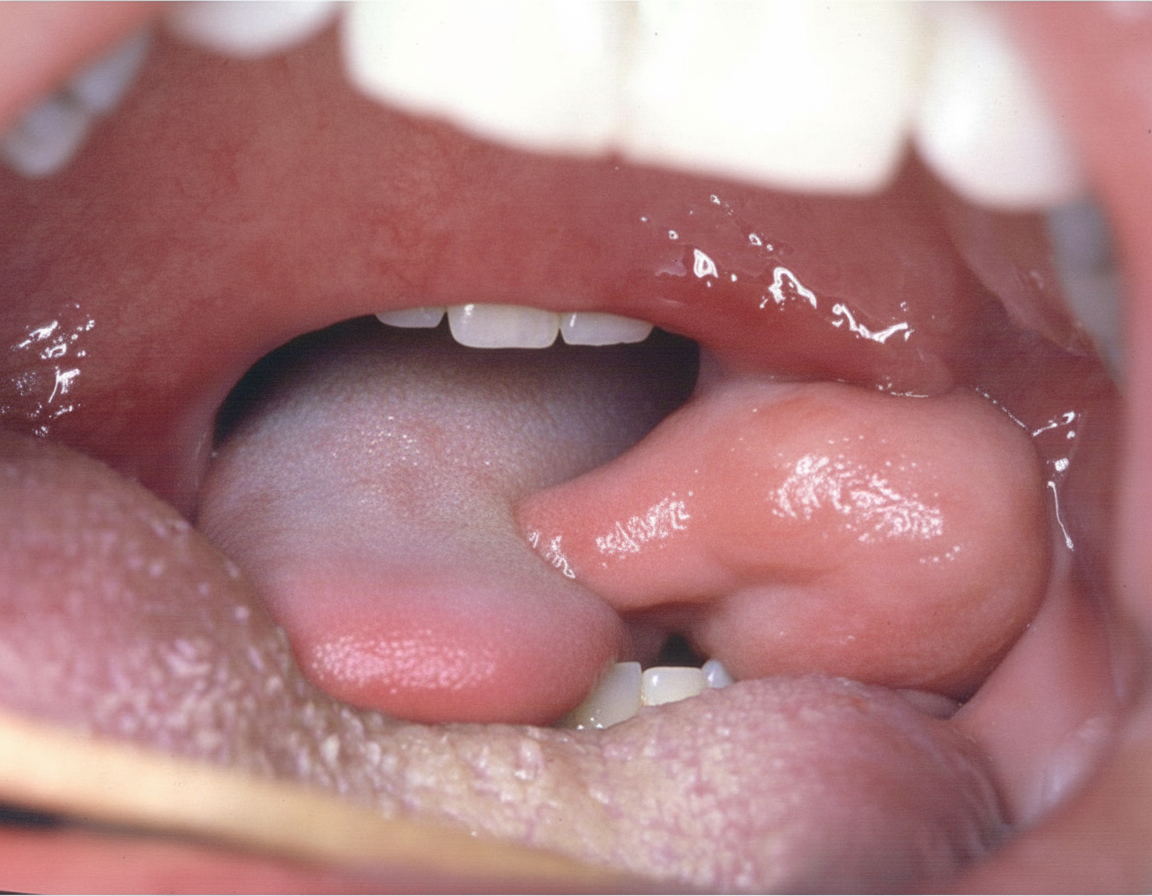
What is the recommended treatment for ameloblastoma?
Radical neck dissection involves all except?
Warthin's tumor is characterized by which of the following features?
The 'Starch iodine test' is useful to diagnose:
What is the most common site for a carbuncle?
The phenomenon of Kernohan's Notch is associated with which of the following?
Which ganglion needs to be avoided during cervical sympathectomy to prevent Horner syndrome?
Which of the following nerves lies closest to the parotid duct?
All of the following statements about lymphoepithelioma of the parotid gland are true, except?
What is the most common primary malignant tumor of the parotid gland?
Explanation: **Explanation:** Ameloblastoma is a benign but **locally aggressive** odontogenic tumor, most commonly occurring in the angle and ramus of the mandible. The hallmark of this tumor is its high rate of local recurrence if not treated radically. **Why Option B is Correct:** Ameloblastoma is known for its "creeping" nature, where tumor cells infiltrate the surrounding cancellous bone beyond the apparent radiological margins. Therefore, the gold standard treatment is **wide local resection** (segmental or marginal resection of the mandible) with a **1–2 cm safety margin** of healthy bone. This radical approach is necessary to prevent the high recurrence rates (up to 50–90%) associated with conservative treatments. **Why Other Options are Incorrect:** * **Option A:** Simple excision or enucleation is insufficient because the tumor lacks a true capsule and micro-invades the surrounding bone. This leads to almost certain recurrence. * **Option C:** Marsupialization is used for odontogenic cysts (like dentigerous cysts) to reduce pressure, but it is not a definitive treatment for a solid neoplasm like ameloblastoma. * **Option D:** Ameloblastoma is locally destructive, causes facial deformity, and can rarely undergo malignant transformation (Ameloblastic carcinoma); thus, active surgical intervention is mandatory. **High-Yield Clinical Pearls for NEET-PG:** * **Radiological Appearance:** Classically described as a **"Soap-bubble"** or **"Honey-comb"** appearance (multilocular radiolucency). * **Most Common Site:** Mandible (80%), specifically the molar-ramus region. * **Histopathology:** The most common type is **Follicular**, characterized by "reverse polarization" of nuclei. * **Key Symptom:** Painless, slow-growing swelling of the jaw with egg-shell crackling on palpation.
Explanation: **Explanation:** Radical Neck Dissection (RND), originally described by George Crile, is the gold standard for managing cervical lymph node metastasis. It involves the systematic removal of all lymph node groups from Level I to Level V on one side of the neck. **Why Vagus Nerve is the Correct Answer:** The Vagus nerve (CN X) lies within the carotid sheath, posterior to and between the Internal Jugular Vein (IJV) and the Common Carotid Artery. In a standard RND, the carotid sheath is opened to remove the lymph nodes, but the **Vagus nerve, Carotid artery, and Phrenic nerve are strictly preserved** unless they are directly involved by a tumor. Sacrificing the Vagus nerve would lead to vocal cord paralysis and autonomic dysfunction, which is not part of the standard RND protocol. **Analysis of Incorrect Options:** To achieve complete oncological clearance in a classic RND, three specific non-lymphatic structures are routinely sacrificed: * **Sternocleidomastoid Muscle (SCM):** Removed to provide access to the deep cervical nodes. * **Internal Jugular Vein (IJV):** Removed as it is closely associated with the deep cervical chain. * **Spinal Accessory Nerve (CN XI):** Removed because it traverses the posterior triangle (Level V), where nodes are cleared. **NEET-PG High-Yield Pearls:** * **Modified Radical Neck Dissection (MRND):** This involves the same lymph node clearance (Levels I-V) but **preserves** one or more of the non-lymphatic structures (SCM, IJV, or CN XI). * *Type I:* Preserves CN XI. * *Type II:* Preserves CN XI and IJV. * *Type III (Functional Neck Dissection):* Preserves all three (CN XI, IJV, and SCM). * **Extended Neck Dissection:** Refers to the removal of additional lymph node groups (e.g., Level VI) or non-lymphatic structures (e.g., Carotid artery, Vagus nerve) not included in the classic RND.
Explanation: **Explanation:** Warthin’s tumor, also known as **Papillary Cystadenoma Lymphomatosum**, is the second most common benign salivary gland tumor, occurring almost exclusively in the **parotid gland**. **1. Why Option A is Correct:** Warthin’s tumor is unique among salivary gland neoplasms due to its tendency for **multifocality** (multiple separate tumor foci within the same gland) and **bilaterality** (occurring in both the left and right parotid glands). It is the most common salivary gland tumor to present bilaterally, occurring in approximately **10–15%** of cases. This is attributed to the tumor arising from salivary gland ductal epithelium entrapped within intra-parotid lymph nodes during embryogenesis. **2. Why Other Options are Incorrect:** * **Options B, C, and D:** While many Warthin’s tumors may clinically present as a single lump (unifocal/unilateral), the *characteristic* pathological feature tested in exams is its high propensity for being multifocal and bilateral compared to other tumors like Pleomorphic Adenoma (which is typically solitary and unilateral). **Clinical Pearls for NEET-PG:** * **Risk Factor:** Strongly associated with **smoking** (8-fold increased risk). * **Demographics:** Typically affects older males (5th–6th decade). * **Imaging:** Shows high uptake on **Technetium-99m (99mTc) pertechnetate scan** (Hot tumor) because the oncocytes lack the ability to secrete the isotope. * **Histology:** Characterized by a **double layer of oncocytic epithelium** forming papillary projections into cystic spaces, with a dense **lymphoid stroma** (germinal centers). * **Malignant Transformation:** Extremely rare (<1%).
Explanation: ### Explanation **Correct Answer: D. Frey’s Syndrome** **Mechanism and Concept:** Frey’s syndrome (auriculotemporal syndrome) is a common complication following parotidectomy. It occurs due to **aberrant regeneration** of the parasympathetic fibers of the **auriculotemporal nerve**. Normally, these fibers supply the parotid gland to stimulate salivation. After surgery, they mistakenly grow to innervate the overlying sweat glands. Consequently, the stimulus of eating (gustatory stimulus) leads to localized sweating and flushing in the preauricular area instead of salivation. The **Minor’s Starch Iodine Test** is the classic diagnostic tool used to confirm this: 1. The affected skin is painted with **iodine** and allowed to dry. 2. **Starch powder** is applied over the area. 3. The patient is given a sialogogue (e.g., a lemon drop) to induce sweating. 4. When sweat reacts with the iodine and starch, it turns **dark blue/black**, mapping the area of gustatory sweating. **Why the other options are incorrect:** * **A. Wegener’s Granulomatosis:** A systemic vasculitis affecting the upper/lower respiratory tract and kidneys. Diagnosis relies on c-ANCA levels and biopsy showing granulomatous inflammation. * **B. Cat Scratch Disease:** Caused by *Bartonella henselae*, presenting with regional lymphadenopathy. Diagnosis is via serology or Warthin-Starry silver stain on biopsy. * **C. Sarcoidosis:** A multisystem granulomatous disease. While it can cause parotid enlargement (Heerfordt’s syndrome), diagnosis involves Kveim’s test (historical), ACE levels, and biopsy showing non-caseating granulomas. **Clinical Pearls for NEET-PG:** * **Prophylaxis:** Interposition of barriers like the **SMAS flap** or Acellular Dermal Matrix during parotidectomy can prevent Frey’s syndrome. * **Treatment:** Topical **Anticholinergics** (Glycopyrrolate) or **Botulinum toxin** injections are the preferred management for symptomatic cases. * **Nerve involved:** Auriculotemporal nerve (branch of the Mandibular nerve, V3).
Explanation: **Explanation:** A **carbuncle** is an infective gangrene of the subcutaneous tissue, most commonly caused by *Staphylococcus aureus*. It typically presents as a cluster of interconnected furuncles (boils) that form a single inflammatory mass with multiple discharging sinuses (the "sieve-like" appearance). **Why the Nape of the Neck is Correct:** The nape of the neck is the most common site because the **skin is thick and the subcutaneous tissue is dense and fibrous**. In this region, the subcutaneous fat is divided into compartments by strong vertical fibrous septa (retinacula cutis) that anchor the skin to the underlying deep fascia. When an infection occurs, these septa prevent the lateral expansion of pus, forcing it to track vertically toward the surface through multiple openings, leading to the characteristic "honeycomb" appearance. **Analysis of Incorrect Options:** * **Forearm and Calf (A & D):** While these areas can develop furuncles, the subcutaneous tissue is relatively lax compared to the neck. Infections here tend to spread horizontally or localize into a single abscess rather than forming the multiloculated structure of a carbuncle. * **Forehead (B):** The skin on the forehead is thin, and while infections can occur, the specific anatomical arrangement of dense vertical septa required for a classic carbuncle is most prominent on the back of the neck and the back. **Clinical Pearls for NEET-PG:** * **Associated Condition:** Always screen for **Diabetes Mellitus** in a patient presenting with a carbuncle; it is the most common predisposing factor. * **Characteristic Sign:** The **"Sieve-like" or "Honeycomb" appearance** due to multiple discharging points. * **Management:** Treatment involves antibiotics and, if necessary, a **cruciate incision** to debride necrotic tissue. * **Common Sites:** Nape of the neck (most common), followed by the back and shoulders.
Explanation: **Explanation:** **Kernohan’s Notch** is a classic "false localizing sign" seen in cases of rapidly increasing intracranial pressure, most commonly due to an expanding supratentorial mass (like an extradural hematoma). 1. **Why Transtentorial Herniation is Correct:** During **uncal (descending transtentorial) herniation**, the medial temporal lobe (uncus) is pushed downwards. This usually compresses the ipsilateral 3rd nerve and peduncle. However, in Kernohan’s phenomenon, the mass effect is so severe that it shifts the entire midbrain laterally, causing the **contralateral cerebral peduncle** to be compressed against the sharp, tough edge of the **tentorium cerebelli** (the "notch"). Since the motor fibers in the peduncle decussate lower down in the medulla, compression of the contralateral peduncle results in **ipsilateral hemiplegia** (paralysis on the same side as the primary lesion). 2. **Analysis of Incorrect Options:** * **Option A:** While 3rd nerve palsy occurs, the hallmark of Kernohan’s is *ipsilateral* hemiplegia, not the standard contralateral presentation. * **Option B:** Subfalcine herniation involves the cingulate gyrus moving under the falx cerebri; it typically causes ACA infarcts, not peduncle compression. * **Option D:** Foramen magnum herniation (tonsillar herniation) leads to respiratory arrest due to medullary compression, not notch-related peduncle injury. **NEET-PG High-Yield Pearls:** * **The Paradox:** Kernohan’s Notch produces **ipsilateral hemiparesis** (same side as the hematoma), which can mislead a surgeon regarding the site of the lesion. * **Triad of Uncal Herniation:** Ipsilateral dilated pupil (3rd nerve), contralateral hemiplegia (standard), and deteriorating consciousness. Kernohan’s flips the motor finding. * **Imaging:** Often seen on MRI as a signal abnormality in the cerebral peduncle opposite the primary mass.
Explanation: **Explanation:** The sympathetic supply to the eye and face follows a three-neuron pathway. The preganglionic sympathetic fibers for the eye originate from the **Ciliospinal Center of Budge (C8–T2)**. These fibers exit the spinal cord primarily via the **T1 nerve root** and ascend through the sympathetic chain to synapse in the Superior Cervical Ganglion. In many individuals, the inferior cervical ganglion fuses with the first thoracic ganglion (T1) to form the **Stellate Ganglion**. Damage to the T1 component or the stellate ganglion interrupts the sympathetic supply to the head and neck, resulting in **Horner Syndrome** (characterized by miosis, partial ptosis, anhidrosis, and enophthalmos). Therefore, during a cervical sympathectomy (often performed for palmar hyperhidrosis), the T1 ganglion must be strictly preserved. **Analysis of Options:** * **A. T1 (Correct):** It contains the essential preganglionic fibers destined for the eye. Its preservation is the "gold standard" rule to avoid postoperative Horner syndrome. * **B, C, and D (T2, T3, T4):** These ganglia provide sympathetic innervation to the upper limbs (axilla and palms). In modern video-assisted thoracoscopic surgery (VATS) for hyperhidrosis, surgeons typically target T2 to T4. Resecting these does not cause Horner syndrome because the ocular sympathetic fibers have already exited or are situated higher in the chain. **High-Yield Clinical Pearls for NEET-PG:** * **Stellate Ganglion:** Formed by the fusion of the Inferior Cervical and T1 ganglia; located at the level of the neck of the 1st rib. * **Surgical Landmark:** To avoid Horner syndrome, dissection should stay **below the level of the second rib**. * **Harlequin Sign:** A rare complication of sympathectomy where one side of the face fails to flush or sweat, often seen alongside Horner syndrome.
Explanation: The correct answer is **B. Lingual nerve**. ### **Explanation** The relationship between the **submandibular (Wharton’s) duct** and the **lingual nerve** is a classic anatomical landmark in head and neck surgery. As the lingual nerve descends into the submandibular region, it exhibits a "triple relation" with the duct: 1. **Lateral:** The nerve starts lateral to the duct. 2. **Inferior:** It crosses beneath the duct (looping under it). 3. **Medial:** It ascends medially to reach the tongue. This "looping" relationship is often described by the mnemonic: **"The nerve loops under the duct."** In the context of the question, while the duct is technically the submandibular duct (often referred to in clinical stems involving the floor of the mouth), the lingual nerve is the structure most intimately associated with it. ### **Why the other options are incorrect:** * **Hypoglossal nerve (A):** Runs inferior to the submandibular duct but does not "loop" around it; it stays on the surface of the hyoglossus muscle. * **Chorda tympani (C):** This nerve joins the lingual nerve high up in the infratemporal fossa, well before the lingual nerve reaches the proximity of the duct. * **Facial nerve (D):** While the facial nerve is intimately related to the **parotid gland**, it is not closely related to the submandibular duct. Note: If the question meant the *parotid (Stensen's) duct*, the buccal branch of the facial nerve runs parallel to it, but the lingual nerve remains the standard answer for "duct-nerve" relationships in this exam context. ### **High-Yield Clinical Pearls for NEET-PG:** * **Surgical Risk:** During excision of the submandibular gland (e.g., for sialolithiasis), the lingual nerve is at high risk of injury during duct ligation due to this close proximity. * **Ganglion:** The **submandibular ganglion** is suspended from the lingual nerve. * **Nerve Supply:** The lingual nerve carries general sensation from the anterior 2/3rd of the tongue, while the hitchhiking chorda tympani carries taste.
Explanation: ### Explanation **Lymphoepithelioma-like carcinoma (LELC)** of the salivary glands is a rare, malignant epithelial tumor characterized by a dense lymphoid stroma. **1. Why Option D is the Correct Answer (The False Statement):** While lymphoepithelioma is histologically similar to undifferentiated nasopharyngeal carcinoma, it is **not** classified as a type of squamous cell carcinoma (SCC). In the salivary glands, it is categorized as a distinct subtype of **undifferentiated carcinoma with lymphoid stroma**. While SCC can occur in the parotid, it lacks the characteristic dense lymphocytic infiltrate and strong EBV association seen in LELC. **2. Analysis of Other Options:** * **Option A:** Among the major salivary glands, the **parotid gland** is indeed the most common site (approx. 80% of cases), followed by the submandibular gland. * **Option B:** There is a very strong etiologic link between **Epstein-Barr Virus (EBV)** and LELC, particularly in endemic regions (e.g., Arctic Inuit, Southeastern Chinese, and Native Americans). * **Option C:** Similar to nasopharyngeal lymphoepithelioma, these tumors are **highly radiosensitive**. Management typically involves surgical resection followed by adjuvant radiotherapy. **3. Clinical Pearls for NEET-PG:** * **Demographics:** Shows a strong racial predilection (Mongoloid/Inuit populations). * **Histology:** Large vesicular nuclei with prominent nucleoli (Regaud’s type) or indistinct cell borders forming a syncytium (Schmincke’s type), surrounded by a "lymphoepithelial" reactive stroma. * **Prognosis:** Despite being a high-grade undifferentiated carcinoma, it has a **better prognosis** than other high-grade salivary malignancies due to its marked radiosensitivity. * **Differential:** Must be distinguished from Warthin’s tumor (benign) and metastatic nasopharyngeal carcinoma.
Explanation: **Explanation:** **Mucoepidermoid carcinoma (Option B)** is the most common primary malignant tumor of the parotid gland, as well as the most common malignant salivary gland tumor overall in both adults and children. It is characterized histologically by a mixture of mucus-secreting cells, epidermoid cells, and intermediate cells. Its prognosis depends heavily on the histological grade (low, intermediate, or high). **Analysis of Incorrect Options:** * **Warthin’s tumor (Option A):** This is the second most common **benign** tumor of the parotid gland (after Pleomorphic Adenoma). It is not malignant. It is strongly associated with smoking and is often bilateral or multicentric. * **Acinic cell carcinoma (Option C):** This is the second most common malignancy of the parotid gland. It is generally slow-growing and has a relatively better prognosis compared to other malignancies. * **Adenoid cystic carcinoma (Option D):** While this is the most common malignant tumor of the **submandibular and minor salivary glands**, it is less common in the parotid. It is notorious for **perineural invasion**, leading to pain and late recurrences. **High-Yield Clinical Pearls for NEET-PG:** * **Rule of 80s for Parotid:** 80% of salivary tumors occur in the parotid; 80% of parotid tumors are benign; 80% of those are Pleomorphic Adenomas. * **Most common benign tumor:** Pleomorphic Adenoma (all glands). * **Most common malignancy:** Mucoepidermoid carcinoma (Parotid and overall). * **Most common malignancy in Submandibular/Minor glands:** Adenoid cystic carcinoma. * **Malignancy Risk:** The smaller the salivary gland, the higher the risk of a tumor being malignant (Parotid < Submandibular < Sublingual).
Salivary Gland Diseases
Practice Questions
Thyroid Gland Disorders
Practice Questions
Parathyroid Gland Disorders
Practice Questions
Neck Masses Evaluation
Practice Questions
Oral Cavity Lesions
Practice Questions
Laryngeal Disorders
Practice Questions
Head and Neck Cancer
Practice Questions
Reconstructive Techniques in Head and Neck Surgery
Practice Questions
Surgical Management of Sleep Apnea
Practice Questions
Airway Management in Head and Neck Surgery
Practice Questions
Surgical Approaches to the Neck
Practice Questions
Neck Dissection Techniques
Practice Questions
Get full access to all questions, explanations, and performance tracking.
Start For Free