A patient presents with chronic sinusitis that is unresponsive to medical therapy. A CT scan reveals mucosal thickening and obstruction at the osteomeatal complex. What is the next best step in management?
A 55-year-old female presents with a rapidly enlarging neck mass and stridor. Fine needle aspiration is inconclusive. What is the most appropriate next step?
A surgeon accidentally lacerates a nerve close to the angle of the mandible during a submandibular gland excision. Which nerve is at risk in this situation?
A 50-year-old female presents with a mass in the floor of the mouth. On examination, the mass is firm, non-tender, and there is no cervical lymphadenopathy. What is the most likely diagnosis?
A 60-year-old man presents with painless, progressive enlargement of the parotid gland. What is the most likely diagnosis?
A patient with a pituitary tumor undergoes transsphenoidal surgery for tumor resection. Which anatomical structure serves as the surgical access route in this procedure?
A middle-aged man with a swelling over the neck since childhood with the overlying skin not intact which had a bag or worm-like appearance with a black spot in the middle. What will be the diagnosis?
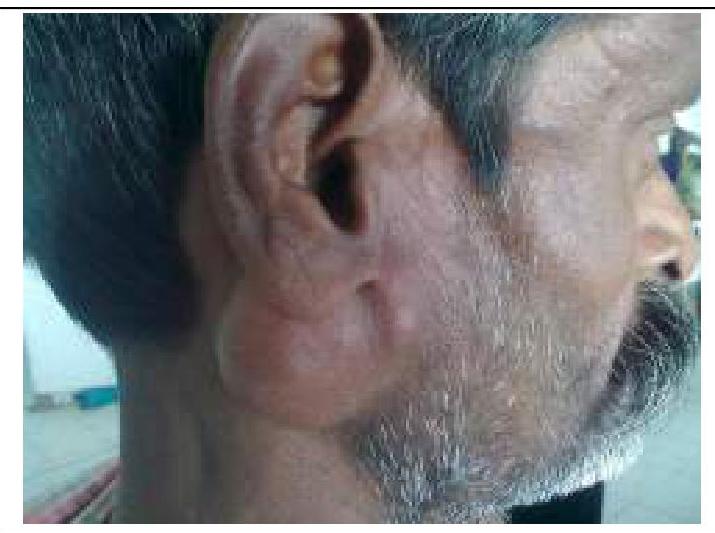
What is the most likely diagnosis for the parotid mass with mixed consistency shown in the image?
In the context of oropharyngeal cancer, for which nodal status is Level III lymph node dissection indicated?
Preferred treatment for oral tongue carcinoma which infiltrates the local cortical bone is -
Explanation: ***Functional endoscopic sinus surgery*** - When **chronic sinusitis** is unresponsive to maximal medical therapy and a CT scan reveals significant mucosal thickening and **osteomeatal complex obstruction**, **FESS** is the next best step. - This procedure aims to restore ventilation and drainage of the sinuses by removing diseased tissue and widening ostia, addressing the anatomical obstruction. *Continued medical therapy* - The question states the patient's **chronic sinusitis is unresponsive to medical therapy**, indicating that further continuation without other interventions would likely be ineffective. - While medical therapy is the initial approach, persistence with it alone after failure requires considering surgical options. *Maxillary sinus irrigation* - This procedure provides temporary relief by flushing out mucus but does not address the underlying anatomical **obstruction at the osteomeatal complex**, which is likely causing recurrent sinusitis. - It is generally considered less effective as a definitive treatment for chronic, obstructive sinusitis compared to surgical correction. *Referral for allergy testing* - While allergies can contribute to chronic rhinitis and sinusitis, this patient has clearly defined anatomical obstruction and mucosal changes visible on CT, indicating a need for intervention beyond allergy management. - Allergy testing would be appropriate as part of a comprehensive workup but is not the **"next best step"** when surgical intervention for a structural problem is indicated.
Explanation: ***Surgical excision biopsy*** - A rapidly enlarging neck mass with **stridor** suggests an aggressive malignancy, and an **inconclusive FNA** necessitates a definitive tissue diagnosis. - An excisional biopsy provides the most comprehensive tissue sample for **histopathological analysis**, allowing for accurate staging and treatment planning. *Repeat fine needle aspiration* - Given the aggressive nature of the mass (rapid enlargement, stridor) and the previous **inconclusive FNA**, repeating the FNA is unlikely to yield a definitive diagnosis quickly enough. - The risk of **sampling error** remains, and delaying a definitive diagnosis could compromise patient outcomes. *Thyroid scan* - A thyroid scan assesses the functional status of thyroid nodules (hot vs. cold) but does not provide a definitive **histopathological diagnosis** for malignancy. - It is primarily used to evaluate **hyperthyroidism** or distinguish between different causes of thyroid nodules, not for rapidly growing, potentially malignant masses. *CT scan of the neck* - A CT scan can provide detailed anatomical information about the mass, its size, local invasion, and involvement of adjacent structures, which is useful for surgical planning. - However, it does not provide a **tissue diagnosis**, which is critical for determining the nature of the rapidly growing mass and guiding treatment.
Explanation: ***Facial nerve*** - The **marginal mandibular branch of the facial nerve** runs close to the inferior border of the mandible and can be injured during submandibular gland excision, especially towards the angle. - Laceration of this nerve would result in **paralysis of the muscles of the lower lip**, causing an asymmetric smile. *Lingual nerve* - The **lingual nerve** passes superior to the submandibular gland, close to its duct, and is at risk during removal of the gland or its duct. - Injury to the lingual nerve would typically cause **loss of general sensation** and **taste** to the anterior two-thirds of the tongue. *Hypoglossal nerve* - The **hypoglossal nerve** innervates the intrinsic and most extrinsic muscles of the tongue, lying deeper and inferior to the submandibular gland. - Damage to this nerve causes **tongue deviation** towards the injured side upon protrusion and difficulty with speech and swallowing. *Glossopharyngeal nerve* - The **glossopharyngeal nerve** (CN IX) lies much deeper in the neck, supplying the stylopharyngeus muscle, parotid gland, and sensation to the posterior tongue and pharynx. - It is generally not at direct risk during a submandibular gland excision, as it is located far from this surgical field.
Explanation: ***Benign salivary gland tumor*** - A **firm, non-tender mass** in the floor of the mouth, without associated lymphadenopathy or systemic symptoms, is characteristic of a benign salivary gland tumor, such as a pleomorphic adenoma. - These tumors grow slowly and typically do not cause pain or inflammation unless they become very large or undergo malignant transformation. *Sialolithiasis* - This condition involves the formation of **stones in salivary ducts**, leading to pain and swelling, especially during eating. - It would typically present with **intermittent pain and swelling** related to meals, which is not mentioned in the presentation of a firm, non-tender mass. *Squamous cell carcinoma* - While possible in the oral cavity, **oral squamous cell carcinoma** often presents with ulceration, rapid growth, pain, and/or associated cervical lymphadenopathy. - The absence of these features (non-tender, no lymphadenopathy) makes it less likely, although biopsy is still crucial for definitive diagnosis. *Lymphoma* - Oral lymphoma can manifest as a mass, but it is often associated with **systemic symptoms** like fever, night sweats, and weight loss, or more diffuse swelling. - Lymphoma in the oral cavity is less common than salivary gland tumors and typically presents with a different clinical picture, often involving the palate or tonsils.
Explanation: ***Parotid gland tumor*** - A **painless, progressive enlargement** of the parotid gland, especially in an older individual, is highly suspicious for a **parotid gland tumor**. - Tumors of the parotid gland can be benign (e.g., pleomorphic adenoma) or malignant (e.g., mucoepidermoid carcinoma), but the key presentation is a **gradual, asymptomatic increase in size**. *Parotitis* - **Parotitis** typically presents with **acute pain, tenderness, and swelling** of the parotid gland, often accompanied by fever and malaise. - It is an inflammatory condition, usually bacterial or viral, and not characterized by a painless, progressive enlargement. *Sialolithiasis* - **Sialolithiasis** (salivary gland stones) usually causes intermittent, **painful swelling of the gland, especially during meals**, due to obstruction of saliva flow. - The pain and swelling are typically episodic and related to eating, which is not described in this case. *Mumps* - **Mumps** is a viral infection that causes **acute, painful swelling of the parotid glands**, usually bilateral, along with fever, headache, and fatigue. - It is more common in children and vaccinated adults can still get mild forms, but the presentation is acute and inflammatory, not painless and progressive.
Explanation: ***Sphenoid sinus*** - The **transsphenoidal approach** uses the sphenoid sinus as the **key surgical corridor** to access the pituitary gland located in the sella turcica. - This method is preferred for pituitary tumors due to its **minimal invasiveness** and reduced risk of damage to surrounding brain structures. - The sphenoid sinus provides **direct posterior access** to the sellar floor, making it the critical anatomical landmark for this procedure. *Nasal septum* - The **nasal septum** is incised or displaced during the initial stages to reach the sphenoid sinus. - While it is traversed during the approach, it serves as an **entry pathway** rather than the definitive surgical corridor to the pituitary gland. - The septum is part of the route but not the structure that provides direct access to the sella turcica. *Maxillary sinus* - The **maxillary sinus** is located in the maxilla and is not in the direct line of access to the pituitary gland via a transsphenoidal approach. - It is typically approached for conditions like sinusitis or tumors originating within the sinus itself, not for pituitary lesions. *Ethmoid sinus* - The **ethmoid sinus** lies anterior and superior to the sphenoid sinus, forming part of the orbit and the roof of the nasal cavity. - While it can be traversed in some extended endoscopic skull base approaches, it is not the primary or most direct route to the pituitary gland for standard transsphenoidal surgery.
Explanation: ***Plexiform neurofibroma*** - The description of a "bag or worm-like appearance" (akin to a **bag of worms**) and a "black spot in the middle" (representing a dermal defect or associated nevus/hyperpigmentation) is classic for a **plexiform neurofibroma**. - This type of neurofibroma, often present since **childhood**, involves plexiform arrangements of nerves and can result in significant tissue distortion and overlying skin changes, characteristic of **Neurofibromatosis Type 1 (NF1)**. - The non-intact overlying skin with the pathognomonic appearance makes this diagnosis highly specific. *Carotid body tumor* - A carotid body tumor (paraganglioma) presents as a **pulsatile lateral neck mass** that moves side-to-side but not up-and-down (Fontaine sign). - It would not have a "bag of worms" texture or the characteristic skin changes with a black spot described in this case. - These are typically firm masses occurring in adults, not childhood-onset swellings. *Sebaceous cyst* - A sebaceous cyst is a **smooth, often freely mobile** subcutaneous lump with a central punctum, not typically presenting with a "bag of worms" texture. - It results from a blocked sebaceous gland and usually has a discrete, contained appearance without the plexiform pattern. - While present since childhood sometimes, it lacks the specific features described here. *Cystic hygroma* - A cystic hygroma (lymphangioma) presents as a **soft, brilliantly transilluminant mass** typically in the posterior triangle of the neck. - It is usually diagnosed in infancy or early childhood and is compressible but smooth, not having a "bag of worms" appearance. - It does not typically have associated skin changes like a black spot or the characteristic texture of plexiform neurofibroma.
Explanation: ***Pleomorphic adenoma*** - The **mixed consistency** of the parotid mass indicates a **benign tumor**, predominantly of epithelial and mesenchymal origin, typical of pleomorphic adenomas. - This type of tumor is usually **pain-free** and can exhibit a **soft** and **firm** texture on examination [1]. *Sebaceous cyst* - Typically presents as a **smooth, fluctuant nodule** and usually has a **firm consistency** rather than mixed. - Generally not seen as a parotid mass; usually found on the skin in areas with sebaceous glands. *Dermoid cyst* - Generally presents as a **well-defined, soft, and mobile mass**, not commonly associated with mixed consistency. - Often contains **keratin** and has a more homogenous consistency rather than the mixed characteristics of pleomorphic adenoma. *All* - As not all options are suitable for the description of a **mixed consistency parotid mass**, this option is incorrect. - Only **pleomorphic adenoma** aligns with the specific clinical presentation detailed in the question [1]. **References:** [1] Kumar V, Abbas AK, et al.. Robbins and Cotran Pathologic Basis of Disease. 9th ed. Head and Neck, pp. 751-753.
Explanation: ***N2*** - **Level III lymph node dissection** is definitively indicated for **N2 nodal status** in oropharyngeal cancer, which represents clinically evident metastatic disease with multiple ipsilateral nodes (N2a), bilateral/contralateral nodes (N2b), or nodes 3-6 cm (N2c). - N2 disease requires **comprehensive neck dissection** (Levels I-V) or modified radical neck dissection, which necessarily includes Level III as part of adequate oncological clearance for established metastatic disease. - The N2 classification indicates a higher tumor burden requiring more extensive surgical intervention compared to N1. *N1* - **N1 nodal status** indicates a single ipsilateral lymph node ≤3 cm, which is typically managed with **selective neck dissection** (Levels II-IV for oropharyngeal cancer), and this selective dissection **does include Level III**. - However, N1 represents an earlier stage where selective (rather than comprehensive) dissection is adequate, making N2 the more definitive indication for comprehensive Level III dissection as part of extensive nodal clearance. - While Level III is included in N1 management, the question asks for the nodal status that most specifically indicates Level III dissection as part of comprehensive management. *N3* - **N3 nodal status** represents advanced disease (node >6 cm or clinically overt extracapsular extension), which requires **radical neck dissection** or multimodality therapy including surgery, radiation, and possibly chemotherapy. - While Level III is certainly removed in N3 dissections, N3 disease often necessitates more extensive resection beyond standard lymph node levels, sometimes requiring sacrifice of critical structures (internal jugular vein, sternocleidomastoid, spinal accessory nerve). - N3 represents the most advanced stage requiring the most aggressive treatment approach. *N0* - **N0 nodal status** means no clinically or radiographically detectable lymph node metastases, and prophylactic Level III lymph node dissection is generally **not indicated** for N0 oropharyngeal cancer. - Management for N0 typically involves observation, primary site treatment with radiation, or elective neck irradiation rather than surgical dissection. - Elective neck dissection, when performed for high-risk N0 cases, typically focuses on Levels II-IV, but this is not standard practice for clinical N0 disease.
Explanation: ***Subtotal glossectomy + selective neck dissection + mandibulectomy*** - **Oral tongue carcinoma** infiltrating cortical bone necessitates aggressive surgical management to achieve **clear margins** and treat potential lymphatic spread. - **Subtotal glossectomy** addresses the primary tumor, **selective neck dissection** manages regional lymph nodes, and **mandibulectomy** removes the involved bone. *Subtotal glossectomy alone* - This option is insufficient as it fails to address both the **cortical bone infiltration** and the high risk of **lymphatic metastasis** associated with oral tongue carcinoma. - Omitting mandibulectomy would likely lead to **incomplete resection** and local recurrence, while skipping neck dissection overlooks regional disease. *Subtotal glossectomy with selective neck dissection only* - While it addresses the primary tumor and regional lymph nodes, this option **does not account for bone infiltration**, which is a critical aspect of the given scenario. - Failing to perform a **mandibulectomy** would leave behind a significant portion of the tumor, jeopardizing oncologic control. *Total glossectomy with selective neck dissection and mandibulectomy* - **Total glossectomy** is a more extensive procedure than typically required for "subtotal" involvement of the tongue and associated bone infiltration. - While it would remove the tumor, it might be **overtreatment** and lead to greater functional deficits than necessary, given that the infiltration is local and not diffuse throughout the entire tongue.
Salivary Gland Diseases
Practice Questions
Thyroid Gland Disorders
Practice Questions
Parathyroid Gland Disorders
Practice Questions
Neck Masses Evaluation
Practice Questions
Oral Cavity Lesions
Practice Questions
Laryngeal Disorders
Practice Questions
Head and Neck Cancer
Practice Questions
Reconstructive Techniques in Head and Neck Surgery
Practice Questions
Surgical Management of Sleep Apnea
Practice Questions
Airway Management in Head and Neck Surgery
Practice Questions
Surgical Approaches to the Neck
Practice Questions
Neck Dissection Techniques
Practice Questions
Get full access to all questions, explanations, and performance tracking.
Start For Free