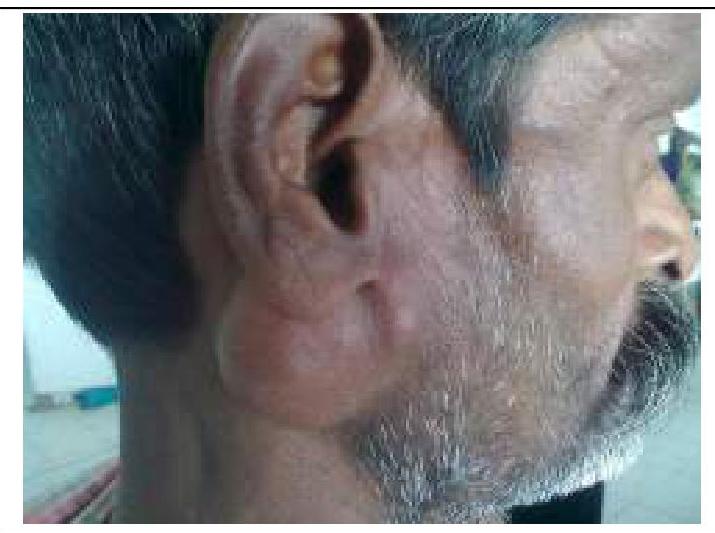
Treatment of choice for nasopharyngeal carcinoma T1 is:
Commonest cause of Ludwig's Angina is
Which of the following structures remains completely intact and uninvolved during enucleation of the eye?
Adenoidectomy is contraindicated in:
The elevator can be used to advantage when:
Treatment of choice for carcinoma larynx T1N0M0 stage -
True about tongue cancer:
Most of the parotid tumors are managed by:
Branchial cleft anomalies are present at birth or shortly after birth. Which of the following is TRUE about branchial anomaly?
Emergency tracheostomy is not indicated in
Explanation: ***Radiation therapy*** - **Radiation therapy** (RT) is the primary treatment modality for early-stage (T1) nasopharyngeal carcinoma due to the tumor's high radiosensitivity and its anatomical location, which makes surgical resection challenging. - The goal is to deliver a definitive dose of radiation to the tumor with curative intent, often using techniques like intensity-modulated radiation therapy (IMRT) to spare surrounding critical structures. - T1 NPC has excellent cure rates (>90%) with RT alone. *Chemotherapy* - **Chemotherapy** is generally used in combination with radiation for locally advanced nasopharyngeal carcinoma (stage II-IVB) or for metastatic disease, not typically as monotherapy for T1 tumors. - While concurrent chemoradiotherapy improves outcomes in more advanced stages, it's not the primary curative treatment for early-stage disease and adds unnecessary toxicity. *Observation* - **Observation** or watchful waiting is not appropriate for nasopharyngeal carcinoma, even at T1 stage, as NPC is an aggressive malignancy requiring active treatment. - Unlike some indolent tumors, NPC has potential for local progression and early lymphatic spread, necessitating definitive treatment at diagnosis. *Surgery* - **Surgery** plays a very limited role in the primary treatment of nasopharyngeal carcinoma, especially for T1 lesions. - The nasopharynx's deep anatomical location, proximity to skull base, critical neurovascular structures, and the tumor's infiltrative nature make surgical resection technically challenging with high morbidity. - Surgery might be considered for salvage in selected cases of recurrent disease after radiation failure, but it is not the first-line treatment.
Explanation: ***Dental infection of 2nd molar teeth*** - Infections of the **mandibular second and third molars** are the most common source of **Ludwig's angina** due to their proximity. - The roots of these teeth extend below the level of the mylohyoid muscle, allowing infection to spread directly into the **submylohyoid space**. *Dental infection of 2nd premolar teeth* - While dental infections can cause **Ludwig's angina**, second premolar infections are less commonly implicated than molar infections. - The roots of premolars are typically positioned above the **mylohyoid muscle**, making direct spread to the submandibular and sublingual spaces less likely. *Dental infection of canine tooth* - Canine tooth infections are more likely to cause localized abscesses or cellulitis rather than the widespread infection characteristic of **Ludwig's angina**. - The anatomical location of canine roots generally directs infection into the **buccal or labial spaces**. *Dental infection of Incisor teeth* - Infections of incisor teeth are rare causes of **Ludwig's angina** as their roots are located superior to the mylohyoid line. - These infections typically spread *anteriorly* or *labially*, rather than into the deep fascial spaces of the neck.
Explanation: ***Eye lids*** - **Enucleation** involves the surgical removal of the entire eyeball, but the **eyelids** remain completely intact and uninvolved in the procedure. - The eyelids are crucial for protecting the orbit and facilitating the fitting of a **prosthesis**. - Unlike other orbital structures that may be manipulated or detached, the eyelids are completely preserved. *Iris* - The **iris** is an internal structure of the eye, forming part of the uveal tract (iris, ciliary body, choroid). - Since enucleation is the surgical removal of the **entire globe**, the iris is necessarily removed with the rest of the eyeball. *Sclera* - The **sclera** is the tough, fibrous outer white layer of the eyeball. - As enucleation is the removal of the **entire eyeball**, the sclera is removed along with all other ocular components. *Extraocular muscles* - While the **extraocular muscles** are preserved in the orbit and not removed during enucleation, they are **detached from the globe** during the procedure. - Their stumps are preserved and may be attached to an orbital implant to improve the **motility of a prosthetic eye**. - However, they are surgically manipulated (cut from their insertion points), unlike the eyelids which remain completely untouched.
Explanation: ***Bleeding disorder*** - Adenoidectomy involves surgical removal of tissue, which carries a risk of **intraoperative and postoperative bleeding**. - In individuals with a **pre-existing bleeding disorder**, this risk is significantly elevated, potentially leading to serious complications. *SOM* - **Serous otitis media (SOM)**, or otitis media with effusion, is often caused by Eustachian tube dysfunction, which can be exacerbated by adenoid hypertrophy. - Adenoidectomy can actually be a **treatment for recurrent SOM**, as it can relieve obstruction of the Eustachian tube. *CSOM* - **Chronic suppurative otitis media (CSOM)** involves a persistent perforation of the tympanic membrane with chronic ear discharge. - While adenoid hypertrophy can contribute to Eustachian tube dysfunction and recurrent acute otitis media that might lead to CSOM, an adenoidectomy is **not directly contraindicated** for CSOM itself. *None of the options* - This option is incorrect because **bleeding disorder** is a clear contraindication for adenoidectomy due to the increased risk of hemorrhagic complications.
Explanation: ***Multiple adjacent teeth are to be extracted.*** - Elevators are highly effective in situations requiring the extraction of **multiple adjacent teeth** because they can leverage the adjacent alveolar bone and PDL space for mechanical advantage. - Using an elevator in such cases helps to progressively loosen each tooth, making subsequent extractions easier and often less traumatic. *The tooth to be extracted is isolated.* - While an elevator can be used on an isolated tooth, its greatest advantage, which is **gaining leverage from an adjacent tooth or bone**, is diminished. - In isolation, the primary action becomes luxation within the socket, which can be achieved but might not be the most efficient use of the elevator's specific design. *The adjacent tooth is not to be extracted.* - Using an elevator when the adjacent tooth is not to be extracted poses a significant risk of **damaging the periodontal ligament or even the enamel and dentin** of the healthy neighboring tooth. - The principle of using an elevator involves applying force against an adjacent structure, and if that structure is to be preserved, this approach is contraindicated. *The interdental bone is used as a fulcrum.* - While interdental bone can indeed be used as a fulcrum for elevators, the wording of this option doesn't fully capture the *advantageous scenario* for using an elevator as effectively as extracting multiple adjacent teeth. - The primary benefit of using an elevator often lies in its ability to **luxate a tooth by wedging into the periodontal ligament space**, and using **interdental bone as a fulcrum** is a technique that can be applied, but it is optimized when multiple teeth are being removed to prevent unnecessary bone loss around a single tooth.
Explanation: ***External beam radiotherapy*** - For **early-stage laryngeal cancer (T1N0M0)**, both **radiotherapy and surgery are considered equally effective first-line treatments** with excellent local control rates (>90%). - EBRT offers the advantage of being **completely non-invasive** while preserving vocal function and avoiding surgical risks. - Treatment duration is typically **6-7 weeks**, requiring patient compliance with daily fractions. - Preferred when patient prefers non-invasive approach or has comorbidities making surgery high-risk. *Surgery* - **Transoral laser microsurgery (TLS)** or endoscopic **cordectomy** are equally effective surgical options for T1 glottic cancer with cure rates comparable to radiotherapy. - Modern laser techniques provide excellent **voice preservation** with minimal morbidity. - Advantages include **shorter treatment time** (single procedure), obtaining tissue for histopathology, and preserving radiotherapy as salvage option. - Both **surgery and radiotherapy are Category 1 recommendations** for T1N0M0 disease; choice depends on institutional expertise, patient preference, and individual factors. *Radioactive implants* - **Brachytherapy (radioactive implants)** can be used for early-stage glottic cancer at specialized centers. - However, **external beam radiotherapy** is more commonly employed due to greater accessibility and extensive outcome data. *Surgery & radiotherapy* - **Combined modality treatment** is indicated for **locally advanced disease** (T3-T4) or **node-positive disease** (N+). - For **T1N0M0 disease**, single modality (either surgery OR radiotherapy) is sufficient and preferred to minimize treatment-related morbidity.
Explanation: ***MC site is on Lateral margin*** - The **lateral border** of the tongue is the most common site for squamous cell carcinoma (SCC) of the tongue due to chronic irritation and exposure to carcinogens. - This anatomical location makes it susceptible to tumor development due to constant friction and potential for trauma. *Slurring of speech is a common complaint* - While speech can be affected by advanced tongue cancer, **dysarthria** (slurring of speech) is not typically an early or primary complaint. - Early symptoms often include a **painless lesion**, ulcer, or lump on the tongue. *Cervical lymph node metastasis is universally present* - While **cervical lymph node metastasis** is common in tongue cancer, its presence is not universal at diagnosis. - The incidence of metastasis varies depending on tumor size, depth of invasion, and location, ranging from 30% to 50% in early stages. *Most common type is adenocarcinoma* - The vast majority of tongue cancers, over 90%, are **squamous cell carcinomas (SCCs)**, arising from the epithelial cells. - **Adenocarcinoma** is a rare type of tongue cancer, originating from glandular tissue, and is not the most common histological type.
Explanation: ***Superficial parotidectomy*** - The vast majority of parotid tumors, especially **benign tumors** like **pleomorphic adenomas**, arise in the **superficial lobe** of the parotid gland. - This procedure removes the superficial lobe while preserving the **facial nerve**, which is crucial for facial expression. - **Most common procedure** for parotid tumors since 80-85% are benign and superficial. *Total parotidectomy* - This procedure removes both the **superficial and deep lobes** of the parotid gland. - Typically reserved for tumors affecting the **deep lobe** or those with extensive involvement. - Less common than superficial parotidectomy as deep lobe tumors are uncommon. *Radical parotidectomy & Neck dissection* - **Radical parotidectomy** involves removing the entire parotid gland, often sacrificing the **facial nerve**, and a **neck dissection** removes lymph nodes in the neck. - This aggressive approach is reserved for **malignant tumors** with known or suspected **nodal metastasis**. - Represents a small percentage of parotid tumor cases. *Radical parotidectomy* - This procedure involves removal of the entire parotid gland, often including the **facial nerve** or its branches, due to tumor infiltration. - Indicated for **high-grade malignant tumors** with nerve involvement but without overt nodal metastasis. - Less common than benign superficial tumors requiring only superficial parotidectomy.
Explanation: ***Most commonly due to 2nd branchial remnants*** - **Second branchial cleft anomalies** are the most prevalent type, accounting for approximately **90-95%** of all branchial anomalies. - They typically present as cysts, sinuses, or fistulas along the anterior border of the **sternocleidomastoid muscle**. *Fistulas are more common than cysts* - **Cysts** are actually the most common presentation of branchial anomalies, often appearing as solitary masses. - While fistulas and sinuses can occur, they are generally **less frequent** than isolated cysts. *For sinuses surgery is not always indicated* - **Surgical excision** is generally indicated for all branchial anomalies, including sinuses, due to the risk of **infection**, recurrence, and potential for an underlying fistula. - Conservative management is typically reserved for infected cysts (drainage and antibiotics) before definitive surgical removal. *Cysts present with dysphagia and hoarseness of voice* - **Dysphagia** (difficulty swallowing) and **hoarseness of voice** are not typical symptoms of branchial cleft cysts, as these cysts are usually located laterally in the neck. - These symptoms are more commonly associated with congenital anomalies affecting the **pharynx**, **larynx**, or **thyroid gland** (e.g., thyroglossal duct cysts when large or infected).
Explanation: ***Acute severe asthma*** - While life-threatening, acute severe asthma is primarily managed with **bronchodilators**, **steroids**, and potentially **non-invasive or invasive ventilation**. - **Tracheostomy** is generally reserved for situations involving upper airway obstruction that cannot be managed by other means, which is not the primary issue in asthma. *Bilateral vocal cord paralysis* - This condition can cause severe **upper airway obstruction** due to the adduction of both vocal cords. - In an emergency setting, a tracheostomy may be life-saving to bypass the obstructed larynx. *Foreign body larynx* - An obstructing **foreign body in the larynx** can lead to immediate and complete airway compromise. - If efforts like the **Heimlich maneuver** or direct laryngoscopy with removal fail, an emergency tracheostomy might be necessary. *Stridor due to laryngeal growth* - A laryngeal growth causing **stridor** indicates significant airway narrowing, which can acutely worsen and lead to respiratory distress. - In cases of severe or rapidly progressive obstruction, an **emergency tracheostomy** is needed to secure the airway below the level of the growth.
Salivary Gland Diseases
Practice Questions
Thyroid Gland Disorders
Practice Questions
Parathyroid Gland Disorders
Practice Questions
Neck Masses Evaluation
Practice Questions
Oral Cavity Lesions
Practice Questions
Laryngeal Disorders
Practice Questions
Head and Neck Cancer
Practice Questions
Reconstructive Techniques in Head and Neck Surgery
Practice Questions
Surgical Management of Sleep Apnea
Practice Questions
Airway Management in Head and Neck Surgery
Practice Questions
Surgical Approaches to the Neck
Practice Questions
Neck Dissection Techniques
Practice Questions
Get full access to all questions, explanations, and performance tracking.
Start For Free