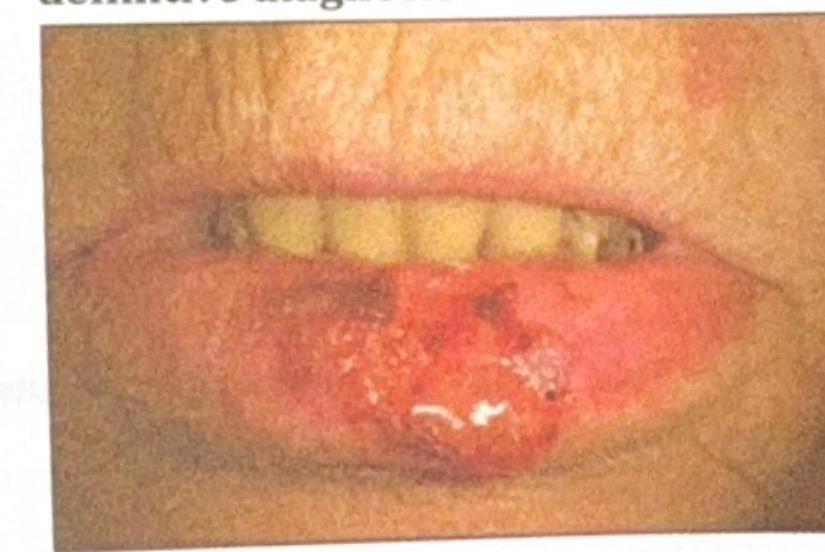
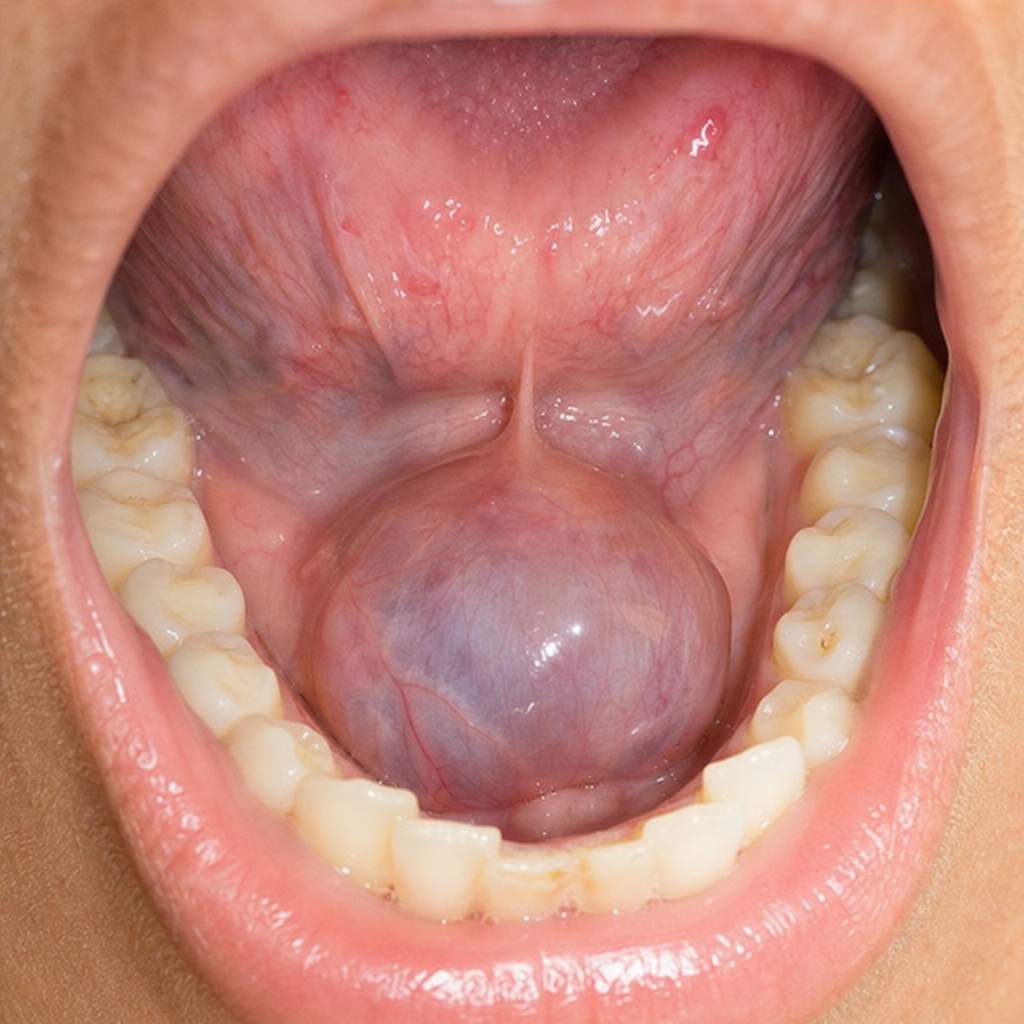
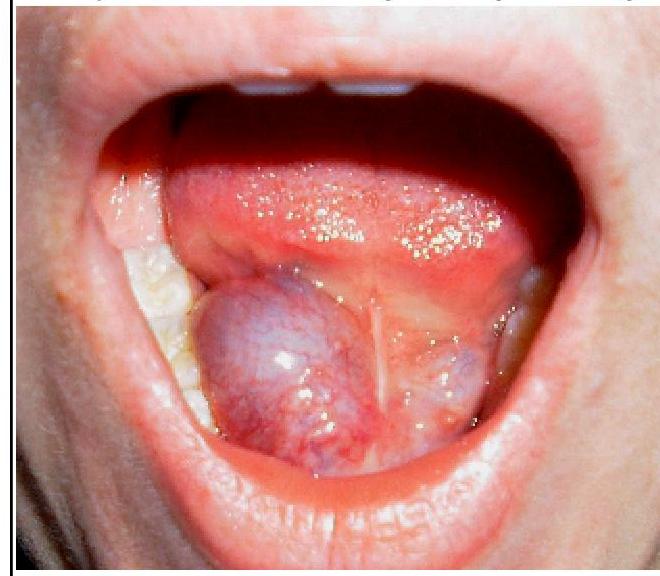
All of the following are congenital cysts except?
What is the best single-drug chemotherapy agent for the treatment of carcinoma of the cheek?
During extraction of an upper first molar, the mesiobuccal root is missing and is suspected to have been pushed into the maxillary sinus. What is the best immediate patient positioning following this incident?
Which of the following statements regarding a branchial cyst is true?
All of the following swellings move with deglutition except?
After the parotidectomy operation, a patient presents with excessive sweating and redness over the parotid region. What is the diagnosis?
A 32-year-old patient who is a chronic tobacco chewer presents with a whitish lesion on the gingivobuccal sulcus for 7 months. What is the next best step in the management of this condition?
All of the following are early complications of cochlear implant surgery shown except:

A 22-year-old female patient complains of discharge from the neck along with a previous history of midline neck swelling. Image of the patient is given below. All the statements regarding this patient are true except:

A patient presents with a midline neck mass that moves with swallowing. The image shows the clinical presentation (arrow indicates the mass). What is the most likely diagnosis?

Explanation: ### Explanation The key to answering this question lies in distinguishing between **developmental (congenital)** cysts and **acquired** cysts. **Why Sebaceous Cyst is the correct answer:** A **sebaceous cyst** (more accurately termed an epidermal inclusion cyst) is an **acquired** cyst. It occurs due to the obstruction of the opening of a sebaceous gland duct, leading to the accumulation of sebum. It is not present at birth and develops later in life due to trauma or follicular blockage. A hallmark clinical feature is the presence of a **punctum**. **Analysis of Incorrect Options:** * **External Angular Dermoid:** This is a **sequestration dermoid**, a congenital cyst formed when surface ectoderm gets trapped along the lines of embryonic fusion (specifically the frontonasal and maxillary processes). It is typically located at the lateral end of the eyebrow. * **Branchial Cyst:** This is a developmental cyst arising from the remnants of the **second branchial cleft** (most commonly). It typically appears in early adulthood but is congenital in origin, located along the anterior border of the sternocleidomastoid muscle. * **Thyroglossal Cyst:** This is a congenital cyst formed along the persistent tract of the **descending thyroid gland** (from the foramen caecum to the thyroid bed). It is characteristically midline and moves upward on protrusion of the tongue. **High-Yield Clinical Pearls for NEET-PG:** * **Dermoid Cysts:** Unlike sebaceous cysts, dermoid cysts **do not** have a punctum and are often fixed to the underlying periosteum (may show "indentation" on X-ray). * **Sebaceous Cysts:** These are common on the scalp and scrotum but are **never** found on the palms and soles (as these areas lack sebaceous glands). * **Sistrunk Operation:** The definitive surgical treatment for a Thyroglossal cyst, involving removal of the cyst, the tract, and the central part of the hyoid bone.
Explanation: **Explanation:** **1. Why Cisplatin is the Correct Answer:** Carcinoma of the cheek (Squamous Cell Carcinoma of the Oral Cavity) is primarily managed surgically or with radiotherapy. However, when chemotherapy is indicated—either as a radiosensitizer or for palliative/recurrent cases—**Cisplatin** is considered the "gold standard" single-drug agent. It is a platinum-based alkylating-like agent that causes DNA cross-linking, leading to apoptosis. In Head and Neck Squamous Cell Carcinoma (HNSCC), Cisplatin demonstrates the highest response rates among single agents and is the backbone of most combination regimens (e.g., PF regimen: Cisplatin + 5-Fluorouracil). **2. Why the Other Options are Incorrect:** * **Cyclophosphamide (A):** An alkylating agent primarily used in lymphomas, breast cancer, and certain pediatric tumors. It has minimal efficacy in epithelial head and neck cancers. * **Vincristine (B):** A vinca alkaloid that inhibits microtubule formation. It is used in leukemias, lymphomas, and sarcomas (like rhabdomyosarcoma), but is not a primary agent for oral SCC. * **Daunorubicin (C):** An anthracycline used almost exclusively in acute leukemias (AML/ALL). It has no role in the management of solid tumors like cheek carcinoma. **3. NEET-PG High-Yield Pearls:** * **Drug of Choice:** Cisplatin is the most effective single agent for HNSCC. * **Radiosensitization:** Low-dose weekly Cisplatin is the standard concurrent chemotherapy given during radiotherapy to enhance local control. * **Side Effects:** Always remember the "C" triad for Cisplatin: **C**hemoreceptor trigger zone stimulation (highly emetogenic), **C**ochlear toxicity (ototoxicity), and **C**onvoluted tubule damage (nephrotoxicity). * **Amifostine** is used to reduce Cisplatin-induced nephrotoxicity.
Explanation: **Explanation:** The displacement of a root fragment into the maxillary sinus is a known complication of upper molar extractions due to the thinness of the antral floor. **Why Upright Position is Correct:** The primary immediate concern when a root tip is displaced is to prevent it from migrating further into the sinus or, more critically, being aspirated or swallowed. Placing the patient in an **upright position** utilizes gravity to keep the root fragment against the floor of the sinus, near the site of the perforation. This facilitates easier retrieval and prevents the fragment from moving toward the ostium or posterior aspects of the sinus, which would occur if the patient were supine. **Analysis of Incorrect Options:** * **Semi-inclined posture:** While it might offer some visualization, it does not provide the gravitational stability of the upright position and increases the risk of the fragment sliding posteriorly. * **Trendelenburg position:** This is contraindicated as it would cause the root fragment to move toward the posterior wall or superior aspect of the sinus, increasing the risk of aspiration into the oropharynx if it falls back through the socket. * **Reverse Trendelenburg:** While similar to upright, the standard clinical recommendation is a fully upright seated position for maximum control and patient safety. **Clinical Pearls for NEET-PG:** * **Most common tooth involved:** Maxillary first molar (specifically the palatal or mesiobuccal root). * **Diagnosis:** If a root disappears, the first step is a periapical or panoramic radiograph to confirm its location (intra-alveolar vs. intra-antral). * **Management:** If the fragment is small (<3mm) and there is no pre-existing infection, it may sometimes be left; however, larger fragments require retrieval via the socket or a **Caldwell-Luc procedure** to prevent chronic maxillary sinusitis. * **Val-Salva Maneuver:** Used clinically to check for an oro-antral communication (OAC); bubbles will appear in the socket when the patient exhales against a pinched nose.
Explanation: **Explanation:** **1. Why Option B is Correct:** Branchial cysts are congenital epithelial cysts resulting from the failure of the branchial clefts (primarily the second) to involute during embryonic development. The **second branchial cleft** is responsible for approximately **95%** of all branchial anomalies. These cysts typically present as a painless, fluctuant swelling in the upper lateral neck. **2. Analysis of Incorrect Options:** * **Option A:** While the statement mentions the anterior border of the sternocleidomastoid (SCM), the classic description is more specific: it is located at the **junction of the upper third and middle third** of the anterior border of the SCM. Option B is a more fundamental and universally true embryological fact. * **Option C:** Although congenital, branchial cysts often remain asymptomatic during childhood. They typically manifest in **late adolescence or early adulthood** (2nd to 3rd decades), often triggered by an upper respiratory tract infection that causes the cyst to enlarge or become infected. * **Option D:** Conservative management is inappropriate due to the high risk of recurrent infection and abscess formation. The definitive treatment is **complete surgical excision** (often via a "stepladder" incision if a fistula is present). **3. NEET-PG High-Yield Pearls:** * **Pathognomonic Feature:** The cyst fluid often contains **cholesterol crystals**, appearing "shimmering" on aspiration. * **Lining:** Most are lined by stratified squamous epithelium. * **Anatomical Relation:** A second branchial fistula typically passes **between the internal and external carotid arteries** and opens internally into the **tonsillar fossa**. * **Differential Diagnosis:** Must be distinguished from a *Cystic Hygroma* (transilluminates, usually in the posterior triangle) and *Carotid Body Tumor* (pulsatile, moves side-to-side but not vertically).
Explanation: **Explanation:** The movement of a neck swelling with deglutition (swallowing) is a classic clinical sign used to differentiate midline and lateral neck masses. **Why Branchial Cyst is the correct answer:** A **Branchial cyst** is a remnant of the second branchial cleft. It is typically located at the junction of the upper 1/3rd and middle 1/3rd of the sternocleidomastoid muscle (anterior border). Because it has no anatomical attachment to the larynx, trachea, or the pretracheal fascia, it **does not move with deglutition**. **Analysis of incorrect options:** * **Thyroid Swelling:** The thyroid gland is enveloped by the **pretracheal fascia**, which is attached to the thyroid and cricoid cartilages. Since the larynx moves upward during swallowing, any swelling arising from the thyroid moves with it. * **Thyroglossal Cyst:** These cysts are remnants of the thyroglossal duct. They are unique because they move with **both deglutition and protrusion of the tongue**, as the duct is closely associated with the hyoid bone and the foramen caecum. * **Tuberculous Lymph Nodes:** Generally, lymph nodes do not move with deglutition. However, in the neck, if lymph nodes (especially the pretracheal or paratracheal groups) become **fixed to the pretracheal fascia** due to inflammation or periadenitis, they may move with swallowing. In the context of this standard MCQ, the Branchial cyst is the most definitive "non-mover." **NEET-PG High-Yield Pearls:** 1. **Movement with Tongue Protrusion:** Pathognomonic for Thyroglossal cyst (due to attachment to the hyoid bone). 2. **Laryngocele:** Another swelling that may move with deglutition and enlarges with the Valsalva maneuver. 3. **Submandibular Salivary Gland:** Does not move with deglutition, helping differentiate it from a low-lying thyroid nodule.
Explanation: ***Frey’s Syndrome***- It is a common post-parotidectomy complication resulting from **aberrant regeneration** of the severed **auriculotemporal nerve**.- The parasympathetic secretomotor fibers meant for the parotid gland mistakenly reinnervate the overlying cutaneous sweat glands and blood vessels, causing **gustatory sweating** and **flushing (redness)** in the parotid region upon chewing or eating.*Horner’s syndrome*- This syndrome results from interruption of the **cervical sympathetic trunk** and presents with the classic triad of **ptosis** (droopy eyelid), **miosis** (constricted pupil), and **anhidrosis** (lack of sweating) on the affected side of the face.- It is unrelated to the auriculotemporal nerve damage common after parotidectomy and involves *lack* of sweating, contrary to the patient's complaint of *excessive* sweating.*Bell’s Palsy*- This is an **idiopathic acute peripheral facial nerve palsy**, leading to unilateral weakness or paralysis of the muscles of facial expression (e.g., inability to close the eye or raise the eyebrow).- While the facial nerve (CN VII) is at risk during parotidectomy, Bell's Palsy itself does not account for the specific symptoms of post-operative gustatory sweating and redness.*Glossopharyngeal neuralgia*- This condition involves brief, severe episodes of stabbing pain in the throat, tonsillar area, back of the tongue, or ear due to irritation of the **glossopharyngeal nerve (CN IX)**.- It is a disorder characterized purely by pain, often triggered by **swallowing** or **talking**, and is not associated with post-operative salivary gland complication symptoms like gustatory sweating.
Explanation: ***Local excision and biopsy*** - The clinical presentation of a persistent white patch in a chronic tobacco user is highly suspicious for **oral leukoplakia**, which is a **premalignant** condition. A **biopsy** is mandatory to establish a definitive histological diagnosis and rule out dysplasia or **squamous cell carcinoma**. - An **excisional biopsy** for a localized lesion is both diagnostic and therapeutic, as it removes the potentially malignant tissue and allows for microscopic examination. *Avoid smoking; wait and watch* - While smoking cessation is a critical part of management, a "wait and watch" approach is inappropriate for a lesion that has persisted for 7 months due to the significant risk of underlying malignancy. - Delaying a definitive diagnosis could allow a potential early-stage cancer to progress, leading to a worse prognosis. *Steroidal injection* - Steroids are used to treat **inflammatory** or **autoimmune** oral lesions like oral lichen planus or pemphigus vulgaris, not potentially neoplastic conditions like leukoplakia. - Using steroids could mask the progression of the lesion and delay the diagnosis of a malignancy. *Sclerotherapy* - Sclerotherapy is a treatment used for **vascular lesions**, such as **hemangiomas** or venous malformations, where a sclerosing agent is injected to cause thrombosis and fibrosis. - This modality is completely inappropriate for an **epithelial** lesion like leukoplakia.
Explanation: ***Device extrusion*** - **Device extrusion** is a late complication typically resulting from chronic infection, trauma, or insufficient soft tissue coverage over time. - While it can occur, it is generally not considered an **early complication** that arises immediately or shortly after cochlear implant surgery. *Facial palsy* - The **facial nerve (CN VII)** runs in close proximity to the surgical field for cochlear implantation. - Injury to the facial nerve during drilling or electrode insertion can lead to **facial palsy**, making it an early complication. *Taste disturbances* - The **chorda tympani nerve**, which carries taste sensation, passes through the middle ear and can be inadvertently damaged during cochlear implant surgery. - Damage to this nerve causes **taste disturbances** (dysgeusia), which can manifest soon after the procedure. *CSF leakage* - Cochlear implant surgery involves breaching the inner ear structures, which are continuous with the **subarachnoid space**. - This can create a pathway for **cerebrospinal fluid (CSF) leakage**, an immediate and serious early complication.
Explanation: ***It is a complication of nodular goiter*** - A **thyroglossal duct cyst** is a congenital anomaly resulting from the incomplete obliteration of the thyroglossal duct, a remnant of thyroid gland development. - While it can become infected or form a fistula, it is not a complication of an acquired thyroid condition like **nodular goiter**, which is an enlargement of the thyroid gland. *This is thyroglossal fistula* - The patient's history of a **midline neck swelling** with **discharge from the neck** is highly suggestive of an infected thyroglossal duct cyst that has ruptured or been incised, forming a thyroglossal fistula. - A fistula is an **abnormal tract** connecting an internal cavity to the surface, in this case, the remnant of the thyroglossal duct to the skin. *Sistrunk's operation is the treatment of choice* - The **Sistrunk procedure** involves excising the thyroglossal duct cyst along with the central portion of the hyoid bone and the core of muscle extending to the foramen cecum at the base of the tongue. - This extensive removal is necessary due to the embryological origin and the high risk of recurrence if any part of the duct system, especially near the hyoid bone, is left behind. *This discharge site will move upwards on protrusion of tongue* - The **thyroglossal duct** travels through the hyoid bone and is embryologically connected to the tongue. - Therefore, structures within the persistent thyroglossal track, including a fistula, will move upwards with the **protrusion of the tongue**, which is a classic diagnostic sign.
Explanation: ***Thyroglossal cyst*** - The image depicts a **midline neck mass** (indicated by the arrow) located superior to the thyroid cartilage, which is characteristic of a **thyroglossal duct cyst**. - Such cysts typically **move superiorly with tongue protrusion** or swallowing, a key diagnostic feature, and arise from remnants of the **thyroglossal tract**. *Branchial cyst* - Branchial cleft cysts are usually located **laterally in the neck**, often anterior to the sternocleidomastoid muscle, not in the midline as shown. - They occur due to incomplete obliteration of the **branchial arches** during embryological development. *Cold abscess* - A cold abscess is a collection of pus that lacks the typical signs of inflammation (redness, warmth, pain) and is often associated with **tuberculosis**. - While it can present as a neck mass, it typically does not demonstrate the specific midline location and movement characteristics of a thyroglossal cyst. *Carotid body tumor* - A carotid body tumor (paraganglioma) is typically located at the **carotid bifurcation**, deep to the sternocleidomastoid muscle, and causes a **lateral neck mass**. - It is often mobile side-to-side but **fixed vertically** ("positive Fontaine's sign") due to its attachment to the carotid artery.
Salivary Gland Diseases
Practice Questions
Thyroid Gland Disorders
Practice Questions
Parathyroid Gland Disorders
Practice Questions
Neck Masses Evaluation
Practice Questions
Oral Cavity Lesions
Practice Questions
Laryngeal Disorders
Practice Questions
Head and Neck Cancer
Practice Questions
Reconstructive Techniques in Head and Neck Surgery
Practice Questions
Surgical Management of Sleep Apnea
Practice Questions
Airway Management in Head and Neck Surgery
Practice Questions
Surgical Approaches to the Neck
Practice Questions
Neck Dissection Techniques
Practice Questions
Get full access to all questions, explanations, and performance tracking.
Start For Free