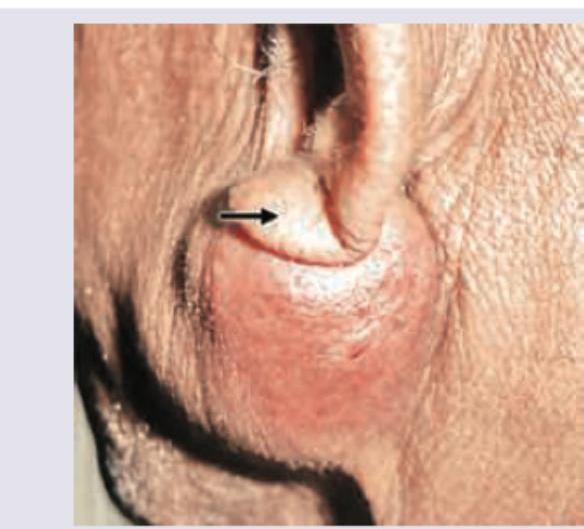
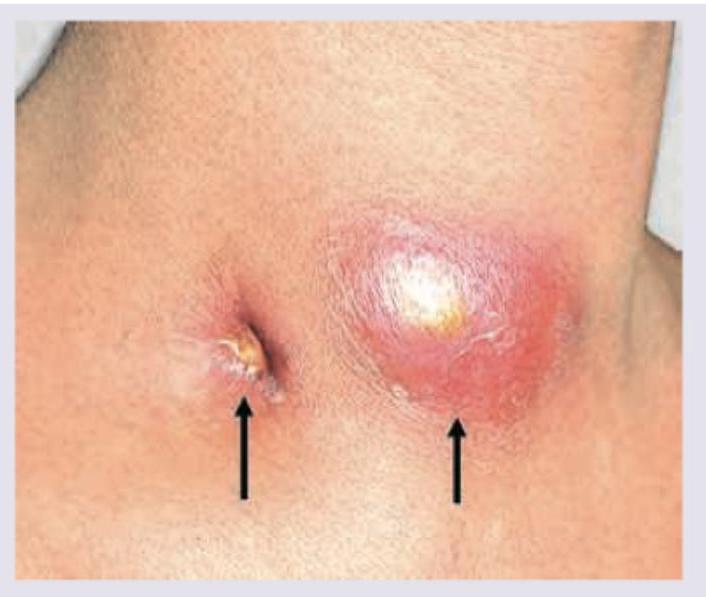
A ranula is most appropriately described by which of the following statements?
The Alkayat and Bramley approach to the TMJ is a modification of which surgical approach?
A 72-year-old man presents to the emergency department complaining of frequent nose-bleeds. What is the most likely site of acute epistaxis?
Which of the following statements regarding pleomorphic adenoma of the salivary gland is true?
Ranula is a:
The sudden appearance of a dumbbell-shaped swelling during a third molar nerve block is mainly due to:
Which of these pathologies is the most common benign tumor of the parotid gland?
A 43-year-old man suddenly develops odynophagia. Which organism is most likely to be isolated on throat culture?
Which of the following is NOT true about supraglottic laryngeal carcinoma?
A 2-year-old boy presents with a superficial gash on his forehead. The wound is bleeding profusely, but examination reveals no fracture. The physician suspects a hypersensitive cardiac reflex. The patient's epicranial aponeurosis (galea aponeurotica) is penetrated, resulting in severe gaping of the wound. Which structure overlies the epicranial aponeurosis?
Explanation: ### Explanation A **ranula** is a clinical term for a translucent, bluish cystic swelling occurring in the **floor of the mouth**. It arises from the **sublingual salivary gland** due to either ductal obstruction (retention cyst) or, more commonly, trauma leading to mucus extravasation into the surrounding tissues (extravasation pseudocyst). #### Why Option C is Correct: The term "ranula" is derived from the Latin word *rana* (frog), as the swelling resembles the translucent underbelly of a frog. Its hallmark anatomical location is the floor of the mouth, lateral to the midline, displacing the tongue upward. #### Why Other Options are Incorrect: * **Option A (Epulis):** An epulis is a localized gingival swelling (tumor-like) on the gums, not a cystic lesion in the floor of the mouth. * **Option B (Thyroglossal Cyst):** This is a midline developmental cyst found in the neck, usually related to the hyoid bone, which moves upward on tongue protrusion. * **Option D (Mucus Retention Cyst):** While some ranulas are retention cysts, the majority (especially large ones) are **extravasation pseudocysts** (lacking an epithelial lining). Therefore, "cystic swelling" is a more accurate general description than strictly "retention cyst." --- ### High-Yield Clinical Pearls for NEET-PG: * **Plunging Ranula:** This occurs when the mucus herniates through the **mylohyoid muscle**, presenting as a soft, painless swelling in the submandibular region of the neck. * **Diagnosis:** Primarily clinical. MRI/CT shows a characteristic "tail sign" in plunging ranulas. * **Treatment of Choice:** **Marsupialization** (for small intraoral ones) or **complete excision of the sublingual gland** (definitive treatment to prevent recurrence). Simple aspiration always leads to recurrence.
Explanation: **Explanation:** The **Al-Kayat and Bramley approach** is a classic surgical modification of the **Preauricular approach** (Option C). It was specifically designed to provide wider exposure of the Temporomandibular Joint (TMJ) and the zygomatic arch while minimizing the risk of injury to the facial nerve. **Why it is correct:** The standard preauricular incision provides limited access. Al-Kayat and Bramley modified this by adding an **extended hemicoronal (temporal) extension**. This "question mark" shaped incision allows for the reflection of a larger flap, providing superior visualization of the joint capsule and the upper facial skeleton. Crucially, it involves reflecting the superficial temporal fascia with the flap to protect the **temporal branch of the facial nerve**. **Analysis of Incorrect Options:** * **A. Hemicoronal approach:** While the Al-Kayat and Bramley approach *uses* a hemicoronal extension, it is fundamentally a modification of the preauricular access to the joint, not a modification of a pure coronal flap used for craniofacial surgery. * **B. Retroauricular approach:** This incision is made behind the ear (often for middle ear surgery). It provides poor access to the TMJ and risks damaging the external auditory canal. * **C. Risdon’s incision:** This is a **submandibular incision** used to access the mandibular ramus and angle. It is located far below the TMJ area. **High-Yield Clinical Pearls for NEET-PG:** * **Primary Indication:** Ankylosis of the TMJ, condylar fractures, and zygomatic arch tumors. * **Nerve at Risk:** The **Temporal (Frontal) branch of the Facial Nerve** is the most vulnerable structure during TMJ surgery. * **Anatomical Landmark:** The incision stays posterior to the superficial temporal artery to maintain a bloodless field. * **Bramley’s Contribution:** He specifically emphasized the "sub-fascial" dissection to protect the facial nerve branches.
Explanation: **Explanation:** The most common site for acute epistaxis is the **nasal septum**, specifically the anteroinferior portion known as **Kiesselbach’s plexus** (or Little’s area). This area is a highly vascular watershed zone where four to five arteries anastomose (Sphenopalatine, Greater palatine, Superior labial, and Anterior ethmoidal arteries). Because this region is located near the nares, it is highly susceptible to trauma, digital irritation, and drying of the mucosa, making it the source of approximately 90% of all nosebleeds. **Analysis of Options:** * **Turbinates (A):** While the turbinates are highly vascularized (especially the inferior turbinate), they are rarely the primary site of spontaneous acute epistaxis compared to the septum. * **Maxillary & Ethmoid Sinuses (C & D):** Bleeding from the sinuses is uncommon and usually associated with severe trauma, malignancy, or chronic inflammatory conditions. These represent "posterior" or "deep" sources, which are far less frequent than anterior septal bleeds. **NEET-PG High-Yield Pearls:** * **Little’s Area (Kiesselbach’s Plexus):** Most common site for **Anterior Epistaxis**. * **Woodruff’s Plexus:** Located over the posterior end of the middle turbinate; it is the most common site for **Posterior Epistaxis** (often seen in elderly or hypertensive patients). * **Artery of Epistaxis:** The **Sphenopalatine artery** is the most common vessel involved in posterior epistaxis. * **First-line Management:** Firm pressure on the nasal alae (Trott’s maneuver) for 10–15 minutes. If this fails, anterior nasal packing or chemical cautery (silver nitrate) is indicated.
Explanation: **Explanation:** **Pleomorphic Adenoma (Benign Mixed Tumor)** is the most common salivary gland tumor, accounting for approximately 70–80% of all salivary neoplasms. 1. **Why Option A is correct:** The **parotid gland** is the most frequent site of occurrence (80–85% of cases), typically arising in the superficial lobe. It presents as a slow-growing, painless, firm, and mobile swelling. 2. **Why Option B is incorrect:** While benign, pleomorphic adenoma has a definite risk of **malignant transformation** (approx. 3–5%), known as *Carcinoma ex pleomorphic adenoma*. The risk increases with the duration of the tumor (up to 10% if present for over 15 years). 3. **Why Option C is incorrect:** **Adenolymphoma** is the synonym for **Warthin’s tumor**, not pleomorphic adenoma. Pleomorphic adenoma is called a "mixed tumor" because it contains both epithelial and mesenchymal (mucoid, myxoid, or chondroid) components. 4. **Why Option D is incorrect:** Pleomorphic adenoma is more common in **females** than males (ratio approx. 2:1), usually occurring in the 4th to 6th decades of life. **High-Yield Clinical Pearls for NEET-PG:** * **Most common site:** Superficial lobe of the parotid. * **Most common site in minor salivary glands:** Hard palate. * **Histology:** Characterized by "pleomorphism"—a mix of epithelial cells and stromal elements (myxomatous or cartilaginous). * **Treatment:** Superficial parotidectomy (Enucleation is contraindicated due to the presence of a "false capsule" and pseudopods, which lead to high recurrence rates). * **Nerve involvement:** Facial nerve palsy is rare in benign pleomorphic adenoma; its presence strongly suggests malignancy.
Explanation: **Explanation:** A **Ranula** is a clinical term for a translucent, bluish mucocele found specifically on the floor of the mouth. It typically arises from the **sublingual gland** (or rarely, the minor salivary glands). 1. **Why Option A is Correct:** Pathologically, a ranula is classified as a **retention cyst**. It occurs due to the partial obstruction of a salivary duct (usually the ducts of Rivinus), leading to the accumulation of saliva within an epithelial-lined cavity. While some literature debates the presence of a true epithelial lining (suggesting an extravasation origin), for standard surgical examinations like NEET-PG, it is classically categorized as a **retention cyst**. 2. **Why Other Options are Incorrect:** * **Option B:** While many oral mucoceles (like those on the lower lip) are extravasation cysts (mucus leak into tissues without a lining), the classic definition of a ranula in standard textbooks (like Bailey & Love) remains a retention cyst. * **Option C & D:** These refer to simple edema (fluid in the interstitial space), whereas a ranula is a localized, cystic collection of saliva. **High-Yield Clinical Pearls for NEET-PG:** * **Appearance:** It is named "Ranula" because of its resemblance to a frog’s belly (*Rana* = frog). * **Plunging Ranula:** This occurs when the mucus extravasates through or around the **mylohyoid muscle**, presenting as a soft, painless swelling in the submandibular region (neck). * **Treatment:** The treatment of choice is **Marsupialization** or complete excision of the offending sublingual gland to prevent recurrence. Simple aspiration is associated with a high recurrence rate.
Explanation: The appearance of a **dumbbell-shaped swelling** during a third molar nerve block (Inferior Alveolar Nerve Block) is a classic clinical sign of an **intra-arterial injection into the internal maxillary artery.** ### **Explanation of the Correct Answer** The internal maxillary artery is a terminal branch of the external carotid artery that runs deep to the neck of the mandible. If the needle accidentally enters this vessel, the high pressure of the arterial system causes rapid retrograde flow of the anesthetic solution. This leads to immediate, localized vasodilation and fluid accumulation in the infratemporal fossa and the buccal space. The anatomical constriction caused by the **buccinator muscle** or the **zygomatic arch** creates a middle indentation, resulting in the characteristic **"dumbbell" shape.** ### **Analysis of Incorrect Options** * **A. Pterygoid Plexus:** Injection here typically results in a **hematoma**, which presents as a diffuse, bluish swelling that develops more slowly than the instantaneous arterial swelling. * **B. Parotid Gland:** Injection into the parotid gland (due to over-insertion of the needle) usually leads to **transient facial nerve palsy** (Bell’s palsy-like symptoms) rather than a dumbbell-shaped swelling. * **C. Nasal Cavity:** While anatomically possible if the needle is directed too superiorly and medially, it would result in the patient tasting the anesthetic or epistaxis, not a facial swelling. ### **High-Yield Clinical Pearls for NEET-PG** * **Prevention:** Always **aspirate** before injecting a local anesthetic to rule out intravascular placement. * **Internal Maxillary Artery:** It is the largest terminal branch of the External Carotid Artery and supplies the deep structures of the face. * **Dumbbell Swelling vs. Hematoma:** Arterial injection is **sudden and dramatic**, whereas venous plexus injury (hematoma) is slower and often accompanied by ecchymosis. * **Management:** Immediate cessation of the procedure, application of pressure, and reassurance. The swelling usually subsides as the anesthetic is redistributed.
Explanation: **Explanation:** **Pleomorphic Adenoma (Option D)** is the correct answer. It is the most common benign tumor of the salivary glands, accounting for approximately 80% of all parotid tumors. Pathologically, it is a "mixed tumor" containing both epithelial and mesenchymal elements (mucoid, chondroid, or osteoid tissue). Clinically, it presents as a slow-growing, painless, firm, and mobile swelling at the angle of the jaw. While benign, it has a risk of malignant transformation into *Carcinoma ex-pleomorphic adenoma* if left untreated for long periods. **Why other options are incorrect:** * **Mumps (Option A):** This is an acute viral infection (Paramyxovirus) and the most common cause of non-obstructive painful parotid swelling in children, not a neoplastic tumor. * **Tuberculosis (Option B):** This is a chronic granulomatous infection. While it can involve the parotid lymph nodes, it is an infectious pathology, not a primary benign neoplasm. * **Heerfordt Syndrome (Option C):** Also known as uveoparotid fever, this is a rare manifestation of **Sarcoidosis** characterized by the triad of parotid enlargement, uveitis, and facial nerve palsy. It is an inflammatory/granulomatous condition. **High-Yield Clinical Pearls for NEET-PG:** * **Rule of 80s for Parotid:** 80% are in the parotid, 80% are benign, 80% are Pleomorphic Adenoma, and 80% occur in the superficial lobe. * **Warthin’s Tumor (Adenolymphoma):** The second most common benign parotid tumor; it is often bilateral, associated with smoking, and shows "hot spots" on Technetium-99m pertechnetate scans. * **Treatment of Choice:** Superficial parotidectomy (to avoid facial nerve injury). Enucleation is contraindicated due to the risk of recurrence from pseudopod extensions.
Explanation: ### Explanation The correct answer is **Normal pharyngeal flora**. **1. Why Normal Pharyngeal Flora is Correct:** The clinical presentation describes a 43-year-old man with **sudden onset odynophagia** (painful swallowing). In the absence of systemic symptoms like high-grade fever, exudates, or lymphadenopathy, the most common cause of acute pharyngitis is **viral** (e.g., Rhinovirus, Adenovirus). In viral pharyngitis, a throat culture will not grow a specific pathogenic bacterium; instead, it will yield **Normal Pharyngeal Flora** (such as Neisseria species, Diphtheroids, and non-hemolytic Streptococci). Statistically, viruses cause up to 70-90% of adult sore throats, making normal flora the most likely culture result. **2. Why Other Options are Incorrect:** * **Mononucleosis (EBV):** While it causes severe odynophagia and pharyngitis, it is a viral infection. A throat culture would still show normal flora; diagnosis is made via Monospot test or atypical lymphocytes on a blood smear. * **S. aureus:** This is not a common primary cause of acute pharyngitis. It is more often associated with skin infections or secondary pneumonia. * **Group A Streptococci (GABHS):** This is the most common *bacterial* cause (Streptococcal Pharyngitis). However, it accounts for only 5-15% of adult cases. Unless the question specifies "Centor Criteria" (fever, tonsillar exudates, absence of cough), a viral etiology is more probable. **Clinical Pearls for NEET-PG:** * **Centor Criteria:** Used to predict the probability of GABHS. Points for: Fever, Tonsillar exudates, Tender anterior cervical lymphadenopathy, and Absence of cough. * **Most common cause of Pharyngitis:** Viral (Overall); GABHS (Bacterial). * **Complication of GABHS:** Rheumatic fever and Post-streptococcal glomerulonephritis (PSGN). Note: Antibiotics prevent Rheumatic fever but **not** PSGN. * **Lemierre’s Syndrome:** Septic thrombophlebitis of the internal jugular vein, usually caused by *Fusobacterium necrophorum* following pharyngitis.
Explanation: **Explanation:** **1. Why Option A is the correct answer (The False Statement):** In the context of laryngeal carcinoma, the **glottis (vocal cords)** is the most common site, accounting for approximately 60-65% of cases. Supraglottic carcinoma is the second most common (30-35%), while subglottic carcinoma is the rarest (<5%). Therefore, stating that the supraglottis is the most common site is factually incorrect. **2. Analysis of other options:** * **Option B:** The supraglottis has a rich lymphatic network. Tumors here frequently metastasize bilaterally, primarily involving the **Level II (upper jugular)** and **Level III (middle jugular)** lymph nodes. * **Option C:** Unlike glottic cancer (which presents early with hoarseness), supraglottic cancer is often "silent" in its early stages. By the time symptoms appear, the disease is often advanced, and a **palpable neck mass** (due to nodal metastasis) is frequently the first clinical sign. * **Option D:** Early-stage supraglottic cancer (T1 and T2) can be treated with high success rates using either **External Beam Radiotherapy (EBRT)** or organ-preserving surgeries (like CO2 laser supraglottic laryngectomy), as both offer similar local control. **Clinical Pearls for NEET-PG:** * **Glottic Cancer:** Most common; presents early with hoarseness; best prognosis due to sparse lymphatics (rare nodal spread). * **Supraglottic Cancer:** Rich lymphatics; high incidence of bilateral nodal metastasis; presents late with throat pain, dysphagia, or a neck mass. * **Subglottic Cancer:** Often presents with stridor; carries the worst prognosis as it is usually diagnosed at an advanced stage.
Explanation: To understand the layers of the scalp and their clinical significance, we use the mnemonic **SCALP**. The layers from superficial to deep are: **S**kin, **C**onnective tissue (dense), **A**poneurosis (Galea), **L**oose areolar tissue, and **P**ericranium. ### **Explanation of the Correct Answer** The **Epicranial Aponeurosis (Galea Aponeurotica)** is the third layer (A). The structure directly overlying it is the second layer: the **Dense Connective Tissue layer**. * **Why it is correct:** This layer contains the rich network of blood vessels and nerves of the scalp. The blood vessels are firmly adherent to the dense connective tissue; when the scalp is cut, these vessels cannot retract or constrict, leading to the **profuse bleeding** described in the clinical scenario. ### **Analysis of Incorrect Options** * **B. Dura mater:** This is an intracranial structure located deep to the skull bones, not part of the scalp layers. * **C. Periosteum (Pericranium):** This is the fifth and deepest layer of the scalp, located **underneath** the epicranial aponeurosis and the loose areolar tissue. * **D. Tendon of the epicranial muscles:** The epicranial aponeurosis *is* the tendon that connects the frontal and occipital bellies of the occipitofrontalis muscle. It does not overlie itself. ### **NEET-PG High-Yield Pearls** * **Gaping Wounds:** A scalp wound gapes significantly only if the **Galea Aponeurotica** is lacerated (coronal tension from the occipitofrontalis muscle). * **Dangerous Layer of Scalp:** The **Loose Areolar Tissue (4th layer)** is the "danger zone" because pus or blood can easily spread within it and reach the intracranial dural venous sinuses via **emissary veins**, potentially causing cavernous sinus thrombosis. * **Cephalhematoma:** Bleeding deep to the Pericranium (5th layer) is limited by skull sutures, distinguishing it from Caput Succedaneum.
Salivary Gland Diseases
Practice Questions
Thyroid Gland Disorders
Practice Questions
Parathyroid Gland Disorders
Practice Questions
Neck Masses Evaluation
Practice Questions
Oral Cavity Lesions
Practice Questions
Laryngeal Disorders
Practice Questions
Head and Neck Cancer
Practice Questions
Reconstructive Techniques in Head and Neck Surgery
Practice Questions
Surgical Management of Sleep Apnea
Practice Questions
Airway Management in Head and Neck Surgery
Practice Questions
Surgical Approaches to the Neck
Practice Questions
Neck Dissection Techniques
Practice Questions
Get full access to all questions, explanations, and performance tracking.
Start For Free