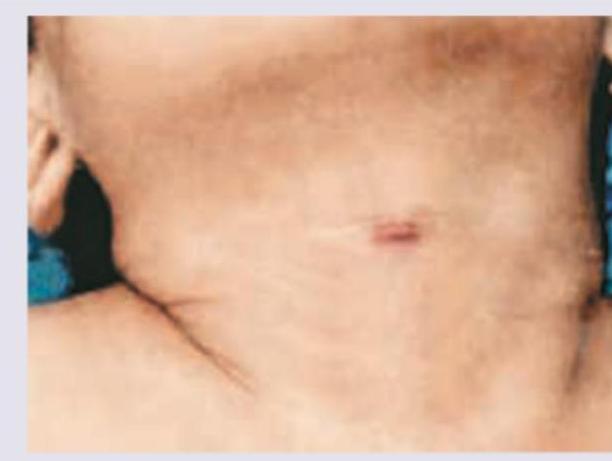
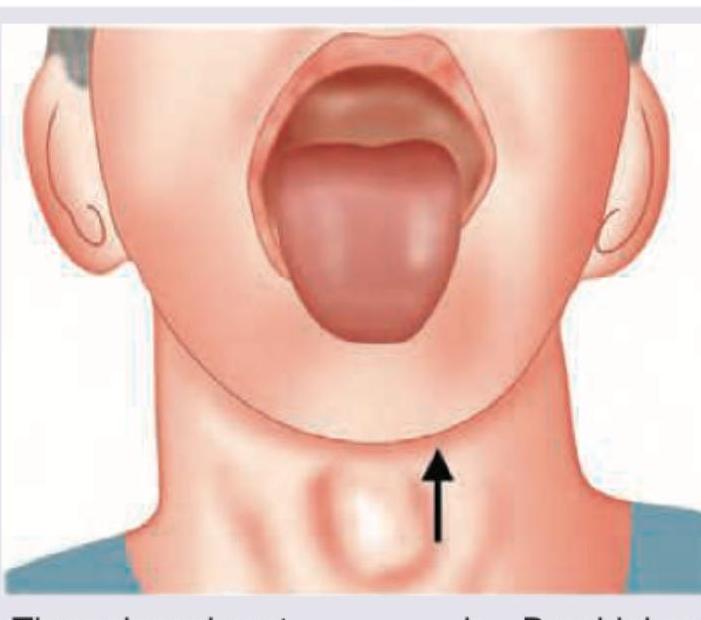
Which of the following presents as a painless midline swelling?
A 40-year-old patient is suffering from a carotid body tumor. What is the best treatment choice for this patient?
What is a Warthin's tumour?
What does a supraomohyoid neck dissection entail?
Which parotid tumor spreads along the nerve sheath?
Swelling of the deep lobe of the parotid gland presents as swelling in which anatomical space?
For extraction of a mandibular molar, anesthesia is administered to block which nerve?
What surgical approach is indicated for an odontogenic tumor located 1cm from the inferior border of the mandible?
A 36-year-old lady presents with a 20-year duration fluctuant and translucent swelling on the right side of her neck. No other history or significant findings on examination are available. What is the most probable diagnosis?
What is the anatomical landmark for applying pressure to control bleeding from a rupture of the carotid artery in the neck region?
Explanation: **Explanation:** The correct answer is **Thyroglossal cyst**. **1. Why Thyroglossal Cyst is Correct:** A thyroglossal cyst is the most common congenital midline neck swelling. It develops from a persistent remnant of the thyroglossal duct, which marks the descent of the thyroid gland from the foramen caecum to its adult position. * **Clinical Hallmark:** It is a painless, smooth, and cystic midline swelling (usually infrahyoid). * **Pathognomonic Sign:** It moves upward on **protrusion of the tongue** (due to its attachment to the hyoid bone and foramen caecum) and on deglutition (swallowing). **2. Why Other Options are Incorrect:** * **Branchial Cyst:** Typically presents as a painless swelling in the **upper lateral neck**, specifically at the junction of the upper 1/3rd and middle 1/3rd of the sternocleidomastoid muscle (anterior border). * **Cystic Hygroma:** A congenital lymphatic malformation usually found in the **posterior triangle** of the neck. It is brilliantly transilluminant and soft, often present at birth. * **Carotid Body Tumor:** A rare neuroendocrine tumor located at the carotid bifurcation (**lateral neck**). It is characterized by the "Fontaine sign" (moves side-to-side but not vertically). **High-Yield Clinical Pearls for NEET-PG:** * **Sistrunk Operation:** The definitive surgical treatment for thyroglossal cyst, involving excision of the cyst, the entire duct, and the **central portion of the hyoid bone** to prevent recurrence. * **Most common site:** Subhyoid (65%). * **Differential for Midline Swelling:** Submental lymph nodes, Dermoid cyst (does NOT move with tongue protrusion), and Ectopic thyroid (always perform an ultrasound to confirm a normal thyroid gland is present before excision).
Explanation: ### Explanation **Carotid Body Tumors (CBTs)**, also known as **Chemodectomas** or paragangliomas, arise from the chemoreceptor cells located at the carotid bifurcation. **1. Why Excision is the Correct Choice:** The definitive treatment for a carotid body tumor is **complete surgical excision**. Because these tumors are slow-growing but locally invasive and carry a 5–10% risk of malignancy, surgical removal is indicated upon diagnosis. The standard technique involves subadventitial resection (the **Gordon-Taylor dissection**), which allows the tumor to be "shaved" off the carotid vessels while preserving the integrity of the internal and external carotid arteries. **2. Why Other Options are Incorrect:** * **Radiotherapy (B):** CBTs are generally radioresistant. Radiotherapy is reserved only for palliative care in inoperable cases, elderly patients who cannot tolerate surgery, or for recurrent malignant disease. * **Chemotherapy (C):** There is no established role for chemotherapy in the management of benign or localized carotid body tumors. * **Carotid Artery Ligation (D):** This is avoided due to the high risk of stroke and mortality. Modern vascular surgery aims for arterial preservation or reconstruction (using saphenous vein grafts) if the artery is involved, rather than simple ligation. **3. High-Yield Clinical Pearls for NEET-PG:** * **Fontaine’s Sign:** The tumor is mobile horizontally but fixed vertically (due to its attachment to the carotid bifurcation). * **Lyre Sign:** On angiography, the tumor causes characteristic widening/splaying of the carotid bifurcation. * **Shamblin Classification:** Used to grade the tumor based on its involvement with the carotid vessels (Group I: minimal attachment; Group III: complete encasement). * **Pre-operative Embolization:** Often performed 24–48 hours before surgery for large tumors (Shamblin II/III) to reduce vascularity and blood loss.
Explanation: **Explanation:** **Warthin’s tumour**, also known as **adenolymphoma** or papillary cystadenoma lymphomatosum, is the second most common benign salivary gland tumour. It characteristically arises in the **parotid gland**, specifically within the tail of the gland. 1. **Why Option A is correct:** The term "adenolymphoma" reflects its unique histology: a double layer of oncocytic epithelium (adenoma) forming cystic spaces and papillary projections, surrounded by a dense stroma of lymphoid tissue with germinal centers (lymphoma). It is believed to arise from salivary gland ductal epithelium entrapped within intra-parotid lymph nodes during embryogenesis. 2. **Why other options are incorrect:** * **Option B:** Pleomorphic adenoma is the *most common* benign salivary gland tumour. Unlike Warthin’s, it contains mesenchymal elements (chondroid/myxoid tissue) and lacks the lymphoid component. * **Options C & D:** Warthin’s tumour is strictly benign. While it can rarely undergo malignant transformation, it is not a primary carcinoma. Furthermore, it is exceptionally rare in the submandibular gland; approximately 95% of cases occur in the parotid. **High-Yield Clinical Pearls for NEET-PG:** * **Demographics:** It is the only salivary tumour more common in **males** and is strongly associated with **smoking**. * **Bilateralism:** It is the most common salivary gland tumour to present **bilaterally** (10%) or multicentrically. * **Imaging:** On Technetium-99m pertechnetate scan, it appears as a **"Hot Spot"** because the oncocytic cells concentrate the isotope. * **Management:** Treatment is surgical excision (superficial parotidectomy or enucleation), with an excellent prognosis and low recurrence rate.
Explanation: **Explanation:** The correct answer is **B. Removal of lymph nodes from levels I to III.** **Understanding the Concept:** Neck dissections are classified into Radical, Modified Radical, and Selective types. A **Supraomohyoid Neck Dissection (SOHND)** is a type of **Selective Neck Dissection (SND)**. It is specifically designed for cancers of the oral cavity where the risk of metastasis is primarily to the upper cervical nodes. The boundaries are the body of the mandible superiorly and the **omohyoid muscle** inferiorly—hence the name "supraomohyoid." It involves the removal of lymph node groups in **Levels I (Submental/Submandibular), II (Upper Jugular), and III (Middle Jugular)**. **Analysis of Incorrect Options:** * **Option A:** Removal of levels I to V describes a **Radical Neck Dissection (RND)** or **Modified Radical Neck Dissection (MRND)**, not a selective one. * **Option C:** This describes a **Classic Radical Neck Dissection (RND)**, which involves levels I-V plus the sacrifice of three non-lymphatic structures (SAN, IJV, and SCM). * **Option D:** This is incorrect because selective neck dissections, by definition, preserve the non-lymphatic structures (SCM, IJV, and SAN) unless they are directly involved by the tumor. **High-Yield Clinical Pearls for NEET-PG:** * **Standard SOHND:** Levels I, II, and III (Commonly used for N0 oral cavity squamous cell carcinoma). * **Extended SOHND:** Includes Level IV (used for cancers of the tongue). * **Lateral Neck Dissection:** Removal of Levels II, III, and IV (Commonly used for laryngeal/pharyngeal cancers). * **Posterolateral Neck Dissection:** Levels II-V (Commonly used for scalp/skin malignancies). * **Structures preserved in MRND Type I:** Spinal Accessory Nerve (SAN). * **Structures preserved in MRND Type II:** SAN and Internal Jugular Vein (IJV). * **Structures preserved in MRND Type III:** SAN, IJV, and Sternocleidomastoid (SCM) muscle (also known as Functional Neck Dissection).
Explanation: **Explanation:** **Adenoid cystic carcinoma (Option C)** is the correct answer because it is uniquely characterized by its high propensity for **perineural invasion (PNI)**. This tumor tends to spread along the nerve sheaths (specifically the facial nerve in parotid cases), which often leads to clinical symptoms like pain, numbness, or facial nerve palsy. Histologically, it is known for its "Swiss-cheese" appearance (cribriform pattern). Due to this skip-pattern spread along nerves, it has a high rate of local recurrence even after surgical resection. **Why the other options are incorrect:** * **Pleomorphic adenoma (Option A):** This is the most common benign salivary gland tumor. While it can recur if the capsule is breached (enucleation), it does not typically exhibit perineural spread. * **Mucoepidermoid carcinoma (Option B):** This is the most common malignant salivary gland tumor. While it can be aggressive, its primary mode of spread is local infiltration and lymphatic metastasis rather than specific nerve sheath tracking. * **Warthin’s tumor (Option C):** Also known as Papillary Cystadenoma Lymphomatosum, this is a benign tumor strongly associated with smoking. It is often bilateral and does not invade nerves. **High-Yield Clinical Pearls for NEET-PG:** * **Most common parotid tumor (overall):** Pleomorphic adenoma. * **Most common malignant parotid tumor:** Mucoepidermoid carcinoma. * **Tumor with highest perineural invasion:** Adenoid cystic carcinoma. * **Hot spot on Technetium-99m pertechnetate scan:** Warthin’s tumor. * **Treatment of choice for Adenoid Cystic Carcinoma:** Wide local excision often followed by radiotherapy due to the difficulty in achieving clear margins along nerve paths.
Explanation: **Explanation:** The parotid gland is anatomically divided into a superficial and a deep lobe by the plane of the **facial nerve** (the "facio-venous plane"). While the superficial lobe lies over the ramus of the mandible, the deep lobe extends medially through the **stylomandibular tunnel**—a narrow space bounded by the mandible, the styloid process, and the stylomandibular ligament. **Why A is correct:** When a tumor or swelling arises in the deep lobe, it cannot expand laterally due to the overlying mandible and superficial lobe. Instead, it follows the path of least resistance medially into the **parapharyngeal space**. Clinically, this presents as a bulge in the lateral pharyngeal wall, often displacing the tonsil medially (resembling a peritonsillar abscess), rather than an external facial swelling. **Why the other options are incorrect:** * **B. Cheek:** Swellings here usually arise from the superficial lobe, the accessory parotid gland, or buccal mucosa pathologies. * **C. Temporal region:** This is superior to the parotid gland. Swellings here are typically related to the temporal bone, temporalis muscle, or dermoid cysts. * **D. Below the ear:** This is the classic presentation of a **superficial lobe** parotid tumor (e.g., Pleomorphic adenoma), which lifts the ear lobule. **High-Yield Clinical Pearls for NEET-PG:** * **Dumbbell Tumor:** A deep lobe tumor that expands both medially and laterally through the stylomandibular tunnel. * **Patey’s Operation:** A total conservative parotidectomy where the facial nerve is preserved while removing both lobes. * **Clinical Sign:** A deep lobe tumor should be suspected if there is medial displacement of the tonsil without signs of acute infection.
Explanation: **Explanation:** The **Inferior Alveolar Nerve (IAN)**, a branch of the mandibular division of the trigeminal nerve (CN V3), is the primary nerve responsible for providing sensory innervation to all mandibular teeth, the associated alveolar bone, and the lower lip/chin. For the extraction of a mandibular molar, an **Inferior Alveolar Nerve Block (IANB)** is the standard procedure. The anesthetic is deposited near the mandibular foramen, where the nerve enters the mandibular canal, effectively numbing the entire quadrant of teeth on that side. **Analysis of Incorrect Options:** * **Buccal Nerve:** This nerve supplies the skin and mucous membrane of the cheek and the buccal gingiva of the mandibular molars. While it is often anesthetized separately for surgical extractions to numb the gums, it does not provide sensation to the tooth itself. * **Lingual Nerve:** This nerve supplies the anterior two-thirds of the tongue and the lingual gingiva. It is usually anesthetized simultaneously during an IANB, but its block alone would not provide pulpal anesthesia for tooth extraction. * **Masseteric Nerve:** This is a motor branch of CN V3 that supplies the masseter muscle. It has no role in dental sensory innervation. **Clinical Pearls for NEET-PG:** * **Target Landmark:** The injection for IANB is aimed at the **pterygomandibular space**, specifically the area superior to the lingula. * **Complication:** If the needle is positioned too far posteriorly, the anesthetic may be deposited into the **parotid gland**, leading to transient **facial nerve palsy** (Bell’s-like symptoms). * **Aspiration:** Always aspirate before injecting to avoid intravascular injection into the inferior alveolar artery.
Explanation: **Explanation:** The management of odontogenic tumors (most commonly Ameloblastoma) depends on the proximity of the tumor to the cortical plates and the inferior border of the mandible. **Why En bloc resection is correct:** When a tumor is located within **1 cm of the inferior border of the mandible**, the structural integrity of the bone is compromised. An **En bloc (segmental) resection** is indicated because it involves removing the full thickness of the bone segment containing the tumor while maintaining a safe oncological margin (usually 1–1.5 cm). This approach ensures complete removal of the tumor, which often has high recurrence rates if treated conservatively. **Why other options are incorrect:** * **Hemi mandibulectomy:** This is a more radical procedure involving the removal of half the mandible from the midline to the condyle. It is reserved for very large, aggressive tumors that cross the midline or involve the entire ramus/body, rather than localized lesions 1 cm from the border. * **Enucleation:** This is a conservative "shelling out" of the lesion. While used for simple cysts, it is contraindicated for most odontogenic tumors (like multicystic ameloblastoma) due to an unacceptably high recurrence rate (up to 50-90%). **High-Yield Clinical Pearls for NEET-PG:** * **Safe Margin:** For aggressive odontogenic tumors, a **1–1.5 cm** bony margin beyond the radiological limit is standard. * **Marginal Resection:** If the tumor is >1 cm away from the inferior border, a "Marginal Resection" (preserving the continuity of the lower border) can be performed. * **Most Common Site:** The **molar-ramus area** of the mandible is the most frequent site for these tumors. * **Radiology:** The classic "soap bubble" or "honeycomb" appearance is characteristic of Ameloblastoma.
Explanation: **Explanation:** The clinical presentation of a long-standing (20 years), **fluctuant**, and **translucent** swelling in the neck is classic for a **Cystic Hygroma (Cystic Lymphangioma)**, also referred to here as a **Lymph cyst**. 1. **Why it is correct:** * **Translucency:** This is the pathognomonic feature. Because lymph cysts contain clear, straw-colored fluid and have thin walls, they transilluminate brilliantly. * **Fluctuance:** Indicates a fluid-filled (cystic) nature. * **Duration:** These are congenital malformations of the lymphatic system. While often detected at birth or by age 2, they can persist or grow slowly over decades, explaining the 20-year history. 2. **Why other options are incorrect:** * **Lymph node:** These are typically solid, firm, and **opaque**. They do not exhibit translucency. * **Colloid nodule:** These are located within the thyroid gland (anterior neck). While they can undergo cystic degeneration, they are rarely translucent due to the overlying strap muscles and the density of the colloid/blood. * **Cold abscess:** Usually secondary to tuberculosis, these are "doughy" or fluctuant but contain pus and necrotic debris, making them **opaque** to light. **NEET-PG High-Yield Pearls:** * **Brilliant Translucency:** If you see this term in a neck swelling question, think Cystic Hygroma or Ranula. * **Anatomical Site:** Most commonly found in the **posterior triangle** of the neck. * **Pathology:** It is a sequestration of lymphatic tissue that fails to join the general lymphatic system. * **Complications:** Sudden increase in size usually indicates hemorrhage into the cyst or secondary infection. * **Treatment of Choice:** Surgical excision is preferred; however, sclerotherapy (e.g., OK-432, Bleomycin) is an alternative for macrocystic lesions.
Explanation: **Explanation:** The correct answer is **D. C6 vertebra**. The anatomical landmark for controlling carotid artery hemorrhage is the **Carotid Tubercle** (also known as **Chassaignac’s tubercle**). This is the prominent anterior tubercle of the transverse process of the **sixth cervical vertebra (C6)**. Because the common carotid artery lies directly anterior to this bony projection, firm digital pressure applied posteriorly at this level compresses the artery against the bone, effectively occluding blood flow and controlling hemorrhage. **Analysis of Options:** * **A. C3 vertebra:** This level corresponds to the hyoid bone. It is too superior for effective compression of the common carotid trunk. * **B. C4 vertebra:** This is the level of the upper border of the thyroid cartilage and the **bifurcation** of the common carotid artery into the internal and external carotid arteries. While clinically significant, it lacks a prominent tubercle for stable compression. * **C. C5 vertebra:** This level corresponds to the thyroid cartilage body; it does not possess the specific anatomical projection required for vascular compression. **Clinical Pearls for NEET-PG:** * **Chassaignac’s Tubercle:** Named after the French surgeon who described its use for carotid compression. * **Stellate Ganglion Block:** The C6 tubercle is also a vital landmark for performing a stellate ganglion block; the needle is typically inserted at C6 to avoid the vertebral artery and then redirected toward C7/T1. * **Cricoid Cartilage:** The C6 level also marks the junction of the larynx with the trachea and the pharynx with the esophagus.
Salivary Gland Diseases
Practice Questions
Thyroid Gland Disorders
Practice Questions
Parathyroid Gland Disorders
Practice Questions
Neck Masses Evaluation
Practice Questions
Oral Cavity Lesions
Practice Questions
Laryngeal Disorders
Practice Questions
Head and Neck Cancer
Practice Questions
Reconstructive Techniques in Head and Neck Surgery
Practice Questions
Surgical Management of Sleep Apnea
Practice Questions
Airway Management in Head and Neck Surgery
Practice Questions
Surgical Approaches to the Neck
Practice Questions
Neck Dissection Techniques
Practice Questions
Get full access to all questions, explanations, and performance tracking.
Start For Free