Which of the following statements is true about the suture material shown in the image?

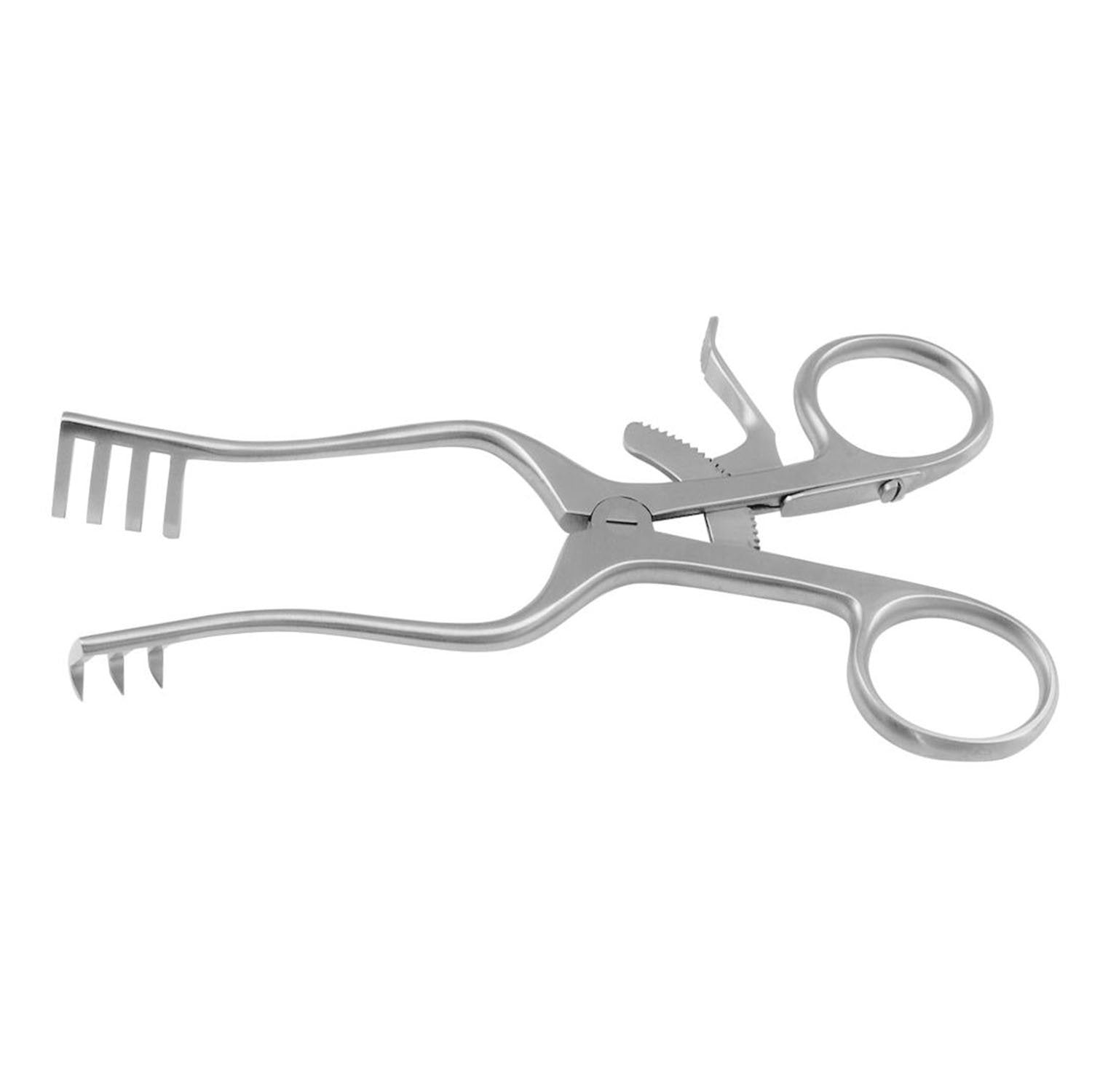
Identify the type of retractor shown in the image.
An Incisional wound heals by
Which type of surgical suture is known to cause the most tissue reaction?
What is the typical absorption duration of Polydioxanone sutures?
Which of the following is NOT a principle of negative pressure wound therapy?
Which of the following nerves is commonly damaged during McBurney's incision?
During abdominal surgery under local anesthesia, the patient suddenly felt pain due to
Which one of the following is used as a preservative for packing catgut suture?
What type of wound is characterized by the scraping away of the skin?
Explanation: ***Degraded by enzymatic degradation*** - Catgut sutures are **natural absorbable sutures** made primarily from purified collagen. - Their absorption in the body occurs through **enzymatic degradation** and phagocytosis, which is a key characteristic distinguishing them from synthetic absorbable sutures that undergo hydrolysis. *Made of cat submucosa* - While historically referred to as "catgut," these sutures are not actually made from cat intestines. - They are typically derived from the **submucosa of sheep or goat intestines**. *Not degraded* - Catgut sutures are explicitly classified as **absorbable surgical sutures**, as stated on the packaging. - Absorbable sutures by definition are designed to be broken down and **resorbed by the body** over time. *Made of rabbit submucosa* - Catgut sutures are not typically made from rabbit submucosa. - The primary sources for natural absorbable sutures like catgut are the **intestines of sheep or goats**.
Explanation: ***Weitlaner retractor*** - The image displays a **self-retaining retractor** with two sets of curved blades with sharp prongs, which is characteristic of a Weitlaner retractor. - **Weitlaner retractors** are commonly used in various surgical procedures, particularly in orthopedic, neurosurgical, and superficial soft tissue surgeries, to hold back wound edges for better visualization. - They feature a self-retaining mechanism with a ratchet lock and typically have 2-3 prongs on each blade. *Czerny retractor* - A **Czerny retractor** is a handheld, double-ended retractor with L-shaped blades of different sizes, not a self-retaining type as shown. - It is typically used for retracting shallow or superficial tissues in abdominal surgery. *Richardson retractor* - A **Richardson retractor** is a handheld, single-ended retractor with a curved lip, often used for deep tissue retraction in abdominal surgeries. - It does not have the self-retaining mechanism or multiple-pronged blades seen in the image. *Lower lid retractor* - A **lower lid retractor** is a small, specialized retractor designed for ophthalmic surgery to retract the eyelid, and its shape is distinct from the instrument shown. - It is much smaller and has a smooth, curved blade to fit the contour of the eyelid.
Explanation: ***Primary Healing*** - An **incisional wound** is typically a clean, sharply incised wound with **minimal tissue loss** and edges that can be approximated. - **Primary healing** (or first intention) occurs when the wound edges are surgically closed, leading to rapid healing with minimal scarring. *Secondary Healing* - This type of healing occurs in wounds with **significant tissue loss** or infection, where the edges cannot be approximated. - The wound must heal by **granulation tissue formation** and **wound contraction**, resulting in a larger scar. *Epithelialization* - **Epithelialization** is a vital process in all types of wound healing, where epithelial cells migrate to cover the wound surface. - However, it describes a *process* rather than a *mode* of overall wound healing for a closed incisional wound. *Delayed primary Healing* - **Delayed primary healing** (or tertiary intention) involves leaving a wound open for a period (e.g., to control infection or edema) before closing it surgically. - This approach is not typical for a clean incisional wound but is used in cases where primary closure is initially unsafe.
Explanation: ***Silk*** - Silk is a **natural, braided, non-absorbable suture** that is known to elicit a significant **inflammatory reaction** due to its natural protein composition and braided structure. - While it was historically used for its good handling properties, its high tissue reactivity makes it less ideal for situations where minimal scarring or inflammation is desired. - **Silk causes the most tissue reaction** among commonly used sutures. *Plain Catgut* - Plain catgut is a **natural, absorbable suture** derived from purified collagen of animal intestines, causing a moderate to high tissue reaction. - However, its absorption by enzymatic hydrolysis is relatively rapid, limiting the duration of the inflammatory response compared to non-absorbable natural materials like silk. *Polydiaxonone* - Polydiaxonone (PDS) is a **synthetic, monofilament, absorbable suture** known for causing a relatively **low tissue reaction**. - Its slow absorption profile and monofilament structure contribute to its minimal inflammatory response, making it suitable for tissues requiring prolonged support. *Chromic Catgut* - Chromic catgut is a treated form of plain catgut that has been coated with chromium salts, which prolong its absorption time and reduce its tissue reactivity compared to plain catgut. - Although it is still a natural, absorbable suture, its tissue reaction is **less than both plain catgut and silk**, but greater than synthetic monofilament sutures like PDS.
Explanation: ***Correct: 6 months*** - **Polydioxanone (PDS) sutures** are known for their **prolonged absorption time**, typically ranging from 180 to 210 days, or approximately 6 months. - This characteristic makes PDS sutures suitable for tissues requiring **extended support** during the healing process. - PDS retains approximately **50% tensile strength at 4 weeks** and **25% at 6 weeks**, with complete absorption occurring over 6-7 months. *Incorrect: 2 weeks* - An absorption duration of 2 weeks is characteristic of **rapidly absorbing sutures**, such as **chromic gut** or **fast-absorbing synthetic sutures**, which are used for tissues that heal quickly or require minimal support. - PDS sutures offer much longer tensile strength retention and absorption than this brief period. *Incorrect: 4 weeks* - A 4-week absorption time is considerably shorter than that of PDS sutures. This duration might be seen with some **intermediate-absorbing sutures**, but not with the long-lasting PDS. - Sutures absorbed in this timeframe would not provide sufficient support for tissues where PDS is typically indicated. *Incorrect: 6 weeks* - While longer than 2 or 4 weeks, 6 weeks (approximately 42 days) is still much shorter than the typical absorption profile of PDS sutures. - Sutures like **Vicryl Rapide** might fall into this absorption range, but PDS is designed for applications needing several months of support.
Explanation: ***Clearance of infection*** - While negative pressure wound therapy (NPWT) can help manage heavily colonized wounds by removing exudate and reducing bacterial burden, it is **not a primary treatment for active infection**. - **Systemic antibiotics** or local antiseptics are required to truly clear an infection, as NPWT alone cannot eliminate deep-seated pathogens. *Stabilization of wound environment* - NPWT helps to **stabilize the wound bed** by holding it in place, protecting it from external contamination and mechanical stress. - This creates an optimal environment for **wound healing** by preventing disruption of newly formed granulation tissue. *Macrodeformation of the wound* - The negative pressure applied to the wound surface causes the wound edges to be drawn together, leading to **macrodeformation**. - This effect reduces wound size and promotes **epithelialization** and **wound contraction**. *Decreased edema* - NPWT actively removes **excess interstitial fluid** and exudate from the wound bed, leading to a significant reduction in edema. - This reduction in swelling improves **perfusion** to the wound tissues and promotes better healing.
Explanation: ***Iliohypogastric nerve*** - The **iliohypogastric nerve** is most commonly injured during **McBurney's incision** due to its superficial position and transverse course at the level of the incision. - Damage can lead to **numbness** or altered sensation in the suprapubic region, and sometimes **weakness of the lower abdominal wall**. *Subcostal nerve* - The **subcostal nerve** (T12) runs inferior to the 12th rib and is generally superior to the typical site of a McBurney's incision. - Injury to this nerve is less common during this procedure compared to the iliohypogastric and ilioinguinal nerves. *10th thoracic nerve* - The **10th thoracic nerve** (T10) provides sensation around the umbilicus. - While it contributes to innervation of the abdominal wall, its location is typically well above the area of a standard McBurney's incision, making injury unlikely. *11th thoracic nerve* - The **11th thoracic nerve** (T11) innervates the abdominal wall and is located superior to the typical incision site for appendectomy. - Injury to T11 during a McBurney's incision is uncommon as the nerve's course lies cephalad to the surgical field.
Explanation: ***Parietal peritoneum*** - The **parietal peritoneum** is richly innervated by somatic nerves (**spinal nerves**), making it highly sensitive to pain, pressure, and temperature. - When stimulated during surgery, even under local anesthesia which might not completely block deeper somatic nerves or if the local block is inadequate, it can cause the patient to suddenly feel **sharp, localized pain**. *Liver* - The liver itself has very few pain receptors in its parenchyma; pain from the liver typically arises from stretching of its fibrous capsule (**Glisson's capsule**). - This pain is usually dull and poorly localized, not the sudden, sharp pain typically experienced during surgical manipulation. *Intestines* - The intestines are primarily innervated by the **autonomic nervous system** and are sensitive to distension and ischemia, causing visceral pain, which is typically dull, crampy, and poorly localized. - They are generally not sensitive to cutting or burning, which are common surgical manipulations. *Visceral peritoneum* - The **visceral peritoneum** covers abdominal organs and is innervated by the autonomic nervous system, similar to the organs it covers. - Like the intestines, it is sensitive to stretch and ischemia, producing diffuse, poorly localized visceral pain rather than sharp, localized pain from surgical incision or manipulation.
Explanation: ***Isopropyl alcohol*** - **Isopropyl alcohol** is commonly used as a preservative for **catgut sutures** due to its antiseptic and denaturing properties that prevent microbial growth and maintain the integrity of the biologic material. - It helps to keep the suture sterile and prevents degradation by enzymes or bacteria during storage. *Colloidal iodine* - **Colloidal iodine** is an antiseptic, but it is not typically used as a preservative for **catgut sutures**; it is more often used for skin preparation or wound disinfection. - Its reactivity and potential to stain or alter **suture material** make it less suitable for long-term preservation within the packaging. *Glutaraldehyde* - **Glutaraldehyde** is a potent disinfectant and sterilant, but it is generally too harsh for preserving **catgut sutures**; it can cause significant cross-linking and denaturation of proteins. - It is more commonly used for sterilizing heat-sensitive medical instruments like **endoscopes**, rather than for preserving **suture materials**. *Hydrogen peroxide* - **Hydrogen peroxide** is an oxidizing agent used as an antiseptic to clean wounds or as a sterilant, but it is not suitable for preserving **catgut sutures**. - Its oxidative action could degrade the **collagenous material** of the suture, compromising its strength and absorption properties.
Explanation: ***Abrasion*** - An **abrasion** is a wound caused by the **scraping or rubbing away of the superficial layers of the skin** (epidermis and sometimes superficial dermis). - It typically results from a fall or friction against a rough surface, common in children's scraped knees or elbows. *Superficial wound* - This is a **general term** and does not specifically describe the mechanism of injury as scraping. - A superficial wound could be a **minor cut or scratch** that doesn't involve scraping. *Tear in the skin* - A **tear in the skin** refers to a **laceration**, which is a wound caused by tearing of soft body tissue, often resulting in irregular edges. - This is distinct from the scraping action characteristic of an abrasion, where tissue is rubbed away rather than torn. *Deep tissue injury* - A **deep tissue injury (DTI)** is a **pressure-related injury** characterized by intact skin with **discoloration** (e.g., maroon or purple) or a blood-filled blister due to damage of underlying soft tissue. - It is not caused by external scraping and involves deeper tissue layers affected by prolonged pressure.
Wound Healing and Care
Practice Questions
Surgical Infections
Practice Questions
Fluid and Electrolyte Management
Practice Questions
Nutrition in Surgical Patients
Practice Questions
Hemostasis and Blood Transfusion
Practice Questions
Surgical Instruments and Equipment
Practice Questions
Sutures and Stapling Devices
Practice Questions
Minimal Access Surgery Principles
Practice Questions
Surgical Complications
Practice Questions
Anesthesia Principles for Surgeons
Practice Questions
Surgical Oncology Principles
Practice Questions
Evidence-Based Surgery
Practice Questions
Get full access to all questions, explanations, and performance tracking.
Start For Free