Which of the following is NOT a criterion for the viability of muscle?
Which nerve is most commonly damaged during hernia repair?
Multiple air fluid levels in X-ray of abdomen are seen in
Most common cause of acute abdomen in a young girl?
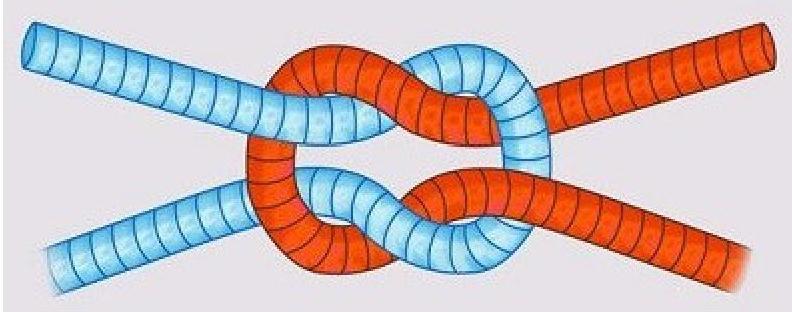
What type of knot is depicted in the image?
Which of the following is not a component of the Thoracoscore?
Identify the surgical instrument based on the following characteristics: short blades, sharp cutting edges, and a central screw or rivet. Commonly used for cutting sutures.
A person reports 4 hours after having a clean wound without laceration. He had taken TT 10 years before. The next step in management is:
Which of the following is a common indication for performing a tracheostomy?
Which of the following layers are cut during fasciotomy ?
Explanation: ***Intact fascia*** - The **fascia** is a connective tissue sheath surrounding muscles; its intactness is **not a direct indicator of muscle viability**. - While important for muscle integrity and function, a healthy, viable muscle can still exist even if its overlying fascia is disrupted or surgically opened. *Colour* - **Healthy muscle** generally has a **reddish-pink colour** due to its rich blood supply and myoglobin content. - **Pale, dusky, or black muscle** suggests **ischemia or necrosis**, indicating poor viability. *Contractility* - **Viable muscle** should be able to **contract** in response to direct electrical stimulation or mechanical irritation. - The **absence of contractility** indicates **muscle death or severe damage**, making it non-viable. *Bleeding when cut* - **Viable muscle** has an **intact blood supply** and will **bleed when incised**. - **Lack of bleeding** suggests **severe ischemia or necrosis**, indicating the muscle is non-viable.
Explanation: ***Ilioinguinal nerve*** - The **ilioinguinal nerve** runs in close proximity to the inguinal canal, making it vulnerable to injury during dissection and suture placement in hernia repair. - Damage can lead to **neuropathic pain**, a common complication in the groin and medial thigh region post-surgery. *Iliohypogastric nerve* - The **iliohypogastric nerve** is also superficial and can be injured, but less frequently than the ilioinguinal nerve. - Injury typically results in sensory deficits over the **suprapubic region** and upper part of the medial thigh. *Genitofemoral nerve* - The **genitofemoral nerve** typically lies deeper and more medially within the psoas muscle, making it less susceptible to direct injury during standard inguinal hernia repair. - Damage would primarily affect sensation in the **anterior thigh** and could impact the **cremasteric reflex**. *No nerve damage* - Although efforts are made to avoid nerve injury, the close anatomical relationship of several nerves to the inguinal canal means that **nerve damage is a recognized potential complication** of hernia repair, ranging from minor irritation to transection. - Post-herniorrhaphy **neuropathic pain** is a significant concern, directly attributable to nerve involvement.
Explanation: ***Intestinal obstruction*** - **Air fluid levels** are a classic radiographic sign of bowel obstruction, resulting from the accumulation of gas and fluid proximal to the obstructed segment. - The obstructed bowel segments fill with ingested air and digestive fluids, forming distinct horizontal fluid levels layered below gas bubbles, particularly evident on **erect or decubitus abdominal X-rays**. *Hollow viscera perforation* - This condition is characterized by the presence of **free air under the diaphragm** (pneumoperitoneum), not typically by multiple air-fluid levels within the bowel loops. - While fluid might extravasate, the primary radiographic finding is *free intraperitoneal gas*, indicating a breach in the luminal wall. *Pyoperitoneum* - Refers to the presence of **pus within the peritoneal cavity**, which would manifest as diffuse fluid accumulation rather than discrete air-fluid levels within bowel segments. - While gas might be present if associated with a gas-forming infection, it's not the primary or defining characteristic like the ordered air-fluid levels of obstruction. *None of the options* - This option is incorrect because **intestinal obstruction** is a well-established cause of multiple air-fluid levels on abdominal X-rays. - The other conditions listed do not typically present with this specific radiographic pattern as their primary or defining feature.
Explanation: ***Acute appendicitis*** - **Acute appendicitis** is the most common cause of acute abdomen in children and young adults, including young girls. - Its high incidence across this age group makes it the leading diagnosis for acute abdominal pain requiring surgical intervention. *Ovarian torsion* - While it can cause severe acute abdominal pain in young girls, **ovarian torsion** is less common than appendicitis. - It often presents with sudden onset, severe, unilateral lower abdominal pain, sometimes with a palpable mass. *Mittelschmerz* - "**Mittelschmerz**" refers to pelvic pain experienced by some women during ovulation, typically mid-cycle. - This is a physiological event, not an acute surgical emergency, and the pain is usually mild and self-limiting. *Renal colic* - **Renal colic** is caused by kidney stones and is characterized by severe, colicky pain radiating from the flank to the groin. - While possible, it is less common in young girls compared to appendicitis and often associated with urinary symptoms.
Explanation: ***Granny knot*** - The image shows a knot where the two half-knots are tied in the **same direction** (left over right, then left over right again, or vice versa), causing it to be unstable and slip. - This instability makes it less secure than a reef knot, as the two end pieces emerge parallel but on opposite sides of the loop. - The granny knot is an **insecure knot** that should be avoided in surgery as it can spontaneously untie. *Surgeon's knot* - A surgeon's knot involves an **extra throw** (double wrap) around the first loop to increase friction and make it more secure, which is not depicted here. - It is typically used to ensure that the first throw holds tension while the second throw is being tied. *Reef knot* - A reef knot (or square knot) is formed by tying two half-knots in **opposite directions** (left over right, then right over left), which creates a flat, stable, and secure knot. - In a reef knot, the two end pieces emerge parallel and on the same side of the loop, unlike the granny knot. *Half hitch* - A half hitch is a simple overhand knot around a standing part of the rope, used as a single throw or in combination with other knots. - It is not the same as the double-throw configuration shown in the image.
Explanation: ***Expected complications post-surgery*** - While patient risk assessment tools aim to predict surgical outcomes, the **Thoracoscore** specifically calculates risk based on present patient characteristics and surgical plan, not based on a list of expected complications. - Expected complications are a *result* of the risk score, not an input into its calculation. *ASA classifications* - The **American Society of Anesthesiologists (ASA) Physical Status Classification System** is a crucial component of the Thoracoscore, reflecting the patient's overall health status and comorbidity burden. - A higher ASA classification indicates greater surgical risk and contributes to the Thoracoscore calculation. *Surgery priorities* - **Surgery priority** (e.g., elective, urgent, emergency) is an important factor in the Thoracoscore, as urgent or emergent surgeries are associated with higher risk. - This parameter helps categorize the immediacy and complexity of the surgical intervention. *Performance status* - The patient's **performance status**, often assessed using scales like the Eastern Cooperative Oncology Group (ECOG) or Karnofsky, is a significant predictor of surgical outcome and is included in the Thoracoscore. - A lower performance status (indicating poorer functional capacity) increases the calculated surgical risk.
Explanation: ***Suture Scissors*** - Characterized by **short, sharp blades** and a central screw, making them ideal for precision cutting of sutures. - Their design allows for a **clean cut** through suture material without fraying, which is crucial in surgical settings. - Also known as **stitch scissors** or suture removal scissors, commonly used for cutting sutures during wound closure or suture removal. *Metzenbaum Scissors* - Known for their **long, slender shafts** and delicate blades, primarily used for **dissecting delicate tissues**. - Designed for blunt and sharp dissection of fine tissues rather than suture cutting. - Their longer, more delicate design makes them less ideal for the quick, precise cutting required for suture removal. *Mayo Scissors* - Possess **sturdy, heavy blades** that can be straight or curved, designed for cutting **tough tissues**, fascia, and heavy sutures. - Their robust construction is designed for cutting dense tissue rather than the fine, precise work of routine suture cutting. - Available in straight (for cutting sutures on skin) and curved (for cutting deep tissues) varieties. *Iris Scissors* - These are very **fine, delicate scissors** with extremely sharp, pointed tips, mainly used in **ophthalmic surgery** and other microsurgical procedures. - While they **can cut fine sutures** (6-0, 7-0) with precision, they are more specialized for delicate tissue dissection. - Their very fine tips make them less suitable as general-purpose suture scissors compared to dedicated stitch scissors.
Explanation: ***Single-dose TT*** - For a **clean wound** when the last **tetanus toxoid (TT)** was given **10 years ago**, a **booster dose** is indicated as the protective immunity duration is **10 years**. - **TT provides immunity for 10 years** for clean wounds; at the 10-year mark, the protective window has elapsed and requires a booster. *No need for any vaccine* - This would be correct only if the last TT dose was given **<10 years ago** (within the protective window). - At exactly **10 years**, the immunity has waned and a **booster is required** for continued protection against tetanus. *Full course Tetanus vaccine to be given* - A **complete primary series (3 doses)** is only indicated for patients who are **unimmunized** or have **unknown vaccination history**. - This patient has documented **prior TT immunization**, so only a **single booster dose** is needed, not a full course. *Full dose TT with TIG* - **Tetanus Immunoglobulin (TIG)** is reserved for **high-risk scenarios**: tetanus-prone wounds in patients with **inadequate immunization** (<3 doses) or **unknown vaccination status**. - For a **clean wound** with documented prior immunization, **TIG is unnecessary** and represents over-treatment.
Explanation: ***Prolonged mechanical ventilation requiring intubation for more than 7-10 days*** - The **most common indication** for tracheostomy is **prolonged mechanical ventilation** when endotracheal intubation is expected to extend beyond **7-10 days**. - Tracheostomy offers advantages over prolonged endotracheal intubation including: reduced **laryngeal injury**, improved **patient comfort**, easier **pulmonary toilet**, decreased sedation requirements, and facilitated **weaning from ventilator**. - This is the standard indication in ICU settings for patients with respiratory failure, neurological conditions, or post-operative states requiring extended ventilatory support. *Severe respiratory distress due to tracheal stenosis* - While **tracheal stenosis** can cause respiratory distress, the definitive treatment is surgical repair (e.g., **tracheal resection and anastomosis**) or **stenting**. - Tracheostomy may be used as a temporary measure or when definitive repair is not feasible, but it's not the most common indication. - The tracheostomy would need to be placed **below the level of stenosis** to be effective. *Severe airway obstruction due to a foreign body* - **Acute foreign body obstruction** requires immediate intervention: **Heimlich maneuver**, **direct laryngoscopy**, or **bronchoscopy** for removal. - Tracheostomy is a **last resort** only in cases of complete obstruction where intubation is impossible and other methods have failed. - This is an emergency procedure, not a common elective indication. *Chronic obstructive pulmonary disease (COPD) exacerbation* - COPD exacerbations are managed with **bronchodilators**, **steroids**, and if needed, **non-invasive positive pressure ventilation (NIPPV)** or **endotracheal intubation**. - Tracheostomy is not indicated for COPD exacerbation itself, though it may be considered if prolonged ventilation (>7-10 days) becomes necessary. - COPD alone is not an indication for tracheostomy.
Explanation: ***Skin+subcutaneous tissue+Superficial fascia+deep fascia*** - A **fasciotomy** is a surgical procedure to relieve **compartment syndrome** by releasing the **deep fascia** that constricts muscle compartments. - To access and incise the deep fascia, all overlying layers must be cut: **skin**, **subcutaneous tissue** (also called superficial fascia or hypodermis), and finally the **deep fascia** itself. - Note: "Superficial fascia" and "subcutaneous tissue" refer to the same anatomical layer, but both terms are listed here to reflect common clinical terminology. *Skin* - Cutting only the skin does not provide access to the deep fascia and cannot relieve compartment syndrome. - The skin is merely the outermost protective layer. *Skin+subcutaneous tissue* - While both these layers must be incised, stopping here leaves the **deep fascia** intact. - The deep fascia is the primary constricting structure in compartment syndrome and must be released. *Skin+subcutaneous tissue+Superficial fascia* - This option is anatomically redundant since superficial fascia and subcutaneous tissue are the same layer. - More importantly, this still does not include division of the **deep fascia**, which is essential for decompression in a true fasciotomy.
Wound Healing and Care
Practice Questions
Surgical Infections
Practice Questions
Fluid and Electrolyte Management
Practice Questions
Nutrition in Surgical Patients
Practice Questions
Hemostasis and Blood Transfusion
Practice Questions
Surgical Instruments and Equipment
Practice Questions
Sutures and Stapling Devices
Practice Questions
Minimal Access Surgery Principles
Practice Questions
Surgical Complications
Practice Questions
Anesthesia Principles for Surgeons
Practice Questions
Surgical Oncology Principles
Practice Questions
Evidence-Based Surgery
Practice Questions
Get full access to all questions, explanations, and performance tracking.
Start For Free