Which surgery is most likely to disturb the paracervical nerve plexus resulting in atonicity of the bladder?
Which of the following are tension-free inguinal hernia repairs? 1. Stoppa's repair 2. Lichtenstein's repair 3. Laparoscopic TEP repair 4. Desarda's repair.
When the hernia extends between the layers of abdominal wall muscles and not directly through them, it is called
Which of the following is the PRIMARY factor that predisposes to the development of incisional hernia?
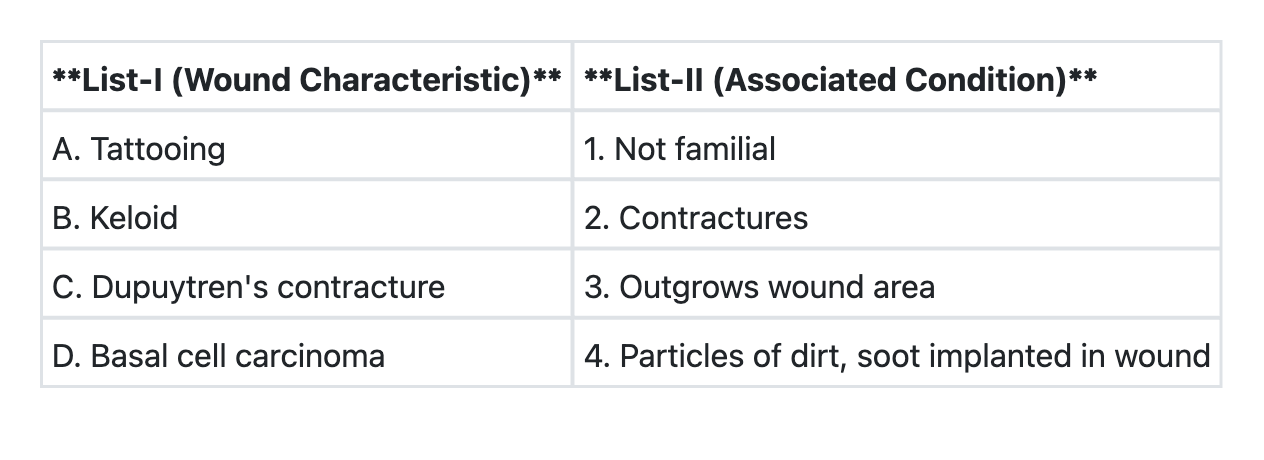
Match List-I with List-II and select the correct answer using the code given below the Lists: (Refer to the image for List-I and List-II)
Consider the following statements regarding splenectomy : 1. It corrects anemia in congenital hereditary spherocytosis. 2. Postponed until the age of 4 years if possible. 3. Polyvalent pneumococcal vaccine to be administered to all before the surgery. Which of the statements given above are correct ?
Splenectomy is best indicated for :
Which one of the following nerves is vulnerable to injury while conducting an appendicectomy through the McBurney's incision ?
Splenectomy is indicated in all of the following conditions, except
The term "debridement of the wound" refers to
Explanation: ***Radical hysterectomy*** - This procedure involves extensive dissection around the cervix and upper vagina, increasing the risk of **damage to the paracervical nerve plexus** (Frankenhäuser's plexus). - Damage to this autonomic plexus, which supplies the bladder, can lead to **atonicity** and urinary retention postoperatively due to disrupted innervation. *Simple hysterectomy* - A simple hysterectomy removes the uterus but preserves the parametrial tissues and hence the **paracervical nerve plexus**, minimizing the risk of bladder denervation. - While temporary bladder dysfunction can occur due to local trauma, long-term atonicity is less likely compared to radical procedures. *Myomectomy* - Myomectomy involves the surgical removal of uterine fibroids (myomas) while **preserving the uterus**. - This procedure generally involves minimal dissection in the vicinity of the paracervical nerve plexus, making bladder atonicity an uncommon complication. *Vaginal hysterectomy* - A vaginal hysterectomy removes the uterus through the vagina, with dissection primarily involving the uterosacral and cardinal ligaments. - Although there is some manipulation near the plexus, the **extent of dissection is typically less** than a radical hysterectomy, leading to a lower risk of complete denervation and atonicity.
Explanation: ***1, 2 and 3*** - **Stoppa's repair**, **Lichtenstein's repair**, and **Laparoscopic TEP repair** are all considered tension-free methods because they use mesh to reinforce the inguinal floor without putting tension on the surrounding tissues. - The use of mesh in these repairs distributes the tension across a wider area, minimizing pain and recurrence rates compared to traditional tension-based repairs. - **Desarda's repair** is excluded because it is a tissue-based (non-mesh) technique that uses the external oblique aponeurosis, and is NOT classified as a tension-free repair. *2, 3 and 4* - This option incorrectly excludes **Stoppa's repair**, which is a widely recognized tension-free technique using a large prosthetic mesh in the preperitoneal space. - **Desarda's repair** is incorrectly included as it is a tissue-based repair without mesh, not a tension-free technique. *1, 3 and 4* - This option incorrectly excludes **Lichtenstein's repair**, which is the most commonly performed tension-free open mesh repair for inguinal hernias. - It involves placing a prosthetic mesh over the defect without suturing muscle or fascia under tension. - **Desarda's repair** is incorrectly included as it does not use mesh and is not classified as tension-free. *1, 2 and 4* - This option incorrectly excludes **Laparoscopic TEP repair**, which is a minimally invasive tension-free approach utilizing mesh to reinforce the posterior wall of the inguinal canal in the preperitoneal space. - **Desarda's repair** is incorrectly included; while it aims to be physiological and mesh-free, it is a tissue-based technique and not a tension-free repair.
Explanation: ***Spigelian hernia*** - A **Spigelian hernia** occurs through a defect in the **Spigelian fascia**, extending between the transverse abdominis and internal oblique muscles. - It typically presents as a bulge between muscular layers, making it often **interparietal** and difficult to diagnose clinically due to its hidden nature. *Amyand's hernia* - This is a rare type of inguinal hernia that contains the **vermiform appendix** within the hernial sac. - It is notable for the potential complication of **appendicitis** within the hernia. *Richter's hernia* - A **Richter's hernia** involves only a portion of the circumference of the bowel wall becoming strangulated within the hernia orifice. - This can lead to **bowel necrosis** without complete obstruction, making diagnosis challenging. *Littre's hernia* - A **Littre's hernia** is characterized by the presence of a **Meckel's diverticulum** within the hernial sac. - It can occur in any hernia type (inguinal, femoral, umbilical) and carries a risk of diverticulitis or perforation.
Explanation: ***Postoperative wound infection*** - **Postoperative wound infection** is the **PRIMARY and most important modifiable risk factor** for incisional hernia development, increasing the risk by **2-4 fold**. - Infection causes **tissue necrosis**, **fascial disruption**, and **impaired collagen synthesis**, directly compromising the structural integrity of the wound closure. - The inflammatory response and proteolytic enzymes released during infection destroy newly formed collagen and prevent proper fascial healing. - This is consistently cited in major surgical textbooks (Sabiston, Schwartz) as the leading preventable cause of incisional hernias. *Malnutrition* - While malnutrition impairs wound healing by reducing collagen synthesis and tissue strength, it acts as a **background predisposing factor** rather than the primary cause [1]. - Protein deficiency affects overall tissue quality but typically requires additional factors (like infection) to result in hernia formation [1]. - Nutritional optimization is important perioperatively but is less directly causative than acute wound complications. *Immunocompromised patient* - Immunocompromise increases susceptibility to infection and impairs healing, but it is an indirect risk factor [1]. - The mechanism primarily operates through **increased infection risk** rather than being an independent primary cause [1]. *Non-absorbable suture material* - Suture material choice affects long-term stability and may influence chronic pain or foreign body reactions. - Current evidence shows **continuous non-absorbable sutures** are actually preferred for fascial closure to reduce hernia risk [1]. - This is a technical consideration but not a primary predisposing factor compared to wound complications.
Explanation: ***A→4, B→1, C→2, D→3*** **Correct Matching:** **Tattooing (A) → Foreign particles like dirt, soot (4)** - Tattooing refers to permanent skin discoloration caused by **foreign pigment insertion** into the dermis - Commonly occurs accidentally after trauma with **dirt, soot, gunpowder, or other foreign particles** - The particles become embedded in the skin causing permanent discoloration **Keloid (B) → Outgrows boundaries of original wound (1)** - A keloid is a **prominent raised scar** that extends beyond the margins of the original injury - Results from excessive collagen deposition during abnormal wound healing - **Key feature**: Growth exceeds the boundaries of the original wound area **Dupuytren's contracture (C) → Contractures (2)** - Progressive fibrosis of the **palmar fascia** leading to finger contractures - Causes permanent flexion deformity, typically affecting the ring and little fingers - Results in functional limitation due to **contracture formation** **Basal cell carcinoma (D) → Not familial (3)** - Most common skin malignancy, typically **sporadic** rather than familial - Associated with UV exposure, fair skin, and immunosuppression - Unlike some other cancers, **typically not inherited** in familial patterns *Incorrect Options:* *A→2, B→3, C→4, D→1* - Incorrectly matches tattooing with contractures and Dupuytren's with foreign particles *A→3, B→4, C→1, D→2* - Incorrectly matches tattooing with non-familial trait and keloid with foreign particles *A→1, B→2, C→3, D→4* - Incorrectly matches tattooing with outgrowing boundaries and basal cell carcinoma with foreign particles
Explanation: ***1, 2 and 3*** - **Splenectomy** is a definitive treatment for **hereditary spherocytosis**, as it removes the primary site of red blood cell destruction, thereby correcting the **anemia**. - Delaying splenectomy until after **4 years of age** reduces the risk of **overwhelming post-splenectomy infection (OPSI)**, allowing the child's immune system to mature. *Note: This reflects 2009 guidelines when this question was set. Current guidelines recommend postponing splenectomy until 5-6 years or even older (6-9 years) to further minimize OPSI risk.* - **Vaccination** against encapsulated bacteria like **Streptococcus pneumoniae** (using a polyvalent vaccine) is crucial before splenectomy to prevent severe infections, as the spleen plays a vital role in clearing these pathogens. *1 and 3 only* - This option is incorrect because it omits the important recommendation to **postpone splenectomy** until the child is older, which is a key part of managing hereditary spherocytosis in children. *2 and 3 only* - This option is incorrect because it fails to acknowledge that **splenectomy effectively corrects the anemia** in congenital hereditary spherocytosis by eliminating the site of premature red blood cell destruction, which is a primary indication for the procedure. *1 and 2 only* - This option is incorrect because it overlooks the critical need for **vaccination** against encapsulated bacteria **before splenectomy** to protect against life-threatening infections, a standard and essential practice.
Explanation: ***Hereditary spherocytosis*** - Splenectomy is a curative treatment for **hereditary spherocytosis** as it removes the primary site of red blood cell destruction. - It alleviates **anemia** and prevents complications such as **gallstones** by reducing hemolysis. *Cirrhosis liver with portal hypertension* - In cirrhosis with **portal hypertension**, splenectomy is generally not the primary treatment and may even worsen portal hypertension in some cases. - Management focuses on treating the underlying **liver disease** and its complications, such as **variceal bleeding**. *Sickle cell disease* - Splenectomy is generally avoided in **sickle cell disease** due to the increased risk of **overwhelming post-splenectomy sepsis** and other complications. - The primary approach is supportive care to manage crises, pain, and prevent infections. *Gaucher's disease* - **Gaucher's disease** involves the accumulation of glucocerebroside in various organs, including the spleen, often leading to **splenomegaly**. - Treatment primarily involves **enzyme replacement therapy (ERT)** and substrate reduction therapy, with splenectomy reserved for rare cases of severe symptoms unresponsive to medical therapy.
Explanation: ***Ilio-inguinal nerve*** - The **ilio-inguinal nerve** runs anterior to the **quadratus lumborum muscle** and enters the **transversus abdominis muscle**, lying between it and the internal oblique muscle. It is especially vulnerable at the lateral edge of the **rectus abdominis.** - **McBurney's incision**, which is an **oblique incision** in the **right lower quadrant**, may damage the ilioinguinal nerve as it exits the deep inguinal ring. *Subcostal nerve* - The **subcostal nerve** is the ventral ramus of **T12**, and it runs inferior to the **12th rib**. - It usually lies significantly superior to the **McBurney’s incision** site, making injury unlikely during this specific procedure. *Lateral cutaneous nerve of the thigh* - The **lateral cutaneous nerve of the thigh** arises from the **lumbar plexus (L2-L3)** and innervates the skin of the lateral thigh. - It traverses near the **anterior superior iliac spine**, which is not typically within the primary field of a **McBurney’s incision**. *Genitofemoral nerve* - The **genitofemoral nerve** originates from the **L1 and L2 spinal nerves** and descends retroperitoneally. - It is located deep and medial to the region of **McBurney’s incision**, making direct injury during this superficial abdominal incision less probable.
Explanation: ***Hydatid cyst of the spleen*** - **Splenectomy** is generally **NOT indicated** as first-line treatment for uncomplicated **hydatid cysts** of the spleen. - The primary concern is the **risk of spillage of cyst contents**, which can lead to **anaphylactic shock** or **disseminated echinococcosis** (secondary hydatid disease). - **Conservative organ-preserving approaches** are strongly preferred, including **PAIR** (Puncture, Aspiration, Injection, Reaspiration, and Drainage) or **pericystectomy** (removing cyst with its pericyst while preserving spleen). - Splenectomy may only be considered in complicated cases (rupture, secondary infection, or inability to preserve spleen tissue), but it is NOT a routine indication. *Hereditary spherocytosis* - **Splenectomy** is the **definitive treatment** for **hereditary spherocytosis** to reduce hemolysis and alleviate symptoms like anemia, jaundice, and splenomegaly. - The spleen is the primary site of destruction of the abnormally shaped red blood cells, so its removal significantly prolongs red blood cell lifespan. - Typically performed after age 5-6 years to reduce infection risk. *Idiopathic thrombocytopenic purpura* - **Splenectomy** is indicated in cases of **chronic refractory ITP** that do not respond to medical therapy (e.g., corticosteroids, IVIG, rituximab). - The spleen is the primary site of **platelet destruction** and **autoantibody production** against platelets in ITP. - Splenectomy achieves remission in approximately 60-70% of patients with chronic ITP. *Myelofibrosis* - **Splenectomy** may be indicated in **myelofibrosis** for severe, symptomatic **splenomegaly** causing debilitating pain, early satiety, cachexia, or mechanical complications. - Also indicated for refractory cytopenias requiring frequent transfusions or severe portal hypertension. - It can alleviate pressure symptoms and reduce the metabolic demands of a massively enlarged spleen, improving quality of life.
Explanation: ***Laying open all layers of the wound and excision of the devitalized tissue*** - **Debridement** specifically involves surgically removing **necrotic (devitalized)** or infected tissue from a wound to promote healing. - This process often requires **laying open all layers** to ensure complete removal of contaminated or dead tissue. *Irrigation and cleaning of the wound* - While **irrigation and cleaning** are components of wound care, they are considered primary steps in **wound prep** and are not synonymous with the complete surgical removal of devitalized tissue. - This option describes a more superficial cleaning rather than the definitive removal of non-viable tissue. *Closure of wound in layers* - **Wound closure in layers** is a step performed *after* debridement and cleaning, as part of the reconstructive phase of wound management. - This refers to the technique used to approximate tissues and is not part of the tissue removal process itself. *Clean excision of at least 1 mm of skin from the edge of the wound* - This describes **wound excision** or **surgical de-epithelialization** which may be performed for specific wound conditions or cosmetic purposes, but not primarily to remove devitalized tissue from the wound bed. - The focus here is on healthy tissue at the wound margins, not the non-viable tissue within the wound.
Wound Healing and Care
Practice Questions
Surgical Infections
Practice Questions
Fluid and Electrolyte Management
Practice Questions
Nutrition in Surgical Patients
Practice Questions
Hemostasis and Blood Transfusion
Practice Questions
Surgical Instruments and Equipment
Practice Questions
Sutures and Stapling Devices
Practice Questions
Minimal Access Surgery Principles
Practice Questions
Surgical Complications
Practice Questions
Anesthesia Principles for Surgeons
Practice Questions
Surgical Oncology Principles
Practice Questions
Evidence-Based Surgery
Practice Questions
Get full access to all questions, explanations, and performance tracking.
Start For Free