All of the following statements are true about qSOFA except?
What is the innermost layer of a hydatid cyst?
Antibioma is best treated by?
In the Lingual split technique, which instrument is used to cut the tooth?
Retractile mesenteritis may be seen in which of the following conditions?
Which of the following is the most common type of splenic cyst?
The Abbe estender flap is based on which artery?
Which of the following is TRUE?
Impacted wisdom teeth may produce referred pain via which nerve?
What is true about hydatid disease?
Explanation: The **qSOFA (quick Sequential Organ Failure Assessment)** score was introduced by the Sepsis-3 definitions to identify patients outside the ICU who are at high risk for poor outcomes. **Explanation of the Correct Answer (Option B):** Option B is the incorrect statement because the threshold for systolic blood pressure (SBP) is **≤ 100 mmHg**, not < 110 mmHg. The three specific criteria for qSOFA are: 1. **Respiratory Rate:** ≥ 22 breaths per minute. 2. **Altered Mentation:** Glasgow Coma Scale (GCS) score < 15. 3. **Systolic Blood Pressure:** ≤ 100 mmHg. A score of **≥ 2** indicates a high risk of mortality or prolonged ICU stay. **Analysis of Other Options:** * **Option A:** True. qSOFA is a bedside tool used to identify patients with suspected infection who are likely to have a prolonged ICU stay or die in the hospital. * **Option C:** True. A qSOFA score of 3 is associated with a significantly high mortality rate, often exceeding 20-25% (thus, "over 10%" is a true statement). * **Option D:** True. Patients with a qSOFA score of 1 have a low but measurable baseline mortality risk, typically cited around 2-3%. **High-Yield Clinical Pearls for NEET-PG:** * **Sepsis-3 Definition:** Sepsis is now defined as life-threatening organ dysfunction caused by a dysregulated host response to infection (SOFA score increase of ≥ 2). * **SIRS vs. qSOFA:** Unlike the older SIRS criteria, qSOFA does **not** include temperature or white blood cell count. * **Septic Shock:** Defined as sepsis requiring vasopressors to maintain MAP ≥ 65 mmHg AND having a serum lactate level > 2 mmol/L despite adequate fluid resuscitation.
Explanation: A hydatid cyst, caused by the larval stage of *Echinococcus granulosus*, consists of three distinct layers. Understanding these layers is crucial for surgical management and NEET-PG preparation. ### **1. Why Endocyst is Correct** The **Endocyst** (Germinal layer) is the **innermost** layer. It is a thin, delicate, transparent membrane (only 10–25 μm thick). It is the only **living** part of the cyst wall and is responsible for: * Producing the hydatid fluid. * Forming the ectocyst. * Asexual reproduction of **brood capsules** and **scolices** (infective units). ### **2. Why Other Options are Incorrect** * **Pericyst (Option A):** This is the **outermost** layer. It is a thick, fibrous protective capsule formed by the **host’s inflammatory response** to the parasite. It is not part of the parasite itself. In the lungs, the pericyst is often thin due to lack of host tissue resistance. * **Ectocyst (Option B):** Also known as the **Laminated membrane**, this is the **middle** layer. It is a tough, white, elastic, non-cellular layer produced by the parasite. It acts as a filter for nutrients and protects the germinal layer. ### **3. Clinical Pearls for NEET-PG** * **Surgical Principle:** During surgery (e.g., Lagrot’s procedure), the goal is to remove the **Endocyst and Ectocyst** (together called the **Endocyst** in some texts, or the "parasitic membranes") while leaving the **Pericyst** intact to avoid injury to host organs/vessels. * **Water-Lily Sign:** Seen on imaging when the endocyst/ectocyst collapses and floats within the pericyst (indicates a ruptured cyst). * **Scolicidal Agents:** Used to kill the germinal layer before aspiration (e.g., 20% Hypertonic saline, 0.5% Silver nitrate, or 10% Povidone-iodine). **Formalin** is no longer used due to the risk of sclerosing cholangitis.
Explanation: **Explanation:** An **Antibioma** is a chronic, non-tender, firm inflammatory mass that develops when an abscess is treated with antibiotics without adequate surgical drainage. The antibiotics sterilize the pus or suppress the acute infection, but the body fails to resorb the debris, leading to the formation of a thick, fibrous capsule around the inspissated material. **Why Complete Resection is the Correct Answer:** Once a thick fibrous wall has formed, the lesion becomes "walled off." Antibiotics cannot penetrate this dense capsule in therapeutic concentrations, and the body cannot naturally resolve the mass. Therefore, **complete surgical excision (resection)** of the mass along with its fibrous capsule is the definitive treatment to ensure complete resolution and prevent recurrence. **Analysis of Incorrect Options:** * **Partial Resection:** This is inadequate as leaving behind any portion of the infected/fibrous tissue leads to persistent inflammation or sinus formation. * **Aspiration:** The contents of an antibioma are often thick, inspissated, or organized. Simple needle aspiration is usually unsuccessful because the material is too viscous to be drawn through a needle and the thick wall remains intact. * **Administration of Antibiotics:** This is the original cause of the condition. Further antibiotic therapy is ineffective because the lack of vascularity in the fibrous capsule prevents the drug from reaching the core of the mass. **Clinical Pearls for NEET-PG:** * **Classic Presentation:** A patient with a history of a painful swelling (abscess) that became painless and firm after taking antibiotics, but never fully disappeared. * **Common Site:** Often seen in the breast (following mastitis) or in the gluteal region (following injection abscesses). * **Key Concept:** "Pus anywhere must be drained." Antibioma is a classic example of the failure of this surgical principle.
Explanation: The **Lingual Split Technique** (originally described by Sir William Kelsey Fry) is a classic surgical method used for the removal of impacted mandibular third molars. ### **Why Chisel is the Correct Answer** The fundamental principle of the Lingual Split Technique is to remove the thin plate of bone on the lingual aspect of the mandible to facilitate tooth delivery. A **chisel** is specifically used because it is designed to cut and split bone or teeth along natural grain lines. In this technique, a sharp chisel and mallet are used to perform a "disto-lingual" bone cut, which allows the lingual plate to be fractured or "split" away, providing a clear path for the tooth. ### **Analysis of Incorrect Options** * **B. Osteotome:** Unlike a chisel (which is beveled on one side for cutting), an osteotome is beveled on both sides and is primarily used for compressing or widening bone rather than splitting it cleanly. * **C. Straight Elevator:** This is a luxating instrument used to disrupt the periodontal ligament and lift the tooth from its socket, not for cutting the tooth or bone. * **D. Surgical Bur:** While burs are used in the "Bur Technique" (modern surgical extraction) to remove bone and section teeth, the Lingual Split Technique is defined by its use of hand instruments (chisel and mallet) to avoid the heat generation and potential emphysema associated with high-speed drills. ### **High-Yield Clinical Pearls for NEET-PG** * **Indication:** Most commonly used for disto-angular or vertically impacted mandibular third molars in young patients where the bone is elastic. * **Advantage:** Faster than the bur technique and avoids thermal damage to the bone. * **Complication:** The most significant risk associated with this technique is **Lingual Nerve injury** due to the proximity of the nerve to the lingual plate. * **Key Instrument:** Always associate "Lingual Split" with the **Chisel and Mallet**.
Explanation: **Explanation:** **Retractile mesenteritis** (also known as sclerosing mesenteritis) is a rare, non-neoplastic inflammatory condition characterized by chronic inflammation, fat necrosis, and eventual fibrosis of the mesenteric adipose tissue. It is part of a spectrum of **IgG4-related systemic diseases**. **Why Option A is Correct:** **Ormond’s disease** (Idiopathic Retroperitoneal Fibrosis) is a condition where abnormal fibro-inflammatory tissue proliferates in the retroperitoneum. Both retractile mesenteritis and Ormond’s disease are considered manifestations of **systemic sclerosing syndromes**. They share a common pathophysiology involving idiopathic fibroblastic proliferation and are frequently associated with each other or other fibrosing conditions like Riedel’s thyroiditis and sclerosing cholangitis. **Why the Other Options are Incorrect:** * **B. Gardner’s Syndrome:** This is a variant of Familial Adenomatous Polyposis (FAP) characterized by colonic polyps, osteomas, and soft tissue tumors (like **desmoid tumors**). While desmoid tumors can occur in the mesentery, they are distinct neoplastic entities, not inflammatory retractile mesenteritis. * **C. Turner’s Syndrome:** A chromosomal anomaly (45, XO) associated with streak ovaries, webbed neck, and coarctation of the aorta. It has no association with mesenteric fibrosis. * **D. Down’s Syndrome:** A trisomy 21 condition associated with duodenal atresia and Hirschsprung disease, but not with sclerosing mesenteritis. **High-Yield Clinical Pearls for NEET-PG:** * **Clinical Presentation:** Often presents with vague abdominal pain, a palpable mass, or intestinal obstruction. * **Radiological Sign:** On CT, it may show the **"Fat Ring Sign"** (preservation of fat around mesenteric vessels) or a **"Tumoral Pseudocapsule."** * **Association:** Always look for other IgG4-related diseases if retractile mesenteritis is mentioned. * **Treatment:** Usually conservative; steroids, tamoxifen, or immunosuppressants are used in symptomatic cases.
Explanation: **Explanation:** Splenic cysts are relatively uncommon clinical entities, but they are frequently tested in surgical exams. They are broadly classified into **Primary (True) cysts**, which possess an epithelial lining, and **Secondary (False) cysts**, which lack one. **Why Pseudocyst is correct:** **Pseudocysts (Secondary cysts)** are the most common type of splenic cyst, accounting for approximately **75-80% of all non-parasitic splenic cysts**. They typically develop as a late complication of **blunt abdominal trauma**, which leads to an intraparenchymal or subcapsular hematoma that subsequently liquefies and develops a fibrous wall without an epithelial lining. **Analysis of Incorrect Options:** * **Parasitic infection (Option C):** While *Echinococcus granulosus* (Hydatid disease) is the most common cause of **true** splenic cysts worldwide (especially in endemic areas), it is less common than post-traumatic pseudocysts globally. * **Congenital anomaly (Option D):** These are "True cysts" (Epidermoid cysts) present from birth. They are lined by squamous epithelium and are the most common type of primary non-parasitic cyst, but they are rarer than pseudocysts. * **Bacterial infection (Option A):** Bacterial infections of the spleen usually result in **splenic abscesses** rather than simple cysts. **High-Yield Clinical Pearls for NEET-PG:** * **Most common cause of splenic cyst overall:** Pseudocyst (Post-traumatic). * **Most common "True" cyst:** Epidermoid cyst (Congenital). * **Tumor Marker:** Epidermoid cysts may show elevated serum **CA 19-9** levels. * **Management:** Small, asymptomatic cysts (<5 cm) are managed conservatively. Large or symptomatic cysts require surgical intervention (preferably **partial splenectomy** or cyst decortication to preserve splenic immune function).
Explanation: The **Abbe flap** (also known as the lip-switch flap or Estlander flap when involving the commissure) is a classic pedicled flap used for the reconstruction of full-thickness lip defects. ### Why Labial Artery is Correct The anatomical basis of the Abbe flap is the **labial artery** (specifically the superior or inferior labial artery). These arteries run within the orbicularis oris muscle, approximately 2–3 mm deep to the mucosal surface and just above the vermilion border. Because the labial arteries form a robust anastomotic circle around the mouth, a flap can be harvested from one lip and rotated 180 degrees into a defect on the opposing lip while remaining viable on a narrow vascular pedicle containing the artery. ### Why Other Options are Incorrect * **A. Lingual artery:** Supplies the tongue and floor of the mouth; it does not provide the superficial circulation required for lip flaps. * **B. Facial artery:** While the labial arteries are branches of the facial artery, the specific pedicle for the Abbe flap is the **labial branch** itself. In surgical exams, the most distal/specific vessel is the preferred answer. * **C. Internal maxillary artery:** Supplies deep facial structures, the maxilla, and teeth via branches like the infraorbital artery, but is not the primary supply for a lip-switch procedure. ### High-Yield Clinical Pearls for NEET-PG * **Abbe vs. Estlander:** The **Abbe flap** is used for central lip defects (does not involve the commissure). The **Estlander flap** is used for defects involving the oral commissure (corner of the mouth). * **Two-stage procedure:** The Abbe flap requires a second surgery (usually after 2–3 weeks) to divide the vascular pedicle once the flap has neovascularized from the recipient site. * **Innervation:** The flap is initially denervated; sensory and motor recovery takes several months.
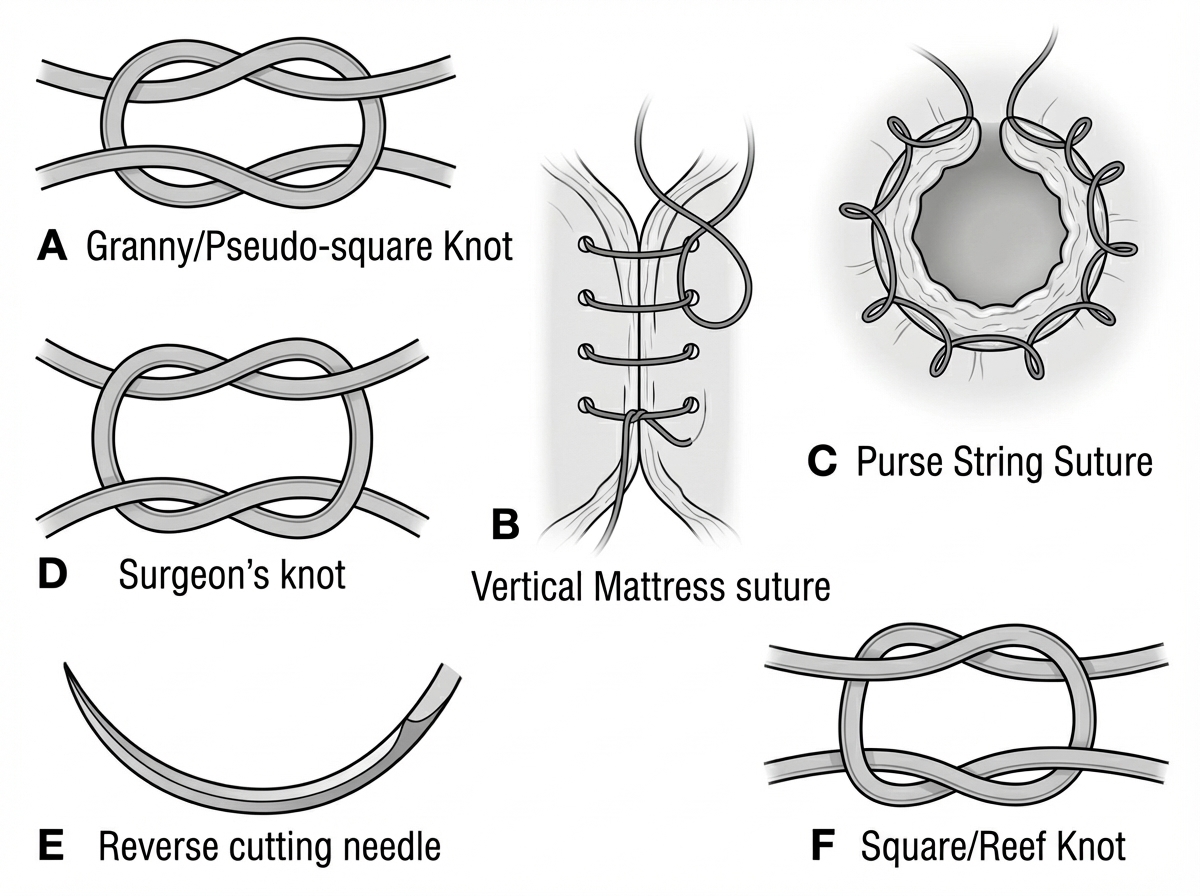
Explanation: ***Square (Reef) Knot - F; Surgeons Knot - D; Granny (Pseudo-square) Knot - A; Reverse cutting needle - E; Vertical Mattress - B; Purse String Suture - C*** - The **Square (Reef) Knot** is properly identified as F, showing the classic symmetrical configuration with both free ends lying parallel to the standing lines on the same side. - The **Surgeon's Knot** is correctly labeled as D, demonstrating the characteristic double throw on the first pass followed by a single throw, providing enhanced security during tying. *Square (Reef) Knot - D; Surgeons Knot - F; Granny (Pseudo-square) Knot - A; Reverse cutting needle - E; Vertical Mattress - B; Purse String Suture - C* - Incorrectly identifies the **Square Knot** as D, which actually shows the **Surgeon's Knot** with its double initial throw configuration. - Misplaces the **Surgeon's Knot** as F, which demonstrates the symmetrical **Square Knot** pattern instead. *Square (Reef) Knot - A; Surgeons Knot - D; Granny (Pseudo-square) Knot - F; Reverse cutting needle - E; Vertical Mattress - B; Purse String Suture - C* - Incorrectly labels the **Square Knot** as A, which shows the asymmetrical **Granny Knot** with crossing pattern that makes it prone to slipping. - Misidentifies the **Granny Knot** as F, which actually displays the secure **Square Knot** configuration. *Square (Reef) Knot - F; Surgeons Knot - A; Granny (Pseudo-square) Knot - D; Reverse cutting needle - E; Vertical Mattress - B; Purse String Suture - C* - Incorrectly places the **Surgeon's Knot** as A, which shows the insecure **Granny Knot** pattern that lacks the double initial throw. - Misidentifies the **Granny Knot** as D, which actually demonstrates the **Surgeon's Knot** with its characteristic enhanced security features.
Explanation: **Explanation:** The correct answer is **C. Branch of the auriculotemporal nerve.** **1. Why the Auriculotemporal Nerve is correct:** Referred pain occurs when sensory fibers from two different areas converge on the same neurological pathway. The mandibular molar teeth (including impacted wisdom teeth) are innervated by the **inferior alveolar nerve**, which is a branch of the **mandibular division of the Trigeminal nerve (V3)**. The **auriculotemporal nerve** is also a branch of V3. When an impacted wisdom tooth causes inflammation or pressure, the pain signals travel via the inferior alveolar nerve to the mandibular nucleus. Due to the common origin (V3), the brain may misinterpret these signals as coming from other areas supplied by the same division. Specifically, the auriculotemporal nerve supplies the **External Auditory Meatus (EAM)** and the **Temporomandibular Joint (TMJ)**. This is why patients with impacted wisdom teeth often present with "earache" despite having a healthy ear. **2. Why other options are incorrect:** * **Lingual Nerve:** While this is a branch of V3 and provides sensory innervation to the anterior two-thirds of the tongue and floor of the mouth, it is not the primary mediator for referred ear pain from dental impaction. * **Facial Nerve (CN VII):** This is primarily a motor nerve for the muscles of facial expression. While it has a small sensory component (nervus intermedius), it does not supply the teeth or the primary areas associated with dental referred pain. **3. Clinical Pearls for NEET-PG:** * **Hilton’s Law:** A nerve supplying a joint also supplies the muscles moving the joint and the skin over the insertion of those muscles. * **Other common referred pains:** * Diaphragmatic irritation (Phrenic nerve) refers to the **shoulder (C3-C5)**. * Myocardial Infarction refers to the **left jaw or inner arm (T1-T5)**. * Otalgia (ear pain) can be referred from the tongue or throat via the **Glossopharyngeal nerve (CN IX)**.
Explanation: Hydatid disease (Cystic Echinococcosis) is caused by the larval stage of *Echinococcus granulosus*. Understanding its management and characteristics is high-yield for NEET-PG. ### **Explanation of Options** * **Option C (Correct):** Scolicidal agents are used during surgery (especially during the PAIR procedure) to kill the infective protoscolices and prevent secondary hydatidosis due to accidental spillage. **20% Hypertonic saline** is the most commonly used scolicidal agent. Other agents include 0.5% silver nitrate, 95% ethyl alcohol, and cetrimide. * **Option A (Incorrect):** The **liver** is the most common site (approx. 75%), followed by the lungs (15%). The parasite enters the portal circulation from the intestine, making the liver the first "filter." * **Option B (Incorrect):** While Albendazole is used, the "treatment of choice" depends on the WHO classification (Gharbi’s). For large, symptomatic cysts, surgery or **PAIR** (Puncture, Aspiration, Injection, Re-aspiration) is preferred. Albendazole is typically started 1–4 weeks preoperatively and continued for 1–3 months postoperatively to reduce cyst pressure and prevent recurrence. ### **Clinical Pearls for NEET-PG** * **Diagnosis:** Ultrasound is the gold standard for screening and classification. Look for the **"Water-lily sign"** (detached endocyst) or **"Wheel-spoke appearance"** (daughter cysts). * **Casoni’s Test:** An immediate hypersensitivity skin test, now largely replaced by ELISA (high sensitivity) for serology. * **PAIR Contraindications:** Avoid PAIR in superficial cysts (risk of rupture), biliary communication, or inactive/calcified cysts (CE4/CE5). * **Complication:** The most dreaded complication of cyst rupture or spillage during surgery is **Anaphylactic shock**. Always keep hydrocortisone and adrenaline ready.
Wound Healing and Care
Practice Questions
Surgical Infections
Practice Questions
Fluid and Electrolyte Management
Practice Questions
Nutrition in Surgical Patients
Practice Questions
Hemostasis and Blood Transfusion
Practice Questions
Surgical Instruments and Equipment
Practice Questions
Sutures and Stapling Devices
Practice Questions
Minimal Access Surgery Principles
Practice Questions
Surgical Complications
Practice Questions
Anesthesia Principles for Surgeons
Practice Questions
Surgical Oncology Principles
Practice Questions
Evidence-Based Surgery
Practice Questions
Get full access to all questions, explanations, and performance tracking.
Start For Free