Carnoy's solution is used in the treatment of which of the following conditions?
Which of the following is the characteristic content of Littre's hernia?
What is the most common site for a thyroglossal cyst?
Which tumour is not typically found in the anterior mediastinum?
Which one of the following conditions can complicate as hyperchloremic acidosis?
What is the most pathognomic sign in pelvic abscess?
What is the most common site of a subphrenic abscess?
Which of the following is most ideal when sealing a vessel?
True about malignant melanoma?
Lung volume reduction operations have been developed as a method of managing patients with which of the following conditions?
Explanation: **Explanation:** **Carnoy’s solution** is a potent chemical cauterizing agent used as an adjuvant therapy in the surgical management of **Odontogenic Keratocysts (OKC)**. OKCs are known for their aggressive behavior and high recurrence rates (up to 30-60% with simple enucleation) due to the presence of "daughter cysts" or "satellite cysts" in the bony wall. 1. **Why Option A is Correct:** After the surgical enucleation of an OKC, Carnoy’s solution is applied to the bony cavity for 3–5 minutes. It penetrates the bone to a depth of approximately 1.5 mm, effectively killing any remaining epithelial remnants or satellite cysts, thereby significantly reducing the risk of recurrence. 2. **Why Other Options are Incorrect:** * **Ameloblastoma (Option B):** While aggressive, the standard of care is wide surgical resection (segmental or marginal) with 1–1.5 cm margins. Carnoy’s is occasionally used for the unicystic variant, but it is classically associated with OKC in exams. * **Dentigerous Cyst (Option C):** These are developmental cysts associated with the crown of an unerupted tooth. They have low recurrence rates and are successfully treated by simple enucleation without the need for chemical cautery. * **Mucocele (Option D):** These are minor salivary gland lesions (mucus extravasation) treated by simple excision of the gland; chemical cautery is not indicated. **High-Yield Clinical Pearls for NEET-PG:** * **Composition of Carnoy’s Solution:** Absolute alcohol (6ml), Chloroform (3ml), Glacial acetic acid (1ml), and Ferric chloride (1g). * **Modified Carnoy’s:** Due to the carcinogenic potential of Chloroform, it is often omitted in modern practice. * **Complication:** Care must be taken to avoid contact with the **inferior alveolar nerve**, as it can cause permanent paresthesia. * **OKC Association:** Frequently associated with **Gorlin-Goltz Syndrome** (Nevoid Basal Cell Carcinoma Syndrome).
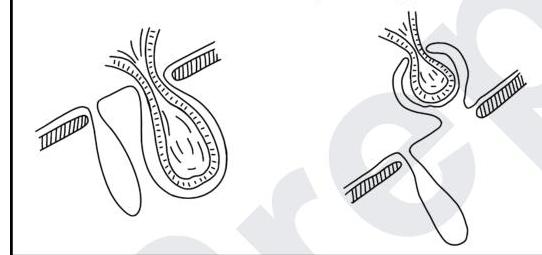
Explanation: **Explanation:** **Littre’s hernia** is defined as the presence of a **Meckel’s diverticulum** within a hernia sac. It most commonly occurs in inguinal hernias (50%), followed by femoral and umbilical hernias. Because Meckel’s diverticulum is a true diverticulum (containing all layers of the intestinal wall), it can become incarcerated, inflamed, or perforated within the hernia sac, often presenting with symptoms of strangulation without signs of complete intestinal obstruction. **Analysis of Options:** * **Option A (Urinary bladder):** When the bladder forms part of the wall of a hernia sac, it is termed a **Sliding Hernia**. This is common in direct inguinal hernias in elderly males. * **Option C (Circumference of intestinal wall):** A hernia involving only a portion of the antimesenteric circumference of the bowel wall is called a **Richter’s hernia**. It is dangerous because strangulation can occur without causing mechanical bowel obstruction. * **Option D (Appendix):** When the vermiform appendix is found within an inguinal hernia sac, it is called **Amyand’s hernia**. If the appendix is found within a femoral hernia sac, it is known as **De Garengeot hernia**. **High-Yield Clinical Pearls for NEET-PG:** * **Meckel’s Diverticulum Rule of 2s:** 2% of the population, 2 feet from the ileocecal valve, 2 inches long, 2 types of ectopic tissue (gastric and pancreatic), and usually presents by age 2. * **Maydl’s Hernia:** A "W-shaped" hernia containing two loops of bowel in the sac with a central loop remaining in the abdomen; the intra-abdominal loop is at highest risk for strangulation. * **Pantaloon Hernia:** Co-existence of direct and indirect inguinal hernia sacs on the same side, straddling the inferior epigastric vessels.
Explanation: ### Explanation **1. Why Subhyoid is Correct:** The thyroglossal duct cyst (TGDC) is the most common congenital neck swelling. It develops from a persistent remnant of the thyroglossal duct, which marks the descent of the thyroid gland from the foramen caecum to its final pre-tracheal position. While a cyst can form anywhere along this tract, the **subhyoid region** (just below the hyoid bone) is the most common site, accounting for approximately **65-85%** of cases. This is primarily because the duct often forms a loop (the duct of Bochdalek) behind or through the hyoid bone, creating a site of anatomical stasis. **2. Analysis of Incorrect Options:** * **Suprahyoid region (A):** This is the second most common site (approx. 20-25%) but occurs less frequently than the subhyoid location. * **Foramen caecum (C):** This is the site of origin of the duct at the base of the tongue. Cysts here are rare (lingual thyroglossal cysts) and can cause airway obstruction or dysphagia. * **Anterior border of sternomastoid (D):** This is the classic location for a **Branchial Cyst** (specifically the second branchial cleft cyst), not a thyroglossal cyst. TGDCs are characteristically midline structures. **3. Clinical Pearls for NEET-PG:** * **Pathognomonic Sign:** The cyst moves upward on **protrusion of the tongue** (due to its attachment to the hyoid bone via the tract) and on deglutition (swallowing). * **Surgical Management:** The treatment of choice is the **Sistrunk Operation**. This involves excision of the cyst, the entire tract, and the **central part of the hyoid bone** to minimize the high risk of recurrence. * **Ectopic Thyroid:** Always perform an ultrasound before surgery to ensure the cyst is not the patient’s only functioning thyroid tissue. * **Malignancy:** Though rare (<1%), the most common cancer arising in a TGDC is **Papillary Thyroid Carcinoma**.
Explanation: ### Explanation The mediastinum is anatomically divided into compartments, each associated with specific characteristic pathologies. The **anterior mediastinum** is the space bounded by the sternum anteriorly and the pericardium/great vessels posteriorly. #### Why Neurofibroma is the Correct Answer **Neurofibroma** is a nerve sheath tumor. In the mediastinum, neurogenic tumors (including neurofibromas, schwannomas, and ganglioneuromas) are almost exclusively found in the **posterior mediastinum**, arising from the paravertebral sympathetic chain or intercostal nerves. Therefore, it is not a typical finding in the anterior compartment. #### Analysis of Incorrect Options (The "4 Ts" of Anterior Mediastinum) The differential diagnosis for an anterior mediastinal mass is classically remembered by the mnemonic **"The 4 Ts"**: * **Thymic Tumours (Option B):** The most common primary anterior mediastinal neoplasm in adults (e.g., Thymoma, Thymic carcinoma). * **Teratoma (Option A):** Represents Germ Cell Tumors (GCTs). Mature teratomas are the most common GCTs found in this region. * **Thyroid Tumours (Option C):** Specifically "Retrosternal Goiter." Ectopic thyroid tissue or an extension of a cervical goiter frequently occupies the superior-anterior mediastinum. * **"Terrible" Lymphoma:** The fourth "T," often presenting with bulky lymphadenopathy. #### NEET-PG High-Yield Pearls * **Most common mediastinal mass overall:** Neurogenic tumors (but specifically in the **posterior** compartment). * **Most common anterior mediastinal mass:** Thymoma. * **Imaging Gold Standard:** Contrast-Enhanced CT (CECT) is the investigation of choice to delineate the compartment and characteristics of the mass. * **Myasthenia Gravis Association:** Approximately 15% of patients with Myasthenia Gravis have a thymoma, while 65-75% have thymic hyperplasia.
Explanation: **Explanation:** **Hyperchloremic Metabolic Acidosis (Normal Anion Gap Acidosis)** occurs when there is a loss of bicarbonate ($HCO_3^-$) from the body, which is compensated by an increase in serum chloride ($Cl^-$) to maintain electroneutrality. **1. Why Ureterosigmoidostomy is Correct:** In this surgical procedure, the ureters are diverted into the sigmoid colon. The colonic mucosa is exposed to urine for prolonged periods. The intestinal epithelium actively reabsorbs chloride ions from the urine in exchange for bicarbonate ions (via the $Cl^-/HCO_3^-$ exchanger). This chronic loss of bicarbonate into the urine and excessive absorption of chloride leads to **Hyperchloremic Metabolic Acidosis**. **2. Analysis of Other Options:** * **Vomiting:** Causes loss of gastric $HCl$, leading to **Hypochloremic Metabolic Alkalosis**. * **Ileoplasty:** While urinary diversions using ileal segments (like an Ileal Conduit) can cause similar electrolyte shifts, the surface area and contact time in a sigmoid diversion are significantly higher, making Ureterosigmoidostomy the classic textbook association for this complication. * **Diarrhea:** While diarrhea *does* cause hyperchloremic metabolic acidosis (due to loss of alkaline intestinal secretions), **Ureterosigmoidostomy** is the more specific surgical complication often tested in this context. *Note: In many clinical scenarios, both B and D are correct, but B is the classic surgical "high-yield" answer.* **Clinical Pearls for NEET-PG:** * **Mnemonic for Normal Anion Gap Acidosis (USED CARP):** **U**reterosigmoidostomy, **S**aline infusion, **E**ndocrine (Addison’s), **D**iarrhea, **C**arbonic anhydrase inhibitors, **A**mmonium chloride, **R**enal tubular acidosis, **P**ancreatic fistula. * **Ureterosigmoidostomy** is rarely performed today due to this metabolic risk and the long-term risk of **adenocarcinoma** at the site of anastomosis.
Explanation: **Explanation:** A pelvic abscess typically occurs as a complication of generalized peritonitis, appendicitis, or pelvic inflammatory disease (PID), where pus collects in the most dependent part of the peritoneal cavity—the **Rectovesical pouch** (in men) or the **Pouch of Douglas** (in women). **Why Mucopurulent Discharge is the Correct Answer:** The abscess lies in direct contact with the anterior wall of the rectum. The intense inflammatory process irritates the rectal mucosa, leading to the hypersecretion of mucus. When the abscess is mature or begins to irritate the anal sphincter mechanism, the patient passes **mucopurulent discharge** (mucus mixed with inflammatory cells/pus). This is considered the most **pathognomonic** (characteristic) sign because it specifically indicates rectal irritation due to adjacent pelvic suppuration. **Analysis of Incorrect Options:** * **A. Constipation:** This is incorrect. While pelvic pain may cause a patient to avoid defecation, the physiological response to pelvic irritation is increased frequency, not constipation. * **C. Loose stool:** While patients often experience "spurious diarrhea" (frequent passage of small amounts of stool and mucus), it is the *nature* of the discharge (mucopurulent) rather than the consistency of the stool that is pathognomonic. * **D. Bleeding:** Rectal bleeding is more characteristic of malignancy, inflammatory bowel disease, or hemorrhoids, rather than an acute pelvic abscess. **NEET-PG High-Yield Pearls:** * **Clinical Triad:** Fever, pelvic pain, and diarrhea/mucus discharge. * **Gold Standard Diagnosis:** Contrast-Enhanced CT (CECT) of the abdomen and pelvis. * **Physical Exam:** Digital Rectal Examination (DRE) reveals a **tender, boggy swelling** on the anterior rectal wall. * **Management:** Surgical drainage via the rectal wall (**Proctotomy**) or vaginal wall (**Posterior Colpotomy**) is indicated once the abscess is "ripe" (fluctuant).
Explanation: ### Explanation The subphrenic spaces are potential spaces between the diaphragm and the transverse colon. The **Right Posterior Intraperitoneal Space** (also known as **Morison’s Pouch** or the hepatorenal pouch) is the most common site for a subphrenic abscess. **1. Why the Right Posterior Intraperitoneal Space is Correct:** This space is the most dependent (lowest) part of the upper abdominal cavity when a patient is in the supine position. Due to the anatomy of the paracolic gutters, infected peritoneal fluid (from conditions like perforated appendicitis or cholecystitis) naturally gravitates toward this area. Its large capacity and anatomical boundaries make it a frequent reservoir for infected collections. **2. Why the Other Options are Incorrect:** * **Right Anterior Intraperitoneal Space:** While common, it is less frequent than the posterior space because fluid must overcome the gravity-dependent barrier of the liver to collect here primarily. * **Left Anterior/Posterior Spaces:** These are less common because the **phrenicocolic ligament** acts as a physical barrier on the left side, preventing the upward flow of infected fluid from the lower abdomen. Additionally, the spleen and stomach occupy much of this space, leaving less room for large collections compared to the right side. **3. Clinical Pearls for NEET-PG:** * **Most common cause:** Most subphrenic abscesses occur as a complication of abdominal surgery (e.g., splenectomy, gastric surgery, or cholecystectomy). * **Clinical Presentation:** Often presents with "hidden" fever (PUO) and referred pain to the shoulder (due to phrenic nerve irritation, C3-C5). * **Imaging:** Ultrasound is the initial screening tool, but **CECT** is the gold standard for diagnosis. * **Management:** The mainstay of treatment is **percutaneous image-guided drainage** and appropriate antibiotics. The old surgical adage "never let the sun set on a subphrenic abscess" emphasizes the need for prompt drainage.
Explanation: ### Explanation The goal of vessel sealing is to achieve **coagulation** and **fusion** of the vessel walls without causing excessive carbonization (charring) or peripheral tissue damage. **1. Why Option A is Correct:** Vessel sealing relies on the **"Cut" mode** of electrosurgery, which utilizes **continuous, low-voltage waveforms**. * **Continuous flow:** Provides a steady application of energy that allows for uniform heating of the vessel wall proteins (collagen and elastin). * **Low voltage:** Minimizes the risk of "arcing" or "sparking." This ensures that the heat is generated through resistance within the tissue rather than through high-heat sparks, leading to a strong, translucent seal (coagulum) rather than rapid burning. **2. Why the Other Options are Incorrect:** * **Options B & D (High-voltage):** High voltage is characteristic of the **"Coag" (Fulguration) mode**. While it sounds counterintuitive, high voltage causes rapid surface dehydration and carbonization (charring). This creates a superficial eschar that is brittle and prone to "pop-offs," making it unreliable for sealing larger vessels. * **Option C (Intermittent low-voltage):** Intermittent (pulsed) waveforms are generally used to modify the duty cycle to control heat spread, but for the specific mechanical fusion required in vessel sealing, a continuous low-voltage delivery is the gold standard to ensure protein denaturation occurs throughout the thickness of the vessel wall. **Clinical Pearls for NEET-PG:** * **Cut Mode:** Continuous, low voltage, high current. Best for clean dissection and vessel sealing. * **Coag Mode:** Intermittent (pulsed), high voltage, low current. Best for fulguration (surface bleeding). * **Bipolar vs. Monopolar:** Modern vessel sealing devices (like Ligasure) use advanced **bipolar** technology with continuous low-voltage energy and pressure to fuse vessels up to **7mm** in diameter. * **Temperature:** Effective sealing occurs at tissue temperatures between **70°C and 100°C**; exceeding this leads to charring and poor seal integrity.
Explanation: **Explanation:** **Malignant Melanoma** is a highly aggressive cutaneous malignancy arising from melanocytes. **1. Why Option A is Correct:** The most common route of initial metastasis for malignant melanoma is via the **lymphatics** to regional lymph nodes. While hematogenous spread occurs later (leading to distant metastases in the lungs, liver, and brain), the predictable lymphatic progression is the basis for staging and surgical management. **2. Why Other Options are Incorrect:** * **Option B:** Lymph node biopsy (specifically Sentinel Lymph Node Biopsy - SLNB) is **not always done**. It is generally indicated for intermediate-thickness lesions (Breslow thickness 0.8 mm to 4.0 mm) or thinner lesions with high-risk features (e.g., ulceration). It is not required for *in situ* melanoma or very thin lesions (<0.8 mm). * **Option C:** Modern surgical practice has shifted away from routine **Completion Lymph Node Dissection (CLND)** even if the sentinel node is positive. Large trials (MSLT-II) showed that CLND improves regional control but does not improve overall survival compared to nodal observation with ultrasound. * **Option D:** While **Microsatellitism** (microscopic nests of tumor cells near the primary lesion) is a known pathological feature and a poor prognostic indicator, it is a *feature* of the disease rather than a defining "true" statement in the context of general surgical principles compared to the primary mode of spread. **High-Yield Clinical Pearls for NEET-PG:** * **Breslow Depth:** The most important prognostic factor (measured from the granular layer to the deepest tumor cell). * **ABCDE Criteria:** Asymmetry, Border irregularity, Color variegation, Diameter >6mm, Evolving. * **Commonest Site:** Back in men; Lower limbs in women. * **Most Common Subtype:** Superficial Spreading Melanoma. * **Most Aggressive Subtype:** Nodular Melanoma.
Explanation: **Explanation:** **Lung Volume Reduction Surgery (LVRS)** is a surgical procedure designed to improve respiratory mechanics in patients with **severe Emphysema** (a component of COPD). **Why Emphysema is the Correct Answer:** In emphysema, the destruction of alveolar walls leads to permanent enlargement of air spaces and loss of elastic recoil. This causes **air trapping and pathological hyperinflation**. The hyperinflated lungs flatten the diaphragm and crowd the chest cavity, making breathing inefficient. LVRS involves resecting the most diseased, non-functional lung tissue (usually 20-30%). This reduces hyperinflation, allows the diaphragm to return to its normal dome shape, and improves the elastic recoil of the remaining healthier lung tissue, thereby decreasing the work of breathing. **Why Other Options are Incorrect:** * **Asbestosis:** This is a restrictive lung disease characterized by diffuse interstitial fibrosis. The lungs are already small and stiff; removing tissue would further decrease vital capacity. * **Bronchiectasis:** This involves permanent dilatation of bronchi with chronic suppuration. Management focuses on antibiotics, postural drainage, or localized lobectomy if the disease is segmental, but not volume reduction. * **Amyloidosis:** Systemic or localized amyloid deposits in the lung do not cause the hyperinflation pathology required for LVRS. **High-Yield Clinical Pearls for NEET-PG:** * **Ideal Candidate:** Patients with **upper-lobe predominant emphysema** and low exercise capacity (based on the NETT trial). * **Goal:** To improve FEV1, exercise tolerance, and quality of life. * **Contraindication:** A DLCO (Diffusing capacity of the lung for carbon monoxide) <20% predicted is a high-risk marker for mortality in LVRS. * **Alternative:** Bronchoscopic Lung Volume Reduction (using one-way valves) is a newer, minimally invasive option.
Wound Healing and Care
Practice Questions
Surgical Infections
Practice Questions
Fluid and Electrolyte Management
Practice Questions
Nutrition in Surgical Patients
Practice Questions
Hemostasis and Blood Transfusion
Practice Questions
Surgical Instruments and Equipment
Practice Questions
Sutures and Stapling Devices
Practice Questions
Minimal Access Surgery Principles
Practice Questions
Surgical Complications
Practice Questions
Anesthesia Principles for Surgeons
Practice Questions
Surgical Oncology Principles
Practice Questions
Evidence-Based Surgery
Practice Questions
Get full access to all questions, explanations, and performance tracking.
Start For Free