A 36-year-old male presents with a swelling in the submandibular region, elevated tongue, dysphagia, and high fever. Intraoral examination reveals a grossly destructed lower first molar. What would be your initial diagnosis?
Trophic ulcers are caused by which of the following conditions?
Among the given populations, the risk of hernia is least in:
Paralytic ileus is characterized by all of the following except-
What is the standard of care regarding vaccination in patients who have undergone splenectomy, excluding which of the following?
Neurosurgical treatment of epilepsy usually involves removal of the epileptic focus from which lobe?
An 18-year-old patient presents with acute abdominal pain, vomiting, and on clinical examination, loin tenderness is present. The patient denies any history of fever. What is the most likely diagnosis?
Which of the following is NOT true for femoral hernias?
Bleeding caused in an extraction socket due to wound sepsis after a few days is called as?
Which of the following statements is true regarding inguinal hernia?
Explanation: ### Explanation The clinical presentation described—submandibular swelling, elevation of the tongue (indicating involvement of the sublingual space), dysphagia, and high fever—is a classic description of **Ludwig’s Angina**. **1. Why Option C is Correct:** Ludwig’s Angina is a rapidly spreading cellulitis (not an abscess) involving the **submandibular, sublingual, and submental spaces** bilaterally. The infection typically originates from an odontogenic source, most commonly the lower second or third molars (though the first molar is also frequently involved). Because the submandibular and submental spaces are anatomically continuous, an infection originating from a mandibular tooth quickly involves both to produce the characteristic "woody" edema and tongue elevation. **2. Why Other Options are Incorrect:** * **Option A & B:** While these spaces are involved, selecting only one is incomplete. The hallmark of this clinical picture (especially the elevated tongue and systemic symptoms) is the multi-spatial involvement. * **Option D:** Parapharyngeal infection presents with lateral pharyngeal wall swelling, trismus, and deviation of the tonsil, but it does not typically cause the characteristic elevation of the tongue seen in submandibular/sublingual infections. **3. NEET-PG Clinical Pearls:** * **Source:** 70–90% of cases are odontogenic. * **Key Sign:** The tongue is pushed **upwards and backwards**, which can lead to rapid airway obstruction (the most common cause of death). * **Management:** The priority is **Airway Management** (often requiring tracheostomy if intubation fails). Treatment includes high-dose IV antibiotics and surgical decompression (incision and drainage) if there is no improvement. * **Microbiology:** Usually a polymicrobial mix of aerobes and anaerobes (Streptococcus, Bacteroides, Fusobacterium).
Explanation: ### Explanation **Concept Overview:** Trophic ulcers (also known as neurotrophic or neuropathic ulcers) are caused by a **loss of sensory perception** in a pressure-bearing area. When pain and temperature sensations are absent, repetitive microtrauma and prolonged pressure go unnoticed, leading to ischemia, tissue necrosis, and deep, painless ulceration—typically over bony prominences like the heel or metatarsal heads. **Why Option A is Correct:** * **Leprosy:** The most common cause of trophic ulcers worldwide. It involves peripheral nerves (like the tibial nerve), leading to anesthesia of the sole. * **Syringomyelia:** A central nervous system disorder characterized by a fluid-filled cyst (syrinx) in the spinal cord. It causes **dissociated sensory loss** (loss of pain and temperature with preserved touch), making the extremities prone to painless injuries and trophic changes. **Why Other Options are Incorrect:** * **Buerger’s Disease (Thromboangiitis Obliterans):** This is an arterial occlusive disease. It causes **ischemic ulcers**, which are excruciatingly painful and usually occur at the tips of digits (dry gangrene), not due to sensory loss. * **Deep Vein Thrombosis (DVT):** DVT leads to chronic venous insufficiency. This results in **venous ulcers** (stasis ulcers), typically located in the "gaiter area" (medial malleolus), characterized by pigmentation and edema rather than neuropathy. **NEET-PG High-Yield Pearls:** * **Classic Appearance:** Trophic ulcers are "punched out," painless, and often have a hyperkeratotic (calloused) rim. * **Common Sites:** Base of the 1st and 5th metatarsals, and the heel. * **Other Causes:** Diabetes Mellitus (most common cause in urban settings), Tabes Dorsalis (Syphilis), and Spina Bifida. * **Management:** The mainstay of treatment is **offloading** (e.g., Total Contact Casting) and treating the underlying neuropathy.
Explanation: **Explanation:** The development of a hernia is primarily driven by an imbalance between **intra-abdominal pressure** and the **integrity of the abdominal wall musculature**. While it is a common misconception that obesity increases hernia risk due to high pressure, clinical evidence and surgical studies (such as those by Rosemar et al.) indicate that the risk of inguinal hernia is actually **lowest in obese individuals.** **Why Obese Individuals have the least risk:** The primary reason is the **mechanical protective effect** of preperitoneal fat and a thick abdominal wall. In obese patients, the increased fatty tissue acts as a "plug" or a cushion that prevents the protrusion of viscera through the inguinal canal. Additionally, the detection of small hernias is clinically more difficult in this population, but epidemiological data consistently show an inverse relationship between Body Mass Index (BMI) and the incidence of inguinal hernias. **Analysis of Incorrect Options:** * **Smokers (A):** Smoking is a major risk factor. It leads to chronic cough (increasing intra-abdominal pressure) and, more importantly, causes an imbalance in protease-antiprotease levels, leading to **decreased collagen synthesis** and weakened fascia. * **Pregnant Women (B):** Pregnancy significantly increases intra-abdominal pressure and causes hormonal changes (relaxin) that soften the connective tissues, increasing the risk of umbilical and femoral hernias. * **Elderly Individuals (C):** Aging leads to the natural atrophy of abdominal muscles and a decrease in the ratio of Type I to Type III collagen, making the abdominal wall structurally weaker. **Clinical Pearls for NEET-PG:** * **Most common hernia in both sexes:** Indirect Inguinal Hernia. * **Most common hernia in females:** Indirect Inguinal Hernia (though Femoral hernia is *more common* in females than in males). * **Nyhus Classification:** Used for grading hernias based on the internal ring, posterior wall, and type. * **High-yield fact:** While obesity protects against *inguinal* hernias, it significantly *increases* the risk of **incisional and umbilical hernias** due to poor wound healing and constant tension.
Explanation: **Explanation:** Paralytic ileus is a state of functional intestinal obstruction where there is a failure of peristalsis without a mechanical cause. **1. Why Option D is correct:** In paralytic ileus, the bowel is adynamic and loses its tone, leading to significant **distension**. On abdominal X-ray or physical examination, the loops of the intestine are **prominently seen** because they are filled with gas and fluid. The lack of peristalsis causes the bowel to remain dilated and stationary, making the loops more apparent, not less. Therefore, the statement that "loops are not seen" is incorrect. **2. Analysis of Incorrect Options:** * **Option A:** Since there is a complete cessation of motor activity (aperistalsis), auscultation typically reveals a "silent abdomen" with **absent bowel sounds**. * **Option B:** Because the propulsive activity of the gut is lost, gas and feces cannot be moved toward the rectum, leading to **obstipation** (no passage of flatus or feces). * **Option C:** Radiologically, both the small and large intestines become dilated. X-rays show **gas-filled loops** throughout the abdomen. While "multiple fluid levels" are more characteristic of mechanical obstruction (step-ladder pattern), they can also occur in paralytic ileus due to the accumulation of secretions, though they are usually at the same level in the same loop. **Clinical Pearls for NEET-PG:** * **Most common cause:** Post-operative state (Physiological ileus). * **Electrolyte trigger:** Hypokalemia is a frequent metabolic cause. * **Radiology:** Characterized by "uniform" gas distribution in both the small and large bowel (unlike mechanical obstruction where gas is absent distal to the block). * **Management:** Usually conservative (NPO, IV fluids, electrolyte correction, and nasogastric decompression).
Explanation: **Explanation:** The spleen plays a critical role in the immune system by filtering blood-borne pathogens and producing opsonins (like tuftsin and properdin). Patients who have undergone a splenectomy are at a lifelong risk of **Overwhelming Post-Splenectomy Infection (OPSI)**, primarily caused by **encapsulated bacteria**. **1. Why Typhoid vaccine is the correct answer:** The standard post-splenectomy vaccination protocol targets organisms that require splenic opsonization for clearance. *Salmonella typhi* (the cause of Typhoid) is an intracellular pathogen, and while it is encapsulated, it is not among the primary triad of organisms responsible for OPSI. Therefore, the Typhoid vaccine is not a standard or mandatory requirement for post-splenectomy care unless indicated by travel to endemic areas. **2. Why the other options are incorrect:** The "Big Three" encapsulated organisms that cause 80% of OPSI cases are: * **Streptococcus pneumoniae (Option C):** The most common cause of OPSI. Vaccination is mandatory. * **Haemophilus influenzae type b (Option A):** A significant cause of sepsis in asplenic patients, especially children. * **Neisseria meningitidis (Option B):** Asplenic patients have a significantly higher risk of meningococcal sepsis and meningitis. **Clinical Pearls for NEET-PG:** * **Timing is Key:** For elective splenectomy, vaccinate **2 weeks before** surgery. For emergency splenectomy, vaccinate **2 weeks after** surgery (to avoid the "stunning" effect of surgery on the immune system). * **Annual Requirement:** Patients should also receive the **annual Influenza vaccine**, as viral infections can predispose them to secondary bacterial pneumonia. * **Prophylaxis:** In addition to vaccines, lifelong prophylactic antibiotics (usually Penicillin V) are often recommended, especially for children under 5 or for the first 2 years post-surgery.
Explanation: **Explanation:** The **Temporal lobe** is the most common site for medically refractory focal epilepsy in adults. The underlying medical concept is **Mesial Temporal Sclerosis (MTS)**, which involves scarring of the hippocampus. This condition is the most frequent cause of drug-resistant epilepsy that is amenable to surgical intervention. The standard surgical procedure is an **Anterior Temporal Lobectomy (ATL)** or Selective Amygdalohippocampectomy, which boasts a high success rate (60-80% seizure-free outcomes). **Analysis of Incorrect Options:** * **Frontal Lobe:** This is the second most common site for focal epilepsy. However, frontal lobe seizures are often harder to localize and have lower surgical success rates compared to temporal lobe epilepsy. * **Parietal and Occipital Lobes:** Seizures originating from these posterior lobes are significantly rarer. Surgery in these areas carries a higher risk of functional deficits, such as visual field defects (Occipital) or sensory-motor impairment (Parietal). **High-Yield Clinical Pearls for NEET-PG:** * **Gold Standard Investigation:** MRI is the imaging modality of choice to identify structural lesions like MTS. * **Functional Mapping:** Before surgery, the **Wada Test** (Intracarotid Sodium Amobarbital Procedure) is often performed to determine hemispheric dominance for language and memory to avoid postoperative deficits. * **Indications:** Surgery is considered when a patient has "Refractory Epilepsy," defined as failure of two or more appropriately chosen and tolerated Anti-Epileptic Drugs (AEDs).
Explanation: **Explanation:** The correct answer is **Acute testicular torsion**. In adolescent males (the peak age group), testicular torsion often presents with sudden-onset, severe abdominal or inguinal pain rather than localized scrotal pain. This is due to the shared nerve supply; the testis and the appendix share the T10 sympathetic dermatome. **Loin tenderness** (referred pain to the flank/lumbar region) is a classic, high-yield clinical sign of torsion that often leads to misdiagnosis as a renal or abdominal condition. **Why other options are incorrect:** * **Acute appendicitis:** While it causes abdominal pain and vomiting, it typically presents with periumbilical pain shifting to the Right Iliac Fossa (RIF), not loin tenderness. * **Acute pyelonephritis:** This would typically present with high-grade fever, chills, and urinary symptoms (dysuria/frequency), which are absent in this patient. * **Acute diverticulitis:** This is rare in an 18-year-old; it typically affects older patients and presents with Left Lower Quadrant pain ("left-sided appendicitis"). **NEET-PG High-Yield Pearls:** * **Golden Period:** Surgical detorsion must ideally occur within **6 hours** to ensure a >90% salvage rate. * **Clinical Signs:** Look for a **high-riding testis** with a horizontal lie (Bell-clapper deformity) and a **negative Prehn’s sign** (pain is not relieved by lifting the scrotum). * **Reflex:** The **Cremasteric reflex is absent** in testicular torsion (the most sensitive physical finding). * **Rule of Thumb:** In any adolescent male with acute abdominal pain, a genital examination is mandatory to rule out torsion.
Explanation: **Explanation:** The correct answer is **C (More common than inguinal hernias)** because this statement is epidemiologically false. In both males and females, **inguinal hernias are the most common type of groin hernia.** While femoral hernias are significantly more common in females than in males (due to a wider pelvis), they still only account for about 20-25% of all hernias in women, whereas inguinal hernias account for the majority. **Analysis of other options:** * **A. More common in females:** This is true. The female-to-male ratio for femoral hernias is approximately 10:1. * **B. More common to strangulate:** This is true. Due to the narrow, rigid boundaries of the femoral canal (specifically the lacunar ligament), femoral hernias have the highest risk of incarceration and strangulation (approx. 30-40%) among all groin hernias. * **D. Mostly asymptomatic:** This is true. Many femoral hernias remain small and asymptomatic until they present acutely with strangulation or bowel obstruction. They are often missed on physical examination, especially in obese patients. **High-Yield Clinical Pearls for NEET-PG:** * **McVay’s Repair:** The traditional tissue-based repair for femoral hernias (approximates the conjoint tendon to Cooper’s ligament). * **Position:** A femoral hernia is located **below and lateral** to the pubic tubercle (Inguinal hernias are above and medial). * **Richter’s Hernia:** Femoral hernias are the most common site for Richter’s hernia (where only a portion of the bowel wall is entrapped). * **Cloquet’s Node:** A lymph node found within the femoral canal that may be mistaken for an incarcerated femoral hernia.
Explanation: **Explanation:** The correct answer is **Secondary Hemorrhage**. This classification is based on the timing and etiology of the bleeding relative to the surgical procedure or injury. **1. Why Secondary Hemorrhage is correct:** Secondary hemorrhage occurs **7 to 14 days** after a procedure. The underlying medical cause is almost always **infection (sepsis)**. Bacteria cause the breakdown of the blood clot and lead to the erosion of the vessel wall or the sloughing of a previously ligated vessel. In an extraction socket, wound sepsis dissolves the organized clot, leading to delayed bleeding. **2. Why the other options are incorrect:** * **Primary Hemorrhage:** This is bleeding that occurs **at the time of injury or operation**. It is the immediate result of vessel transection. * **Reactionary Hemorrhage:** This occurs within **24 hours** (usually 4–6 hours) of the procedure. It is typically caused by a rise in blood pressure as the patient recovers from anesthesia, the slipping of a ligature, or the reversal of vasoconstriction. * **Systemic Hemorrhage:** This is not a standard chronological classification of surgical bleeding; it refers to bleeding tendencies caused by systemic disorders (like hemophilia or thrombocytopenia) rather than a localized wound issue. **Clinical Pearls for NEET-PG:** * **The Rule of Timing:** Primary (Immediate), Reactionary (<24 hours), Secondary (1–2 weeks). * **Key Trigger:** If a question mentions "infection," "sepsis," or "sloughing," the answer is invariably **Secondary Hemorrhage**. * **Management:** While primary and reactionary bleeding often require mechanical control (ligation/cautery), secondary hemorrhage is primarily managed by treating the infection (antibiotics) and local packing, though severe cases may require proximal vessel ligation.
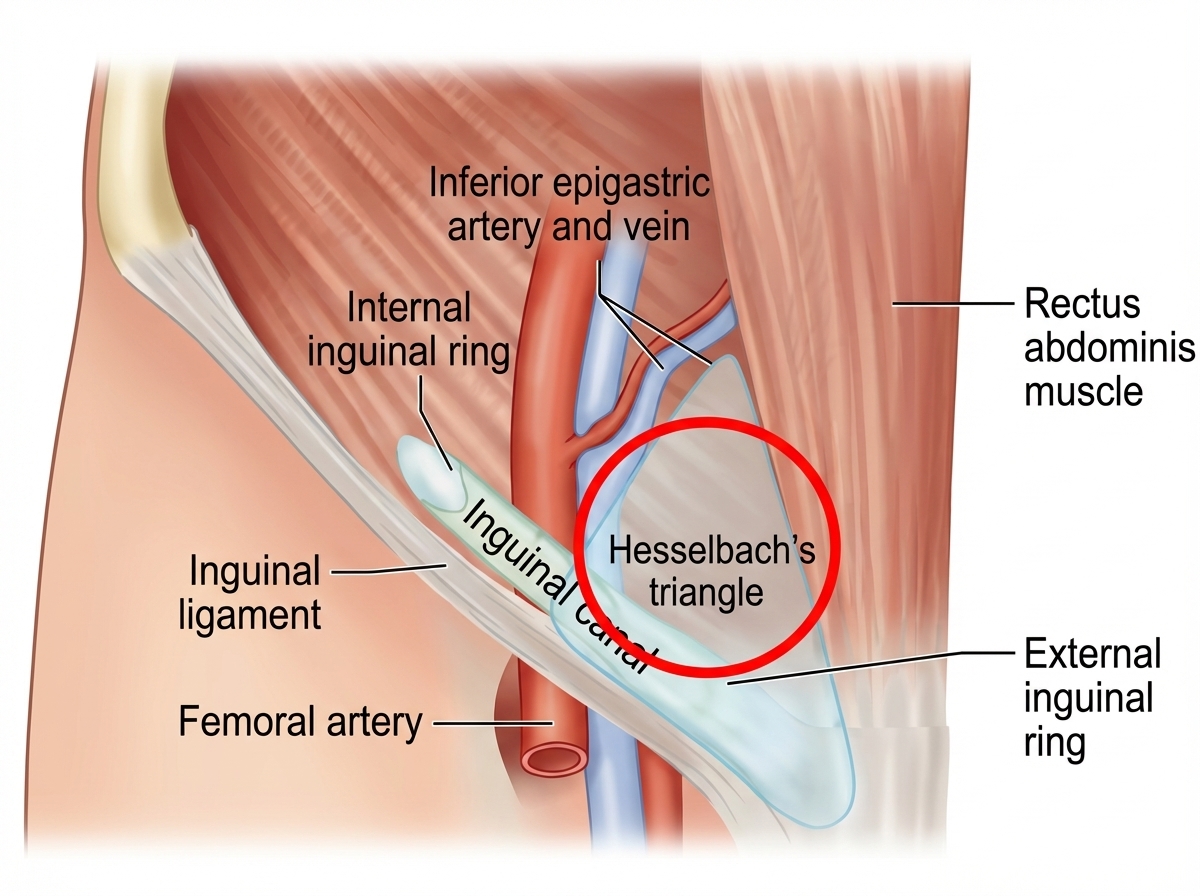
Explanation: **Explanation:** **Correct Option: A (Pain could indicate obstruction)** In an uncomplicated inguinal hernia, the swelling is typically painless or associated with a dull ache. The sudden onset of sharp or severe pain is a clinical "red flag" suggesting **obstruction** (lumen of the bowel is blocked) or **strangulation** (blood supply is compromised). This transition from a reducible, painless swelling to an irreducible, painful one is a surgical emergency. **Analysis of Incorrect Options:** * **B. Direct inguinal hernia is more common in children:** This is incorrect. **Indirect inguinal hernias** are the most common type in children (and all age groups) due to the failure of the *processus vaginalis* to obliterate. Direct hernias are acquired and seen primarily in the elderly due to weakened abdominal musculature (Hesselbach’s triangle). * **C. Spigelian hernia occurs through the rectus sheath:** This is incorrect. A Spigelian hernia occurs through the **Spigelian aponeurosis** (the "semilunar line"), which is the transition zone between the muscle fibers and the aponeurosis of the transversus abdominis, lateral to the rectus sheath. * **D. Inguinal hernia is more common on the left side:** This is incorrect. Inguinal hernias are more common on the **right side**. This is attributed to the later descent of the right testis and the delayed obliteration of the right processus vaginalis. **High-Yield Clinical Pearls for NEET-PG:** * **Most common hernia overall:** Indirect Inguinal Hernia (regardless of sex). * **Most common hernia in females:** Indirect Inguinal Hernia (though Femoral hernias are more common in females than in males). * **Hesselbach’s Triangle Boundaries:** Lateral border of rectus abdominis (medial), Inferior epigastric vessels (lateral), and Inguinal ligament (inferior). * **Gold Standard Repair:** Lichtenstein tension-free mesh repair.
Wound Healing and Care
Practice Questions
Surgical Infections
Practice Questions
Fluid and Electrolyte Management
Practice Questions
Nutrition in Surgical Patients
Practice Questions
Hemostasis and Blood Transfusion
Practice Questions
Surgical Instruments and Equipment
Practice Questions
Sutures and Stapling Devices
Practice Questions
Minimal Access Surgery Principles
Practice Questions
Surgical Complications
Practice Questions
Anesthesia Principles for Surgeons
Practice Questions
Surgical Oncology Principles
Practice Questions
Evidence-Based Surgery
Practice Questions
Get full access to all questions, explanations, and performance tracking.
Start For Free