Which of the following statements is true regarding an epigastric hernia?
Which one of the following is not included in the treatment of malignant melanoma?
All are true about alveolar osteitis except?
A patient underwent emergency laparotomy and ileostomy closure. Three months later, he developed swelling in the ileostomy region with a cough impulse. What is this condition known as?
What is the normal intra-abdominal pressure?
All of the following are true regarding lung abscess, EXCEPT?
A traumatic wound was cleaned and dressed. A few days later, suturing was done to approximate the edges. This type of wound healing is termed as:
A 36-year-old male presents with an asymptomatic swelling in the body of the mandible, exhibiting radiographic features of radiolucency with radiopaque flecks. What is the most likely diagnosis?
All are true regarding the use of a T-tube in the common bile duct, except:
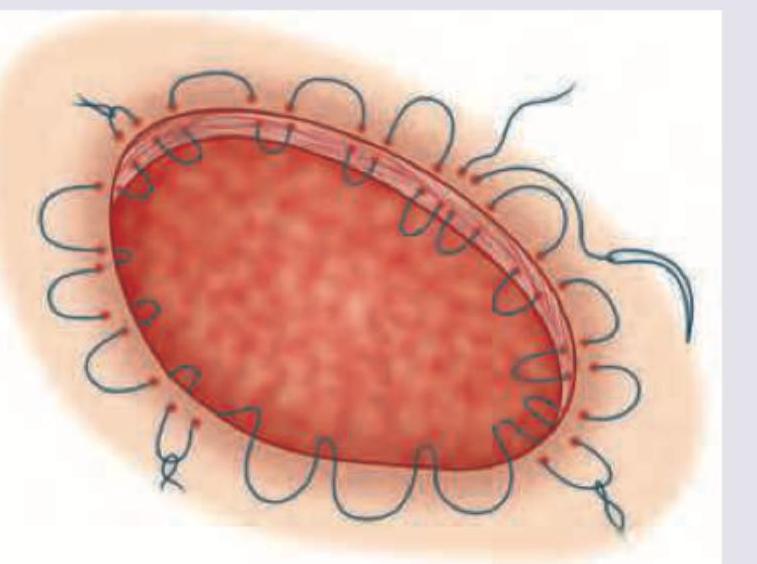
Catgut is prepared from the submucosal layer of the intestine of which animal?
Explanation: ### Explanation **Correct Answer: C. Always located above the umbilicus on either side of the midline.** **Understanding the Concept:** An epigastric hernia occurs through a defect in the **linea alba**, which is the fibrous structure formed by the fusion of the aponeuroses of the abdominal muscles. While the linea alba is technically the "midline," it has a specific width. Epigastric hernias typically occur through small openings where **perivascular fatty tissues** or small blood vessels pierce the linea alba. Crucially, the fibers of the linea alba decussate (cross over) in a complex pattern. In the epigastric region (between the xiphoid process and the umbilicus), these fibers often interlace in a way that creates small gaps. These gaps are frequently located **just to one side of the anatomical midline** rather than exactly in the center. Therefore, while they are "midline hernias" in a general sense, they are clinically found on either side of the midline. **Analysis of Incorrect Options:** * **Option A & B:** While epigastric hernias are indeed above the umbilicus, they are rarely perfectly central. They occur through decussating fibers that favor a para-median position. Furthermore, by definition, an "epigastric" hernia must be above the umbilicus; if it is below, it is typically classified as a ventral or ventral-incisional hernia. * **Option D:** Hernias occurring elsewhere on the abdomen have specific names (e.g., Spigelian hernia at the semilunar line, Umbilical, or Incisional hernias). **NEET-PG High-Yield Pearls:** * **Contents:** Most commonly contains **extraperitoneal fat** (fatty hernia of the linea alba); a peritoneal sac is present in only about 20% of cases. * **Clinical Presentation:** Often presents as a small, painful lump. The pain can mimic peptic ulcer disease or gallbladder disease ("Epigastric hernia: The great mimic"). * **Demographics:** More common in athletic males aged 20–50. * **Management:** They do not resolve spontaneously; surgical repair (herniotomy and primary closure) is the treatment of choice.
Explanation: **Explanation:** The primary management of malignant melanoma is surgical, as this tumor is characteristically **radioresistant**. While radiation therapy may be used in specific palliative settings (e.g., painful bone metastases or brain involvement), it is **not** a standard component of the primary curative treatment algorithm for melanoma, unlike many other solid tumors. **Analysis of Options:** * **A. Radiation (Correct):** Melanoma cells have a high capacity for sublethal damage repair, making them resistant to standard radiotherapy. Therefore, it is not included in the primary treatment protocol. * **B. Surgical Excision:** This is the **gold standard** and definitive treatment. The margin of excision depends on the **Breslow thickness** (e.g., 1 cm margin for tumors <1 mm thick; 2 cm for tumors >2 mm). * **C. Chemotherapy:** Historically used for metastatic disease (e.g., Dacarbazine), though it has largely been superseded by targeted therapies. * **D. Immunotherapy:** This has revolutionized melanoma care. Agents like **Ipilimumab** (CTLA-4 inhibitor) and **Pembrolizumab/Nivolumab** (PD-1 inhibitors) are now standard for advanced or metastatic stages. **High-Yield Clinical Pearls for NEET-PG:** * **Most Important Prognostic Factor:** Breslow Thickness (vertical depth of invasion in mm). * **Staging:** Sentinel Lymph Node Biopsy (SLNB) is the most important procedure for staging the regional node basin in tumors >0.8 mm or those with ulceration. * **Common Mutation:** **BRAF V600E** (Targeted by Vemurafenib). * **ABCDE Criteria:** Asymmetry, Border irregularity, Color variegation, Diameter (>6mm), and Evolving.
Explanation: **Alveolar Osteitis (Dry Socket)** is a common post-extraction complication characterized by the premature loss or disintegration of the blood clot within the tooth socket. ### Explanation of Options: * **Option C (Correct Answer):** This statement is false because alveolar osteitis is **not an infection**; it is a delayed healing process due to clot lysis. Therefore, the main aim of treatment is **pain management** and promoting healing, not the prevention of pus formation (which is characteristic of osteomyelitis or an abscess). * **Option A:** This is a true statement. The condition typically manifests on the **3rd to 4th postoperative day**. It occurs because of increased **fibrinolytic activity** (plasminogen to plasmin conversion), which dissolves the clot before granulation tissue can stabilize it. * **Option B:** This is true. **Smoking** reduces local blood flow and creates negative pressure that dislodges the clot. **Oral contraceptives** increase estrogen levels, which indirectly enhances fibrinolytic activity, making females more susceptible. * **Option D:** This is true. Management is conservative. It involves gentle **irrigation** with warm saline to remove debris, followed by the placement of an **obtundent (pain-relieving) dressing**, typically containing **Zinc Oxide Eugenol** or Alveogyl. ### NEET-PG High-Yield Pearls: * **Most Common Site:** Mandibular third molar (wisdom tooth) extraction sites. * **Clinical Feature:** Severe, radiating neuralgic pain and a "foul odor" (halitosis) without systemic signs like fever or lymphadenopathy. * **Pathophysiology:** Localized fibrinolysis; the socket appears "empty" or contains grayish necrotic remnants. * **Antibiotics:** Generally **not indicated** unless the patient is immunocompromised, as the condition is non-infectious.
Explanation: ### Explanation **Correct Answer: B. Incisional Hernia** The patient presents with a swelling at the site of a previous surgical wound (ileostomy closure) that demonstrates a **cough impulse**, which is the hallmark of a hernia. An **incisional hernia** is defined as the protrusion of abdominal contents through a defect in the abdominal wall at the site of a previous surgical incision or stoma closure. When an ileostomy is closed, the site becomes a point of potential weakness in the fascia. If the abdominal wall fails to heal adequately, intra-abdominal pressure can force contents through this scar, resulting in an incisional hernia. **Why other options are incorrect:** * **A. Lumbar hernia:** These occur through the posterior abdominal wall in the superior (Grynfelt-Lesshaft) or inferior (Petit’s) lumbar triangles. They are not related to anterior stoma sites. * **C. Spigelian hernia:** This occurs through the *linea semilunaris* (at the level of the arcuate line). It is a lateral ventral hernia but is spontaneous and not typically associated with surgical scars. * **D. Parastomal hernia:** This is a specific type of incisional hernia that occurs **adjacent to an active, functioning stoma**. Since this patient had an **ileostomy closure**, the stoma no longer exists; therefore, the resulting defect is classified as a standard incisional hernia. **Clinical Pearls for NEET-PG:** * **Risk Factors:** Wound infection (most common), obesity, malnutrition, and emergency surgery (as seen in this case). * **Classification:** Incisional hernias are a subtype of ventral hernias. * **Management:** Small defects may be repaired primarily, but large defects (>2 cm) usually require **mesh repair** (Lichtenstein or Laparoscopic IPOM) to reduce the high recurrence rate. * **Distinction:** Always check if the stoma is present. **Present = Parastomal; Closed = Incisional.**
Explanation: **Explanation:** **1. Understanding the Correct Answer (A):** Intra-abdominal pressure (IAP) is the steady-state pressure concealed within the abdominal cavity. In a healthy, resting adult who is breathing spontaneously, the normal IAP ranges from **0 to 5 mm Hg**. It is influenced by the compliance of the abdominal wall and the volume of the abdominal contents. In critically ill patients, a baseline IAP of 5–7 mm Hg is often considered normal. **2. Analysis of Incorrect Options:** * **B (10 mm Hg):** While slightly elevated, this is often seen in obese patients or those with mild ileus, but it exceeds the physiological "normal" baseline. * **C (15 mm Hg):** This represents **Intra-abdominal Hypertension (IAH)**. Grade I IAH starts at 12–15 mm Hg. This is also the standard pressure used during laparoscopic surgery to create a pneumoperitoneum. * **D (20 mm Hg):** This is a dangerously high pressure. Sustained IAP >20 mm Hg associated with new organ dysfunction defines **Abdominal Compartment Syndrome (ACS)**, a surgical emergency. **3. NEET-PG High-Yield Pearls:** * **Gold Standard Measurement:** IAP is most commonly measured indirectly via **intra-vesical (bladder) pressure** using a Foley catheter (transducer method). * **Abdominal Perfusion Pressure (APP):** Calculated as MAP minus IAP. An APP >60 mm Hg is a good predictor of survival in IAH. * **Laparoscopy:** During surgery, IAP is maintained at **12–15 mm Hg**. Pressures above this can decrease venous return and compromise ventilation. * **Grades of IAH:** * Grade I: 12–15 mm Hg * Grade II: 16–20 mm Hg * Grade III: 21–25 mm Hg * Grade IV: >25 mm Hg
Explanation: ### Explanation **1. Why Option A is the correct (False) statement:** The management of lung abscess is primarily **medical**, not surgical. Over 80-90% of lung abscesses resolve with prolonged antibiotic therapy (usually 4–6 weeks) and postural drainage. Size alone is not an indication for surgery; even large abscesses (e.g., >6 cm) are initially managed medically. Surgery (resection or drainage) is reserved for complications like massive hemoptysis, suspicion of malignancy, or failure of medical therapy after 6–8 weeks. **2. Analysis of other options:** * **Option B:** If a lung abscess ruptures into the pleural space, it leads to a **pyopneumothorax** or empyema [1]. In such cases, the immediate and often sufficient treatment is the insertion of an Intercostal Drainage (ICD) tube to drain the pleural space [3]. * **Option C:** While aspiration of oropharyngeal contents (often following dental infections or altered consciousness) is the most common mechanism, these are technically categorized as complications arising from the flora of the upper respiratory tract/oropharynx. * **Option D:** This is a true statement. Surgery is indicated in less than 10-15% of cases. The mainstay remains targeted antibiotics. **3. Clinical Pearls for NEET-PG:** * **Most common site:** The **posterior segment of the right upper lobe** and the **superior segment of the right lower lobe** (due to the anatomy of the right main bronchus and gravity during aspiration). * **Microbiology:** Most are polymicrobial, involving **anaerobes** (Bacteroides, Peptostreptococcus). * **Radiology:** Characterized by a thick-walled cavity with an **air-fluid level**. * **Indications for Surgery:** Failure of medical therapy, abscess >6 cm (relative), massive hemoptysis [2], or suspected bronchogenic carcinoma.
Explanation: **Explanation:** The correct answer is **Tertiary intention**, also known as **Delayed Primary Closure**. **1. Why Tertiary Intention is correct:** Tertiary intention occurs when a wound is initially left open (often due to contamination, infection, or high tension) and managed with cleaning, debridement, and dressings. Once the wound bed is clean and granulation tissue appears (usually after 3–5 days), the edges are surgically approximated with sutures. This method combines the benefits of initial drainage with the final cosmetic result of primary closure. **2. Why other options are incorrect:** * **Primary intention:** This involves immediate closure of clean, surgical wounds using sutures, staples, or tape. There is no waiting period, and minimal tissue loss occurs. * **Secondary intention:** The wound is left open to heal spontaneously through granulation, contraction, and epithelialization. This is used for infected or heavily contaminated wounds where suturing is not possible. It results in a larger scar. * **Delayed secondary intention:** This is not a standard surgical term. Healing is either primary, secondary, or tertiary (delayed primary). **3. NEET-PG High-Yield Pearls:** * **Primary Intention:** Best cosmetic result; occurs in clean surgical incisions. * **Secondary Intention:** Characterized by **Myofibroblasts** (responsible for wound contraction). * **Tertiary Intention:** Ideal for contaminated traumatic wounds or "dirty" surgeries (e.g., ruptured appendix) to prevent abscess formation. * **Timeline:** If a wound is closed *after* the appearance of granulation tissue, it is tertiary intention.
Explanation: ### Explanation The correct diagnosis is **Calcifying Epithelial Odontogenic Tumor (CEOT)**, also known as a **Pindborg tumor**. **1. Why the Correct Answer is Right:** The Pindborg tumor is a rare, benign but locally aggressive odontogenic neoplasm. The hallmark of this tumor is its radiographic appearance: a well-defined radiolucency containing characteristic **radiopaque flecks** or "driven-snow" appearance. These flecks represent calcifications within the tumor matrix (Liesegang rings). It most commonly occurs in the 30–50 age group and is frequently associated with an impacted tooth (usually the mandibular molar). **2. Why the Incorrect Options are Wrong:** * **Odontogenic Keratocyst (OKC):** Radiographically, OKCs typically present as a well-defined, unilocular or multilocular **radiolucency** with smooth or scalloped margins. They do **not** contain internal radiopaque calcifications. * **Ameloblastoma:** This is the most common odontogenic tumor. It typically presents as a "soap-bubble" or "honeycomb" **multilocular radiolucency**. While it can cause significant bone expansion and root resorption, it lacks internal radiopacities/calcifications. * **None of the above:** Incorrect, as the clinical and radiological description is a classic textbook presentation of CEOT. **3. NEET-PG High-Yield Pearls:** * **Histology of Pindborg Tumor:** Look for polyhedral epithelial cells, **amyloid-like material** (stains with Congo Red and shows apple-green birefringence), and **Liesegang rings** (concentric calcifications). * **Location:** 2/3rd of cases occur in the mandible (molar-premolar region). * **Management:** Conservative local resection with a margin of healthy bone is the treatment of choice due to its lower recurrence rate compared to ameloblastoma.
Explanation: **Explanation:** The correct answer is **A**. A T-tube should **not** be removed within 5-7 days. The standard practice is to wait **at least 10 to 14 days** (often up to 3 weeks in elderly or malnourished patients) before removal. This delay is crucial to allow for the formation of a mature, fibrous **fistulous tract** around the tube. If removed too early, bile can leak into the peritoneal cavity, leading to biliary peritonitis. **Analysis of Options:** * **Option B:** Before removal, a "clamping test" is performed. The tube is clamped to ensure bile flows naturally into the duodenum without causing pain, jaundice, or leakage. * **Option C:** A **T-tube Cholangiogram** is mandatory prior to removal (usually on day 7-10) to rule out retained stones or distal strictures. If a stone is found, the tube is left in place for 4-6 weeks to allow the tract to mature enough for Burhenne’s technique (percutaneous stone extraction). * **Option D:** T-tubes are traditionally made of **latex** because latex is an irritant that promotes the rapid inflammatory response necessary to form the fibrous tract. **Clinical Pearls for NEET-PG:** * **Indication:** T-tubes are placed after a Common Bile Duct (CBD) exploration (Choledochotomy) to provide a low-pressure exit for bile and prevent leaks from the ductal incision. * **Burhenne’s Technique:** Used for extracting retained CBD stones via the T-tube tract using a Steerable catheter/Dormia basket. * **Contraindication for removal:** If the cholangiogram shows a filling defect (stone) or lack of free flow into the duodenum, the tube must remain in situ.
Explanation: **Explanation:** **Catgut** is a natural, absorbable, monofilament suture. Despite its name, it has no relation to cats. It is derived from the **submucosal layer of the small intestine of sheep** or the serosal layer of the intestine of cattle (bovine). 1. **Why Sheep is Correct:** The submucosa of the sheep's intestine is rich in high-quality collagen. During manufacturing, the intestines are slit into ribbons, the submucosa is isolated, chemically treated (often with alkaline solutions), twisted, and polished to create a uniform strand. 2. **Why other options are incorrect:** * **Cat:** The term "catgut" likely derives from "kitgut" (referring to a "kit" or fiddle/violin string) or "cattigut" (from the word cattle). Cats have never been a source for surgical sutures. * **Human being:** Human tissue is not used for mass-produced suture material due to ethical, logistical, and immunological reasons. * **Rabbit:** While used in laboratory research, rabbits do not provide the length or tensile strength of collagen required for commercial suture production. **High-Yield Clinical Pearls for NEET-PG:** * **Absorption:** Catgut is absorbed by **proteolysis** (enzymatic degradation) by polymorphonuclear leukocytes, unlike synthetic absorbable sutures (like Vicryl) which are absorbed by **hydrolysis**. * **Types:** * **Plain Catgut:** Loses tensile strength in 7–10 days; absorbed in 60 days. * **Chromic Catgut:** Treated with chromium salts to delay absorption and reduce tissue reaction. Loses tensile strength in 14–21 days; absorbed in 90 days. * **Contraindication:** It should never be used in infected tissues or for suturing the rectus sheath, as its absorption rate is unpredictable and it can provoke a marked inflammatory response.
Wound Healing and Care
Practice Questions
Surgical Infections
Practice Questions
Fluid and Electrolyte Management
Practice Questions
Nutrition in Surgical Patients
Practice Questions
Hemostasis and Blood Transfusion
Practice Questions
Surgical Instruments and Equipment
Practice Questions
Sutures and Stapling Devices
Practice Questions
Minimal Access Surgery Principles
Practice Questions
Surgical Complications
Practice Questions
Anesthesia Principles for Surgeons
Practice Questions
Surgical Oncology Principles
Practice Questions
Evidence-Based Surgery
Practice Questions
Get full access to all questions, explanations, and performance tracking.
Start For Free