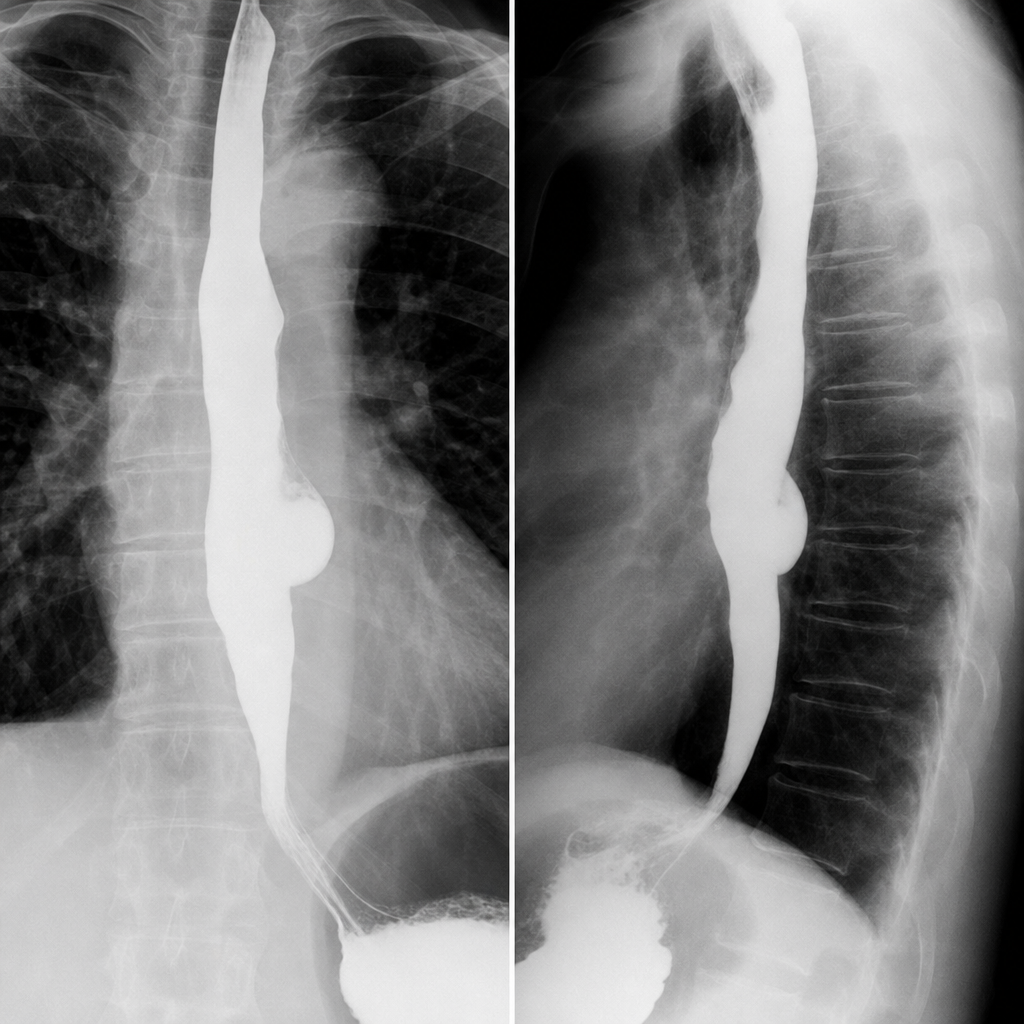
All are true about Dieulafoy's lesion except?
What is the most frequent symptom of gastric diverticulum?
Anastomotic leaks are most commonly seen in which type of surgical procedure?
A patient on autocoids for 1 year complains of severe epigastric pain relieved by IV antacids. The patient now complains of pain in the right iliac fossa and epigastrium, with fever and loss of liver dullness. What is the diagnosis?
What is the mortality rate in acute hemorrhagic pancreatitis?
Which of the following is a dynamic cause of intestinal obstruction?
Which of the following statements are true about Barrett's esophagus?
A 68-year-old male musician presents with sudden onset of colicky abdominal pain and massive vomiting of 4-hour duration. Examination shows an elevated WBC of 13,200 with a HCT of 45%. Electrolytes and BUN are normal. An erect abdominal film reveals dilatation of the stomach with distended loops of bowel. What is the clinical diagnosis?
All of the following is true about achalasia cardia except?
Which type of haemorrhoids is treated by the injection of a sclerosing agent?
Explanation: **Explanation:** Dieulafoy’s lesion is a rare but life-threatening cause of gastrointestinal bleeding. It is characterized by a **large-caliber submucosal artery** that fails to taper as it reaches the mucosa. **1. Why Option A is the Correct Answer (The "Except"):** While angiographic embolization is a valid treatment option, it is **not the preferred or first-line treatment**. The gold standard and preferred initial management for Dieulafoy’s lesion is **Endoscopic Therapy** (e.g., clipping, banding, or thermal coagulation), which has a success rate of over 90%. Angiography or surgery is reserved only for cases where endoscopic management fails. **2. Analysis of Other Options:** * **Option B:** Endoscopic treatment (mechanical clips, bipolar cautery, or epinephrine injection) is indeed the primary modality for both diagnosis and treatment. * **Option C:** The lesion occurs because the abnormally large artery exerts constant **pulsatile pressure** on the overlying mucosa, leading to focal erosion, thinning, and eventually a "pinpoint" ulceration that causes massive bleeding. * **Option D:** By definition, it involves a **persistent submucosal artery** that maintains a diameter of 1–3 mm (much larger than normal capillaries). **Clinical Pearls for NEET-PG:** * **Most Common Location:** Lesser curvature of the **stomach** (within 6 cm of the gastroesophageal junction). * **Clinical Presentation:** Sudden, massive, painless hematemesis or melena in an otherwise asymptomatic patient. * **Diagnosis:** Often difficult because the surrounding mucosa looks normal; "hidden" between bleeding episodes. * **Management Priority:** 1st: Endoscopy; 2nd: Angiographic Embolization; 3rd: Surgical Wedge Resection.
Explanation: **Explanation:** **Gastric diverticula** are the rarest form of gastrointestinal diverticula. They are typically "true" diverticula (involving all layers of the gastric wall) and are most commonly located on the **posterior wall of the fundus**, just below the gastroesophageal junction. 1. **Why Epigastric Pain is Correct:** While the majority (approx. 70–80%) of gastric diverticula are asymptomatic and discovered incidentally, when symptoms do occur, **epigastric pain** is the most frequent presentation. This pain is often vague, localized to the upper abdomen, and can be caused by the distension of the diverticular sac with food or associated localized inflammation (diverticulitis). 2. **Analysis of Incorrect Options:** * **B. Haematemesis:** While ulceration or ectopic gastric mucosa within the diverticulum can cause bleeding, it is a rare complication rather than a frequent symptom. * **C. Vomiting:** This may occur if the diverticulum is large or causes a functional obstruction, but it is significantly less common than dyspeptic pain. * **D. Pain relieved by food:** This is a classic feature of duodenal ulcers. In gastric diverticula, pain is often **aggravated** by eating or occurs immediately after meals due to the filling of the sac. **High-Yield Clinical Pearls for NEET-PG:** * **Most common site:** Posterior wall of the gastric fundus (2 cm below the GE junction). * **Diagnosis:** Upper GI endoscopy or Barium swallow (shows a "flask-shaped" outpouching with a narrow neck). * **Management:** Asymptomatic cases require no treatment. Surgical resection (diverticulectomy) is indicated only for large (>4 cm) or symptomatic diverticula. * **Differential:** Must be distinguished from a "pseudodiverticulum" caused by peptic ulcer disease or malignancy.
Explanation: **Explanation:** The correct answer is **Billroth 1**. The primary reason for the higher incidence of anastomotic leaks in Billroth 1 (gastroduodenostomy) compared to other reconstructions is **tension at the suture line**. 1. **Why Billroth 1 is correct:** In a Billroth 1 procedure, the stomach is directly anastomosed to the duodenum. Because the duodenum is a retroperitoneal, fixed structure, mobilizing it sufficiently to reach the gastric remnant often results in significant tension. Tension is the enemy of healing; it compromises blood supply to the edges, leading to ischemia and subsequent dehiscence (leakage). 2. **Why the others are incorrect:** * **Roux-en-Y Gastrojejunostomy:** This involves a tension-free anastomosis because a mobile limb of the jejunum is brought up to the stomach. * **Polya Gastrectomy:** This is a type of Billroth 2 reconstruction (gastrojejunostomy). Like the Roux-en-Y, it uses the mobile jejunum, which can be easily positioned without tension, making it safer regarding leak rates than Billroth 1. * **Antral Gastrectomy:** This refers to the extent of resection rather than the method of reconstruction. The leak risk depends on how the continuity is restored (B1 vs. B2). **Clinical Pearls for NEET-PG:** * **Tension and Blood Supply:** These are the two most critical local factors for any successful surgical anastomosis. * **Kocherization:** To reduce tension in Billroth 1, surgeons perform a "Kocher maneuver" to mobilize the duodenum. If tension persists, a Billroth 2 is preferred. * **Most Common Site of Leak:** In a Billroth 2/Polya reconstruction, the most dreaded complication is actually a **Duodenal Stump Blowout**, usually occurring 3–6 days post-op due to afferent loop obstruction. * **Gold Standard:** For gastric bypass and reducing reflux, Roux-en-Y is superior to Billroth reconstructions.
Explanation: ### Explanation **1. Why Duodenal Perforation is Correct:** The patient’s history of long-term **autocoid use** (likely NSAIDs or steroids) is a major risk factor for Peptic Ulcer Disease (PUD). The initial epigastric pain relieved by antacids is classic for a peptic ulcer. The sudden onset of severe pain, fever, and **loss of liver dullness** (obliteration of liver dullness) are pathognomonic signs of **pneumoperitoneum** resulting from a hollow viscus perforation. The pain in the **right iliac fossa (RIF)** in the setting of a duodenal perforation is known as **Valentino’s Syndrome**. This occurs when gastric/duodenal contents track down the right paracolic gutter, irritating the peritoneum in the RIF and mimicking appendicitis. **2. Why Incorrect Options are Wrong:** * **Diverticulitis:** Typically presents with "left-sided appendicitis" (left lower quadrant pain) and does not usually cause loss of liver dullness unless a massive perforation occurs, which is less common than in PUD. * **Gastroenteritis:** Presents with colicky pain, vomiting, and diarrhea. It does not cause pneumoperitoneum (loss of liver dullness) or localized RIF pain. * **Enteric Perforation:** Usually occurs in the 3rd week of Typhoid fever. While it causes pneumoperitoneum, the preceding history would involve prolonged high-grade fever (step-ladder pattern) rather than chronic epigastric pain relieved by antacids. **3. Clinical Pearls for NEET-PG:** * **Best Initial Investigation:** X-ray Erect Abdomen (shows free air under the diaphragm in 70-80% of cases). * **Valentino’s Syndrome:** Perforated peptic ulcer mimicking appendicitis due to fluid tracking. * **Most common site of perforation:** Anterior wall of the first part of the duodenum (D1). * **Drug of Choice:** Most perforations require emergency surgery (Graham’s Omental Patch repair).
Explanation: ### Explanation **Correct Answer: A. 20%** Acute pancreatitis is broadly classified into **Edematous (Interstitial)** and **Necrotizing (Hemorrhagic)** types. While edematous pancreatitis is usually self-limiting with a mortality rate of <1%, **Acute Hemorrhagic Pancreatitis** is a severe form characterized by extensive parenchymal necrosis and vascular erosion. 1. **Why 20% is correct:** According to standard surgical textbooks (like Bailey & Love and Harrison’s), the overall mortality rate for severe necrotizing/hemorrhagic pancreatitis fluctuates between **10% and 20%**. If the necrosis remains sterile, mortality is lower (~10%); however, if the necrotic tissue becomes infected (**Infected Pancreatic Necrosis**), the mortality rate climbs significantly, averaging the statistical figure to approximately 20% with modern intensive care and surgical intervention. 2. **Why other options are incorrect:** * **40% - 60% (Options B, C, D):** These figures are historically associated with infected necrosis before the era of "step-up" minimally invasive approaches or are seen only in subsets of patients with multi-organ failure (MOF) that does not respond to treatment. They do not represent the general mortality rate for hemorrhagic pancreatitis in contemporary practice. ### Clinical Pearls for NEET-PG: * **Most common cause:** Gallstones (overall), followed by Alcohol. * **Cullen’s Sign:** Periumbilical ecchymosis (indicates hemoperitoneum/hemorrhagic pancreatitis). * **Grey Turner’s Sign:** Flank ecchymosis (indicates retroperitoneal hemorrhage). * **Gold Standard Investigation:** Contrast-Enhanced CT (CECT) scan (best done after 72 hours to assess necrosis). * **Sentinel Loop:** A dilated loop of proximal jejunum seen on X-ray, indicating localized ileus. * **Prognostic Scoring:** Ranson’s Criteria, APACHE II, and the Modified Glasgow scale are used to predict severity.
Explanation: Intestinal obstruction is broadly classified into two categories: **Dynamic (Mechanical)** and **Adynamic (Functional)**. ### 1. Why "Gall stone" is correct A **Dynamic obstruction** occurs when there is a physical, intraluminal, intramural, or extramural barrier preventing the passage of intestinal contents. The bowel responds with increased peristalsis to overcome the blockage. **Gallstone ileus** is a classic example of dynamic obstruction where a large gallstone enters the bowel (usually via a cholecystoduodenal fistula) and becomes impacted, typically at the narrowest part of the small intestine—the **ileocecal valve**. ### 2. Why the other options are incorrect * **Paralytic ileus (B):** This is an **adynamic** cause. There is no physical blockage; instead, there is a failure of peristalsis due to neural or muscular inhibition (often post-operative or due to electrolyte imbalances). * **Mesenteric vascular obstruction (C):** This is an **adynamic** cause. Ischemia leads to bowel wall infarction and cessation of motor activity, resulting in a functional "dead" segment rather than a mechanical blockage. * **Ogilvie syndrome (D):** Also known as **Acute Colonic Pseudo-obstruction**, this is an **adynamic** condition characterized by massive dilation of the colon without a mechanical cause, usually seen in elderly or critically ill patients. ### 3. NEET-PG High-Yield Pearls * **Rigler’s Triad (for Gallstone Ileus):** 1. Pneumobilia (air in biliary tree), 2. Small bowel obstruction, 3. Ectopic gallstone in the iliac fossa. * **Most common cause of Dynamic SBO:** Post-operative adhesions. * **Most common cause of Dynamic Large Bowel Obstruction:** Malignancy (Colorectal cancer). * **Key distinction:** In dynamic obstruction, bowel sounds are **hyperactive/borborygmi** (early stage); in adynamic obstruction, bowel sounds are **absent**.
Explanation: **Explanation:** **Barrett’s Esophagus (BE)** is defined as the metaplastic replacement of the normal stratified squamous epithelium of the lower esophagus with **specialized columnar epithelium** (containing Goblet cells) due to chronic gastroesophageal reflux disease (GERD). **Why Option D is Correct:** While endoscopy can suggest BE by identifying "salmon-pink" tongues of mucosa extending above the gastroesophageal junction, the **gold standard and definitive requirement for diagnosis is a biopsy.** Histological confirmation of **intestinal metaplasia** (presence of Goblet cells) is mandatory to distinguish it from gastric metaplasia and to assess for dysplasia. **Analysis of Incorrect Options:** * **Option A:** This is a tricky distractor. While BE is indeed a premalignant condition, in the context of NEET-PG, if a question asks for the "most true" or "definitive" statement regarding diagnosis, the histological requirement (Option D) takes precedence. (Note: Some examiners consider A true, but D is the clinical prerequisite). * **Option B:** BE predisposes specifically to **Adenocarcinoma**, not squamous cell carcinoma. Chronic irritation from alcohol and smoking typically leads to squamous cell carcinoma. * **Option C:** Endoscopy alone cannot diagnose BE; it can only raise suspicion. Visual findings must be confirmed histologically to rule out mimics like esophagitis or a hiatal hernia. **High-Yield Clinical Pearls for NEET-PG:** * **Prague Criteria:** Used for endoscopic grading (C = circumferential length; M = maximal extent). * **Surveillance:** Patients without dysplasia require endoscopy every 3–5 years. * **Management:** High-grade dysplasia is managed with endoscopic mucosal resection (EMR) or radiofrequency ablation (RFA). * **Segment Length:** "Short-segment" BE is <3 cm; "Long-segment" is >3 cm (higher malignancy risk).
Explanation: ### **Explanation** The clinical presentation of sudden onset colicky pain followed by **massive vomiting** within a short duration (4 hours) is a hallmark of **High (Proximal) Small Bowel Obstruction**. **1. Why Option A is Correct:** In **complete proximal obstruction** (e.g., at the duodenum or jejunum), the stomach and proximal loops quickly fill with secretions and swallowed air. Because the obstruction is high, the reservoir capacity is limited, leading to early, frequent, and voluminous vomiting. The abdominal X-ray confirms this by showing a **dilated stomach** and distended proximal loops, while the absence of gas in the distal bowel (implied by the clinical severity) suggests a complete blockage. The elevated WBC (13,200) indicates physiological stress or early ischemia. **2. Why the other options are incorrect:** * **Option B & D (Incomplete Obstructions):** Incomplete or partial obstructions usually present more subacutely. Patients continue to pass flatus or some liquid stool, and vomiting is typically less "massive" as some content passes the transition point. * **Option C (Complete Ileal Obstruction):** Distal (ileal) obstructions present with **central abdominal distension** as the primary feature. Vomiting occurs much later in the clinical course (after several hours or days) and may become feculent. The X-ray in distal obstruction would show multiple "step-ladder" air-fluid levels across the mid-abdomen, rather than just a dilated stomach and a few proximal loops. ### **Clinical Pearls for NEET-PG:** * **Vomiting Pattern:** The higher the obstruction, the earlier and more severe the vomiting. The lower the obstruction, the more prominent the abdominal distension. * **Radiology:** A "double bubble" sign suggests duodenal atresia/obstruction; multiple central loops with valvulae conniventes (plicae circulares) suggest jejunal obstruction. * **Metabolic Profile:** Proximal obstructions (especially supra-ampullary) can lead to **Metabolic Alkalosis** (hypochloremic, hypokalemic) due to loss of gastric HCl. However, in this case, the 4-hour duration is too short for significant electrolyte derangement, explaining the normal BUN and electrolytes.
Explanation: **Explanation:** Achalasia cardia is a primary esophageal motility disorder characterized by the failure of the Lower Esophageal Sphincter (LES) to relax and the absence of progressive peristalsis in the distal esophagus. **Why Option B is the Correct Answer (The False Statement):** Achalasia cardia affects **males and females equally** (1:1 ratio). There is no significant gender predilection. It typically presents between the ages of 25 and 60 years. **Analysis of Other Options:** * **Option A:** The hallmark pathophysiology is the selective loss of inhibitory neurons (containing Nitric Oxide and VIP) in the myenteric (Auerbach’s) plexus, leading to a **failure of the LES to relax** in response to swallowing. * **Option C:** On a chest X-ray, the **absence of a gastric air bubble** is a classic sign. This occurs because the hypertensive LES prevents air from entering the stomach. Other X-ray findings include a widened mediastinum and an air-fluid level in the esophagus. * **Option D:** **Esophageal Manometry** is the **gold standard (most confirmatory)** investigation. It typically shows incomplete LES relaxation (residual pressure >10 mmHg) and aperistalsis in the smooth muscle portion of the esophagus. **Clinical Pearls for NEET-PG:** * **Barium Swallow:** Shows the classic **"Bird’s Beak"** or "Rat-tail" appearance. * **Chagas Disease:** Caused by *Trypanosoma cruzi*, it can mimic achalasia (Secondary Achalasia). * **Heller’s Myotomy:** The surgical treatment of choice, usually performed with a partial fundoplication (Dor or Toupet) to prevent reflux. * **POEM (Per-Oral Endoscopic Myotomy):** A newer, minimally invasive endoscopic treatment option. * **Complication:** Long-standing achalasia increases the risk of **Squamous Cell Carcinoma** of the esophagus due to chronic stasis and irritation.
Explanation: **Explanation:** **Sclerotherapy** is a non-surgical treatment modality primarily indicated for **early-stage internal haemorrhoids** (specifically 1st degree and early 2nd degree). The procedure involves injecting a sclerosing agent (e.g., 5% Phenol in almond or arachis oil) into the **submucosa** above the dentate line at the base of the pile mass. This induces an inflammatory reaction followed by fibrosis, which obliterates the vascular channels and "pins" the mucosa back to the underlying muscle, preventing prolapse and bleeding. **Analysis of Options:** * **Internal Haemorrhoids (Correct):** These originate above the dentate line and are covered by autonomic-innervated insensitive mucosa. This allows for painless injection. * **External Haemorrhoids (Incorrect):** These are covered by anoderm/skin, which is richly supplied by somatic nerves. Injection here would cause excruciating pain and is contraindicated. * **Prolapsed Haemorrhoids (Incorrect):** 3rd and 4th-degree haemorrhoids generally require mechanical intervention like Rubber Band Ligation (RBL) or surgical haemorrhoidectomy, as sclerotherapy is ineffective for significantly displaced tissue. * **Thrombosed Haemorrhoids (Incorrect):** These are acutely painful emergencies (usually external) requiring incision and evacuation of the clot or conservative management; sclerotherapy has no role in treating a thrombus. **NEET-PG High-Yield Pearls:** * **Site of Injection:** The injection is given at the **pedicle** (3, 7, and 11 o'clock positions) above the dentate line. * **Agent of Choice:** 5% Phenol in oil is most common. * **Complications:** Prostatitis or prostatic abscess (if injected too deeply/anteriorly) and mucosal ulceration (if injected too superficially). * **Contraindication:** Sclerotherapy should never be used for external piles due to the somatic nerve supply.
Esophageal Disorders
Practice Questions
Gastric Disorders
Practice Questions
Small Intestine Pathology
Practice Questions
Appendicitis
Practice Questions
Inflammatory Bowel Disease
Practice Questions
Intestinal Obstruction
Practice Questions
Gastrointestinal Bleeding
Practice Questions
Diverticular Disease
Practice Questions
Anorectal Disorders
Practice Questions
Colorectal Neoplasms
Practice Questions
Gastrointestinal Stomas
Practice Questions
Bariatric Surgery Principles
Practice Questions
Get full access to all questions, explanations, and performance tracking.
Start For Free