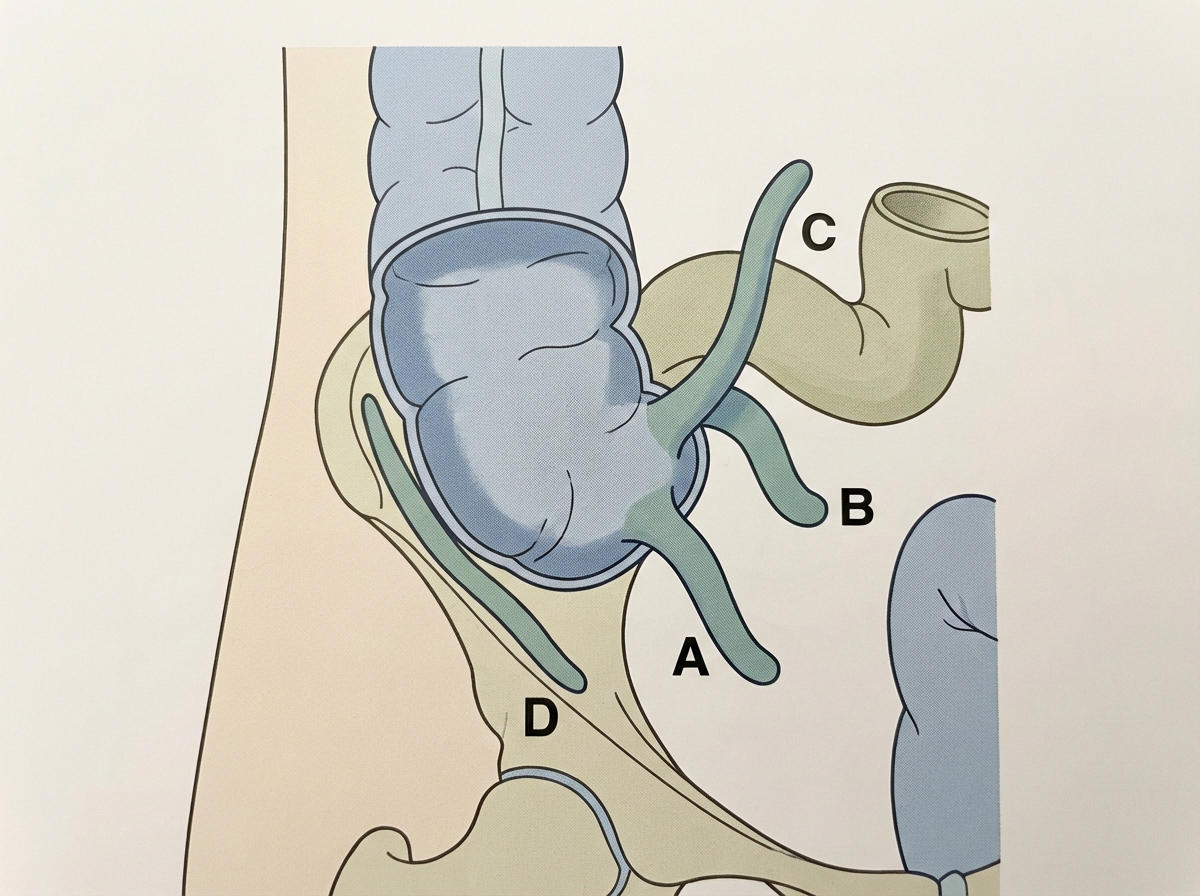
Diffuse peritonitis in acute appendicitis is caused due to:
According to the latest evidence, which latent virus infection is responsible for the pathogenesis of achalasia?
All of the following benign conditions are associated with increased rates of gastric cancer except?
All are true about the Tillaux triad of a mesenteric cyst, except?
Which of the following is NOT a cause of chronic constipation?
What is an uncommon cause of upper gastrointestinal bleeding?
What is the concentration of epinephrine used for injection therapy in the endoscopic management of actively bleeding peptic ulcers?
Ileocecal tuberculosis presents with all of the following except?
All of the following are true for Meckel's diverticulum EXCEPT?
A patient in the ICU developed stress-related mucosal damage. What is the MOST common site for stress ulcers?
Explanation: **Explanation:** In acute appendicitis, the clinical outcome depends heavily on whether the body has time to localize the infection. **1. Why "Early Rupture" is correct:** Diffuse peritonitis occurs when the appendix perforates **before** the greater omentum and adjacent loops of small bowel have had sufficient time to wall off the inflamed organ. In cases of rapid progression to gangrene and sudden rupture, the infected contents spill freely into the general peritoneal cavity, leading to generalized (diffuse) peritonitis. This is most common in children, where the omentum is short and "underdeveloped," failing to reach the site of inflammation in time. **2. Analysis of Incorrect Options:** * **Late Rupture:** A late rupture usually allows enough time for the "policeman of the abdomen" (the omentum) to migrate to the right iliac fossa. This results in a localized **appendix mass** or a localized abscess rather than diffuse involvement. * **Fecolith:** While a fecolith is the most common cause of luminal obstruction leading to appendicitis, its presence alone does not dictate the extent of peritonitis; the timing of the subsequent rupture does. * **Old Age:** While elderly patients have a higher risk of perforation due to a thinner appendicular wall and atherosclerosis of the appendicular artery, they are more likely to present with vague symptoms. While they are at risk, "early rupture" remains the specific pathological mechanism for the *diffuseness* of the peritonitis. **High-Yield NEET-PG Pearls:** * **Most common cause of appendicitis:** Fecolith (Adults), Lymphoid hyperplasia (Children). * **First symptom:** Visceral pain (periumbilical); **First sign:** Tenderness at McBurney’s point. * **Investigation of choice:** CECT Abdomen (Gold standard); Ultrasound (Initial in children/pregnancy). * **Omentum:** Known as the "Policeman of the Abdomen" for its role in localizing intraperitoneal infections.
Explanation: **Explanation:** **Pathogenesis of Achalasia Cardia:** Achalasia is characterized by the failure of the Lower Esophageal Sphincter (LES) to relax and the absence of esophageal peristalsis. The underlying pathology is the **loss of inhibitory nitrergic neurons** in the myenteric (Auerbach’s) plexus. The most widely accepted theory for this neuronal destruction is an **autoimmune response triggered by a latent viral infection** in genetically susceptible individuals (HLA-DQw1 association). **Herpes Simplex Virus-1 (HSV-1)** is the primary culprit identified in recent molecular studies. HSV-1 is neurotropic and has a predilection for squamous epithelium; it remains latent in the ganglion cells, leading to a chronic inflammatory infiltrate (T-cell mediated) that eventually destroys the ganglion cells. **Analysis of Incorrect Options:** * **Hepatitis C:** While associated with extrahepatic manifestations like lichen planus or cryoglobulinemia, it has no known link to esophageal dysmotility or myenteric plexus destruction. * **Rubella & Measles:** These are associated with congenital defects or subacute sclerosing panencephalitis (SSPE) but have not been isolated from the esophageal tissues of achalasia patients. **High-Yield Clinical Pearls for NEET-PG:** * **Gold Standard Investigation:** Esophageal Manometry (shows incomplete LES relaxation and aperistalsis). * **Classic Sign:** "Bird’s Beak" appearance on Barium Swallow. * **Treatment of Choice:** Laparoscopic Heller’s Myotomy with partial fundoplication. * **Chagas Disease:** Caused by *Trypanosoma cruzi*, it is a common cause of **secondary achalasia** (Pseudoachalasia) in South America.
Explanation: **Explanation:** The development of gastric adenocarcinoma is a multi-step process often preceded by chronic mucosal inflammation and precancerous lesions. **Why MEN 1 is the correct answer:** Multiple Endocrine Neoplasia type I (MEN 1) is characterized by the "3 Ps": Pituitary, Parathyroid, and Pancreatic/duodenal tumors. While MEN 1 is strongly associated with **Zollinger-Ellison Syndrome (Gastrinomas)**, which leads to hypergastrinemia and parietal cell hyperplasia, it does **not** increase the risk of gastric adenocarcinoma. Instead, the chronic hypergastrinemia in MEN 1/ZES is associated with an increased risk of **Type II Gastric Carcinoid tumors** (neuroendocrine tumors), not epithelial gastric cancer. **Why the other options are incorrect:** * **Pernicious Anemia:** This is an autoimmune condition where antibodies attack parietal cells, leading to achlorhydria and vitamin B12 deficiency. The resulting chronic inflammation and compensatory hypergastrinemia increase the risk of gastric cancer by approximately 3-fold. * **Chronic Atrophic Gastritis:** Often caused by *H. pylori* or autoimmunity, this leads to the replacement of gastric glandular epithelium with intestinal metaplasia, a well-recognized precursor to the intestinal type of gastric adenocarcinoma (Correa’s pathway). * **Adenomatous Polyps:** Unlike hyperplastic polyps (which have low malignant potential), gastric adenomas are true neoplastic lesions. They carry a significant risk of harboring or developing into invasive adenocarcinoma, especially if they are >2 cm in size. **High-Yield Clinical Pearls for NEET-PG:** * **Correa’s Hypothesis:** Normal Mucosa → Chronic Gastritis → Atrophic Gastritis → Intestinal Metaplasia → Dysplasia → Adenocarcinoma. * **Blood Group A:** Associated with an increased risk of gastric cancer. * **Post-Gastrectomy Stumps:** Increased risk of cancer 15–20 years after surgery due to alkaline reflux. * **Hyperplastic Polyps:** The most common type of gastric polyp, but they have minimal malignant potential compared to adenomatous polyps.
Explanation: **Explanation:** The **Tillaux Triad** is a classic clinical sign used to diagnose a **mesenteric cyst**. Understanding the anatomical relationship between the cyst and the mesentery is key to answering this question. **1. Why Option A is the Correct Answer (The "Except" statement):** The characteristic mobility of a mesenteric cyst is that it **moves freely in a direction perpendicular to the line of the mesentery** (from left to right) but has restricted mobility along the line of the mesentery (from the right iliac fossa to the left second lumbar vertebra). Option A states the movement is restricted perpendicular to the mesentery, which is the opposite of the clinical reality. **2. Analysis of Incorrect Options (True statements about Tillaux Triad):** * **Option B:** On percussion, there is a **central area of dullness** (due to the fluid-filled cyst) surrounded by a **zone of resonance** (due to the surrounding gas-filled bowel loops). This is a hallmark of the triad. * **Option C:** Mesenteric cysts most commonly present as a **soft, fluctuant, and non-tender swelling** located typically in the **umbilical region**, reflecting their origin in the small bowel mesentery. * **Option D:** Most mesenteric cysts are asymptomatic and present as a **painless abdominal swelling** unless complications like torsion, rupture, or infection occur. **Clinical Pearls for NEET-PG:** * **Most common site:** Mesentery of the ileum. * **Pathology:** Most are benign (Chylolymphatic cysts are the most common type). * **Investigation of choice:** Contrast-Enhanced CT (CECT) or Ultrasound. * **Treatment of choice:** Complete surgical excision (Enucleation). If the blood supply to the adjacent bowel is compromised, bowel resection and anastomosis are required.
Explanation: **Explanation:** Chronic constipation is a functional or structural impairment of stool evacuation. The correct answer is **Polyps** because they are intraluminal growths that typically do not cause constipation. Instead, polyps are usually asymptomatic or present with **painless lower GI bleeding** (hematochezia) or anemia. Large pedunculated polyps may occasionally cause intussusception, but they are not a recognized cause of chronic constipation. **Analysis of Incorrect Options:** * **Hirschsprung Disease:** This is a congenital condition characterized by the **absence of ganglion cells** (Auerbach’s and Meissner’s plexuses) in the distal colon. This leads to a failure of relaxation of the internal anal sphincter, resulting in functional obstruction and chronic constipation from birth. * **Chagas Disease:** Caused by *Trypanosoma cruzi*, this infection leads to the destruction of the myenteric plexus. This results in **acquired megacolon**, which manifests as severe chronic constipation. * **Hypokalemia:** Electrolyte imbalances, specifically hypokalemia and hypercalcemia, interfere with smooth muscle contraction in the gut. Low potassium levels lead to **decreased intestinal motility** (paralytic ileus or chronic constipation). **Clinical Pearls for NEET-PG:** * **Hirschsprung Disease:** Gold standard diagnosis is a **Full-thickness rectal biopsy** showing absent ganglion cells and hypertrophied nerve bundles. * **Metabolic causes of constipation:** Remember the mnemonic "Low K+, High Ca2+" (Hypokalemia, Hypercalcemia). * **Red Flags:** Constipation of recent onset in an elderly patient should always be investigated for **Colorectal Carcinoma**, not just simple polyps.
Explanation: **Explanation:** Upper Gastrointestinal Bleeding (UGIB) is a common surgical emergency. The classification of causes is typically divided into common (major) and uncommon (minor) based on their frequency of presentation in clinical practice. **Why Carcinoma of the Stomach is the Correct Answer:** While gastric malignancy is a significant surgical condition, it is considered an **uncommon cause** of acute, massive UGIB. Bleeding from gastric cancer is usually chronic, resulting in occult blood loss and iron-deficiency anemia rather than brisk hematemesis. It accounts for only about **1% to 5%** of all UGIB cases. **Analysis of Incorrect Options:** * **Peptic Ulcer (Option C):** This is the **most common cause** of UGIB worldwide (accounting for ~50% of cases). Both duodenal and gastric ulcers can erode into vessels (e.g., the gastroduodenal artery), leading to significant hemorrhage. * **Erosive Gastritis (Option B):** Also known as hemorrhagic gastritis, this is a frequent cause of UGIB, often secondary to NSAID use, alcohol consumption, or severe physiological stress (Stress ulcers). * **Varices (Option A):** Esophageal and gastric varices are the most common causes of **massive** UGIB in patients with portal hypertension (cirrhosis). They carry the highest mortality rate among the options. **NEET-PG High-Yield Pearls:** 1. **Most common cause of UGIB:** Peptic Ulcer Disease. 2. **Most common cause of massive UGIB:** Esophageal Varices. 3. **Dieulafoy’s Lesion:** An uncommon but important cause of UGIB involving a large tortuous submucosal artery that erodes the overlying epithelium. 4. **Forrest Classification:** Used endoscopically to predict the risk of re-bleeding in peptic ulcers (Forrest Ia is active spurting).
Explanation: **Explanation:** The primary goal of endoscopic injection therapy in bleeding peptic ulcers is to achieve **hemostasis** through a combination of local vasoconstriction and mechanical tamponade. **Why 1:10,000 is the Correct Answer:** The standard concentration used globally is **1:10,000 (0.1 mg/mL)**. This concentration provides a potent vasoconstrictive effect on the bleeding vessel while minimizing systemic cardiovascular side effects. It is typically diluted in normal saline and injected in 0.5 mL to 2 mL aliquots around the ulcer base. The saline provides the volume necessary for **tamponade**, while the epinephrine induces local vasospasm and promotes platelet aggregation. **Analysis of Incorrect Options:** * **A (1:1,000):** This is the standard concentration for intramuscular injection in anaphylaxis. Using it endoscopically is dangerous as it can cause severe systemic absorption, leading to hypertensive crisis, arrhythmias, or myocardial ischemia. * **B (1:5,000):** While occasionally used in some surgical settings, it is considered too concentrated for routine endoscopic injection and increases the risk of local tissue necrosis and systemic toxicity. * **D (1:30,000):** This concentration is too dilute to provide effective local vasoconstriction required to stop active arterial spurting (Forrest Ia) or oozing (Forrest Ib). **High-Yield Clinical Pearls for NEET-PG:** * **Dual Therapy:** Epinephrine injection alone is less effective than "dual therapy." For high-risk ulcers, it should be combined with a second modality (e.g., thermal coagulation or mechanical clips) to prevent re-bleeding. * **Forrest Classification:** Injection therapy is indicated for **Forrest Ia (Spurting)**, **Ib (Oozing)**, and **IIa (Visible vessel)**. * **Volume:** Usually, 5–20 mL of the 1:10,000 solution is injected in total.
Explanation: In intestinal tuberculosis (TB), the characteristic pathological finding is **transverse (circumferential) ulcers**, not longitudinal ones. This occurs because the *Mycobacterium tuberculosis* bacilli travel via the lymphatics, which are arranged circumferentially around the bowel wall. As these transverse ulcers heal by fibrosis, they often lead to stricture formation. In contrast, **longitudinal ulcers** are a hallmark of **Crohn’s disease**. **Explanation of Options:** * **Option A (Rapid emptying):** Known as **Stierlin’s Sign**. On a barium meal, the inflamed and irritable terminal ileum empties rapidly into the cecum, appearing narrow or empty while the proximal ileum and distal cecum contain contrast. * **Option B (Inseed umbrella sign):** This refers to the **Fleischner sign**, where a thickened, patulous ileocecal valve (due to infiltration) associated with a narrowed terminal ileum resembles an inverted umbrella or a "crow's foot" appearance. * **Option C (Stellate ulcer):** Early tubercular lesions often present as shallow, stellate (star-shaped) ulcers with elevated, undermined margins and a pale base covered with slough. * **Option D (Correct Answer):** As established, TB causes transverse ulcers; longitudinal ulcers are characteristic of Crohn's disease. **High-Yield Clinical Pearls for NEET-PG:** * **Most common site:** Ileocecal region (due to high lymphoid density/Peyer’s patches and increased stasis). * **Sterling’s Sign:** Rapid emptying of the terminal ileum. * **Goose-neck deformity:** Shortening and narrowing of the terminal ileum. * **Conical Cecum:** Shrunken, fibrosed cecum pulled out of the iliac fossa. * **Pulled-up Cecum:** The cecum is displaced upward due to fibrosis of the mesentery.
Explanation: **Explanation:** Meckel’s diverticulum is the most common congenital anomaly of the gastrointestinal tract, resulting from the incomplete obliteration of the **vitellointestinal duct** (omphalomesenteric duct). **Why Option D is the Correct Answer (The Exception):** Meckel’s diverticulum is a **true diverticulum** (containing all layers of the bowel wall) and is characteristically located on the **antimesenteric border** of the ileum. This is a critical anatomical distinction because it derives its blood supply from the vitelline artery (a branch of the SMA), unlike acquired diverticula which typically occur at the mesenteric border where vessels enter the bowel. **Analysis of Other Options:** * **Option A:** It is frequently lined by **heterotopic epithelium**. Gastric mucosa is the most common (found in 50% of symptomatic cases), followed by pancreatic tissue. This gastric acidity is what leads to peptic ulceration and painless bleeding. * **Option B:** While the classic "Rule of 2s" states a **2% prevalence**, clinical studies and surgical series often show a range of **2-4% or 3-5%** in the general population. * **Option C:** Although the incidence is equal in both sexes for asymptomatic cases, **symptomatic** Meckel’s diverticulum is significantly **more common in males** (often cited as a 2:1 to 3:1 ratio). *Note: In the context of this specific question, Option D is the definitive anatomical falsehood.* **High-Yield NEET-PG Pearls:** * **Rule of 2s:** 2% of population, 2 feet (60cm) from the ileocaecal valve, 2 inches long, 2 types of common ectopic tissue (Gastric/Pancreatic), and presents before age 2. * **Most common presentation:** Painless lower GI bleeding in children; Intestinal obstruction (intussusception/volvulus) in adults. * **Investigation of choice:** Meckel’s Scan (Technetium-99m pertechnetate) which labels ectopic gastric mucosa.
Explanation: **Explanation:** Stress-related mucosal damage (SRMD) refers to acute erosive lesions that develop in the gastrointestinal tract of critically ill patients due to physiological stress (e.g., sepsis, trauma, burns, or major surgery). **1. Why the Stomach is Correct:** The **stomach (specifically the fundus and body)** is the most common site for stress ulcers. The pathophysiology involves a combination of splanchnic hypoperfusion (leading to mucosal ischemia) and the breakdown of protective mucosal barriers. Unlike chronic peptic ulcers, stress ulcers are typically multiple, superficial, and occur in the acid-secreting portions of the stomach. **2. Why Other Options are Incorrect:** * **Duodenum:** While the duodenum is the most common site for *chronic* peptic ulcers, it is less common than the stomach for acute stress-related lesions. An exception is the **Curling ulcer**, which can occur in the duodenum following severe burns. * **Esophagus:** Stress ulcers rarely involve the esophagus. Esophageal lesions in the ICU are more likely related to GERD or prolonged nasogastric intubation rather than primary SRMD. * **Ileum:** The small intestine is generally spared from stress-related mucosal damage, as the mechanism is primarily driven by gastric acid in the presence of impaired mucosal defense. **3. High-Yield Clinical Pearls for NEET-PG:** * **Cushing’s Ulcer:** Associated with **increased intracranial pressure** (ICP). These are often single, deep, and carry a high risk of perforation. They can occur in the stomach, duodenum, or esophagus. * **Curling’s Ulcer:** Associated with **severe burns**. Most commonly found in the fundus of the stomach or the proximal duodenum. * **Prophylaxis:** The standard of care for high-risk ICU patients (e.g., those on mechanical ventilation >48 hours or with coagulopathy) includes Proton Pump Inhibitors (PPIs) or H2-receptor antagonists.
Esophageal Disorders
Practice Questions
Gastric Disorders
Practice Questions
Small Intestine Pathology
Practice Questions
Appendicitis
Practice Questions
Inflammatory Bowel Disease
Practice Questions
Intestinal Obstruction
Practice Questions
Gastrointestinal Bleeding
Practice Questions
Diverticular Disease
Practice Questions
Anorectal Disorders
Practice Questions
Colorectal Neoplasms
Practice Questions
Gastrointestinal Stomas
Practice Questions
Bariatric Surgery Principles
Practice Questions
Get full access to all questions, explanations, and performance tracking.
Start For Free