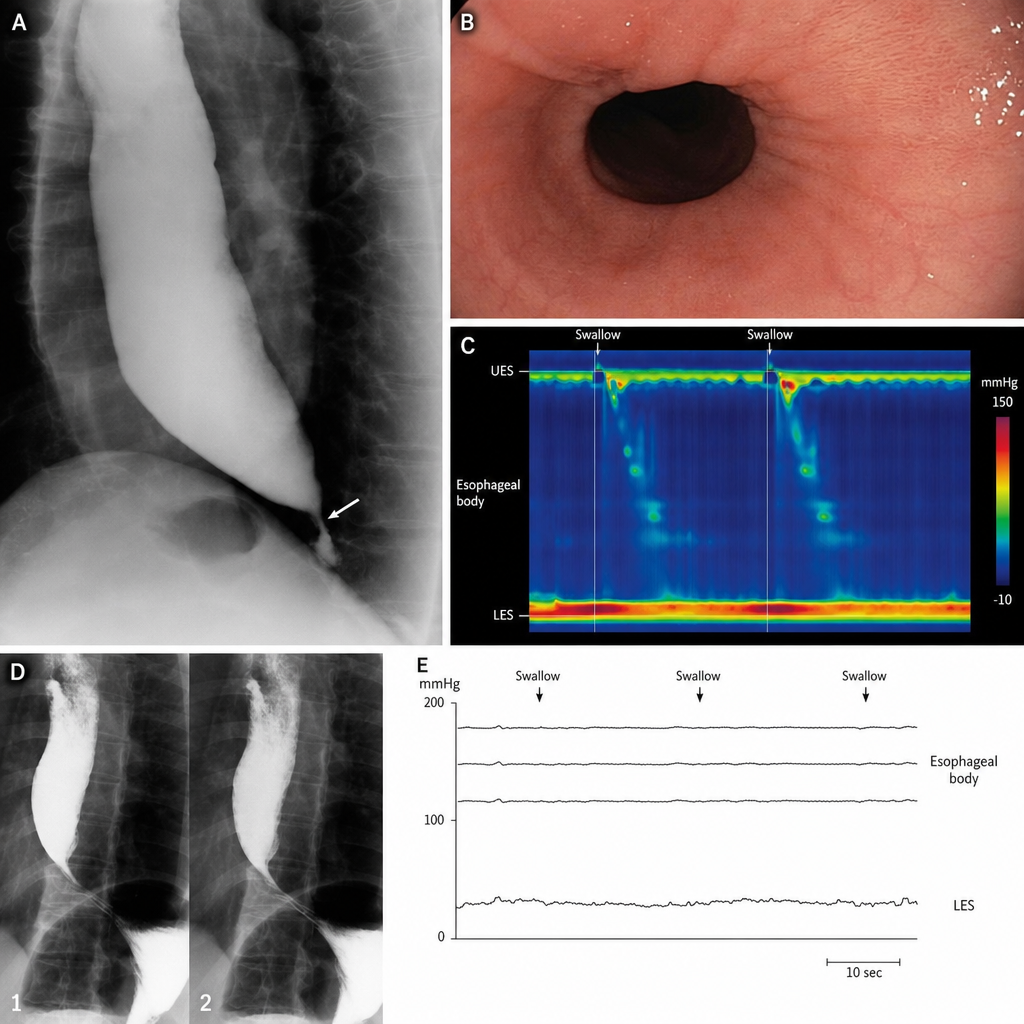
Which of the following statements is not true about Schatzki's ring?
What is the most common tumor of the small intestine?
What is the most common presentation of carcinoma of the right colon?
Which of the following staging systems is used for gastroesophageal reflux disease (GERD)?
During an operation for presumed appendicitis, the patient's appendix is found to be markedly thickened and feels rubbery to firm. The serosa is edematous and inflamed, and the mesentery is thickened with fat growing about the bowel circumference. What is the most likely diagnosis?
Diffuse peritonitis following appendicitis is usually seen when?
Peptic ulcers located in which site are most likely to perforate?
Which of the following is the most common complication of appendectomy?
The below instrument is used for the treatment of:

Which artery is most commonly responsible for bleeding in duodenal ulcer hemorrhage?
Explanation: **Explanation:** **Schatzki’s ring** (also known as a B-ring) is a thin, mucosal circumferential narrowing located at the **squamocolumnar junction** in the lower esophagus. 1. **Why Option C is the correct answer (The False Statement):** Schatzki’s rings typically cause **intermittent episodic dysphagia only for solids**, particularly large boluses of meat or bread (often called "Steakhouse Syndrome"). Unlike motility disorders (like Achalasia) which cause dysphagia for both solids and liquids, mechanical obstructions like rings and webs initially affect only solid food passage. 2. **Analysis of Incorrect Options:** * **Option A:** True. It is specifically found at the distal esophagus, marking the proximal border of a hiatal hernia. * **Option B:** True. While the exact etiology is debated, it is strongly associated with **Gastroesophageal Reflux Disease (GERD)** and hiatal hernia; some theories also suggest a congenital origin. * **Option D:** True. Asymptomatic esophageal rings and webs are common incidental findings, occurring in approximately 10-15% of the general population during routine barium studies. **Clinical Pearls for NEET-PG:** * **Location:** Schatzki’s ring (B-ring) is mucosal (lower esophagus); the A-ring is muscular (above the B-ring). * **Association:** Almost always associated with a **sliding hiatal hernia**. * **Diagnosis:** Barium swallow is more sensitive than endoscopy for detection. * **Treatment:** Reassurance for asymptomatic cases; **endoscopic dilation** or bolus extraction for symptomatic patients. * **Key Differentiator:** If the lumen diameter is >20mm, it is rarely symptomatic; if <13mm, it is almost always symptomatic.
Explanation: **Explanation:** The classification of small bowel tumors is a high-yield topic for NEET-PG, often categorized by whether the tumor is benign or malignant. **1. Why Leiomyoma is correct:** Overall, **benign tumors** are more common than malignant tumors in the small intestine. Among all small bowel neoplasms, **Leiomyoma** is the most common benign tumor (and thus the most common tumor overall). These are mesenchymal tumors arising from the smooth muscle layer. While many remain asymptomatic and are discovered incidentally, they can occasionally lead to bleeding or intussusception. **2. Analysis of Incorrect Options:** * **Lymphoma (B):** This is a common primary malignancy of the small bowel, particularly in the ileum (due to Peyer’s patches), but it is less frequent than benign lesions. * **Adenocarcinoma (C):** This is the **most common primary malignancy** of the small intestine. It most frequently occurs in the duodenum. However, as a category, malignant tumors are less common than benign ones. * **Hemangioma (D):** These are benign vascular tumors. While they are a common cause of occult gastrointestinal bleeding in the small bowel, they are less frequent than leiomyomas. **3. Clinical Pearls for NEET-PG:** * **Most common benign tumor:** Leiomyoma. * **Most common malignant tumor:** Adenocarcinoma (though some recent registries suggest Neuroendocrine Tumors/Carcinoids are increasing in frequency, Adenocarcinoma remains the standard answer for exams unless specified otherwise). * **Most common site for Adenocarcinoma:** Duodenum. * **Most common site for Carcinoid/Lymphoma:** Ileum. * **Peutz-Jeghers Syndrome:** Associated with multiple hamartomatous polyps in the small bowel.
Explanation: **Explanation:** The clinical presentation of colorectal carcinoma varies significantly based on the anatomical location of the tumor due to differences in luminal diameter and fecal consistency. **Why Anemia is the correct answer:** The right colon (caecum and ascending colon) has a large luminal diameter and contains liquid fecal matter. Consequently, tumors here tend to be **exophytic or polypoid** rather than constricting. These lesions often undergo chronic, occult surface bleeding. Because the blood mixes with liquid stool and travels the length of the colon, it is not visible to the patient (melena is rare; hematochezia is absent). This results in **iron-deficiency anemia** as the most common and often the earliest clinical presentation. Patients typically present with fatigue, palpitations, or exertional dyspnea. **Analysis of Incorrect Options:** * **B. Mass:** While a palpable mass in the right iliac fossa is a common finding in right-sided growth, it is usually a later sign compared to the onset of occult bleeding and anemia. * **C. Obstruction:** This is the hallmark of **left-sided colon cancer**. The left colon has a narrower lumen and solid feces; tumors here are often "napkin-ring" or annular, leading to early obstructive symptoms. * **D. Diarrhea:** While altered bowel habits can occur, it is less specific and less common than anemia in right-sided lesions. **Clinical Pearls for NEET-PG:** * **Right-sided lesions:** Present with Anemia, weight loss, and vague abdominal pain. * **Left-sided lesions:** Present with altered bowel habits (constipation/diarrhea) and intestinal obstruction. * **Rectal lesions:** Present with tenesmus and hematochezia (bright red blood per rectum). * **Rule of thumb:** Any elderly patient with unexplained iron-deficiency anemia must be investigated for right-sided colon cancer via colonoscopy.
Explanation: **Explanation:** The correct answer is **C. Savary Miller**. **1. Why Savary Miller is correct:** The Savary-Miller classification is a widely used endoscopic staging system for **Gastroesophageal Reflux Disease (GERD)**, specifically used to grade the severity of reflux esophagitis. It categorizes the extent of mucosal damage: * **Grade I:** Single erosive lesion. * **Grade II:** Multiple erosive lesions (non-circumferential). * **Grade III:** Circumferential erosive lesions. * **Grade IV:** Chronic complications (ulcers, strictures, or esophageal shortening). * **Grade V:** Barrett’s esophagus. **2. Why the other options are incorrect:** * **A. Ranson Criteria:** Used to predict the severity and mortality of **Acute Pancreatitis** based on parameters at admission and 48 hours later. * **B. Gleason Score:** Used by pathologists to grade the aggressiveness of **Prostate Cancer** based on histological patterns. * **D. Hunter Scale:** This is not a standard surgical staging system. (Note: The *Hill Grade* is often confused with this, which assesses the gastroesophageal flap valve). **Clinical Pearls for NEET-PG:** * **Los Angeles (LA) Classification:** This is the other major system for GERD/Esophagitis (Grades A to D) and is currently more common in clinical practice than Savary-Miller. * **Gold Standard Investigation:** 24-hour ambulatory pH monitoring is the gold standard for diagnosing GERD. * **Surgical Management:** Nissen Fundoplication (360° wrap) is the procedure of choice for refractory GERD. * **Barrett’s Esophagus:** Defined by intestinal metaplasia (replacement of squamous epithelium with columnar epithelium). It is a precursor to Adenocarcinoma.
Explanation: ### Explanation The clinical presentation described is a classic intraoperative finding of **Crohn’s Disease** (specifically terminal ileitis), which often mimics acute appendicitis. **1. Why the correct answer is right:** The key diagnostic feature mentioned is **"fat growing about the bowel circumference,"** also known as **"fat wrapping" or "creeping fat."** This occurs when mesenteric fat extends over the serosal surface of the bowel, a pathognomonic sign of Crohn’s disease. The "rubbery to firm" texture and thickened mesentery reflect the **transmural inflammation** and edema characteristic of the disease, leading to the "hose-pipe" appearance of the bowel. **2. Why the incorrect options are wrong:** * **Meckel’s diverticulitis:** While it can mimic appendicitis, it presents as an inflamed pouch on the antimesenteric border of the ileum. It does not cause circumferential fat wrapping or generalized thickening of the ileal mesentery. * **Ulcerative colitis:** This is a mucosal disease primarily affecting the colon and rectum. It does not involve the terminal ileum (except in "backwash ileitis") and lacks transmural involvement or mesenteric fat changes. * **Ileocecal tuberculosis:** A common differential in India, it typically presents with "pulled-up cecum," transverse ulcers, and significant lymphadenopathy. While it causes thickening, the specific "creeping fat" sign is characteristic of Crohn’s. **3. NEET-PG High-Yield Pearls:** * **Creeping Fat:** Pathognomonic for Crohn’s Disease. * **String Sign of Kantor:** Radiological finding (barium meal) due to terminal ileal narrowing. * **Skip Lesions:** Discontinuous areas of inflammation (unlike the continuous involvement in UC). * **Cobblestone Appearance:** Due to deep longitudinal and transverse ulcers. * **Surgery Rule:** In Crohn’s, surgery is not curative; the principle is **"minimal resection"** or stricturoplasty to avoid Short Bowel Syndrome.
Explanation: **Explanation:** The development of diffuse peritonitis in acute appendicitis depends on whether the body’s defense mechanisms—specifically the **greater omentum** (the "policeman of the abdomen") and adjacent loops of small bowel—have had sufficient time to wall off the inflamed organ. 1. **Why Option A is Correct:** When perforation occurs **early (within 24 hours)**, the omentum has not yet had enough time to migrate to the right iliac fossa and wrap around the appendix. Consequently, the infected contents spill freely into the peritoneal cavity, leading to **generalized (diffuse) peritonitis**. This is more common in children, where the omentum is short and underdeveloped. 2. **Why Option B is Incorrect:** If perforation occurs late (usually after 48 hours), the omentum and small bowel have typically localized the infection. This results in an **appendicular mass** or a localized **appendicular abscess** rather than diffuse spread. 3. **Why Option C is Incorrect:** Non-obstructive (catarrhal) appendicitis is generally milder. Obstructive appendicitis (usually due to a fecolith) leads to a closed-loop obstruction, rapid rise in intraluminal pressure, and early gangrene/perforation, making it the primary driver of peritonitis. 4. **Why Option D is Incorrect:** While withholding antibiotics worsens the prognosis, it is the **timing of the perforation** relative to the anatomical walling-off process that determines whether the peritonitis is localized or diffuse. **NEET-PG High-Yield Pearls:** * **Most common cause of appendicitis:** Fecolith (in adults), Lymphoid hyperplasia (in children). * **Sequence of symptoms (Murphy’s Triad):** Pain (periumbilical then RIF), Vomiting, Fever. * **Pelvic Appendix:** May present with diarrhea or urinary frequency; often lacks classic abdominal rigidity. * **Retrocecal Appendix:** Most common position (75%); may present with a positive Psoas sign and "silent" abdomen on palpation.
Explanation: **Explanation:** The correct answer is **Anterior duodenal ulcers**. This is a classic high-yield concept in surgical gastroenterology based on the anatomical relationship of the duodenum to the peritoneal cavity. **1. Why Anterior Duodenal Ulcers Perforate:** The first part of the duodenum is the most common site for peptic ulcer disease. The **anterior wall** of the duodenum is covered by the peritoneum and faces the open peritoneal cavity. When an ulcer on the anterior wall erodes through the muscularis and serosa, there are no adjacent organs to "plug" the hole. This leads to the immediate leakage of gastric and duodenal contents into the sac, resulting in acute chemical peritonitis and the classic "pneumoperitoneum" (gas under the diaphragm) seen on X-rays. **2. Why the other options are incorrect:** * **Posterior Duodenal Ulcers:** These are located against the retroperitoneal structures. Instead of perforating into the open cavity, they tend to **penetrate** into the pancreas. More importantly, they are notorious for causing **massive hemorrhage** due to erosion into the **Gastroduodenal Artery**, which runs directly behind the first part of the duodenum. * **Gastric Ulcers (Anterior/Posterior):** While gastric ulcers can perforate, they are statistically less common than duodenal ulcers. Posterior gastric ulcers often erode into the pancreas or the lesser sac. **Clinical Pearls for NEET-PG:** * **Most common site of PUD:** First part of the Duodenum (D1). * **Perforation = Anterior Duodenal Ulcer** (presents with sudden onset board-like rigidity). * **Bleeding = Posterior Duodenal Ulcer** (involves Gastroduodenal Artery). * **Investigation of Choice for Perforation:** X-ray Erect Abdomen (shows free air under the diaphragm in ~75% of cases). * **Surgical Management:** Modified Graham’s Patch repair (omental patch).
Explanation: **Explanation:** The most common complication following an appendectomy is **wound infection** (surgical site infection). This is primarily due to the nature of the surgery; the appendix is a hollow viscus containing bacteria, and its inflammation or perforation leads to the contamination of the subcutaneous tissue during removal. The incidence varies significantly based on the stage of the disease: it is approximately 5% in simple appendicitis but can rise to over 20% in cases of gangrenous or perforated appendicitis. **Analysis of Options:** * **B. Ileus:** While transient paralytic ileus is common immediately post-operatively due to peritoneal irritation and handling of the bowel, it is usually self-limiting and occurs less frequently as a clinical complication compared to wound infection. * **C. Adhesive intestinal obstruction:** This is the most common **late** complication of appendectomy. While appendectomy is a leading cause of post-surgical adhesions, it does not surpass wound infection in overall frequency. * **D. Fecal fistula:** This is a rare complication, usually occurring due to the slipping of the appendiceal tie, necrosis of the cecal wall, or underlying Crohn’s disease. **High-Yield Pearls for NEET-PG:** * **Most common complication overall:** Wound infection. * **Most common late complication:** Adhesive intestinal obstruction. * **Most common site for an abscess post-appendectomy:** Pelvic abscess (presents with diarrhea and mucus in stools). * **Prophylaxis:** A single dose of preoperative antibiotics (covering anaerobes and gram-negative bacilli) significantly reduces the rate of wound infection.
Explanation: ***Variceal bleeding*** - The instrument shown is the **Sengstaken-Blakemore tube**, a **balloon tamponade device** used for emergency control of **esophageal variceal bleeding**. - It features a **triple-lumen design** with **gastric balloon**, **esophageal balloon**, and **gastric aspiration port** that provides direct compression to stop bleeding varices. *Retention of urine* - Urinary retention is treated with a **Foley catheter**, which is a simple tube inserted into the bladder through the urethra. - The Sengstaken-Blakemore tube has **multiple balloons** and is designed for **esophageal compression**, not urinary drainage. *Hemorrhoids* - Hemorrhoids are treated with instruments like **proctoscopes** for visualization or **rubber band ligators** for treatment. - The **balloon tamponade system** of the Sengstaken-Blakemore tube is specifically designed for **vascular compression** in the esophagus, not rectal pathology. *Achalasia cardia* - Achalasia is treated with **pneumatic dilators** that gradually stretch the **lower esophageal sphincter**. - The Sengstaken-Blakemore tube provides **acute compression** rather than the **controlled dilation** needed for achalasia treatment.
Explanation: **Explanation:** The **Gastroduodenal Artery (GDA)** is the correct answer because of its specific anatomical relationship with the duodenum. Most peptic ulcers causing significant hemorrhage are located on the **posterior wall** of the first part of the duodenum (D1). The GDA descends vertically directly behind the first part of the duodenum; therefore, a deep penetrating posterior ulcer can erode into this large-caliber vessel, leading to massive, life-threatening upper gastrointestinal bleeding. **Analysis of Incorrect Options:** * **Splenic Artery:** This is the most common artery involved in bleeding from a **gastric ulcer** located on the posterior wall of the body of the stomach or erosion due to chronic pancreatitis (pseudoaneurysm). * **Left Gastric Artery:** This is the most common source of bleeding in **gastric ulcers** (specifically those located on the lesser curvature). * **Superior Mesenteric Artery (SMA):** While the SMA provides blood supply to the lower duodenum via the inferior pancreaticoduodenal artery, it is located further down and is not typically involved in primary duodenal ulcer erosion. **NEET-PG High-Yield Pearls:** * **Location Rule:** Anterior duodenal ulcers are more likely to **perforate** (causing pneumoperitoneum), whereas posterior duodenal ulcers are more likely to **bleed** (due to GDA erosion). * **Source of GDA:** The GDA is a branch of the Common Hepatic Artery (which arises from the Celiac Trunk). * **Management:** In refractory bleeding, surgical ligation of the GDA (via a longitudinal pyloroduodenotomy) is the classic treatment.
Esophageal Disorders
Practice Questions
Gastric Disorders
Practice Questions
Small Intestine Pathology
Practice Questions
Appendicitis
Practice Questions
Inflammatory Bowel Disease
Practice Questions
Intestinal Obstruction
Practice Questions
Gastrointestinal Bleeding
Practice Questions
Diverticular Disease
Practice Questions
Anorectal Disorders
Practice Questions
Colorectal Neoplasms
Practice Questions
Gastrointestinal Stomas
Practice Questions
Bariatric Surgery Principles
Practice Questions
Get full access to all questions, explanations, and performance tracking.
Start For Free