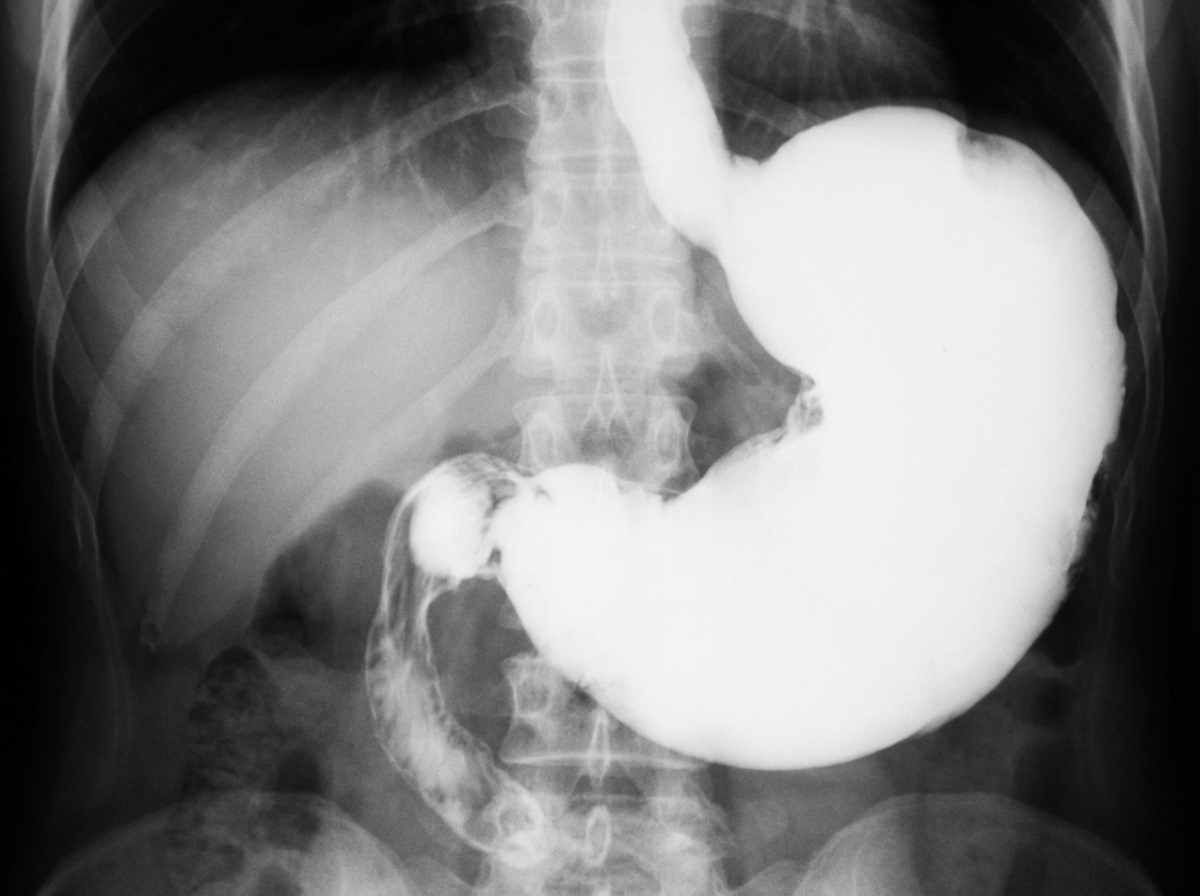
The most commonly used scoring system to assess mortality and risk of rebleeding in the setting of nonvariceal upper GI bleeding is:
Which of the following statements regarding Familial Adenomatous Polyposis (FAP) is FALSE?
What is the management for a duodenal blowout?
The diagnosis of neuroendocrine tumor (NET) of the small bowel is made by which investigation?
In esophageal perforation, all the following signs are typically seen EXCEPT?
In esophageal cancer, prognosis is best determined by which factor?
Which of the following is commonly associated with Crohn's disease?
Endoscopic mucosal resection in Barrett's esophagus can result in which of the following complications?
Solitary rectal ulcer is:
A 60-year-old male with carcinoma of the descending colon presents with acute intestinal obstruction. What is the treatment of choice in the emergency department?
Explanation: **Explanation:** The **Complete Rockall Score** is the gold standard for predicting both **mortality and the risk of rebleeding** in patients with non-variceal upper gastrointestinal bleeding (NVUGIB). It is a composite score consisting of: 1. **Clinical components:** Age, shock (heart rate/blood pressure), and comorbidities. 2. **Endoscopic components:** Diagnosis and endoscopic stigmata of recent hemorrhage (e.g., visible vessel, adherent clot). A score of <3 indicates a good prognosis, while a score >8 indicates a high risk of mortality. **Analysis of Options:** * **A. Blatchford Score (Glasgow-Blatchford Score):** This is primarily used **pre-endoscopy** to identify "low-risk" patients who can be safely managed as outpatients without urgent intervention. It does not require endoscopic findings but is less specific for mortality than the Rockall score. * **B. Clinical Rockall Score:** This uses only the clinical parameters (Age, Shock, Comorbidity) before endoscopy. While useful for initial triage, it is less accurate than the "Complete" score because it lacks the prognostic data provided by the endoscopic diagnosis. * **C. Artificial Neural Network Score:** These are complex computer-based models. While they show promise in research settings for high accuracy, they are not "commonly used" in standard clinical practice or guidelines. **High-Yield Clinical Pearls for NEET-PG:** * **Rockall Score:** Best for mortality and rebleeding (Post-endoscopy). * **Glasgow-Blatchford Score (GBS):** Best for deciding the need for intervention/hospitalization (Pre-endoscopy). * **Forrest Classification:** Used during endoscopy to grade ulcer bleeding and guide the need for endoscopic therapy (e.g., Forrest Ia/Ib require active intervention). * **Most common cause of NVUGIB:** Peptic Ulcer Disease.
Explanation: **Explanation:** Familial Adenomatous Polyposis (FAP) is an autosomal dominant condition caused by a mutation in the **APC (Adenomatous Polyposis Coli) gene** on chromosome 5q21. **Why Option D is the Correct (False) Statement:** While polyps begin to appear in the second decade of life (average age 16 years), colon cancer does not typically develop until later. The average age for the development of colorectal cancer in untreated FAP patients is **39–40 years**. Developing cancer at age 20 is rare; however, because the risk becomes nearly 100% by age 40-50, prophylactic proctocolectomy is usually recommended in the late teens or early twenties. **Analysis of Other Options:** * **Option A:** FAP is indeed the **most common** hereditary polyposis syndrome, affecting approximately 1 in 10,000 to 15,000 live births. * **Option B:** The clinical diagnosis of classic FAP requires the presence of **>100 adenomatous polyps**. In many cases, thousands of polyps carpet the colon. * **Option C:** Without surgical intervention (prophylactic colectomy), the progression from adenoma to carcinoma is inevitable, with a lifetime risk of **nearly 100%**. **NEET-PG High-Yield Pearls:** * **Extracolonic Manifestations:** Duodenal adenomas (most common cause of death post-colectomy), desmoid tumors, osteomas, and CHRPE (Congenital Hypertrophy of Retinal Pigment Epithelium). * **Gardner’s Syndrome:** FAP + Osteomas + Soft tissue tumors (sebaceous cysts, desmoids). * **Turcot’s Syndrome:** FAP + CNS tumors (Medulloblastoma). * **Screening:** Starts at age **10–12 years** with annual flexible sigmoidoscopy.
Explanation: **Explanation:** A **duodenal blowout** is a life-threatening complication typically occurring 4–7 days after a Billroth II gastrectomy or Whipple procedure. It involves the disruption of the duodenal stump closure due to increased intraluminal pressure or ischemia. **1. Why Transcutaneous Peritoneal Drainage is correct:** In the modern surgical era, the primary goal of managing a duodenal blowout is **controlled external fistulization**. If a drain was placed during the initial surgery, it is managed conservatively. If no drain is present or if there is a localized collection, **Transcutaneous (Percutaneous) Peritoneal Drainage** under USG or CT guidance is the preferred initial step. This stabilizes the patient, prevents generalized peritonitis, and allows the fistula to heal spontaneously (conservative management) by converting a "blowout" into a "controlled fistula." **2. Why other options are incorrect:** * **Secondary Closure:** This is almost always unsuccessful. The duodenal tissue is edematous, friable, and bathed in proteolytic enzymes (bile and pancreatic juice), making sutures likely to cheese through and fail. * **Re-exploration:** While mandatory if the patient has generalized peritonitis or is hemodynamically unstable, it is not the first-line management for a localized blowout. Re-operation in an inflamed field is technically difficult and carries high morbidity. **NEET-PG High-Yield Pearls:** * **Most common cause:** Poor surgical technique or distal obstruction (afferent loop syndrome). * **Gold Standard Management:** Conservative management (NPO, TPN, Octreotide, and **Drainage**). * **Mortality:** Historically high (up to 50%), emphasizing the need for early detection and drainage. * **Prevention:** Use of a "Tube Duodenostomy" during the primary surgery if the stump closure is deemed insecure.
Explanation: **Explanation:** The correct answer is **C. 24-hour urinary 5-HIAA**. **1. Why 5-HIAA is the correct answer:** Small bowel neuroendocrine tumors (NETs), historically called carcinoid tumors, are derived from enterochromaffin cells. These cells frequently produce **serotonin** (5-hydroxytryptamine). Serotonin is metabolized by the liver and lungs into **5-hydroxyindoleacetic acid (5-HIAA)**, which is then excreted in the urine. A 24-hour urinary 5-HIAA test has high specificity (approx. 90%) for diagnosing carcinoid syndrome, which typically occurs when a small bowel NET has metastasized to the liver, allowing serotonin to bypass hepatic metabolism and enter the systemic circulation. **2. Why the other options are incorrect:** * **Options A & B (Metanephrines and VMA):** These are metabolites of catecholamines (epinephrine and norepinephrine). They are the gold-standard biochemical markers for diagnosing **Pheochromocytoma** and **Paraganglioma**, not NETs of the bowel. * **Option D (Urinary Cortisol):** 24-hour urinary free cortisol is used as a screening test for **Cushing’s Syndrome** to evaluate hypercortisolism. **Clinical Pearls for NEET-PG:** * **Most common site of NET:** The **Appendix** is the most common site overall (often an incidental finding), but the **Ileum** is the most common site for symptomatic/metastatic NETs. * **Carcinoid Syndrome Triad:** Flushing (most common), Diarrhea, and Right-sided heart failure (Tricuspid regurgitation/Pulmonary stenosis). * **Diagnostic Imaging:** **Ga-68 DOTATATE PET/CT** is currently the most sensitive imaging modality for localizing NETs (superior to the older Octreoscan). * **Dietary Note:** Patients must avoid serotonin-rich foods (bananas, walnuts, avocados) for 48 hours before the 5-HIAA test to prevent false positives.
Explanation: **Explanation:** Esophageal perforation is a surgical emergency that leads to the rapid contamination of the mediastinum with gastric contents, saliva, and bacteria. This triggers an intense inflammatory response known as **Mediastinitis**, which quickly progresses to **Systemic Inflammatory Response Syndrome (SIRS)** and septic shock. **1. Why Bradycardia is the Correct Answer:** In the setting of acute perforation and subsequent sepsis, the body’s compensatory mechanism is to increase cardiac output to maintain tissue perfusion. This results in **Tachycardia** (increased heart rate), not bradycardia. Bradycardia is not a typical feature of esophageal perforation and would only be seen as a pre-terminal event or in unrelated conduction pathologies. **2. Analysis of Incorrect Options:** * **Pain (Option A):** This is the most common and earliest symptom. It is typically sudden, excruciating, and retrosternal, often radiating to the back or shoulders. * **Fever (Option C):** As mediastinitis develops, the bacterial load and inflammatory cytokines lead to a rapid rise in body temperature. * **Hypotension (Option D):** This occurs due to "third-spacing" of fluids into the mediastinum and the vasodilatory effects of sepsis, leading to distributive shock. **Clinical Pearls for NEET-PG:** * **Mackler’s Triad:** Vomiting, chest pain, and subcutaneous emphysema (pathognomonic for Boerhaave syndrome). * **Hamman’s Sign:** A crunching sound heard over the precordium synchronized with the heartbeat, indicating mediastinal emphysema. * **Diagnosis:** The gold standard is a **Gastrografin (water-soluble) swallow study**. Chest X-rays may show pneumomediastinum or pleural effusion (usually on the left). * **Most common site:** The left posterolateral aspect of the distal esophagus (in Boerhaave syndrome).
Explanation: **Explanation:** In esophageal cancer, the most significant prognostic factor is the **pathological stage of the disease**, specifically the **T stage** (Depth of Invasion). **1. Why T stage is correct:** The esophagus lacks a serosal layer (except for the intra-abdominal portion), which facilitates early transmural spread. The T stage directly reflects how deeply the tumor has penetrated the esophageal wall layers (mucosa, submucosa, muscularis propria, and adventitia). As the T stage increases, the likelihood of lymph node involvement and distant metastasis rises exponentially. Studies consistently show that the depth of wall penetration is the primary determinant of five-year survival rates. **2. Why other options are incorrect:** * **Cellular differentiation (Option A):** While high-grade (poorly differentiated) tumors are more aggressive, the anatomical extent of the disease (staging) remains a much stronger predictor of outcome than the histological grade. * **Age of patient (Option B):** Age may influence a patient’s fitness for surgery (comorbidities), but it does not dictate the biological prognosis of the cancer itself. * **Length of involvement (Option D):** While a longer tumor (>5 cm) often correlates with advanced disease, it is less precise than the T stage. A long superficial tumor (T1) has a better prognosis than a short tumor that invades the aorta or tracheobronchial tree (T4). **Clinical Pearls for NEET-PG:** * **Most common site:** Middle third (Squamous Cell Carcinoma); Lower third (Adenocarcinoma). * **Lymphatic spread:** The esophagus has a rich submucosal lymphatic plexus, leading to "skip metastasis." * **Gold Standard Investigation:** Endoscopic Ultrasound (EUS) is the most accurate tool for T-staging. * **Prognostic Hierarchy:** Overall Stage > Nodal Status > T-stage. However, among the given options, T-stage is the fundamental determinant of the primary tumor's behavior.
Explanation: **Explanation:** Crohn’s disease is a chronic inflammatory bowel disease characterized by **transmural inflammation**, which leads to the formation of deep fissures and tracks. These tracks often penetrate the serosa, resulting in **fistula formation** between the bowel and adjacent organs. **Why Cologastric fistula is correct:** While fistulae in Crohn’s disease most commonly involve the ileum (e.g., ileo-ileal or ileocolic), **cologastric fistulae** are a classic, albeit rare, complication specifically associated with Crohn’s disease or malignancy. In the context of inflammatory conditions, Crohn’s is the most common cause of a fistula connecting the colon (usually the transverse colon) to the stomach. Patients often present with "feculent vomiting" or malabsorption. **Analysis of Incorrect Options:** * **Coloureteric fistula:** These are extremely rare and more commonly associated with diverticulitis or pelvic malignancies rather than Crohn's disease. * **Colovesical fistula:** This is the most common type of enterovesical fistula overall, but it is most frequently caused by **Diverticulitis** (approx. 65-70% of cases), followed by malignancy. While it can occur in Crohn's, it is not the "defining" association compared to cologastric tracks in surgical exams. * **Coloduodenal fistula:** These are rare and usually secondary to a perforated duodenal ulcer or a malignancy in the right colon/duodenum. **NEET-PG High-Yield Pearls:** * **Most common fistula in Crohn’s:** Entero-enteric (between loops of bowel). * **Most common external fistula:** Enterocutaneous fistula (often post-surgical). * **Perianal disease:** Fistula-in-ano is a hallmark of Crohn’s (seen in up to 30% of patients) and is rarely seen in Ulcerative Colitis. * **Management:** Medical management (Infliximab) is often the first line for fistulizing Crohn's, but surgical resection of the diseased segment is required for refractory cases.
Explanation: **Explanation:** **Endoscopic Mucosal Resection (EMR)** is a minimally invasive procedure used to remove dysplastic tissue or early-stage neoplasia in Barrett’s esophagus. 1. **Why Stricture Formation is Correct:** The primary complication of EMR, especially when involving a large circumference of the esophageal lumen, is **esophageal stricture formation**. This occurs due to the healing process of the deep mucosal defect, which leads to fibrosis and collagen deposition. The risk of stricture increases significantly if more than 50–75% of the esophageal circumference is resected. Patients typically present with progressive dysphagia following the procedure. 2. **Why Other Options are Incorrect:** * **Peptic ulceration:** While EMR creates an iatrogenic "ulcer" during the procedure, "peptic ulceration" refers to acid-induced injury typically found in the stomach or duodenum, not a direct mechanical complication of endoscopic resection. * **Reflux esophagitis:** This is the *cause* of Barrett’s esophagus, not a complication of its surgical/endoscopic treatment. In fact, aggressive PPI therapy is usually mandatory post-EMR to promote healing. * **Achalasia cardia:** This is a primary motility disorder caused by the failure of the Lower Esophageal Sphincter (LES) to relax and loss of peristalsis. EMR does not affect the myenteric plexus or the functional motility of the LES. **High-Yield Clinical Pearls for NEET-PG:** * **Most common acute complication of EMR:** Minor bleeding (usually controlled endoscopically). * **Most common late complication of EMR:** Esophageal stricture. * **Risk Factors for Stricture:** Resection of >3/4 of the circumference or a longitudinal length >3 cm. * **Management:** Post-EMR strictures are typically managed with **endoscopic balloon dilatation**. * **Other serious (but rare) complication:** Esophageal perforation (<1%).
Explanation: **Explanation:** **Solitary Rectal Ulcer Syndrome (SRUS)** is a chronic, benign condition often associated with disordered defecation. 1. **Why Option A is correct:** The primary pathophysiology involves **internal intussusception** or **rectal prolapse**. During strained defecation, the anterior rectal mucosa prolapses into the anal canal. This leads to repeated trauma, pressure necrosis, and ischemia of the mucosa against the puborectalis muscle, eventually forming an ulcer. Despite the name, ulcers are often multiple or may appear as erythematous patches rather than a single "solitary" ulcer. 2. **Why other options are incorrect:** * **Option B:** SRUS is a completely **benign** inflammatory condition. However, it can sometimes be misdiagnosed as malignancy because it may present with a polypoid mass or suspicious-looking ulceration. * **Option C:** Surgery is **not** the first-line treatment. Most cases are managed conservatively with high-fiber diets, stool softeners, and biofeedback to correct defecation habits. Surgery (like rectopexy) is reserved only for full-thickness prolapse or refractory cases. * **Option D:** It is notoriously **difficult to treat** and often runs a chronic, relapsing course. Patient compliance with behavioral changes is frequently poor. **High-Yield Clinical Pearls for NEET-PG:** * **Classic Presentation:** Passage of mucus and blood per rectum, straining (dyschezia), and a feeling of incomplete evacuation. * **Histology (Pathognomonic):** **Fibromuscular obliteration** of the lamina propria with "diamond-shaped" crypts. * **Common Site:** Usually located on the **anterior or anterolateral wall** of the rectum, approximately 7–10 cm from the anal verge.
Explanation: ### Explanation In the management of an obstructing carcinoma of the **descending or sigmoid colon**, the primary goal in an emergency setting is to relieve the obstruction while minimizing the risk of anastomotic leak. **Why Hartman’s Procedure is the Correct Choice:** Hartman’s procedure involves the resection of the obstructing tumor, followed by the creation of an end-colostomy and closure of the distal rectal stump. In an emergency (acute obstruction), the proximal bowel is often dilated, edematous, and loaded with fecal matter, while the patient may be hemodynamically unstable or malnourished. Performing a primary anastomosis under these conditions carries a high risk of dehiscence. Hartman’s procedure is the safest "gold standard" because it removes the pathology and avoids a risky anastomosis. **Analysis of Incorrect Options:** * **A. Defunctioning colostomy:** This is a palliative or temporary measure that leaves the tumor in situ. It does not address the primary pathology and is generally reserved for unresectable cases. * **C. Total colectomy:** While sometimes performed for obstructing left-sided lesions to allow for an ileorectal anastomosis (using healthy ileum), it is a major, time-consuming surgery and is not the standard first-line emergency treatment for a localized descending colon cancer. * **D. Left hemicolectomy:** This implies a resection with primary anastomosis. As mentioned, primary anastomosis in an unprepared, obstructed bowel is traditionally avoided in emergency settings due to the high risk of leak. **Clinical Pearls for NEET-PG:** * **Right-sided obstruction:** The treatment of choice is usually a **Right Hemicolectomy with Primary Ileotransverse Anastomosis** (the ileum has a better blood supply and lower bacterial load than the colon). * **Left-sided obstruction:** **Hartman’s Procedure** is the classic emergency choice. However, if the patient is stable, **Subtotal Colectomy** or **On-table Irrigation** with primary anastomosis are modern alternatives. * **Staging:** Remember that for any colon cancer, the most important prognostic factor is the **Stage (TNM)**, and the most common site of distant metastasis is the **Liver**.
Esophageal Disorders
Practice Questions
Gastric Disorders
Practice Questions
Small Intestine Pathology
Practice Questions
Appendicitis
Practice Questions
Inflammatory Bowel Disease
Practice Questions
Intestinal Obstruction
Practice Questions
Gastrointestinal Bleeding
Practice Questions
Diverticular Disease
Practice Questions
Anorectal Disorders
Practice Questions
Colorectal Neoplasms
Practice Questions
Gastrointestinal Stomas
Practice Questions
Bariatric Surgery Principles
Practice Questions
Get full access to all questions, explanations, and performance tracking.
Start For Free