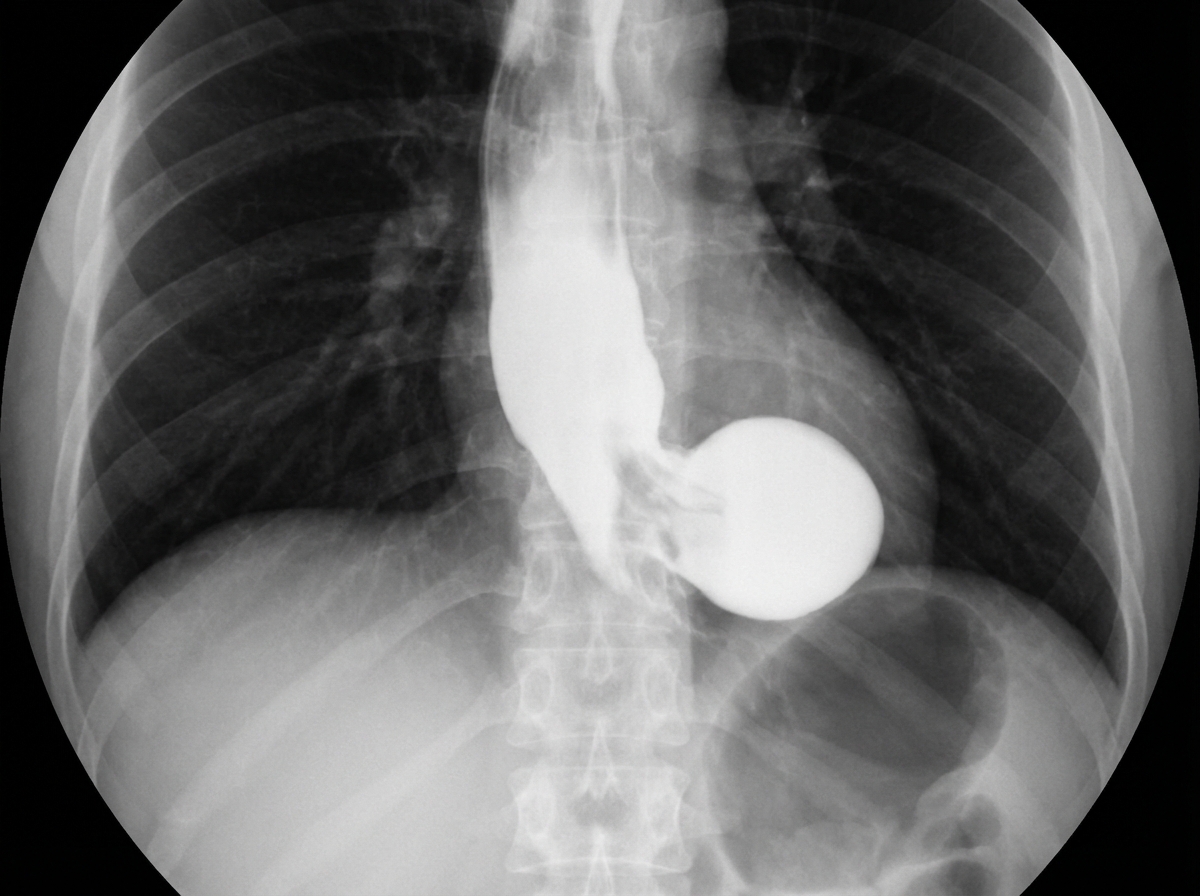
Dysphagia lusoria is caused by which of the following?
Curling's ulcer is commonly found in which part of the duodenum?
The Rossetti modification of Nissen's fundoplication involves which of the following?
Laparoscopic operation for gastrointestinal reflux should be considered in a patient with any of the following situations, EXCEPT:
A 65-year-old man diagnosed with adenocarcinoma of the distal esophagus experienced a 25-lb weight loss over the previous 6 months. He underwent a transhiatal esophagectomy complicated by a cervical leak and is receiving enteral feeds through a jejunostomy tube. After one week, his physicians wish to assess his nutritional resuscitation. Which of the following is the most accurate measure of the adequacy of his nutritional support?
What is the treatment of gallstone ileus?
Which of the following tumors is most commonly associated with pseudo myxoma peritonei?
Which of the following is FALSE about paraduodenal hernia?
Which of the following is NOT a feature of paralytic ileus?
What is the most common type of gastric tumor in adults?
Explanation: **Explanation:** **Dysphagia lusoria** (derived from *lusus naturae*, meaning "freak of nature") refers to difficulty swallowing caused by extrinsic compression of the esophagus by an **aberrant right subclavian artery**. 1. **Why the Correct Answer is Right:** In this congenital vascular anomaly, the right subclavian artery arises from the descending aorta (distal to the left subclavian) rather than the brachiocephalic trunk. To reach the right arm, it travels behind the esophagus (retro-esophageal) in 80% of cases, creating a "vascular sling" that compresses the esophageal lumen. While often asymptomatic in childhood, symptoms typically manifest in adulthood due to age-related atherosclerotic stiffening or aneurysmal changes (Kommerell’s diverticulum) of the vessel. 2. **Why Incorrect Options are Wrong:** * **Esophageal webs (A):** These are thin mucosal folds (common in Plummer-Vinson syndrome) that cause internal luminal narrowing, not extrinsic vascular compression. * **Achalasia (B):** This is a primary motility disorder caused by the failure of the Lower Esophageal Sphincter (LES) to relax and the absence of peristalsis. * **Esophageal stricture (C):** These are usually secondary to chronic acid reflux (GERD) or corrosive ingestion, leading to fibrotic narrowing of the wall. **Clinical Pearls for NEET-PG:** * **Diagnosis:** Barium swallow typically shows a **posterior indentation** on the esophagus. CT/MRI angiography is the gold standard for definitive vascular mapping. * **Treatment:** Surgical management (reconstruction or transposition of the artery) is only indicated for severe, symptomatic cases. * **Association:** Often associated with **Kommerell’s diverticulum** (a dilation at the origin of the aberrant vessel).
Explanation: **Explanation:** **Curling’s ulcer** is a stress-induced acute erosion or ulceration of the gastrointestinal tract occurring as a complication of **severe burns**. The underlying pathophysiology involves severe hypovolemia leading to mucosal ischemia and reduced protective bicarbonate production, making the lining susceptible to gastric acid. * **Why the 1st part of the Duodenum is correct:** Statistically and clinically, Curling’s ulcers most frequently involve the **proximal duodenum (1st part)**, though they can also occur in the stomach. The first part of the duodenum is the most common site because it is the most physiologically exposed to acidic gastric contents immediately upon emptying from the pylorus. * **Why other options are incorrect:** The 2nd and 3rd parts of the duodenum are further from the stomach and are partially protected by the neutralizing effect of alkaline bile and pancreatic secretions (which enter at the Ampulla of Vater in the 2nd part). Therefore, primary stress ulceration rarely initiates in these distal segments. **High-Yield Clinical Pearls for NEET-PG:** 1. **Curling vs. Cushing:** * **Curling’s Ulcer:** Associated with **Burns** (Think: *Curling* iron causes burns). * **Cushing’s Ulcer:** Associated with **Increased Intracranial Pressure (ICP)** or head trauma. These are typically deeper and have a higher risk of perforation. 2. **Mechanism:** Curling’s is due to **ischemia** (reduced mucosal blood flow), whereas Cushing’s is due to **vagal overstimulation** leading to hypersecretion of gastric acid. 3. **Prophylaxis:** In modern burn units, the incidence has significantly decreased due to the routine use of H2 blockers, Proton Pump Inhibitors (PPIs), and early enteral feeding.
Explanation: ### Explanation **Concept:** Nissen’s fundoplication is the gold standard surgical treatment for Gastroesophageal Reflux Disease (GERD). It involves a 360-degree wrap of the gastric fundus around the lower esophagus. The **Rossetti modification** was developed to simplify the procedure and reduce operative time by avoiding the extensive mobilization of the gastric fundus. **Why Option C is Correct:** In the standard Nissen fundoplication, the **short gastric vessels** are often divided to mobilize the fundus, allowing both the anterior and posterior walls to be wrapped around the esophagus. In the **Rossetti modification**, the short gastric vessels are **not divided**. Instead, the **anterior wall** of the gastric fundus is pulled behind the esophagus and wrapped around to meet itself anteriorly. Therefore, the wrap is constructed entirely from the anterior surface of the stomach. **Analysis of Incorrect Options:** * **Option A:** Excluding the stomach wall is impossible, as the "wrap" (plication) is by definition made of the gastric fundus. * **Option B:** While the posterior wall is the part being wrapped *around* the back in a standard Nissen, the Rossetti specifically utilizes the mobile anterior wall to create the 360-degree circuit. * **Option D:** This describes the **Standard Nissen Fundoplication**, where full mobilization (often involving division of short gastric vessels) allows both walls to contribute to the wrap. **Clinical Pearls for NEET-PG:** * **Nissen Fundoplication:** 360° wrap (Total). * **Toupet Fundoplication:** 270° posterior wrap (Partial). * **Dor Fundoplication:** 180–200° anterior wrap (Partial); often done post-Heller’s cardiomyotomy. * **Key Complication:** "Gas-bloat syndrome" is the most common side effect of a 360° wrap due to the inability to belch or vomit. * **Rossetti Advantage:** Reduced risk of splenic injury because short gastric vessels are left intact.
Explanation: **Explanation:** The primary goal of anti-reflux surgery (e.g., Nissen Fundoplication) is to restore the intra-abdominal length of the esophagus and create a tension-free wrap. **Why "Significant Esophageal Shortening" is the correct answer:** Significant esophageal shortening (often defined as <2.5 cm of intra-abdominal esophagus) is a **relative contraindication** to standard laparoscopic anti-reflux procedures. If the esophagus is too short, the fundoplication wrap will be under tension and likely migrate into the chest, leading to a high failure rate. In such cases, a standard Nissen fundoplication is insufficient; a **Collis Gastroplasty** (an esophageal lengthening procedure) is required to ensure the wrap remains below the diaphragm. **Analysis of Incorrect Options:** * **A. Barrett’s Esophagus:** This is a strong indication for surgery. While surgery does not always reverse metaplasia, it prevents further acid/bile reflux, which is critical in managing the progression of the disease. * **B. Daily PPI dependence:** Patients who require lifelong, daily medication for symptomatic relief, or those who experience "breakthrough" symptoms despite PPIs, are ideal candidates for surgery to avoid long-term drug side effects and improve quality of life. * **C. Esophageal Stricture:** A peptic stricture indicates advanced GERD. Once the stricture is dilated, anti-reflux surgery is indicated to prevent recurrence by eliminating the underlying acid reflux. **Clinical Pearls for NEET-PG:** * **Gold Standard Investigation:** 24-hour pH monitoring is the most objective tool to confirm GERD before surgery. * **Manometry:** Essential pre-operatively to rule out motility disorders like Achalasia, which would contraindicate a 360° wrap. * **DeMeester Score:** A score >14.72 on pH monitoring indicates significant reflux. * **Surgical Choice:** Nissen Fundoplication (360° wrap) is the standard; Toupet (270° posterior) or Dor (180° anterior) are used if esophageal motility is poor.
Explanation: ### Explanation **Correct Option: C. Serum albumin level** In the context of surgical recovery and chronic malnutrition (as evidenced by a 25-lb weight loss), **Serum Albumin** is the most reliable indicator of long-term nutritional status and the adequacy of resuscitation. While it has a long half-life (approx. 20 days), it is the gold standard for assessing the baseline nutritional reserve and predicting postoperative outcomes. In a patient with a cervical leak and ongoing enteral feeds, a rising or stable albumin level indicates that the body is transitioning from a catabolic to an anabolic state. **Why other options are incorrect:** * **A. Urinary nitrogen excretion level:** This measures nitrogen balance. While it helps determine if a patient is in a negative or positive nitrogen state, it is technically difficult to perform accurately and is more a measure of metabolic stress than overall nutritional adequacy. * **B. Total serum protein level:** This is a non-specific measure influenced by various factors including hydration status, globulin levels, and acute phase reactants, making it unreliable for specific nutritional assessment. * **D. Serum transferrin level:** Transferrin has a shorter half-life (8–10 days) than albumin, but its levels are heavily influenced by iron stores and liver function. In a postoperative patient, it is less reliable than albumin for assessing overall nutritional resuscitation. **Clinical Pearls for NEET-PG:** * **Half-lives of Proteins:** * Albumin: 20 days (Best for chronic status) * Transferrin: 8–10 days * Pre-albumin (Transthyretin): 2–3 days (Best for **acute** changes/weekly monitoring) * Retinol-binding protein: 12 hours (Shortest half-life) * **Albumin Facts:** It is the most abundant plasma protein. Hypoalbuminemia (<3.5 g/dL) is a strong independent predictor of poor surgical wound healing and increased postoperative complications. * **Jejunostomy (J-tube):** Preferred over gastrostomy in esophagectomy patients to allow early enteral feeding even if there is a proximal anastomotic leak.
Explanation: **Explanation:** Gallstone ileus is a mechanical intestinal obstruction caused by the impaction of a large gallstone (usually >2.5 cm) in the bowel lumen, most commonly at the **ileocecal valve** (the narrowest part of the small intestine). The stone enters the bowel through a cholecystoenteric fistula. **1. Why "Removal of obstruction" is correct:** The primary goal in the acute setting is to relieve the life-threatening intestinal obstruction. These patients are typically elderly, dehydrated, and have multiple comorbidities. Therefore, the safest and most widely accepted initial procedure is an **enterolithotomy** (removal of the stone via a longitudinal incision in the proximal healthy bowel). This "simple" approach has significantly lower morbidity and mortality compared to more extensive procedures. **2. Why the other options are incorrect:** * **Options A, C, and D:** These involve performing a cholecystectomy and/or fistula repair simultaneously with the enterolithotomy. While this "one-stage" procedure prevents future biliary complications, it is associated with much higher mortality rates in the emergency setting. Definitive biliary surgery is generally reserved for stable, younger patients or performed as a delayed "two-stage" procedure only if the patient remains symptomatic. **Clinical Pearls for NEET-PG:** * **Rigler’s Triad (X-ray findings):** 1. Pneumobilia (air in biliary tree), 2. Small bowel obstruction, 3. Ectopic calcified gallstone. * **Most common site of obstruction:** Terminal ileum. * **Most common fistula:** Cholecystoduodenal fistula. * **Management:** Enterolithotomy is the gold standard. Spontaneous closure of the fistula occurs in over 50% of cases once the distal obstruction is relieved.
Explanation: **Explanation:** **Pseudomyxoma Peritonei (PMP)** is a clinical syndrome characterized by the progressive accumulation of mucinous (gelatinous) ascites within the peritoneal cavity. This condition most commonly results from the rupture of a mucinous tumor, leading to the "redistribution phenomenon" where mucin-producing cells implant on peritoneal surfaces. 1. **Why Appendix is Correct:** The **Appendix** is the most common primary site of origin for PMP (accounting for >90% of cases). It typically arises from a **Low-grade Appendiceal Mucinous Neoplasm (LAMN)** or an appendiceal adenocarcinoma. When these tumors rupture, they leak mucus and neoplastic cells into the abdomen, causing the characteristic "jelly belly" appearance. 2. **Why Other Options are Incorrect:** * **Gallbladder, Stomach, and Pancreas:** While mucinous carcinomas can arise from these organs and occasionally cause peritoneal carcinomatosis, they are rare causes of the classic PMP syndrome. Historically, the ovary was thought to be a primary site, but current evidence suggests most ovarian mucinous tumors associated with PMP are actually metastases from an appendiceal primary. **Clinical Pearls for NEET-PG:** * **Clinical Presentation:** Often presents as increasing abdominal girth, "jelly belly," or an incidental finding during hernia repair or appendectomy. * **Redistribution Phenomenon:** Neoplastic cells follow the normal flow of peritoneal fluid and settle at sites of fluid absorption (e.g., omentum, undersurface of the diaphragm) while sparing the mobile small bowel. * **Treatment of Choice:** Cytoreductive Surgery (CRS) combined with **Hyperthermic Intraperitoneal Chemotherapy (HIPEC)**. * **Tumor Marker:** CEA and CA-19-9 are often elevated and used for monitoring.
Explanation: **Explanation:** Paraduodenal hernias are the most common type of internal hernia, accounting for approximately 50% of cases. They result from the entrapment of small bowel loops into congenital fossae formed by folds of the peritoneum during midgut rotation. **Why Option D is False:** Paraduodenal hernias are significantly more common on the **left side** (75%) than on the right side (25%). * **Left-sided hernias** occur through the **Fossa of Landzert**, located to the left of the fourth part of the duodenum. * **Right-sided hernias** occur through the **Fossa of Waldeyer** (also known as the mesentericoparietal fossa), located behind the superior mesenteric artery in the first part of the jejunal mesentery. **Analysis of Other Options:** * **Option A (Congenital):** This is true. They are developmental defects arising from abnormal rotation and fixation of the midgut and its mesentery. * **Option B (Fossa of Kolb):** This is true. The Fossa of Landzert is also referred to as the Fossa of Kolb or the paraduodenal fossa. * **Option C (Fossa of Landzert):** This is true. As mentioned, this is the specific anatomical site for the more common left-sided paraduodenal hernia. **High-Yield Clinical Pearls for NEET-PG:** * **Vascular Landmarks:** In a **Left** paraduodenal hernia, the **Inferior Mesenteric Vein** and left colic artery lie in the anterior margin of the orifice. In a **Right** paraduodenal hernia, the **Superior Mesenteric Artery** and vein lie in the anterior margin. * **Presentation:** Often presents as chronic, intermittent abdominal pain or acute intestinal obstruction. * **Diagnosis:** CT scan is the gold standard, showing a "cluster" of dilated small bowel loops encased in a sac-like appearance.
Explanation: **Explanation:** The core distinction between **Paralytic Ileus** and **Mechanical Bowel Obstruction** lies in the presence or absence of peristalsis. Paralytic ileus is a state of functional adynamic bowel where there is a failure of peristaltic activity without a physical blockage. **Why "Colicky Pain" is the correct answer:** Colicky pain is a hallmark of **mechanical obstruction**, where the bowel contracts vigorously against a physical barrier to overcome it. In contrast, paralytic ileus is characterized by a lack of motor activity; therefore, the patient typically experiences **vague, dull, generalized abdominal discomfort** or distension, but **never true colicky pain.** **Analysis of Incorrect Options:** * **A. Hypoactive bowel sounds:** Since there is no peristalsis, bowel sounds are characteristically absent or "silent." In mechanical obstruction, sounds are initially hyperactive (borborygmi). * **B. Presence of gas in the rectum:** In paralytic ileus, gas is distributed throughout the entire GI tract, including the colon and rectum. In complete mechanical obstruction, gas is absent distal to the site of blockage. * **D. Dilated bowel loops with multiple air-fluid levels:** X-rays in ileus show generalized dilatation of both the small and large bowel. While air-fluid levels are more classic for mechanical obstruction, they can also be seen in ileus due to stagnant fluid and gas. **Clinical Pearls for NEET-PG:** * **Most common cause:** Post-operative state (Physiological ileus: Small bowel recovers in 0–24h, Stomach in 24–48h, Colon in 48–72h). * **Metabolic triggers:** Hypokalemia (most common electrolyte abnormality), hyponatremia, and uremia. * **Management:** Usually conservative (NPO, IV fluids, electrolyte correction, and nasogastric decompression). Prokinetics like Erythromycin or Neostigmine may be used in specific cases (e.g., Ogilvie’s Syndrome).
Explanation: **Explanation:** **Adenocarcinoma** is the most common type of gastric tumor, accounting for approximately **90–95%** of all malignant gastric neoplasms in adults. It originates from the glandular epithelium of the gastric mucosa. Risk factors include *H. pylori* infection, smoking, high salt intake, and chronic atrophic gastritis. **Analysis of Incorrect Options:** * **Stromal tumor (GIST):** While Gastrointestinal Stromal Tumors are the most common mesenchymal tumors of the GI tract, they account for only about 1–3% of all gastric malignancies. They originate from the interstitial cells of Cajal. * **Lymphoma:** The stomach is the most common site for extranodal lymphomas (predominantly MALToma and DLBCL), but these represent only about 1–5% of gastric cancers. * **Leiomyosarcoma:** These are rare smooth muscle malignancies. Most tumors previously classified as leiomyosarcomas are now identified as GISTs through immunohistochemistry (CD117/c-kit positivity). **High-Yield Clinical Pearls for NEET-PG:** * **Lauren Classification:** Divides gastric adenocarcinoma into **Intestinal** (associated with environmental factors/metaplasia) and **Diffuse** (associated with younger age and Signet ring cells). * **Virchow’s Node:** Left supraclavicular lymphadenopathy, a classic sign of metastatic gastric cancer. * **Sister Mary Joseph Nodule:** Periumbilical metastasis. * **Krukenberg Tumor:** Metastasis to the ovaries (classically from the diffuse type). * **Investigation of Choice:** Upper GI Endoscopy with biopsy.
Esophageal Disorders
Practice Questions
Gastric Disorders
Practice Questions
Small Intestine Pathology
Practice Questions
Appendicitis
Practice Questions
Inflammatory Bowel Disease
Practice Questions
Intestinal Obstruction
Practice Questions
Gastrointestinal Bleeding
Practice Questions
Diverticular Disease
Practice Questions
Anorectal Disorders
Practice Questions
Colorectal Neoplasms
Practice Questions
Gastrointestinal Stomas
Practice Questions
Bariatric Surgery Principles
Practice Questions
Get full access to all questions, explanations, and performance tracking.
Start For Free