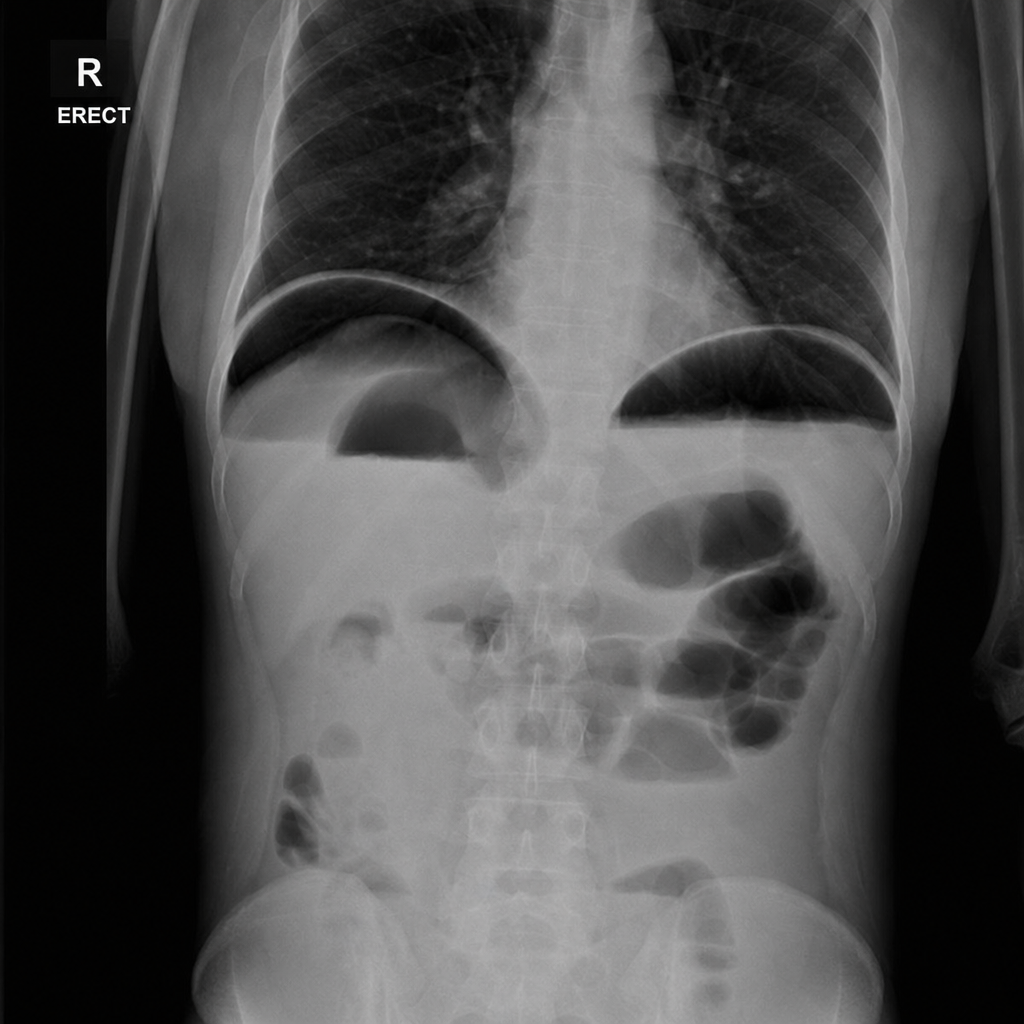
Which of the following is not related to carcinoma of the stomach?
What is the treatment of choice in multiple jejunal strictures?
In the Wharfe assessment of impacted third molars, what does 'A' stand for?
What is the most common cause of painless bleeding per rectum in a man?
All of the following are true regarding Superior Mesenteric Artery Syndrome, except?
Resection of the adjacent gut is most often required in which of the following conditions?
What is true about enterocutaneous fistula?
A pregnant lady at 16 weeks gestation presents with acute appendicitis and a TLC of 24,000. What is the recommended management?
A 60-year-old man complains of recurrent attacks of painless rectal bleeding. Colonoscopy reveals normal mucosa between the cecum and the anal verge. What is the most helpful test to determine the cause of bleeding?
Which of the following statements about Pseudomyxoma peritonei is FALSE?
Explanation: **Explanation:** The correct answer is **Blood group O** because it is classically associated with **Peptic Ulcer Disease (Duodenal Ulcers)**, whereas **Blood group A** is the one specifically linked to an increased risk of **Gastric Carcinoma**. **1. Why Blood Group O is the correct answer:** Epidemiological studies have consistently shown that individuals with Blood Group O have a higher predisposition to *H. pylori* colonization leading to duodenal ulcers, but they do not have an increased risk for gastric malignancy. In contrast, Blood Group A is a well-known genetic risk factor for the **diffuse type** of gastric adenocarcinoma. **2. Analysis of other options:** * **Blood group A:** Strongly associated with gastric cancer. The hypothesized mechanism involves differences in mucosal cell surface antigens that may facilitate malignant transformation or alter the immune response to chronic inflammation. * **Smoked fish:** These foods are high in **polycyclic aromatic hydrocarbons** and salt. High salt intake acts as a mucosal irritant, leading to chronic atrophic gastritis, which is a precursor to the intestinal type of gastric cancer. * **Nitrosoamines:** These are potent carcinogens formed from dietary nitrates and nitrites (found in preserved meats and fertilizers). They induce DNA damage and are major environmental drivers of gastric carcinogenesis. **Clinical Pearls for NEET-PG:** * **Lauren Classification:** Gastric cancer is divided into **Intestinal** (associated with environmental factors like smoked foods/nitrosamines) and **Diffuse** (associated with Blood Group A and E-cadherin/CDH1 mutations). * **Most common site:** Historically the antrum, but the incidence of proximal/cardia cancers is rising. * **Virchow’s Node:** Left supraclavicular lymphadenopathy (Troisier’s sign) is a classic sign of metastatic gastric cancer. * **Sister Mary Joseph Nodule:** Umbilical metastasis, most commonly from gastric origin.
Explanation: **Explanation:** The treatment of choice for multiple jejunal strictures, particularly in the context of **Crohn’s disease** or **Intestinal Tuberculosis**, is **Stricturoplasty**. The underlying medical concept is **bowel preservation**. In conditions like Crohn’s, where strictures are often multiple and recurrent, performing multiple resections would lead to "Short Bowel Syndrome," resulting in severe malabsorption. Stricturoplasty allows for the relief of obstruction by widening the narrowed lumen without removing any length of the small intestine. **Analysis of Options:** * **Option A (Resection and anastomosis):** While effective for a single, long, or complicated stricture (e.g., phlegmon or perforation), it is avoided in multiple strictures to prevent excessive loss of functional bowel. * **Option B (Noble’s procedure):** This is a historical "plication" technique used to prevent recurrent adhesions by suturing bowel loops together. it does not address the internal narrowing of strictures. * **Option D (End-to-side anastomosis):** This is a method of reconstruction after resection, not a primary treatment for multiple strictures. **Clinical Pearls for NEET-PG:** 1. **Heineke-Mikulicz Stricturoplasty:** Used for short strictures (≤ 10 cm). It involves a longitudinal incision and transverse closure. 2. **Finney Stricturoplasty:** Used for medium-length strictures (10–20 cm). 3. **Michelassi Stricturoplasty:** A side-to-side isoperistaltic technique used for very long, complex strictures (> 20 cm). 4. **Contraindications:** Stricturoplasty should not be performed if there is a perforation, malignancy, or if the stricture is too close to a planned resection site.
Explanation: The **WHARFE assessment** is a clinical scoring system used to predict the difficulty of surgical extraction for impacted mandibular third molars. It was developed by MacGregor to provide a more objective evaluation than traditional classifications. ### Explanation of the Correct Answer In the WHARFE mnemonic, **'A' stands for Angulation of the 3rd molar**. This refers to the position of the long axis of the third molar in relation to the second molar (e.g., mesioangular, horizontal, vertical, or distoangular). Distoangular impactions are generally considered the most difficult to extract in the mandible, whereas mesioangular impactions are typically the easiest. ### Analysis of Incorrect Options * **Axis of rotation:** While the path of delivery is important in surgery, it is not a component of the WHARFE acronym. * **Application of elevator:** This refers to a surgical technique/step, not a preoperative assessment parameter. * **Amber line:** This is a distractor. The **Winter’s Lines** (Red, Amber, and White) are used to assess the depth of impaction, but the WHARFE acronym specifically uses the term "Depth" (from the Amber line) rather than the word "Amber" itself for the letter 'A'. ### High-Yield Facts for NEET-PG To memorize the **WHARFE** assessment components: * **W: Winter’s Classification** (Angulation) * **H: Height** of the mandible (Density of bone) * **A: Angulation** of the second molar * **R: Root** shape and number (Curvature, bulbous roots) * **F: Follicle** size (Presence of cyst or space) * **E: Exit** path (Space available for delivery) **Clinical Pearl:** The most common type of mandibular impaction is **Mesioangular**, while the most common maxillary impaction is **Vertical**. According to the WHARFE score, the higher the total score, the greater the surgical difficulty.
Explanation: **Explanation:** The correct answer is **Piles (Hemorrhoids)**. In clinical practice and for the NEET-PG exam, internal hemorrhoids are recognized as the most common cause of painless, bright red bleeding per rectum (hematochezia) across all age groups and genders. **Why Piles is correct:** Internal hemorrhoids originate above the dentate line, where the mucosa is supplied by visceral nerves (insensitive to pain). The classic presentation is "splashing the pan"—painless, bright red bleeding occurring at the end of defecation. While external hemorrhoids can be painful if thrombosed, the primary symptom of internal piles is bleeding without pain. **Analysis of Incorrect Options:** * **Fissure-in-ano:** This is the most common cause of **painful** bleeding per rectum. The pain is typically sharp, "knife-like," and persists for hours after defecation. * **Diverticulosis:** While this is the most common cause of **massive, brisk** lower GI bleeding in the elderly, it is less frequent in the general population compared to hemorrhoids. * **Colorectal Cancer:** Though a critical differential for painless bleeding, it is statistically less common than hemorrhoids, especially in younger demographics. **High-Yield Clinical Pearls for NEET-PG:** * **Most common cause of painless bleeding (Overall):** Hemorrhoids. * **Most common cause of painful bleeding:** Anal Fissure. * **Most common cause of massive lower GI bleed:** Diverticulosis. * **Most common cause of rectal bleeding in children:** Meckel’s Diverticulum or Juvenile Polyps. * **Rule of Thumb:** Any patient over 40 presenting with new-onset rectal bleeding must undergo a digital rectal examination (DRE) and proctoscopy/colonoscopy to rule out malignancy.
Explanation: **Superior Mesenteric Artery (SMA) Syndrome**, also known as Wilkie’s syndrome, is a rare cause of proximal small bowel obstruction. It occurs when the **third part of the duodenum** is compressed between the SMA and the abdominal aorta. ### Why Option D is the Correct Answer (The Exception) SMA syndrome is **not** most common in the 6th-7th decade. It typically affects **adolescents and young adults** (10–30 years of age). The condition is associated with rapid weight loss or linear growth spurts, which lead to the loss of the mesenteric fat pad that normally keeps the SMA away from the aorta. ### Explanation of Other Options * **Option A:** The third (horizontal) part of the duodenum passes directly through the **aortomesenteric angle**. Narrowing of this angle (normally 38°–65°) leads to mechanical compression. * **Option B:** It is classically seen in **young, underweight females** (asthenic habitus) or patients with conditions causing rapid weight loss (e.g., anorexia nervosa, malabsorption, or major burns). * **Option C:** It generally **does not occur in obese individuals** because an abundance of retroperitoneal fat maintains a wide aortomesenteric angle, protecting the duodenum from compression. ### Clinical Pearls for NEET-PG * **Aortomesenteric Angle:** The syndrome occurs when the angle narrows to **<25°** (Normal: 38°–65°) or the aortomesenteric distance decreases to **<8–10 mm** (Normal: 10–28 mm). * **Clinical Presentation:** Postprandial epigastric pain, fullness, and vomiting. Symptoms are often **relieved by the prone position**, knee-chest position, or the Left Lateral Decubitus (Hayes maneuver). * **Diagnosis:** Contrast-enhanced CT or barium swallow showing a "dilated proximal duodenum with an abrupt cutoff" at the third part. * **Management:** Initial treatment is conservative (nasogastric decompression and nutritional support). If failed, the surgical procedure of choice is **Duodenojejunostomy**.
Explanation: **Explanation:** The correct answer is **Enterogenous cyst**. The primary reason resection of the adjacent gut is required in this condition is the **shared blood supply**. 1. **Enterogenous Cyst (Correct):** These are developmental anomalies (duplication cysts) that arise from the mesenteric border of the intestine. Crucially, they share a common muscular wall and a common blood supply with the adjacent segment of the bowel. Because the blood supply is intertwined, it is surgically impossible to excise the cyst alone without compromising the vascularity of the neighboring gut. Therefore, formal resection of the cyst along with the involved segment of the bowel is mandatory. 2. **Chylolymphatic Cyst (Incorrect):** These are the most common type of mesenteric cysts. They have an independent blood supply and are thin-walled. They can usually be "enucleated" (shelled out) without necessitating bowel resection. 3. **Mesenteric Dermoid Cyst (Incorrect):** These are rare, germ-cell-derived cysts. Like most other mesenteric cysts, they do not typically share a common wall or primary blood supply with the intestine, allowing for simple excision. 4. **Simple Cyst (Incorrect):** These are serous cysts of lymphatic origin. They are easily separable from the bowel and do not require intestinal resection. **High-Yield Clinical Pearls for NEET-PG:** * **Most common site for Enterogenous cysts:** Terminal Ileum. * **Pathological hallmark:** They are lined by intestinal mucosa (often ectopic gastric mucosa, which can lead to perforation or hemorrhage). * **Surgical Principle:** "Enucleation" is the treatment of choice for most mesenteric cysts, **EXCEPT** for Enterogenous cysts, where "Resection-Anastomosis" is the rule. * **Differential Diagnosis:** On ultrasound, a "double-wall sign" (inner echogenic mucosa and outer hypoechoic muscularis) is highly suggestive of an enterogenous/duplication cyst.
Explanation: ### Explanation An **Enterocutaneous Fistula (ECF)** is an abnormal communication between the gastrointestinal tract and the skin. Management follows the "SNAP" protocol (Sepsis control, Nutrition, Anatomy, Plan). **Why Option D is the Correct (though counter-intuitive) Answer:** In the context of this specific question, "No skin damage" is often cited in older surgical texts or specific exam patterns to indicate that the fistula tract itself is lined by granulation tissue or epithelium, or it refers to the fact that skin damage is a *complication* rather than a defining *characteristic* of the fistula. However, clinically, skin excoriation is common due to succus entericus. In NEET-PG, this option is sometimes selected when other options are mathematically or etiologically more incorrect. **Analysis of Incorrect Options:** * **Option A:** High output fistulas are defined as draining **>500 ml/day**. Low output is <200 ml/day, and moderate is 200–500 ml/day. * **Option B:** The most common cause of ECF is **iatrogenic (post-operative)**, accounting for 75–85% of cases. Malignancy, Crohn’s disease, and radiation are less common primary causes. * **Option C:** This is actually a **true statement** (Fluid and electrolyte loss is a major complication). However, if the question asks for a specific defining feature or if the key identifies "No skin damage," it highlights the importance of checking the most "technically" accurate surgical definition provided in standard textbooks like Bailey & Love. **High-Yield Clinical Pearls for NEET-PG:** * **Most common cause:** Post-operative (Iatrogenic). * **Spontaneous Closure:** Factors preventing closure (**FRIEND**: **F**oreign body, **R**adiation, **I**nflammation/IBD, **E**pithelialization of the tract, **N**eoplasia, **D**istal obstruction). * **Management:** Initial priority is **fluid resuscitation and electrolyte correction**, followed by skin protection (Zinc oxide) and nutritional support (TPN is often preferred to reduce secretions).
Explanation: **Explanation:** **1. Why Early Surgery is Correct:** Acute appendicitis is the most common non-obstetric surgical emergency during pregnancy. The standard of care is **early surgical intervention** (Laparoscopic or Open Appendectomy), regardless of the trimester. In this case, the high TLC (24,000) suggests significant inflammation. Delaying surgery increases the risk of **perforation**, which is associated with a much higher rate of fetal loss (up to 20-30%) and maternal morbidity compared to non-perforated cases (approx. 3-5% fetal loss). Pregnancy-related anatomical changes (displacement of the appendix) often mask classic signs, making early intervention crucial to prevent complications. **2. Why Other Options are Wrong:** * **Option A & D:** Conservative or medical management is generally avoided because the risk of rupture is higher in pregnancy due to the lack of omental "wrapping" (the gravid uterus prevents the omentum from reaching the appendix). Recurrence or progression to peritonitis poses a lethal threat to the fetus. * **Option C:** Appendicitis is not an indication for termination of pregnancy. With modern anesthesia and surgical techniques, the pregnancy can be safely maintained. **Clinical Pearls for NEET-PG:** * **Diagnosis:** The most common symptom is still **RLQ pain**, but the location of the appendix shifts **superiorly and laterally** as the uterus grows (Alder’s sign). * **Imaging:** Ultrasound is the first-line investigation; MRI is the preferred second-line if USG is inconclusive. * **Surgical Timing:** The second trimester (as in this patient) is often considered the "safest" time for surgery, but surgery should never be delayed based on the trimester if appendicitis is suspected. * **Laparoscopy:** Currently considered safe in all trimesters, provided intra-abdominal pressure is maintained at 10–12 mmHg.
Explanation: ### Explanation **1. Why Angiography is the Correct Answer:** The clinical presentation of **recurrent, painless rectal bleeding** in an elderly patient (60 years) with a **normal colonoscopy** strongly suggests a source that is either vascular or located in the small bowel. **Angiodysplasia** (arteriovenous malformations) is the most common vascular cause of lower GI bleeding in the elderly, typically occurring in the cecum or right colon. Since these lesions are often submucosal or intermittent, they can be missed on standard colonoscopy. **Selective Mesenteric Angiography** is the gold standard for diagnosis during an active bleed (detecting rates as low as 0.5 mL/min) as it identifies the characteristic "tufts" or early venous filling. **2. Why Other Options are Incorrect:** * **B. Technetium (99mTc-pertechnetate) Scan:** This is the test of choice for **Meckel’s diverticulum**. However, Meckel’s typically presents in children or young adults ("Rule of 2s"). It is an unlikely cause for a first-time presentation in a 60-year-old. * **C. Upper GI Endoscopy:** While brisk upper GI bleeds can cause hematochezia, they are usually accompanied by hemodynamic instability or melena. A normal colonoscopy up to the cecum makes a colonic or small bowel source more likely in a stable patient. * **D. Small-bowel series:** Barium studies have a very low yield for identifying the source of active or recurrent GI bleeding and may interfere with subsequent angiography or endoscopy. **3. NEET-PG High-Yield Pearls:** * **Most common cause of massive lower GI bleed in elderly:** Diverticulosis. * **Most common vascular cause of lower GI bleed in elderly:** Angiodysplasia. * **Diagnostic threshold for Angiography:** 0.5 mL/min. * **Diagnostic threshold for Tagged RBC Scan:** 0.1 mL/min (more sensitive but less specific for localization than angiography). * **Association:** Angiodysplasia is frequently associated with **Aortic Stenosis** (Heyde’s Syndrome) and Chronic Renal Failure.
Explanation: ### Explanation: Pseudomyxoma Peritonei (PMP) **Pseudomyxoma Peritonei** is a clinical syndrome characterized by the accumulation of abundant mucinous (gelatinous) ascites within the peritoneal cavity, often referred to as "Jelly Belly." #### Why Option C is the Correct (False) Statement: The primary management of PMP is surgical, not systemic chemotherapy. **Systemic chemotherapy has a very limited role** because the mucinous material is relatively avascular, making it difficult for systemic drugs to reach the tumor cells effectively. The gold standard treatment is **Cytoreductive Surgery (CRS)** combined with **Hyperthermic Intraperitoneal Chemotherapy (HIPEC)**. While HIPEC uses chemotherapy, it is a localized, heated delivery system; traditional systemic chemotherapy is generally considered ineffective. #### Analysis of Other Options: * **Option A (More common in females):** This is **True**. While it can occur in both sexes, it is more frequently diagnosed in females, often presenting as an apparent ovarian mass (Krukenberg-like presentation). * **Option B (Can arise from a locally malignant tumor):** This is **True**. The most common origin is a low-grade mucinous neoplasm of the **appendix** (LAMN). It is considered "locally malignant" because it spreads by surface seeding rather than lymphatic or hematogenous routes. * **Option D (Requires surgical debulking):** This is **True**. Aggressive surgical debulking (Cytoreductive surgery) to remove all visible tumor implants and the primary source (usually the appendix) is the cornerstone of treatment. --- ### High-Yield Facts for NEET-PG: * **Most Common Origin:** Appendix (specifically a Mucocele or Mucinous Cystadenoma/Adenocarcinoma). * **Characteristic Sign:** "Jelly Belly" (thick, gelatinous ascites). * **Redistribution Phenomenon:** Tumor cells follow the flow of peritoneal fluid and settle in "static" areas like the pelvis, paracolic gutters, and Omentum (Omental cake), while sparing the mobile small bowel. * **Treatment of Choice:** Sugarbaker Procedure (Cytoreductive Surgery + HIPEC). * **Tumor Markers:** CEA, CA-125, and CA 19-9 are often elevated and used for monitoring.
Esophageal Disorders
Practice Questions
Gastric Disorders
Practice Questions
Small Intestine Pathology
Practice Questions
Appendicitis
Practice Questions
Inflammatory Bowel Disease
Practice Questions
Intestinal Obstruction
Practice Questions
Gastrointestinal Bleeding
Practice Questions
Diverticular Disease
Practice Questions
Anorectal Disorders
Practice Questions
Colorectal Neoplasms
Practice Questions
Gastrointestinal Stomas
Practice Questions
Bariatric Surgery Principles
Practice Questions
Get full access to all questions, explanations, and performance tracking.
Start For Free