Which of the following is NOT characteristic of lymphogranuloma venereum proctitis?
Emergency management of Ulcerative colitis is by:
The most common complication of Zenker's diverticulum is:
What is the treatment of choice for a 70-year-old male patient who presents with peritonitis secondary to ruptured diverticulitis?
Which of the following conditions is not reduced by a high-fiber diet?
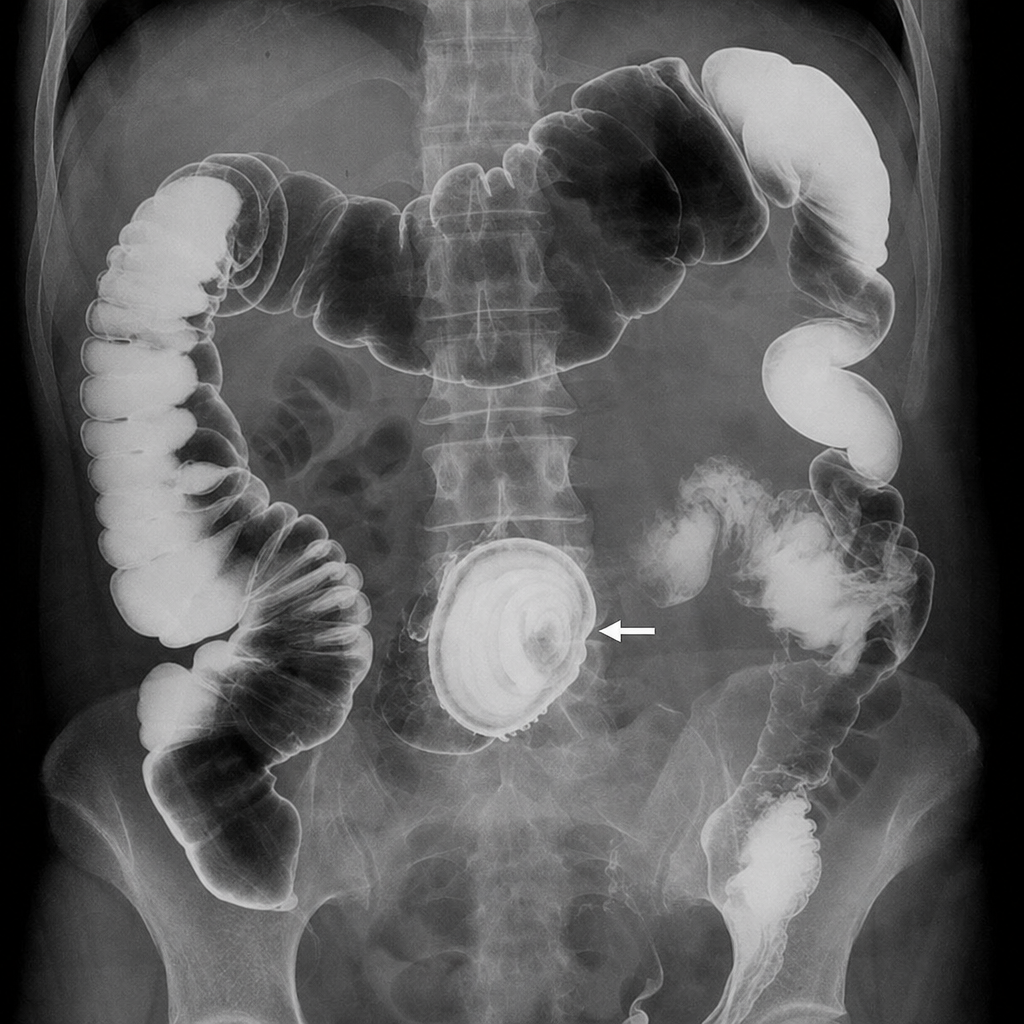
A patient presents with abdominal pain, blood in stools and a palpable mass on examination. A Barium Study was performed, probable diagnosis is?
Massive bleeding per rectum in an elderly patient is due to.
Dohlman surgery in Zenker's diverticulum is:-
A 40-year-old male with gastroesophageal reflux disease (GERD) is found to have Barrett's esophagus with low-grade dysplasia on endoscopy. What is the most appropriate initial pharmacological treatment for this condition?
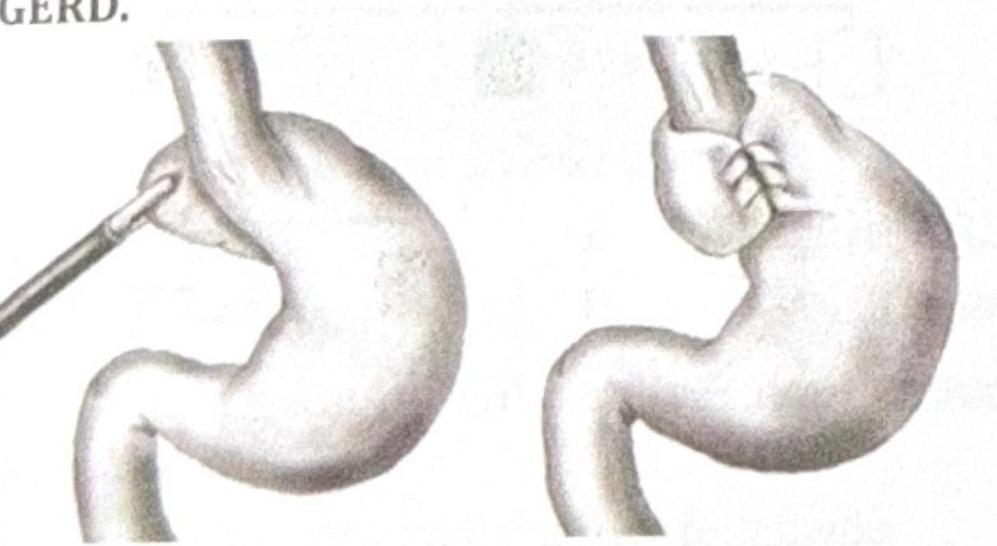
Identify the procedure shown in the image, which is performed in a patient with recurrent GERD.
Explanation: Absence of inguinal lymphadenopathy - **Lymphogranuloma venereum (LGV)** characteristically causes **inguinal lymphadenopathy** (buboes) due to its systemic nature and potential concurrent genital involvement, even in cases of isolated rectal infection [1]. - While the rectum drains primarily to **internal iliac and sacral lymph nodes**, LGV's systemic spread and inflammatory response typically result in inguinal lymph node involvement, making its absence atypical [1]. *Painful defecation* - **LGV proctitis** commonly causes **painful defecation** and **tenesmus** due to severe inflammation and ulceration of the rectal mucosa [1]. - The inflammatory process affects **nerve endings** in the rectal wall, leading to significant discomfort during bowel movements [1]. *Constipation alternating with diarrhea* - **Rectal inflammation** from LGV disrupts normal bowel function, causing **altered bowel habits** including constipation alternating with diarrhea. - **Rectal strictures** may develop in chronic cases, further contributing to irregular bowel patterns and incomplete evacuation. *Rectal discharge and bleeding* - **LGV proctitis** typically presents with **mucopurulent rectal discharge** due to extensive mucosal inflammation and secondary bacterial infection [1]. - **Rectal bleeding** occurs from **mucosal ulceration** and increased vascular fragility caused by the inflammatory process.
Explanation: ***Subtotal colectomy with end ileostomy*** - This is the **standard emergency procedure** for fulminant ulcerative colitis, toxic megacolon, perforation, or massive hemorrhage - Involves removal of the **entire colon** (from ileocecal junction to upper rectum) while **preserving the rectal stump** as a Hartmann's pouch - Creates an **end ileostomy** for fecal diversion - **Proctectomy is avoided** in the emergency setting due to higher morbidity, risk of pelvic sepsis, and technical difficulty in acutely ill patients - The rectal stump can be removed later (2nd stage) with consideration for **ileal pouch-anal anastomosis (IPAA)** after patient stabilization - This staged approach allows for optimization of the patient's condition and future reconstructive options *Total proctocolectomy with end ileostomy* - This involves removal of both the **colon and rectum** with permanent ileostomy - **NOT recommended in emergency settings** as proctectomy adds significant morbidity in critically ill patients - Requires pelvic dissection in inflamed tissues, increasing risk of complications - May be performed electively as a **second-stage procedure** or in patients not candidates for reconstructive surgery *Right hemicolectomy* - Removes only the **right side of the colon** (cecum, ascending colon, and part of transverse colon) - Inappropriate for ulcerative colitis, which is a **pan-colonic disease** that always involves the rectum and extends proximally - Inadequate resection would leave diseased colon in place *Left hemicolectomy* - Removes only the **left side of the colon** (descending colon and part of transverse colon) - Inadequate for ulcerative colitis as it doesn't address the **entire diseased colon** - Would leave inflamed segments and the **always-involved rectum** in place
Explanation: ***Aspiration pneumonia*** - **Aspiration pneumonia** is the **most common complication** of Zenker's diverticulum, occurring due to chronic regurgitation of food and secretions that accumulate in the diverticulum. - Patients frequently experience **nocturnal regurgitation** of undigested food, which is then *aspirated* into the airways, leading to recurrent pulmonary infections. - This is the primary reason for surgical intervention in symptomatic patients with Zenker's diverticulum. *Lung abscess* - **Lung abscess** is a more *severe* but **less common** complication that can develop as a consequence of chronic, recurrent aspiration pneumonia. - It represents a localized, necrotizing infection and is a **progression** from untreated or recurrent aspiration, rather than the initial or most frequent complication. *Dysphonia* - While **dysphonia** (hoarseness) can occur due to irritation from regurgitated contents or compression of the recurrent laryngeal nerve, it is **uncommon** as a complication. - Dysphonia is more typically associated with **GERD** or direct laryngeal pathology. *Perforation* - **Perforation** of Zenker's diverticulum is a **rare** complication that may occur spontaneously, due to impacted food, or iatrogenically during endoscopic procedures. - While serious, it is far less common than pulmonary complications from chronic aspiration.
Explanation: ***Hartmann's procedure*** - For **peritonitis secondary to ruptured diverticulitis** in an elderly patient, a Hartmann's procedure is often the safest choice, involving resection of the diseased bowel and creation of an **end colostomy**. - This procedure avoids a primary anastomosis in the presence of **sepsis** and inflammation, reducing the risk of anastomotic leak in a high-risk patient. *Conservative* - **Conservative management** with antibiotics is typically reserved for **uncomplicated diverticulitis** (i.e., no perforation or generalized peritonitis). - Given the presence of **peritonitis**, a surgical intervention is necessary to address the source of infection and contamination. *Primary resection and anastomosis* - While possible in select, hemodynamically stable patients with localized contamination, **primary anastomosis** carries a higher risk of **anastomotic leak** in the setting of diffuse peritonitis and inflammation. - This approach is generally avoided in elderly patients with significant contamination due to increased morbidity and mortality risks. *Whipple procedure* - The **Whipple procedure**, or pancreaticoduodenectomy, is a complex surgical operation to remove the **head of the pancreas**, duodenum, gallbladder, and part of the bile duct. - It is used to treat **pancreatic cancer** and other tumors of the periampullary region, and is completely unrelated to diverticular disease or peritonitis.
Explanation: ***Sigmoid volvulus (intestinal obstruction)*** - While a high-fiber diet can promote **regular bowel movements**, it does not specifically reduce the risk of **sigmoid volvulus**, which is primarily caused by an abnormally long and mobile sigmoid colon, often exacerbated by a narrow mesenteric attachment. - The mechanical twisting of the colon is not directly influenced by stool bulk or transit time in a way that prevents its occurrence.*Inflammatory bowel disease (IBD)* - A high fiber diet may actually exacerbate symptoms in some patients with **IBD**, particularly during flares, as it can increase stool bulk and intestinal irritation. - While fiber can have anti-inflammatory effects in some gut conditions, its role in preventing or reducing IBD is complex and not consistently supported as a primary preventive measure.*Colorectal cancer (bowel tumor)* - A high-fiber diet is strongly associated with a **reduced risk of colorectal cancer** by increasing stool bulk, diluting carcinogens, and shortening transit time, thereby limiting exposure of the colon lining to harmful substances. - Fiber fermentation by gut bacteria produces **short-chain fatty acids** like butyrate, which have protective effects on colonocytes.*Diverticulitis (colon inflammation)* - A high-fiber diet is effective in **preventing diverticulosis** and reducing the risk of diverticulitis by increasing stool bulk and reducing intraluminal pressure in the colon [1]. - This prevents the formation and inflammation of **diverticula**, which are small pouches that can protrude from the colon wall [1].
Explanation: ***Intussusception*** - This condition is characterized by a "telescoping" of one segment of the intestine into another, which can lead to **abdominal pain**, **rectal bleeding** (often described as "currant jelly" stools), and a **palpable sausage-shaped mass** on examination. - A barium study (specifically a **barium enema**) is often diagnostic and can also be therapeutic for intussusception, revealing a **coiled spring appearance** or an obstruction. *Volvulus* - Volvulus involves the **twisting of a loop of bowel** around its mesentery, often presenting with sudden onset, severe **abdominal pain**, vomiting, and constipation. - While it can cause an obstruction and pain, a palpable mass and bloody stools are less common initial findings compared to intussusception. *Meckel's Diverticulum* - Meckel's diverticulum is a **congenital outpouching** of the small intestine that can be asymptomatic or cause complications like **gastrointestinal bleeding** (due to ectopic gastric mucosa), obstruction, or diverticulitis. - While it can cause painless rectal bleeding, a palpable mass and acute, intermittent abdominal pain are not typical primary presentations for an uncomplicated Meckel’s diverticulum. *Diverticulitis* - Diverticulitis is the **inflammation of diverticula** (small pouches in the colon), typically presenting with **left lower quadrant abdominal pain**, fever, and changes in bowel habits. - While it can cause bleeding, a palpable mass is less common unless there's an abscess, and the clinical picture does not align as strongly with the "currant jelly stool" and classic palpable mass of intussusception.
Explanation: ***Diverticulosis*** - **Diverticular bleeding** is the most common cause of **massive lower gastrointestinal bleeding** in elderly patients. - Bleeding occurs when a small artery at the base of a diverticulum is eroded, leading to significant, often **painless, rectal bleeding**. *Colitis* - While colitis can cause rectal bleeding, it is typically associated with **diarrhea, abdominal pain**, and often **bloody stools** rather than massive, isolated rectal bleeding. - Inflammatory conditions like ulcerative colitis can cause bleeding, but a single episode of massive hemorrhage is less characteristic. *Colorectal cancer* - **Colorectal cancer** can cause rectal bleeding, but it is typically **chronic, intermittent, and low-volume**, often presenting as blood mixed with stool or on the surface of the stool. - It rarely presents as a sudden, **massive hemorrhage** that fills the toilet bowl. *Peptic ulcer disease* - **Peptic ulcer disease** is a cause of **upper gastrointestinal bleeding**, presenting as **hematemesis** (vomiting blood) or **melena** (black, tarry stools) [1]. - It would not cause **massive bleeding per rectum** unless there is a very rapid transit of blood through the entire gastrointestinal tract, which is uncommon.
Explanation: ***Endoscopic electrocautery technique*** - The **Dohlman procedure** (Dohlman-Mattsson procedure, 1960) is an **endoscopic electrosurgical technique** that uses **diathermy/electrocautery** to divide the cricopharyngeal muscle (the septum between the esophagus and the diverticulum). - This method creates a common cavity between the esophagus and the diverticulum, allowing food to pass freely and preventing pooling. - It is one of the **classic endoscopic approaches** for treating Zenker's diverticulum and remains widely used. *Endoscopic suturing of pouch* - Endoscopic suturing is not the primary technique for the Dohlman procedure. - The goal is to **divide the septum**, not to suture or reduce the pouch itself. *Laser division of pouch* - **Laser division** of the cricopharyngeal muscle is another endoscopic approach, often called **endoscopic laser diverticulostomy**. - While effective, this is a **different technique** from the Dohlman procedure, which specifically uses electrocautery. *Endoscopic stapling of septum* - **Endoscopic stapling** (using an endoscopic stapler to divide the septum) is associated with the **Collard-Peracchia technique** or endoscopic stapling diverticulostomy. - While this is a modern and effective approach, it is **not the Dohlman procedure**, which historically and traditionally refers to the electrocautery technique.
Explanation: ***PPI*** - In patients with **GERD** and **low-grade dysplasia**, high-dose **proton pump inhibitors (PPIs)** are the initial treatment of choice to suppress acid reflux. - Continuous acid suppression can help in the regression of dysplasia and prevent its progression to higher grades. *Fundoplication* - **Fundoplication** is a surgical procedure to treat severe GERD, but it is not the primary initial treatment for low-grade dysplasia. - It might be considered if medical therapy with PPIs fails or if there are significant anatomical defects. *Esophageal resection* - **Esophageal resection** is a major surgical procedure typically reserved for **high-grade dysplasia** or **esophageal adenocarcinoma**. - It is an overly aggressive and unnecessary intervention for initial management of low-grade dysplasia. *Diet modification* - **Diet modification** is an important adjunctive therapy for GERD symptoms and overall gastric health. - However, it is generally insufficient as a standalone initial treatment for documented **low-grade dysplasia** without concurrent pharmacotherapy.
Explanation: ***Nissen fundoplication*** - The image clearly depicts the **fundus of the stomach** being wrapped completely around the lower esophagus and sutured in place, which is the hallmark of a **360-degree Nissen fundoplication**. - This procedure aims to strengthen the **lower esophageal sphincter (LES)** to prevent reflux in patients with recurrent GERD. *Partial gastrectomy* - This procedure involves the **surgical removal of a portion of the stomach** and is typically performed for conditions like gastric cancer or severe ulcers, not primarily for GERD. - The image shows the stomach intact and being wrapped, not resected. *Esophageal banding* - Esophageal banding is a procedure used to treat **esophageal varices** by placing elastic bands around dilated veins, not a surgical intervention for GERD that alters stomach anatomy. - The image shows a gastric maneuver, not banding of the esophagus. *Toupet fundoplication* - A Toupet fundoplication involves a **partial (270-degree) wrap** of the fundus around the esophagus, leaving a small portion unwrapped. - The image distinctly illustrates a **complete 360-degree wrap**, distinguishing it from a Toupet fundoplication.
Get full access to all questions, explanations, and performance tracking.
Start For Free