What is the standard treatment for medullary carcinoma of the thyroid?
Which of the following is the most common histologic type of thyroid cancer?
What is the therapy of choice for diffuse toxic goiter in a patient over 45 years of age?
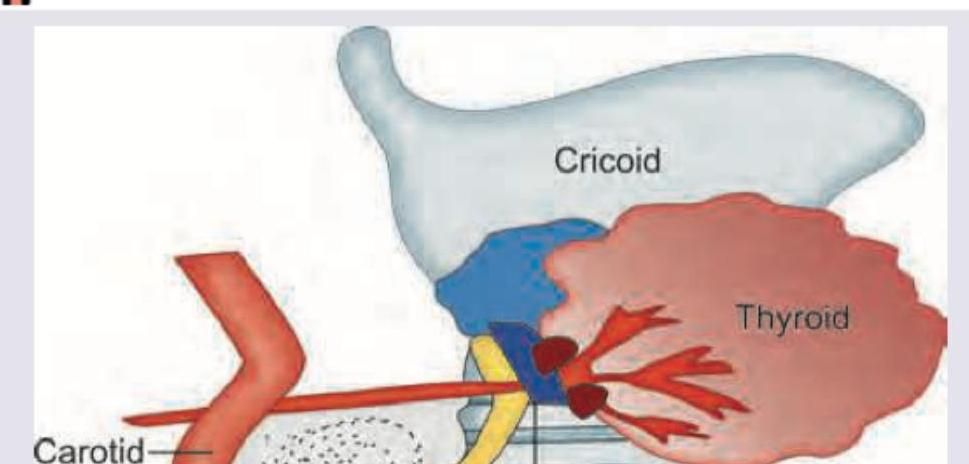
In the case of hyperthyroidism, which is the most common nerve to be damaged?
What is the typical thyroid status in patients with thyroid carcinoma?
Which of the following statements about anaplastic carcinoma of the thyroid is false?
Which type of thyroid carcinoma commonly presents with blood-borne metastasis?
Which of the following is true regarding medullary carcinoma of the thyroid?
A patient undergoes thyroid surgery, following which he develops perioral tingling. His blood calcium level is 8.9 meq. What is the next best step?
Carcinoma arising in a thyroglossal cyst is most commonly which type?
Explanation: **Explanation:** Medullary Thyroid Carcinoma (MTC) arises from the **parafollicular C-cells** (neural crest origin), which secrete calcitonin. Unlike papillary or follicular cancers, MTC is characterized by early lymphatic spread and a lack of iodine uptake. **Why Option D is Correct:** The standard surgical management for MTC is **Total Thyroidectomy** combined with **Prophylactic Central Neck Dissection (Level VI)**. This is because MTC is frequently multicentric (especially in familial cases) and has a high propensity for early metastasis to the central compartment lymph nodes, even when they are not clinically palpable. **Analysis of Incorrect Options:** * **Option A:** Total thyroidectomy alone is inadequate because of the high incidence of occult nodal involvement in the central neck. * **Option B:** Radical neck dissection is overly aggressive and morbid. Lateral neck dissection (Levels II-V) is only indicated if there is clinical or radiological evidence of nodal involvement (therapeutic, not prophylactic). * **Option C:** MTC cells do not concentrate iodine because they are not derived from follicular epithelium. Therefore, **Radioactive Iodine (RAI) therapy has no role** in the treatment of MTC. **Clinical Pearls for NEET-PG:** * **Tumor Marker:** Serum **Calcitonin** is used for diagnosis and monitoring recurrence; **CEA** is a secondary marker. * **Genetic Screening:** All patients with MTC must be screened for **RET proto-oncogene** mutations to rule out MEN 2A/2B. * **Pre-op Rule Out:** Always exclude **Pheochromocytoma** (via urinary/plasma metanephrines) before thyroid surgery to prevent a hypertensive crisis. * **MEN 2A/2B:** MTC is the most common cause of death in these syndromes.
Explanation: **Explanation:** **Papillary Thyroid Carcinoma (PTC)** is the most common histological type of thyroid cancer, accounting for approximately **80–85%** of all thyroid malignancies. Its high prevalence is attributed to its association with radiation exposure and specific genetic mutations (e.g., BRAF, RET/PTC rearrangements). It typically presents as a slow-growing, painless thyroid nodule and has an excellent prognosis. **Analysis of Options:** * **A. Anaplastic type:** This is the rarest (<2%) but most aggressive form. It typically occurs in elderly patients and carries a very poor prognosis due to rapid local invasion. * **B. Medullary type:** Accounting for about 5–10% of cases, this arises from the parafollicular C-cells (secreting Calcitonin). It can be sporadic or associated with MEN 2A/2B syndromes. * **C. Follicular type:** The second most common type (10–15%). It is characterized by hematogenous spread (to bone and lungs) rather than lymphatic spread, which is more common in PTC. **High-Yield Clinical Pearls for NEET-PG:** * **Hallmark Histology:** Look for **Orphan Annie eye nuclei** (empty-appearing nuclei), **Psammoma bodies** (laminated calcifications), and **Nuclear grooves**. * **Spread:** PTC primarily spreads via the **lymphatics** to cervical lymph nodes. * **Risk Factor:** History of childhood **ionizing radiation** to the neck is a major risk factor. * **Prognosis:** PTC has the best prognosis among all thyroid cancers, with a 10-year survival rate exceeding 90%. * **Investigation of Choice:** Fine Needle Aspiration Cytology (FNAC) is the gold standard for diagnosis (Note: FNAC cannot distinguish between follicular adenoma and carcinoma).
Explanation: **Explanation:** Diffuse toxic goiter (Graves' disease) can be managed via three main modalities: antithyroid drugs (ATD), radioactive iodine (RAI), and surgery. The choice depends heavily on patient age, comorbidities, and goiter size. **Why Radioactive Iodine (RAI) is correct:** In patients **over 45 years of age**, RAI ($I^{131}$) is considered the therapy of choice. At this age, the risk of radiation-induced carcinogenesis is negligible, and RAI provides a definitive, non-invasive cure. It is particularly preferred in older patients because it avoids the surgical and anesthetic risks associated with thyroidectomy, such as recurrent laryngeal nerve injury or hypoparathyroidism. **Why other options are incorrect:** * **Antithyroid drugs (ATD):** While used for induction of remission, they have a high relapse rate (approx. 50-60%). They are generally the first-line for children, adolescents, and pregnant women, but not the definitive choice for older adults unless they refuse RAI/surgery. * **Surgery:** Total or near-total thyroidectomy is preferred for patients with very large goiters (>80g), suspected malignancy, or those with severe ophthalmopathy. In a standard case over 45, it is considered more invasive than RAI. * **ATD followed by surgery:** This sequence is used to achieve a euthyroid state before an operation to prevent thyroid storm, but surgery itself is not the primary recommendation for this age group unless specific indications (like compressive symptoms) exist. **Clinical Pearls for NEET-PG:** * **Absolute Contraindications for RAI:** Pregnancy and breastfeeding (RAI crosses the placenta and is secreted in milk). * **Relative Contraindication:** Severe Graves' ophthalmopathy (RAI can worsen it; steroids are given if RAI is used). * **Drug of choice in Pregnancy:** PTU in the 1st trimester; Methimazole in the 2nd and 3rd trimesters. * **Definitive treatment for Toxic Multinodular Goiter:** RAI is also preferred here, especially in the elderly.
Explanation: **Explanation:** The **Recurrent Laryngeal Nerve (RLN)** is the most common nerve injured during thyroid surgery, including surgeries for hyperthyroidism (like Graves' disease). This is due to its intimate anatomical relationship with the **inferior thyroid artery** and its course in the **tracheoesophageal groove**, where it is vulnerable during gland mobilization and ligation of vessels. In hyperthyroidism, the gland is often highly vascular and friable, increasing the risk of accidental trauma, traction, or thermal injury. **Analysis of Options:** * **A. Recurrent Laryngeal Nerve (Correct):** Statistically the most frequently injured nerve. Unilateral injury leads to hoarseness; bilateral injury can cause life-threatening airway obstruction (stridor). * **B. Inferior Laryngeal Nerve:** This is simply another name for the Recurrent Laryngeal Nerve. However, in standard surgical nomenclature and NEET-PG patterns, "Recurrent Laryngeal Nerve" is the preferred and more common term used in questions. * **C. External Branch of Superior Laryngeal Nerve (EBSLN):** This is the second most common nerve injured. It runs close to the **superior thyroid artery**. Injury leads to loss of pitch (inability to hit high notes) due to paralysis of the cricothyroid muscle. * **D. Internal Branch of Superior Laryngeal Nerve:** This nerve provides sensory innervation to the larynx above the vocal cords. It is rarely injured during routine thyroidectomy as it enters the thyrohyoid membrane well away from the surgical field. **High-Yield Clinical Pearls for NEET-PG:** * **Most common nerve injured:** Recurrent Laryngeal Nerve. * **Nerve most likely to be missed (often asymptomatic):** EBSLN. * **Safest way to avoid RLN injury:** Visual identification of the nerve during surgery. * **Relationship with Inferior Thyroid Artery:** The RLN may pass anterior, posterior, or between the branches of the artery (most commonly posterior on the right, anterior on the left). * **Berry’s Ligament:** The most common site of RLN injury is near the Ligament of Berry, where the nerve is most superficial.
Explanation: **Explanation:** The thyroid status in patients with thyroid carcinoma is **usually euthyroid**. This is because thyroid malignancies (such as Papillary, Follicular, or Medullary carcinoma) typically arise from a localized clone of cells that do not interfere with the overall hormone-producing capacity of the remaining normal thyroid parenchyma. Furthermore, most thyroid cancer cells are less efficient at iodine uptake and thyroid hormone synthesis than normal follicular cells. **Analysis of Options:** * **Option A (Hypothyroidism):** Thyroid cancer rarely causes hypothyroidism because it seldom involves the entire gland extensively enough to destroy all functional tissue. Hypothyroidism is more commonly associated with autoimmune conditions like Hashimoto’s thyroiditis. * **Option B (Hyperthyroidism):** Most thyroid cancers are "cold" nodules on scintigraphy, meaning they do not produce excess hormones. While rare cases of functioning follicular carcinomas exist, they are exceptions rather than the rule. * **Option D (Toxic Nodules):** Toxic nodules (Plummer’s disease) are almost always benign. The risk of malignancy in a "hot" or hyperfunctioning nodule is extremely low (<1%). **Clinical Pearls for NEET-PG:** * **The "Cold Nodule" Rule:** On a Technetium-99m or Iodine-123 scan, most thyroid cancers appear as **"cold" nodules** (non-functioning). A cold nodule has a 15-20% risk of malignancy, whereas a hot nodule is rarely malignant. * **Initial Investigation:** The first step in evaluating a thyroid nodule is a **Serum TSH level**. If TSH is normal (euthyroid), the next step is a **Fine Needle Aspiration Cytology (FNAC)**, which is the gold standard for diagnosis. * **Exception:** In Medullary Thyroid Carcinoma (MTC), patients are euthyroid but may have elevated **Calcitonin** levels, which serves as a tumor marker.
Explanation: **Anaplastic Thyroid Carcinoma (ATC)** is one of the most aggressive solid tumors in humans, characterized by rapid growth and a dismal prognosis. ### **Explanation of Options** * **Why Option B is False (Correct Answer):** Anaplastic carcinoma is notorious for being **highly chemoresistant and radioresistant**. While multimodal therapy (surgery + radiotherapy + chemotherapy) is often attempted, the response rate to conventional chemotherapy (like Doxorubicin or Paclitaxel) is very poor. It does not show the "highly sensitive" response seen in tumors like lymphomas or germ cell tumors. * **Option A (Local Infiltration):** This is a hallmark of ATC. It rapidly invades adjacent structures in the neck, such as the trachea, esophagus, and recurrent laryngeal nerve, often leading to symptoms of airway obstruction, dysphagia, and hoarseness. * **Option C (Limited Surgery):** Because the tumor is usually extensive and infiltrative at the time of diagnosis, **curative surgery is rarely possible**. Surgery is typically restricted to palliative measures, such as a "debulking" procedure or a tracheostomy to secure the airway. * **Option D (Lymphatic Spread):** ATC spreads aggressively through both **lymphatic and hematogenous routes**. Regional lymph node involvement is present in about 40% of cases at presentation, and distant metastasis (especially to the lungs) is common. ### **High-Yield Clinical Pearls for NEET-PG** * **Demographics:** Typically affects elderly patients (6th–7th decade). * **Pathology:** Often arises from a pre-existing long-standing multinodular goiter or a well-differentiated thyroid cancer (transformation). * **Microscopy:** Characterized by spindle, pleomorphic giant, or squamoid cells with high mitotic figures. * **Diagnosis:** Core needle biopsy or incisional biopsy is often required as FNAC may be inconclusive. * **Prognosis:** Median survival is only 3–6 months. The most common cause of death is **upper airway obstruction**.
Explanation: **Explanation:** The correct answer is **Follicular Thyroid Carcinoma (FTC)**. The fundamental concept to remember for thyroid malignancies is the route of spread: **Papillary spreads via lymphatics, while Follicular spreads via the bloodstream.** 1. **Why Follicular is Correct:** FTC is characterized by its tendency for **angioinvasion** (invasion into blood vessels). Because of this, it bypasses the regional lymph nodes and spreads via the hematogenous route. The most common sites for distant metastasis in FTC are the **bones** (often presenting as osteolytic, pulsating lesions) and the **lungs**. 2. **Why the others are Incorrect:** * **Papillary (B):** This is the most common thyroid cancer. It primarily spreads via the **lymphatic system** to the cervical lymph nodes. While distant blood-borne spread can occur (especially to the lungs), it is not the characteristic or "common" initial presentation compared to FTC. * **Mixed (C):** Most mixed patterns behave similarly to Papillary carcinoma and follow lymphatic spread. * **Medullary (D):** Arising from parafollicular C-cells, it spreads via both lymphatic and hematogenous routes, but it is classically associated with early nodal involvement and is less common than FTC. **High-Yield Clinical Pearls for NEET-PG:** * **Psammoma bodies** are a hallmark of Papillary, not Follicular. * **Orphan Annie eye nuclei** and **nuclear grooves** are diagnostic for Papillary. * FTC cannot be diagnosed by FNAC because FNAC cannot identify **capsular or vascular invasion**; a formal histological biopsy (lobectomy) is required. * **Hürthle cell carcinoma** is a variant of FTC that also spreads hematogenously but has a higher rate of lymph node metastasis than typical FTC.
Explanation: **Explanation:** **Medullary Thyroid Carcinoma (MTC)** arises from the **parafollicular C-cells** of the thyroid, which are neuroendocrine cells derived from the neural crest. These cells are responsible for the secretion of **calcitonin**. Therefore, elevated serum calcitonin is a highly sensitive and specific tumor marker for the diagnosis, screening, and monitoring of recurrence in MTC. **Analysis of Options:** * **Option A (Incorrect):** MTC is strongly associated with mutations in the **RET proto-oncogene**, not the MET oncogene. MET is more commonly associated with papillary renal cell carcinoma. * **Option C (Incorrect):** MTC is a component of **MEN 2A and 2B** syndromes. MEN 1 (Wermer’s Syndrome) typically involves the "3 Ps": Pituitary, Parathyroid, and Pancreatic tumors. * **Option D (Incorrect):** **Papillary Thyroid Carcinoma** is the most common type of thyroid cancer (approx. 80-85%). MTC accounts for only about 5-10% of cases. **High-Yield Clinical Pearls for NEET-PG:** 1. **Amyloid Stroma:** Histologically, MTC is characterized by nests of cells separated by an amyloid stroma (stained by Congo Red). 2. **Genetics:** 75% of cases are sporadic; 25% are familial (MEN 2A, 2B, or Familial MTC). 3. **Prophylactic Surgery:** In patients with known RET mutations, prophylactic total thyroidectomy is recommended. 4. **Carcinoembryonic Antigen (CEA):** This is another important tumor marker used alongside calcitonin for MTC. 5. **Spread:** Unlike papillary cancer (lymphatic), MTC spreads via both lymphatic and hematogenous routes.
Explanation: ### Explanation **1. Why Option C is Correct:** The patient is presenting with **symptomatic hypocalcemia** (perioral tingling/paresthesia) following thyroid surgery, most likely due to transient hypoparathyroidism or accidental removal/devascularization of the parathyroid glands. In clinical practice, the **symptoms of hypocalcemia take precedence over the absolute laboratory value.** Even though 8.9 mg/dL (assuming mg/dL as per standard clinical units, though the question mentions meq) is near the lower limit of normal, the presence of neuromuscular irritability (tingling) indicates a rapid drop in ionized calcium. The standard of care for symptomatic post-operative hypocalcemia is **Intravenous Calcium Gluconate** (usually 10 ml of 10% solution) to prevent progression to tetany, seizures, or laryngospasm, followed by serial monitoring. **2. Why Other Options are Incorrect:** * **Options A & B:** Oral supplementation (Calcium/Vitamin D) is appropriate for asymptomatic patients or as maintenance therapy. However, for acute symptomatic presentations, oral absorption is too slow to provide immediate relief or ensure safety. * **Option D:** Waiting for a specific threshold (like 7.0 mg/dL) in a symptomatic patient is dangerous. Hypocalcemia can lead to life-threatening complications like cardiac arrhythmias (QT prolongation) and laryngeal stridor. Treatment should be initiated based on clinical symptoms. **3. Clinical Pearls for NEET-PG:** * **Most common cause of post-thyroidectomy hypocalcemia:** Transient ischemia of the parathyroid glands. * **Chvostek’s Sign:** Tapping the facial nerve leads to twitching of facial muscles. * **Trousseau’s Sign:** Carpal spasm induced by inflating a BP cuff above systolic pressure (more sensitive than Chvostek’s). * **ECG Finding:** Prolonged QT interval. * **Management Rule:** If symptomatic $\rightarrow$ IV Calcium Gluconate. If asymptomatic and Calcium < 8.0 mg/dL $\rightarrow$ Oral Calcium.
Explanation: **Explanation:** Carcinoma arising in a thyroglossal duct cyst (TGDC) is a rare occurrence, seen in less than 1% of cases. The correct answer is **Papillary Carcinoma**, which accounts for approximately **75–85%** of these malignancies. **1. Why Papillary Carcinoma is correct:** The thyroglossal duct is formed by the descent of the thyroid primordium from the foramen cecum. Ectopic thyroid tissue is frequently found within the wall of the cyst. Since papillary carcinoma is the most common type of primary thyroid cancer and arises from follicular cells, it is also the most frequent malignancy found in the ectopic thyroid tissue of a TGDC. **2. Why other options are incorrect:** * **Follicular Carcinoma:** While it arises from follicular cells, it is much less common than papillary carcinoma in both the thyroid gland and TGDCs (approx. 5%). * **Medullary Carcinoma:** This arises from **Parafollicular C-cells** (derived from the ultimobranchial body). Since C-cells do not typically migrate with the thyroglossal duct, medullary carcinoma is almost never found in a TGDC. * **Anaplastic Carcinoma:** This is an undifferentiated, highly aggressive tumor that is extremely rare in the context of a thyroglossal cyst. **High-Yield Pearls for NEET-PG:** * **Most common location of TGDC:** Subhyoid (65%). * **Surgical Treatment:** The **Sistrunk Procedure** (excision of the cyst, the tract, and the central portion of the hyoid bone). * **Diagnostic Clue:** A midline neck swelling that moves upward on **protrusion of the tongue** and on deglutition. * **Management of TGDC Carcinoma:** If the thyroid gland is normal on imaging, a Sistrunk procedure is often sufficient; however, total thyroidectomy is considered if there are suspicious nodules in the main gland or cervical lymphadenopathy.
Thyroid Nodules
Practice Questions
Thyroid Cancer
Practice Questions
Graves' Disease
Practice Questions
Thyroiditis
Practice Questions
Primary Hyperparathyroidism
Practice Questions
Secondary and Tertiary Hyperparathyroidism
Practice Questions
Adrenal Cortical Tumors
Practice Questions
Pheochromocytoma
Practice Questions
Adrenal Incidentalomas
Practice Questions
Multiple Endocrine Neoplasia
Practice Questions
Neuroendocrine Tumors
Practice Questions
Intraoperative Monitoring in Endocrine Surgery
Practice Questions
Get full access to all questions, explanations, and performance tracking.
Start For Free