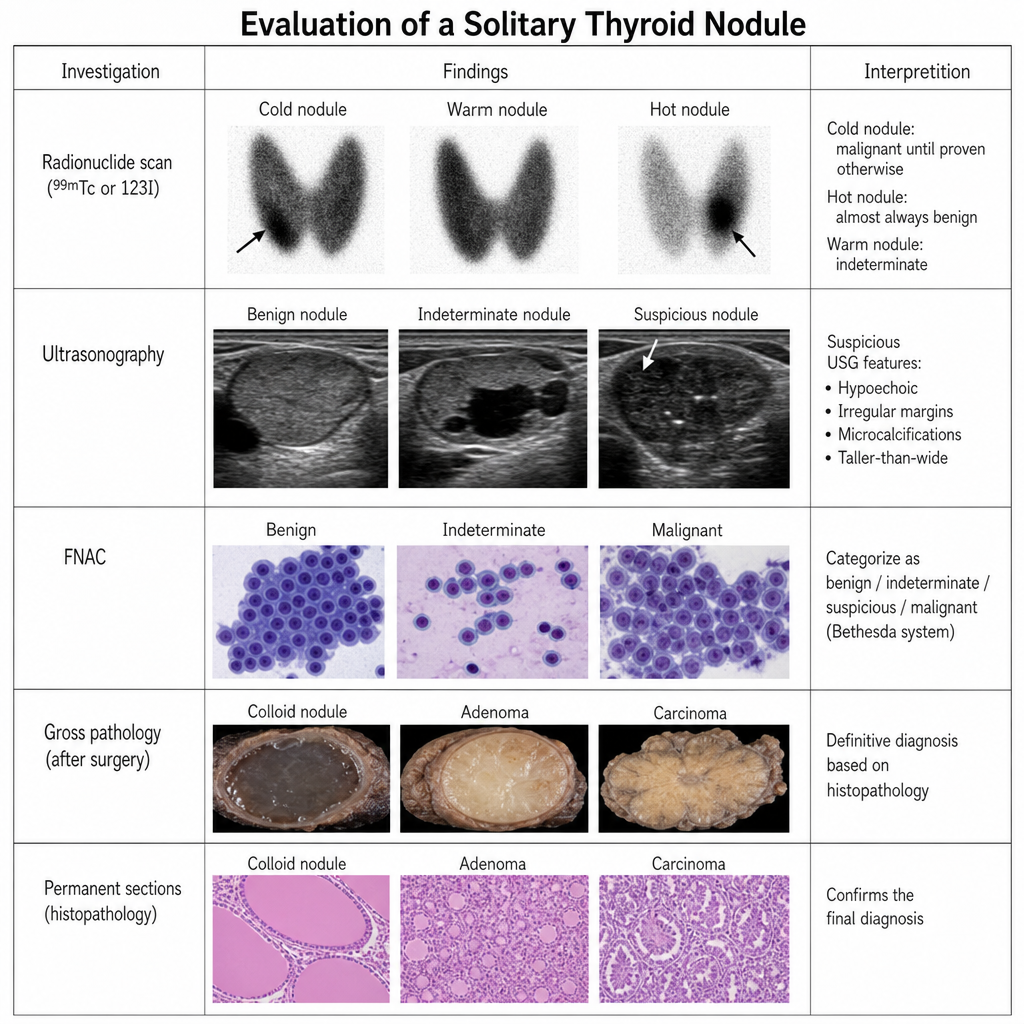
What is the best treatment for follicular carcinoma of the thyroid?
Parathyroid adenoma most commonly involves which of the following sites?
All statements about papillary thyroid cancer are true except?
What are the contents of Lugol's Iodine?
During thyroidectomy, where is the inferior thyroid artery typically ligated?
Which is the most common surgically repairable cause of hyperparathyroidism?
What is the recommended screening method for medullary carcinoma of the thyroid?
Following surgical resection of a large thyroid mass, a patient complains of persistent hoarseness and a weak voice. What is the most likely cause of these symptoms?
A middle-aged woman presented with neck swelling, nervousness, and weight loss, diagnosed with hyperthyroidism. Following a partial thyroidectomy, she developed hoarseness. What is the most likely cause of her hoarseness?
Which of the following is a definitive treatment for Graves' thyrotoxicosis?
Explanation: **Explanation:** Follicular Thyroid Carcinoma (FTC) is the second most common thyroid malignancy. Unlike Papillary carcinoma, FTC is characterized by hematogenous spread and is often more aggressive, necessitating a more definitive surgical approach. **Why Near-Total Thyroidectomy is the Correct Choice:** The standard of care for FTC (especially for lesions >1 cm or those with vascular invasion) is **Near-Total Thyroidectomy (NTT)** or **Total Thyroidectomy**. 1. **Facilitates RAI Therapy:** FTC cells are well-differentiated and take up iodine. Removing nearly all thyroid tissue allows for effective postoperative Radioiodine (RAI) ablation to destroy residual microscopic disease or distant metastases (e.g., lungs/bones). 2. **Monitoring:** It allows for the use of **Serum Thyroglobulin** as a highly sensitive tumor marker for detecting recurrence. 3. **Safety:** NTT leaves a tiny remnant (<1g) of tissue near the ligament of Berry to protect the recurrent laryngeal nerve and parathyroid glands, balancing oncological safety with reduced morbidity. **Analysis of Incorrect Options:** * **A. Hemithyroidectomy:** Generally insufficient for FTC because the diagnosis is often made postoperatively (due to the need to see capsular/vascular invasion). If FTC is confirmed, completion thyroidectomy is usually required to allow for RAI. * **C. Subtotal Thyroidectomy:** This leaves too much tissue (4-6g) in both lobes, making RAI therapy ineffective and increasing the risk of local recurrence. * **D. Radiotherapy alone:** External beam radiation is not a primary treatment for differentiated thyroid cancers; it is reserved for palliative care or unresectable local recurrence. **High-Yield Clinical Pearls for NEET-PG:** * **Diagnosis:** FTC cannot be diagnosed by FNAC (it cannot distinguish between follicular adenoma and carcinoma). Histopathology showing **capsular or vascular invasion** is mandatory. * **Spread:** FTC spreads **hematogenously** (Bones, Lungs), whereas Papillary spreads via lymphatics. * **Hürthle Cell Carcinoma:** A variant of FTC that is less likely to take up iodine and has a higher risk of nodal metastasis.
Explanation: **Explanation:** The **inferior parathyroid glands** are the most common site for parathyroid adenomas (approximately 80% of cases). This is primarily due to their complex embryological migration. While the superior parathyroid glands (derived from the 4th branchial pouch) have a short, constant descent, the inferior glands (derived from the 3rd branchial pouch) travel a longer distance alongside the thymus. This extended migration path makes the inferior glands more prone to anatomical variation and ectopic locations, but in the majority of primary hyperparathyroidism cases, the adenoma is found at the lower pole of the thyroid. **Analysis of Options:** * **A. Thyroid gland substance:** While "intrathyroidal" parathyroid glands occur, they are rare (approx. 2–3%) and represent an ectopic location rather than the most common site. * **B. Superior parathyroid gland:** These are more constant in position (usually posterior to the mid-portion of the thyroid) but are less frequently involved in adenoma formation compared to the inferior glands. * **D. Mediastinum:** This is the most common site for **ectopic** parathyroid adenomas (specifically the anterior mediastinum within the thymus), but it is not the most common site overall. **High-Yield Clinical Pearls for NEET-PG:** * **Rule of 80s:** Approximately 80-85% of primary hyperparathyroidism is caused by a **single adenoma**, and 80% of these occur in the **inferior** glands. * **Embryology:** Inferior parathyroids = 3rd pouch; Superior parathyroids = 4th pouch. * **Localization:** Sestamibi scan (Technetium-99m) is the gold standard for preoperative localization. * **Surgery:** The definitive treatment is parathyroidectomy. Intraoperative PTH monitoring (Miami criteria) is used to confirm successful removal (a >50% drop in PTH from baseline).
Explanation: **Explanation:** This question requires identifying the incorrect statement regarding Papillary Thyroid Carcinoma (PTC). **Why Option C is the "Correct" Answer (The False Statement):** While radiation exposure is a well-documented risk factor for PTC, the phrasing of this question in a NEET-PG context often hinges on identifying the *most* accurate clinical descriptions. However, in standard surgical pathology, **Option B is technically the false statement.** The most common variant of PTC is the **Classical (Conventional) variant**, not the follicular variant. The follicular variant is indeed common and can be difficult to diagnose (often requiring histological assessment of the capsule), but it does not surpass the classical type in frequency. *Note: If the provided key marks C as correct, it may be due to a specific textbook source or a technicality in the question's wording; however, clinically, radiation is a major risk factor for PTC (e.g., post-Chernobyl).* **Analysis of Other Options:** * **Option A:** True. PTC accounts for 80–85% of all thyroid malignancies, making it the most common subtype. * **Option D:** True. The diagnosis of PTC is based on **pathognomonic nuclear features** (Orphan Annie eye nuclei, nuclear grooves, and pseudo-inclusions), not the presence of papillae. Many PTCs (like the follicular variant) do not form papillae at all. **High-Yield Clinical Pearls for NEET-PG:** * **Spread:** Primarily **lymphatic** (to level VI nodes). Hematogenous spread is rare. * **Psammoma Bodies:** Present in 50% of cases (laminated calcifications). * **Genetics:** Associated with **BRAF mutations** (most common) and **RET/PTC rearrangements**. * **Prognosis:** Excellent, with a 10-year survival rate >90%. * **Risk Factors:** Childhood neck irradiation and family history (Gardner’s syndrome/FAP).
Explanation: **Explanation:** Lugol’s Iodine (Strong Iodine Solution) is a classic pharmacological agent used in endocrine surgery. The correct composition is **5% elemental iodine and 10% potassium iodide (KI)** in distilled water. The potassium iodide acts as a solubilizing agent, allowing the elemental iodine to dissolve in water by forming polyiodide ions ($I_3^-$). **Why Option A is Correct:** The standard pharmaceutical preparation of Lugol's solution is defined by its 1:2 ratio of iodine to potassium iodide, specifically 5g of Iodine and 10g of Potassium Iodide per 100ml of solution. **Why Other Options are Incorrect:** Options B, C, and D provide incorrect concentrations and ratios. Deviating from the 5%/10% standard would either result in a solution that is too dilute to be clinically effective or too concentrated, increasing the risk of iodine toxicity and local irritation of the gastrointestinal mucosa. **Clinical Pearls for NEET-PG:** * **Mechanism of Action:** It works via the **Wolff-Chaikoff effect**, where high levels of plasma iodide acutely inhibit the organification of iodine, thereby decreasing the synthesis and release of thyroid hormones ($T_3$ and $T_4$). * **Surgical Utility:** In Graves' disease, it is administered 7–10 days preoperatively to **decrease the vascularity** and increase the firmness of the thyroid gland, making the surgery technically easier and safer. * **Limitation:** It should not be used long-term because of the "escape phenomenon," where the thyroid resumes hormone production after 10–14 days. * **Contraindication:** It should be avoided in patients with toxic multinodular goiter to prevent the **Jod-Basedow effect** (iodine-induced hyperthyroidism).
Explanation: **Explanation:** The correct answer is **B. Close to the thyroid gland.** The primary anatomical concern during the ligation of the **inferior thyroid artery (ITA)** is the protection of the **recurrent laryngeal nerve (RLN)**. The RLN has a variable relationship with the ITA; it may pass anterior, posterior, or between the branches of the artery. 1. **Why "Close to the gland" is correct:** To minimize the risk of nerve injury, the ITA is ligated **peripherally (distally)**, as close to the thyroid capsule as possible. At this point, the artery has usually branched, and ligating individual branches on the capsule ensures that the main trunk of the RLN, which lies deeper, is not accidentally clamped or divided. 2. **Why "Away from the gland" is wrong:** Historically, some surgeons practiced proximal ligation (away from the gland). However, this is avoided today because the RLN often crosses the artery laterally or centrally. Ligating far from the gland increases the risk of catching the nerve in the ligature. Furthermore, proximal ligation can compromise the blood supply to the **parathyroid glands**, which receive their primary nutrition from the ITA. 3. **Why Option C is wrong:** This location is anatomically irrelevant to the safe ligation of the ITA and does not correspond to the surgical entry point of the vessel. **High-Yield Clinical Pearls for NEET-PG:** * **Superior Thyroid Artery (STA):** Should be ligated **close to the gland** to avoid injuring the **External Branch of the Superior Laryngeal Nerve (EBSLN)**. * **Berry’s Ligament:** The most common site of RLN injury during thyroidectomy. * **Parathyroid Blood Supply:** Primarily derived from the Inferior Thyroid Artery; hence, subcapsular ligation is vital to prevent post-operative hypocalcemia.
Explanation: **Explanation:** Primary Hyperparathyroidism (PHPT) is the most common cause of hypercalcemia in non-hospitalized patients. The question asks for the most common **surgically repairable** cause, which refers to the underlying pathology of PHPT. **1. Why Adenoma is Correct:** A **solitary parathyroid adenoma** is responsible for approximately **85-90%** of cases of Primary Hyperparathyroidism. It typically involves a single gland, while the remaining three glands are suppressed. Surgical excision (parathyroidectomy) is the definitive treatment and is curative in the vast majority of cases. **2. Why the other options are incorrect:** * **Hyperplasia:** This involves all four parathyroid glands and accounts for only **10-15%** of cases. It is often associated with hereditary syndromes like MEN 1 or MEN 2A. * **Carcinoma:** Parathyroid carcinoma is extremely rare, accounting for **<1%** of cases. It is characterized by very high calcium levels (>14 mg/dL) and a palpable neck mass. * **Renal Disease:** Chronic kidney disease leads to **Secondary Hyperparathyroidism** (due to hypocalcemia and hyperphosphatemia). While it can be managed surgically in refractory cases (Tertiary HPT), it is a systemic metabolic consequence rather than the primary surgical cause of HPT in the general population. **High-Yield Clinical Pearls for NEET-PG:** * **Most common site for ectopic adenoma:** Thymus (Inferior parathyroid gland). * **Sestamibi Scan (99mTc):** The investigation of choice for pre-operative localization of an adenoma. * **Hungry Bone Syndrome:** A common post-operative complication characterized by profound hypocalcemia. * **Biochemical Hallmark:** Elevated Serum Calcium + Elevated/Inappropriately normal PTH.
Explanation: **Explanation:** **1. Why Serum Calcitonin is Correct:** Medullary Thyroid Carcinoma (MTC) arises from the **parafollicular C-cells** of the thyroid gland. These cells are neuroendocrine in origin and their primary function is the secretion of **calcitonin**. Because calcitonin is produced almost exclusively by these cells, it serves as a highly specific and sensitive tumor marker. Elevated levels are used for screening (especially in familial cases like MEN 2A and 2B), monitoring treatment response, and detecting recurrence. **2. Why the Other Options are Incorrect:** * **B. Serum Calcium:** While MTC is associated with Multiple Endocrine Neoplasia (MEN) type 2A (which includes hyperparathyroidism), serum calcium is a marker for parathyroid activity, not the thyroid tumor itself. * **C. Serum Alkaline Phosphatase (ALP):** ALP is a marker for liver disease or high bone turnover (e.g., Paget’s disease or bony metastasis), but it has no diagnostic value for MTC. * **D. Serum Acid Phosphatase:** This was historically used as a marker for prostate cancer; it has no relevance to thyroid pathology. **3. High-Yield Clinical Pearls for NEET-PG:** * **Genetic Screening:** All patients with MTC should be screened for **RET proto-oncogene** mutations to rule out familial syndromes (MEN 2A/2B). * **Carcinoembryonic Antigen (CEA):** This is the second most important marker for MTC; it is useful for prognosis and monitoring but less specific than calcitonin for initial screening. * **Amyloid Stroma:** On histopathology, MTC characteristically shows **Congo Red positive** amyloid deposits (formed by pro-calcitonin). * **Provocative Testing:** In borderline cases, calcium or pentagastrin infusion can be used to stimulate calcitonin secretion for diagnosis.
Explanation: ### Explanation **Correct Answer: C. Injury to the recurrent laryngeal nerve** The **Recurrent Laryngeal Nerve (RLN)** provides motor supply to all intrinsic muscles of the larynx except the cricothyroid. It also provides sensory innervation to the larynx below the vocal cords. During thyroid surgery, the RLN is at risk due to its close proximity to the inferior thyroid artery and the ligament of Berry. * **Unilateral RLN injury** leads to the vocal cord assuming a paramedian position, resulting in **hoarseness** and a **weak/breathy voice** due to the inability to adduct the cords effectively. * **Bilateral RLN injury** is a surgical emergency as it can cause acute airway obstruction (stridor). **Why other options are incorrect:** * **A & B (Traumatic/Prolonged Intubation):** While these can cause laryngeal edema or vocal cord granulomas leading to temporary hoarseness, they are less likely than direct nerve injury following a "large thyroid mass" resection, where surgical planes are often distorted. * **D (Superior Laryngeal Nerve - External Branch):** This nerve supplies the **cricothyroid muscle**, which tenses the vocal cords. Injury typically results in a loss of high-pitched tones and "vocal fatigue" (common in professional singers), but not significant persistent hoarseness or a weak voice. **High-Yield Clinical Pearls for NEET-PG:** * **Most common nerve injured in thyroidectomy:** External branch of the Superior Laryngeal Nerve (due to proximity to the superior thyroid artery). * **Most serious nerve injury:** Bilateral Recurrent Laryngeal Nerve (requires tracheostomy). * **Identification:** The best way to prevent RLN injury is intraoperative visualization. * **Nerve of Galen:** An anastomosis between the internal laryngeal nerve and the recurrent laryngeal nerve.
Explanation: **Explanation:** **1. Why Option A is Correct:** The **recurrent laryngeal nerve (RLN)** provides motor supply to all the intrinsic muscles of the larynx, except the cricothyroid. It is responsible for the abduction and adduction of the vocal cords. During thyroid surgery, the RLN is at risk due to its close proximity to the inferior thyroid artery and the ligament of Berry. **Unilateral injury** to the RLN leads to the vocal cord assuming a paramedian position, resulting in **hoarseness of voice** and an ineffective cough. This is the most common cause of post-thyroidectomy hoarseness. **2. Why Other Options are Incorrect:** * **Option B (Internal Laryngeal Nerve):** This is a purely sensory nerve supplying the laryngeal mucosa above the vocal cords. Injury leads to **loss of the cough reflex** and increased risk of aspiration, but it does not cause hoarseness. * **Option C (External Laryngeal Nerve):** This nerve supplies the **cricothyroid muscle**, which tenses the vocal cords. Injury results in a loss of high-pitched sounds and **voice fatigue** (common in professional singers), but not frank hoarseness. * **Option D:** Incorrect because the clinical presentation of hoarseness specifically points to RLN dysfunction. **High-Yield Clinical Pearls for NEET-PG:** * **Unilateral RLN injury:** Hoarseness of voice. * **Bilateral RLN injury:** Acute airway obstruction/stridor (requires emergency tracheostomy). * **Most common nerve injured** in thyroidectomy: External laryngeal nerve (often overlooked), but the most common cause of **hoarseness** is the RLN. * **Nerve Identification:** The gold standard to prevent injury is the intraoperative identification of the nerve. The RLN is found in the **tracheoesophageal groove**.
Explanation: ### Explanation **Graves' disease** is an autoimmune condition caused by TSH-receptor antibodies (TRAb) that stimulate the thyroid gland to overproduce hormones. In the context of thyrotoxicosis, "definitive treatment" refers to modalities that permanently eliminate the hyperthyroid state, as opposed to medical management which often results in relapse. **Why Radioiodine (RAI) Therapy is Correct:** Radioiodine ($I^{131}$) is considered a definitive non-surgical treatment. It is orally administered, trapped by thyroid follicular cells, and emits beta-particles that cause local tissue destruction over 6–18 weeks. It permanently resolves hyperthyroidism, though it typically results in permanent hypothyroidism, requiring lifelong thyroxine replacement. **Analysis of Incorrect Options:** * **Carbimazole:** This is an anti-thyroid drug (ATD). While it is the first-line treatment to achieve euthyroidism, it is **not definitive**. Relapse rates after stopping ATDs are as high as 50–60%. * **Steroids:** These are used to manage Graves' Ophthalmopathy (thyroid eye disease) or thyroid storm, but they do not treat the underlying thyroid overactivity. * **Hemithyroidectomy:** In Graves' disease, the entire gland is hyperfunctional. Removing only half (hemithyroidectomy) is inadequate and will lead to persistent thyrotoxicosis. The definitive surgical procedure for Graves' is a **Total Thyroidectomy**. **High-Yield Clinical Pearls for NEET-PG:** * **Indications for Surgery over RAI:** Large goiters (>80g), suspected malignancy, co-existing hyperparathyroidism, or moderate-to-severe Graves' Ophthalmopathy (RAI can worsen eye disease). * **Pre-op Preparation:** Patients must be rendered **euthyroid** using ATDs and Lugol’s iodine (to decrease vascularity) before surgery to prevent a **Thyroid Storm**. * **RAI Contraindications:** Absolute contraindications include **pregnancy and breastfeeding**. Patients should avoid conceiving for 6 months post-therapy.
Thyroid Nodules
Practice Questions
Thyroid Cancer
Practice Questions
Graves' Disease
Practice Questions
Thyroiditis
Practice Questions
Primary Hyperparathyroidism
Practice Questions
Secondary and Tertiary Hyperparathyroidism
Practice Questions
Adrenal Cortical Tumors
Practice Questions
Pheochromocytoma
Practice Questions
Adrenal Incidentalomas
Practice Questions
Multiple Endocrine Neoplasia
Practice Questions
Neuroendocrine Tumors
Practice Questions
Intraoperative Monitoring in Endocrine Surgery
Practice Questions
Get full access to all questions, explanations, and performance tracking.
Start For Free