A 27-year-old homosexual male presents with a foreign body in the rectum. During the extraction of the foreign body, a large tear in the sigmoid colon with extensive devitalization and contamination is observed. What is the preferred method of treatment?
Gardner syndrome is associated with all of the following except?
Which of the following is true about hemangioma of the rectum?
What is the recommended treatment for a 24-year-old male diagnosed with an appendicular carcinoma measuring 3cm x 2cm?
What is true about rectal cancer?
Which is a common complication following hemorrhoidectomy?
According to Hagitt's classification, a polyp invading the neck between the head and stalk is classified as which level?
Delorme's Procedure is used for which condition?
Peritoneal metastasis in colon cancer is staged as:
What is the investigation of choice for fistula in ano?
Explanation: ### Explanation The management of rectal foreign bodies depends on the location of the injury and the degree of peritoneal contamination. This case describes a **sigmoid colon tear** with **extensive devitalization and contamination**, which signifies a high-grade colonic injury. **Why Option D is Correct:** In the presence of extensive devitalization and significant fecal contamination, a primary repair (simple closure) is associated with a high risk of anastomotic leak and sepsis. The standard surgical principle for such unstable or "unfavorable" colonic injuries is to **divert the fecal stream**. This is achieved by either: 1. **Primary closure with a proximal diverting colostomy** (to protect the repair). 2. **Exteriorization of the injured segment** as a colostomy (Hartmann’s procedure or loop colostomy), which removes the source of contamination from the peritoneal cavity. **Why Other Options are Wrong:** * **Option A (Observation):** Perforation of a hollow viscus with contamination is a surgical emergency; observation leads to fatal peritonitis. * **Option B (Proctoscopic repair):** The sigmoid colon is intraperitoneal and cannot be adequately reached or safely repaired via a proctoscope, especially with devitalized tissue. * **Option C (Laparotomy and closure):** Simple closure (primary repair) is only indicated for small, clean wounds (<50% circumference) without significant contamination or ischemia. In this case, devitalization makes primary closure highly likely to fail. **Clinical Pearls for NEET-PG:** * **Rectal Trauma Classification:** Injuries are divided into extraperitoneal (below the peritoneal reflection) and intraperitoneal (above the reflection). Sigmoid injuries are always **intraperitoneal**. * **The "6-hour Rule":** Primary repair is generally preferred if the injury is treated within 6 hours and contamination is minimal. Beyond this, or with devitalized tissue, diversion is safer. * **Diagnostic Choice:** An upright X-ray (gas under diaphragm) or CT scan is used to confirm perforation before surgery.
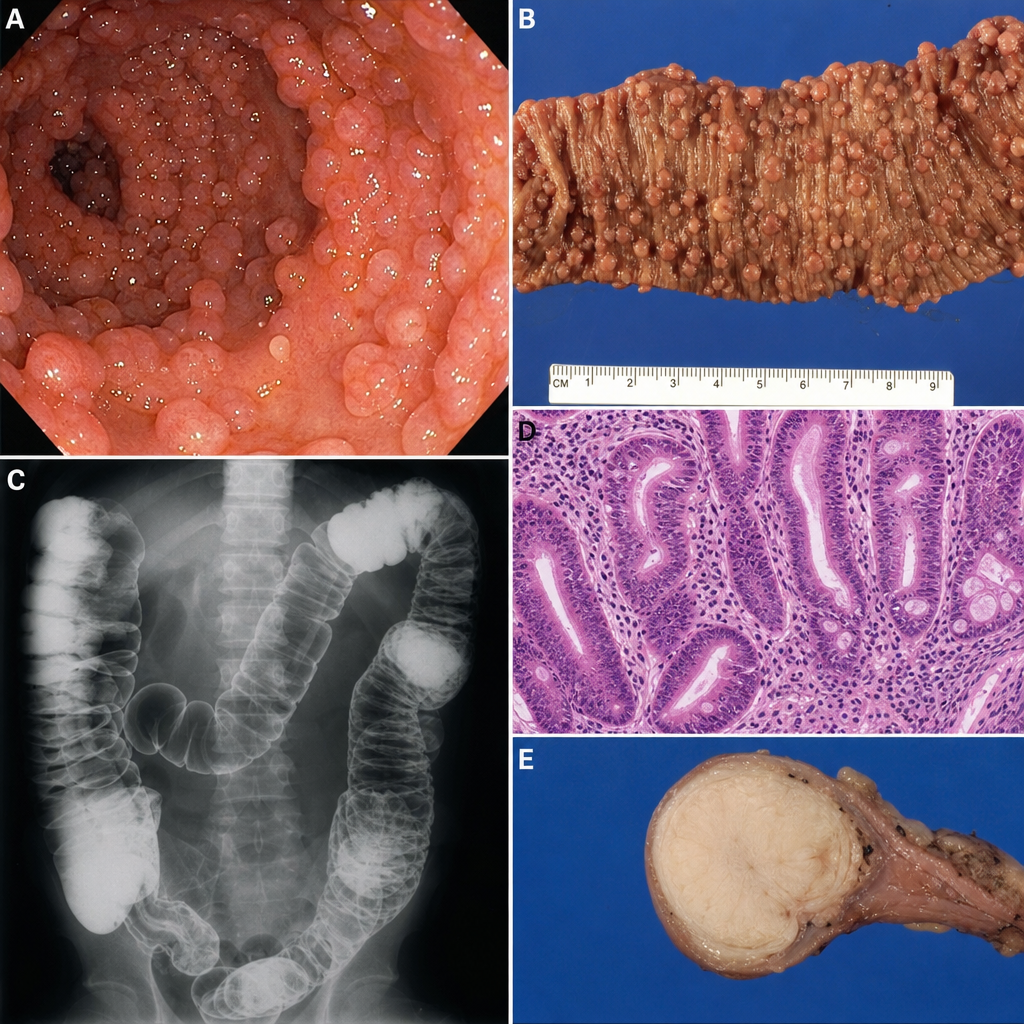
Explanation: **Explanation:** Gardner syndrome is a clinical variant of **Familial Adenomatous Polyposis (FAP)**, caused by a germline mutation in the **APC gene** on chromosome 5q21. It is characterized by the classic triad of colonic polyposis plus specific extraintestinal manifestations. **Why "Tumors of the CNS" is the correct answer:** Tumors of the Central Nervous System (specifically medulloblastomas and glioblastomas) associated with colonic polyposis define **Turcot Syndrome**, not Gardner syndrome. While both are part of the FAP spectrum, CNS involvement is the distinguishing feature of Turcot syndrome. **Analysis of incorrect options:** * **A. Intestinal polyps:** These are the hallmark of all FAP variants. Hundreds to thousands of adenomatous polyps develop throughout the colon, with a 100% risk of progression to colorectal cancer if left untreated. * **B. Osteomas:** These are benign bony outgrowths, most commonly found in the mandible and skull. They are a classic diagnostic feature of Gardner syndrome. * **C. Dental abnormalities:** Patients frequently present with impacted teeth, supernumerary teeth, or congenitally missing teeth. **High-Yield Clinical Pearls for NEET-PG:** * **Gardner Syndrome Mnemonic (SOD):** **S**oft tissue tumors (Epidermoid cysts, Desmoid tumors), **O**steomas, and **D**ental abnormalities. * **Desmoid Tumors:** These are aggressive fibromatoses that often occur post-surgery in Gardner syndrome patients and can be a significant cause of morbidity. * **CHRPE:** Congenital Hypertrophy of Retinal Pigment Epithelium is a highly specific screening marker for FAP/Gardner syndrome. * **Inheritance:** Autosomal Dominant.
Explanation: **Explanation:** **Hemangioma of the rectum** is a rare but clinically significant vascular malformation. While the question identifies it as a "common tumor" in the context of vascular lesions of the gut, it is relatively rare compared to other colorectal pathologies. 1. **Why Option A is Correct:** The hallmark of cavernous hemangioma of the rectum is **painless, massive, and recurrent bouts of rectal bleeding**, which can often lead to **fatal hemorrhage** if not managed promptly. These lesions are typically congenital and can involve the entire thickness of the rectal wall and even extend into the pelvic floor. 2. **Analysis of Incorrect Options:** * **Option B:** While fatal hemorrhage is a key feature, it is incomplete compared to the description provided in Option A within the context of this specific question format. * **Option C:** Although hemangiomas can cause tenesmus or mucus discharge, they do not typically present with the classic inflammatory triad of Ulcerative Colitis (bloody diarrhea, abdominal pain, and systemic features like weight loss). * **Option D:** Acute anal fissure presents with excruciating pain during defecation and a sentinel pile; hemangiomas are generally painless unless complicated by thrombosis. **Clinical Pearls for NEET-PG:** * **Classic Presentation:** A young patient with a lifelong history of episodic, massive rectal bleeding. * **Diagnostic Sign:** On proctoscopy, these appear as **bluish, compressible submucosal nodules** (resembling internal hemorrhoids, but higher up). * **Radiology:** Plain X-ray may show **phleboliths** (calcified thrombi) in the pelvis, which is a highly suggestive diagnostic clue. * **Treatment:** The treatment of choice for extensive lesions is **Sleeve Resection** or **Proctectomy** with coloanal anastomosis. Biopsy should be avoided due to the risk of uncontrollable bleeding.
Explanation: **Explanation:** The management of appendiceal adenocarcinoma (carcinoma of the appendix) is primarily determined by the size and location of the tumor. For a 24-year-old with a lesion measuring **3 cm**, the standard of care is a **Right Hemicolectomy**. **Why Right Hemicolectomy is Correct:** Appendiceal tumors >2 cm have a significantly higher risk of lymph node metastasis. A simple appendicectomy is oncologically insufficient for these cases. A right hemicolectomy is mandatory to ensure adequate lymphadenectomy (including the ileocolic chain) and clear surgical margins, which are essential for long-term survival in invasive adenocarcinoma. **Why Other Options are Incorrect:** * **Appendicectomy:** This is only sufficient for small, well-differentiated tumors (usually carcinoids) that are **<1 cm** in size and located at the tip, without involving the base or mesoappendix. * **Caecal Resection:** This does not provide an adequate lymph node harvest. It is occasionally considered for tumors between 1–2 cm involving the base, but for a 3 cm lesion, it is oncologically inadequate. * **Radiotherapy:** Appendiceal adenocarcinoma is primarily a surgical disease. Radiotherapy is not a primary treatment modality for localized appendiceal cancer. **High-Yield Clinical Pearls for NEET-PG:** * **Size Threshold:** The "Magic Number" is **2 cm**. If >2 cm, always perform a Right Hemicolectomy. * **Indications for Right Hemicolectomy in <2 cm tumors:** Involvement of the appendiceal base, lymphovascular invasion, high-grade histology (goblet cell carcinoid), or mesoappendiceal involvement. * **Most common site:** Most appendiceal tumors are found at the **tip** of the appendix. * **Incidental Finding:** Most cases are diagnosed post-operatively after an appendicectomy for suspected acute appendicitis.
Explanation: **Explanation:** **Correct Option (A): Mucinous adenocarcinoma type** Adenocarcinoma is the most common histological type of rectal cancer. Among its variants, **mucinous adenocarcinoma** (defined by >50% extracellular mucin) is a recognized subtype. It is clinically significant because it often presents at an advanced stage, has a higher propensity for peritoneal spread, and generally carries a poorer prognosis compared to non-mucinous types. **Analysis of Incorrect Options:** * **B. Surgery is the treatment of choice:** While surgery is the definitive treatment, for **locally advanced rectal cancer** (T3/T4 or Node positive), the standard of care is **Neoadjuvant Chemoradiotherapy (nCRT)** followed by surgery. Therefore, surgery alone is not always the initial "treatment of choice." * **C. Surgical treatment is indicated despite hepatic metastasis:** In the presence of distant metastasis (Stage IV), the primary goal shifts to palliative care or systemic chemotherapy. Surgery is only indicated if the primary tumor is causing obstruction, perforation, or uncontrollable bleeding, or if the metastases are resectable (curative intent). * **D. Abdominoperineal resection (APR) is done for lesions of the upper rectum:** APR is reserved for **low rectal cancers** (within 5 cm of the anal verge) where a safe distal margin cannot be achieved or the sphincter is involved. Upper rectal lesions are treated with **Anterior Resection (AR)** or High Anterior Resection, preserving the anal sphincter. **NEET-PG High-Yield Pearls:** * **Gold Standard Investigation:** Contrast-Enhanced CT (CECT) for staging; **MRI (Pelvis)** is superior for assessing local T-stage and circumferential resection margin (CRM). * **Distance Rule:** Upper rectum (>10-15 cm), Middle (6-10 cm), Lower (<5 cm from anal verge). * **Total Mesorectal Excision (TME):** The surgical hallmark for reducing local recurrence.
Explanation: **Explanation:** **Urinary retention** is the most common early complication following hemorrhoidectomy, occurring in approximately 10% to 30% of patients. The underlying mechanism is multifactorial: 1. **Reflex Spasm:** Pain and surgical trauma to the perianal area cause a reflex spasm of the levator ani muscles, which inhibits the detrusor muscle of the bladder. 2. **Autonomic Interference:** The shared nerve supply (S2–S4) between the anorectum and the bladder leads to sympathetic overactivity. 3. **Fluid Overload:** Excessive perioperative IV fluids can lead to bladder overdistension, exacerbating the inability to void. **Analysis of Incorrect Options:** * **A. Hemorrhage:** While a significant complication, it is less frequent than urinary retention. Primary hemorrhage occurs within 24 hours (usually due to a slipped ligature), while secondary hemorrhage occurs 7–10 days later (due to sloughing of the pedicle). * **B. Infection:** The perianal area has a rich blood supply and high resistance to local flora; thus, serious infection or abscess formation is relatively rare. * **C. Fecal impaction:** This is a common *late* or postoperative concern due to pain-induced avoidance of defecation, but it occurs less frequently than acute urinary retention in the immediate postoperative period. **Clinical Pearls for NEET-PG:** * **Prevention:** The most effective way to reduce the risk of urinary retention is **judicious perioperative fluid restriction** and adequate pain control (e.g., local anesthetic infiltration). * **Milligan-Morgan Procedure:** This is the "Open" hemorrhoidectomy, while **Ferguson’s** is the "Closed" technique. * **Stapled Hemorrhoidopexy (Longo’s):** Associated with less postoperative pain and lower rates of urinary retention compared to conventional excision.
Explanation: **Explanation:** Haggitt’s classification is a clinical staging system used to determine the depth of invasion of adenocarcinoma arising in a pedunculated polyp. It is crucial for deciding whether a simple polypectomy is sufficient or if a formal bowel resection is required. * **Level 0:** Carcinoma in situ or intramucosal carcinoma (no invasion of muscularis mucosae). * **Level 1:** Carcinoma invades through the muscularis mucosae into the submucosa but is limited to the **head** of the polyp. * **Level 2 (Correct Answer):** Carcinoma invades the **neck** of the polyp (the junction between the head and the stalk). * **Level 3:** Carcinoma invades any part of the **stalk**. * **Level 4:** Carcinoma invades the **base** of the polyp or the submucosa of the adjacent bowel wall. **Why other options are incorrect:** * **Level 1:** Limited to the head only. * **Level 3:** Involves the stalk itself, beyond the neck. * **Level 4:** Represents the highest risk; all sessile (non-pedunculated) polyps with invasive carcinoma are automatically classified as Level 4. **High-Yield Clinical Pearls for NEET-PG:** 1. **Management:** Levels 1, 2, and 3 are generally considered "low risk" and can be managed by endoscopic polypectomy alone if the margins are clear (>2mm) and the tumor is well-differentiated. 2. **Level 4** always requires formal surgical resection because the risk of lymph node metastasis is significantly higher (approx. 10-25%). 3. **Sessile Polyps:** Remember that Haggitt’s Levels 1-3 apply only to pedunculated polyps. Any invasion in a sessile polyp is Level 4.
Explanation: **Explanation:** **Delorme’s Procedure** is a perineal surgical technique used primarily for the treatment of **Full-thickness Rectal Prolapse (Procidentia)**. It is particularly indicated in elderly or high-risk patients who cannot tolerate an abdominal procedure (like Rectopexy). * **Mechanism:** The procedure involves stripping (excising) the redundant rectal mucosa and plicating (folding) the underlying denuded rectal musculature to create a muscular "bolster" that prevents further descent. * **Why Option A is correct:** It directly addresses the anatomical defect of rectal prolapse by shortening the rectum and reinforcing the pelvic floor through a perineal approach. **Analysis of Incorrect Options:** * **B. Solitary Rectal Ulcer Syndrome (SRUS):** While SRUS is often associated with internal intussusception or prolapse, the primary management is conservative (fiber, biofeedback). Surgery is reserved for refractory cases, but Delorme’s is not the primary treatment for the ulcer itself. * **C. Rectal Bilharziasis:** This is a parasitic infection (Schistosomiasis) treated medically with Praziquantel. Surgery is only indicated for complications like strictures or malignancy. * **D. Proctalgia Fugax:** This is a functional disorder characterized by episodic rectal pain due to levator ani spasms. Management involves reassurance, warm baths, or topical nitrates, not major surgical resection. **High-Yield Clinical Pearls for NEET-PG:** * **Altemeier’s Procedure:** Another perineal approach for rectal prolapse involving a full-thickness perineal proctosigmoidectomy (preferred over Delorme’s if the prolapse is >5cm). * **Abdominal Rectopexy (e.g., Wells or Ripstein):** Gold standard for fit, younger patients due to lower recurrence rates compared to perineal procedures. * **Thiersch Wiring:** A historical, minimally invasive procedure for prolapse (anal encirclement), now largely obsolete.
Explanation: This question is based on the **AJCC 8th Edition TNM Staging** for colorectal cancer. Understanding the sub-classification of distant metastasis (M stage) is crucial for NEET-PG, as it dictates prognosis and management. ### **Explanation of the Correct Answer** **C. M1c:** According to the AJCC 8th edition, **M1c** is specifically defined as metastasis to the **peritoneal surface**, with or without involvement of other visceral organs (like the liver or lungs). Peritoneal carcinomatosis carries a significantly poorer prognosis compared to isolated solid organ metastasis, which is why it was given its own distinct sub-category in the latest update. ### **Analysis of Incorrect Options** * **A. M1a:** This refers to metastasis confined to **one organ or site** (e.g., liver only, lung only, or a single distant lymph node) without peritoneal involvement. * **B. M1b:** This refers to metastasis to **two or more organs/sites** (e.g., both liver and lungs) but specifically **excluding** the peritoneum. * **D. M1d:** This category does not exist in the current AJCC 8th edition TNM staging for colorectal cancer. ### **High-Yield Clinical Pearls for NEET-PG** * **Most common site of metastasis:** The **Liver** (via the portal venous system). * **Most common site for Rectal Cancer metastasis:** The **Lungs** (due to systemic venous drainage of the middle/inferior rectal veins bypassing the liver). * **Prognostic Significance:** M1c (peritoneal spread) has the worst survival rate among all M1 categories. * **Management:** While M1a/b may be candidates for surgical resection, M1c often requires specialized approaches like **CRS (Cytoreductive Surgery)** combined with **HIPEC (Hyperthermic Intraperitoneal Chemotherapy)** in selected patients.
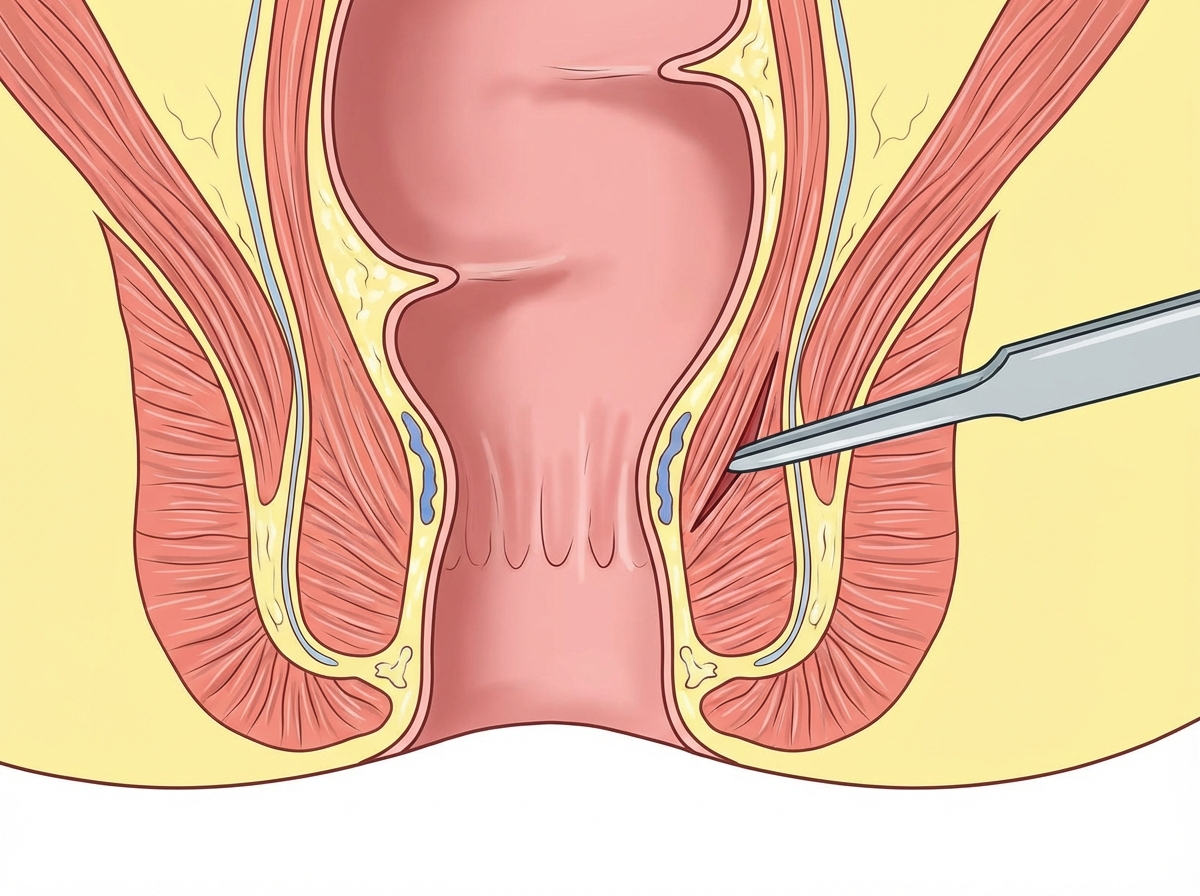
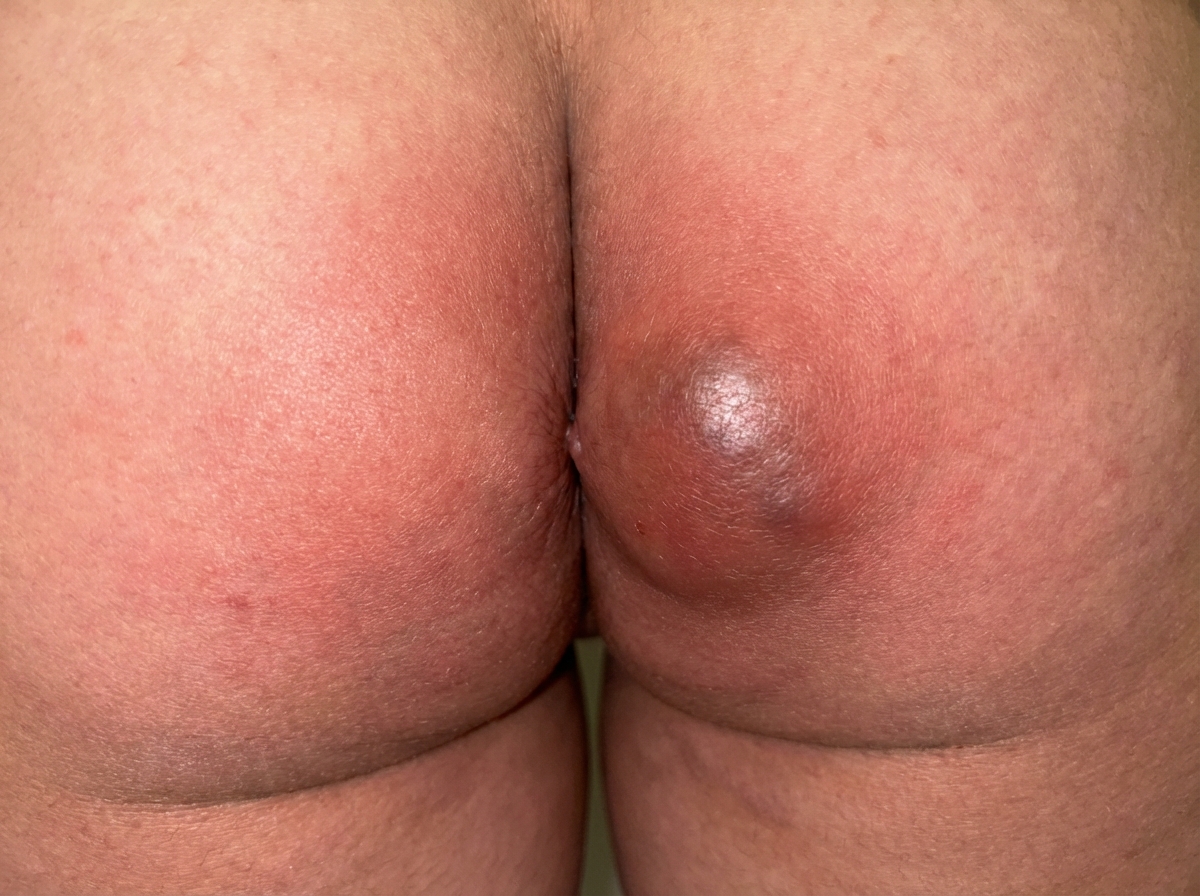
Explanation: **Explanation:** The management of fistula-in-ano depends heavily on understanding the relationship between the fistula track and the anal sphincter complex. **1. Why MR Fistulogram is the Correct Answer:** **MR Fistulogram (MRI Pelvis)** is the **investigation of choice (Gold Standard)** because it provides superior soft-tissue contrast. It accurately identifies the primary track, secondary extensions (branching), and abscess cavities. Most importantly, it clearly delineates the fistula's relationship to the internal and external anal sphincters and the levator ani muscle, which is crucial for surgical planning to prevent post-operative fecal incontinence. **2. Why Other Options are Incorrect:** * **Fistulogram:** This involves injecting radio-opaque dye into the external opening followed by X-rays. It is now largely obsolete because it fails to visualize the anal sphincters and often cannot identify the internal opening or complex secondary tracks. * **MRI:** While technically the same modality, "MR Fistulogram" is the specific protocol used to visualize fistulous tracks. In exams, always choose the most specific terminology provided. * **CT Scan:** CT has poor soft-tissue resolution for the pelvic floor and is generally ineffective for mapping small fistulous tracks, though it may be used to detect large perirectal abscesses. **3. High-Yield Clinical Pearls for NEET-PG:** * **Goodsall’s Rule:** Helps predict the track. External openings **posterior** to the transverse anal line follow a curved path to the 6 o'clock position; **anterior** openings follow a straight radial path (Exception: Anterior openings >3cm from the anus follow a curved posterior path). * **Park’s Classification:** Categorizes fistulae into Intersphincteric (most common), Transsphincteric, Suprasphincteric, and Extrasphincteric. * **Endoanal Ultrasound (EAUS):** Another excellent modality, often comparable to MRI for primary tracks, but less effective for high/complex supralevator extensions.
Colorectal Anatomy and Physiology
Practice Questions
Diverticular Disease
Practice Questions
Inflammatory Bowel Disease
Practice Questions
Colorectal Polyps
Practice Questions
Colorectal Cancer
Practice Questions
Anorectal Abscess and Fistula
Practice Questions
Hemorrhoids
Practice Questions
Rectal Prolapse
Practice Questions
Fecal Incontinence
Practice Questions
Intestinal Stomas Creation and Management
Practice Questions
Pelvic Floor Disorders
Practice Questions
Enhanced Recovery After Colorectal Surgery
Practice Questions
Get full access to all questions, explanations, and performance tracking.
Start For Free