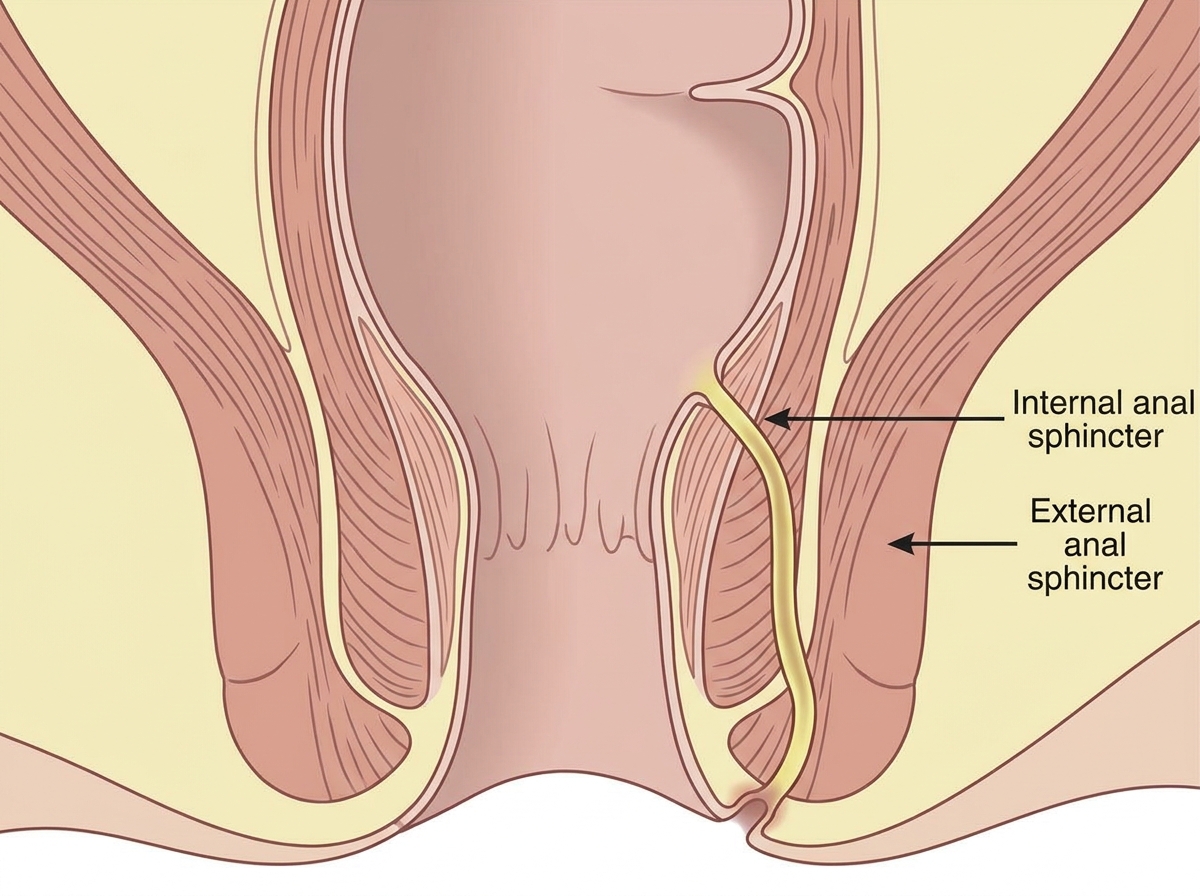
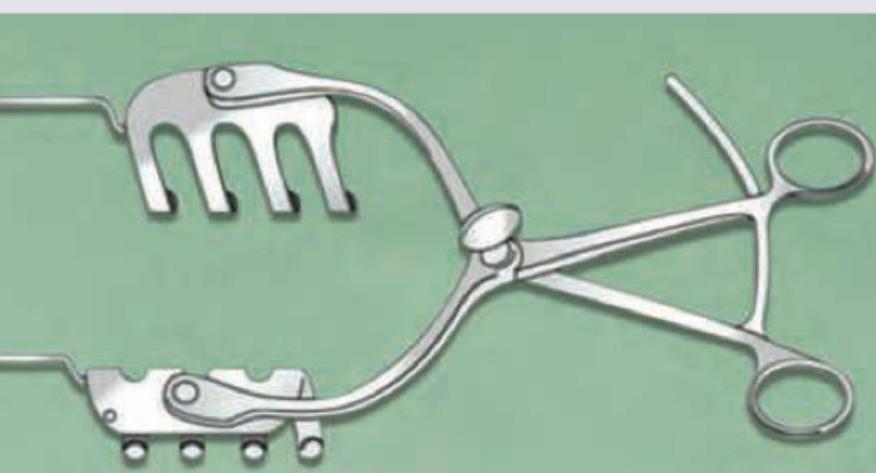
What surgery is shown here in the image?

Which of the following is not a perineal approach for the condition shown in the image?

A 53-year-old patient presents with per rectal bleeding. Which is the most appropriate investigation to evaluate for colorectal pathology?
A patient with a complex rectovaginal fistula (secondary to obstetric trauma with tissue loss) should be initially treated with
Which is the most common site for colorectal cancer metastasis?
What is the most common symptom of rectal prolapse?
A 60-year-old male presents with rectal bleeding and a palpable mass on digital rectal examination. A biopsy confirms adenocarcinoma. What is the best initial step in management?
Which surgical procedure is commonly used to treat severe ulcerative colitis?
A 70-year-old male presents with a long history of constipation and straining during defecation. He reports a sensation of a bulge from the rectum. What is the most appropriate surgical treatment?
What is the most appropriate management for a patient with confirmed diverticulitis and an abscess larger than 4 cm?
Explanation: ***Thiersch wiring*** - The image clearly depicts a **suture or wire** placed circumferentially around the anus to reduce its caliber, which is the hallmark of a **Thiersch procedure**. - This technique is used to treat **anal incontinence** by constricting the anal opening and improving sphincter function. *Hemorrhoidectomy* - This procedure involves the **surgical removal of hemorrhoids** and the images do not show any identifiable hemorrhoidal tissue being excised. - While bleeding and prolapse can be associated with hemorrhoids, the depicted technique with circumferential wiring is not used for their removal. *Altemeier operation* - The Altemeier operation is a type of **perineal rectosigmoidectomy** for rectal prolapse that involves resecting the prolapsed segment of the rectum. - The image does not illustrate resection of rectal tissue; instead, it shows a constricting device around the anus. *Wells procedure* - The Wells procedure, or **rectopexy**, involves anchoring the rectum to the sacrum to correct rectal prolapse. - This procedure typically involves an abdominal approach and fixation techniques, which are not represented in the illustration.
Explanation: ***Ripstein's procedure*** - The Ripstein procedure is an **abdominal approach** used for performing a rectopexy to treat rectal prolapse, which is clearly visible in the image. - It involves **fixing the rectum to the sacrum** through an abdominal incision using a synthetic mesh sling. - This is the **only non-perineal approach** among the options listed. *Delorme's procedure* - This is a **perineal approach** for rectal prolapse. - Involves **mucosal stripping** and plication of the rectal muscle wall through the anus. - Suitable for patients unfit for abdominal surgery or with short segment prolapse. *Altemeier's procedure* - This is a **perineal rectosigmoidectomy** (perineal approach). - Involves **resection of the prolapsed rectum and sigmoid colon** through the perineum. - Often combined with levatoroplasty for better results. *Thiersch's procedure* - This is a **perineal encirclement procedure**. - Involves placing a **wire, suture, or synthetic material** around the anus to narrow the anal opening. - Simple perineal approach but has high recurrence rates; rarely used as definitive treatment.
Explanation: ***Colonoscopy*** - **Gold standard investigation** for per rectal bleeding and suspected colorectal pathology - Allows **direct visualization** of the entire colon and rectum - Enables **biopsy** of any suspicious lesions for histopathological diagnosis - Can identify various causes: **polyps, diverticula, inflammatory bowel disease, and colorectal cancer** - Therapeutic potential for polypectomy during the same procedure *CECT (Contrast-enhanced CT scan)* - Can detect large masses and assess for metastasis but not the primary diagnostic tool - Does not allow direct visualization of the mucosa or biopsy capability - Not suitable for identifying subtle mucosal lesions or early pathology - May be used as an adjunct for staging after diagnosis *CA-19-9 levels* - Tumor marker primarily associated with **pancreatic cancer** - Not routinely used for diagnosis or screening of colorectal malignancies - Lacks sensitivity and specificity for colorectal pathology - Not appropriate as initial investigation for per rectal bleeding *CEA levels (Carcinoembryonic antigen)* - Tumor marker that can be elevated in colorectal cancer - Primarily used for **monitoring treatment response** and **detecting recurrence** - Not sensitive or specific enough for initial diagnosis - Cannot replace endoscopic evaluation for per rectal bleeding
Explanation: ***Colostomy*** * Initial treatment involves **fecal diversion** via a colostomy to allow for inflammation reduction and tissue healing around the fistula. * This step is crucial for optimising conditions for a more successful definitive repair later. *Immediate primary repair* * **Immediate primary repair** is generally not recommended due to high risk of failure in the presence of acute inflammation, infection, or poor tissue quality. * These factors can lead to **dehiscence** and recurrence of the fistula. *Vaginal repair (Colporrhaphy)* * **Vaginal repair** is a definitive surgical approach but should only be performed after proper preparation, which includes fecal diversion and allowing inflammation to subside. * Attempting this as an initial step without prior **diversion** significantly increases the risk of breakdown and failure. *Rectal resection (Anterior resection)* * **Rectal resection** is a more extensive surgical procedure usually reserved for complex fistulas, higher fistulas, or those associated with severe local tissue destruction, not typically for initial management. * It is a reconstructive procedure that may follow diversion, once the tissue is healthy enough for repair.
Explanation: ***Liver*** - The liver is the **most common site** for colorectal cancer metastasis due to its direct vascular connection via the **portal venous system**. - Blood from the colon and rectum drains into the **portal vein**, which then carries cancer cells directly to the liver. *Brain* - While brain metastases can occur, they are **relatively rare** and typically late manifestations in the course of colorectal cancer. - The brain is **not the primary organ** for initial metastatic spread from colorectal cancer. *Peritoneum* - **Peritoneal carcinomatosis** is a significant mode of spread, especially in advanced colorectal cancer, but it is **less common** than liver metastasis. - This type of spread involves the **lining of the abdominal cavity**, often leading to ascites and bowel obstruction. *Lungs* - **Pulmonary metastasis** is the **second most common** site for colorectal cancer after the liver. - Cancer cells reaching the lungs usually do so via the **systemic circulation** after passing through or bypassing the liver.
Explanation: ***Protrusion of the rectum*** - The most defining and common symptom of rectal prolapse is the **visible protrusion** of rectal tissue through the anus, especially during straining or defecation. - This symptom directly reflects the underlying pathology where the rectal wall telescopes out of the anal opening. *Rectal bleeding* - While rectal prolapse can cause bleeding due to **mucosal irritation** or **ulceration**, it is not the most common or direct symptom. - Rectal bleeding is also a symptom of many other conditions, such as **hemorrhoids** or **colorectal cancer**. *Painful defecation* - **Painful defecation** (proctalgia) may occur with rectal prolapse, particularly if the prolapsed tissue becomes incarcerated or ulcerated, but it's not the primary symptom. - Many patients experience discomfort or a feeling of incomplete evacuation rather than severe pain. *Fecal incontinence* - **Fecal incontinence** is a common associated symptom due to damage to the anal sphincter muscles and nerve stretch from the prolapse. - However, the **physical protrusion** of the rectum is the most direct and universally reported initial symptom that defines the condition itself.
Explanation: ***Full colonoscopy*** - A definitive diagnosis of **rectal adenocarcinoma** has been made, but the extent of the disease and the presence of **synchronous lesions** in the rest of the colon must be determined. - A **full colonoscopy** allows for visualization of the entire colon, identification of additional polyps or tumors (present in 3-5% of colorectal cancer patients), and is essential before proceeding with further staging and treatment planning. - After colonoscopy, additional staging with **MRI pelvis** (for local staging) and **CT chest/abdomen/pelvis** (for distant metastases) would be performed. *Immediate surgery* - While surgery is often the definitive treatment for rectal cancer, it is performed only after comprehensive staging with colonoscopy, cross-sectional imaging, and determination of need for neoadjuvant therapy. - Doing surgery immediately without full staging can lead to incomplete resection, missed synchronous lesions, or inappropriate treatment sequencing. *Chemotherapy* - **Chemotherapy** is typically used in the **neoadjuvant** setting (with radiation for locally advanced rectal cancer) or **adjuvant** setting (after surgery for high-risk disease). - It's not the initial step because complete staging with colonoscopy and imaging must be done first to determine the treatment approach. *Radiation therapy* - **Radiation therapy** (often with concurrent chemotherapy as neoadjuvant chemoradiation) is commonly used for **locally advanced rectal cancer** to achieve tumor downstaging before surgery. - However, it cannot be initiated without first completing colonoscopy to rule out synchronous lesions and cross-sectional imaging for proper staging.
Explanation: ***Total colectomy*** - **Total colectomy** involves the surgical removal of the entire colon, which is the most definitive treatment for severe, refractory ulcerative colitis, effectively eliminating the diseased organ. - This procedure usually necessitates an ileostomy or an ileal pouch-anal anastomosis (IPAA) to maintain bowel continuity and function. - Standard operations include **total proctocolectomy with IPAA** (for suitable candidates) or **total proctocolectomy with end ileostomy**. *Partial gastrectomy* - A **partial gastrectomy** involves the removal of a portion of the stomach and is primarily used to treat conditions such as severe peptic ulcer disease, gastric cancer, or morbid obesity. - This procedure does not address the pathology of ulcerative colitis, which affects the large intestine (colon and rectum). *Laparoscopic cholecystectomy* - **Laparoscopic cholecystectomy** is the minimally invasive surgical removal of the gallbladder, typically performed for symptomatic cholelithiasis (gallstones) or cholecystitis. - This procedure is unrelated to the treatment of inflammatory bowel disease like ulcerative colitis, as it targets a different organ system. *Hemicolectomy* - A **hemicolectomy** involves the surgical removal of only a section (left or right half) of the colon and is commonly performed for localized conditions like colon cancer or diverticular disease. - This is **inadequate for severe ulcerative colitis** because UC characteristically affects the colon in a **continuous pattern starting from the rectum** and extending proximally, often involving the entire colon. Leaving diseased colon segments would fail to control the disease and symptoms.
Explanation: ***Rectopexy*** - The described symptoms of **constipation**, **straining**, and a **rectal bulge** strongly suggest a **rectal prolapse** or significant **rectocele**. - **Rectopexy** is the most appropriate surgical treatment for rectal prolapse, aiming to fix the rectum in its anatomical position, alleviating symptoms of bulging and improving bowel function. *Hemorrhoidectomy* - **Hemorrhoidectomy** is a procedure to remove hemorrhoids, which present with **bleeding**, **pain**, and **pruritus** but typically not a sensation of a rectal bulge requiring surgical fixation. - While straining can contribute to hemorrhoids, it doesn't address the primary issue of rectal protrusion. *Anterior resection* - **Anterior resection** involves removing a portion of the rectum, usually for **rectal cancer** or **severe diverticular disease**. - This procedure addresses different pathologies and is not indicated for isolated rectal prolapse or rectocele. *Sigmoid colectomy* - **Sigmoid colectomy** is the removal of part or all of the sigmoid colon, typically for conditions like **diverticulitis** or **colon cancer**. - It is not indicated for the surgical correction of rectal prolapse, which involves fixation of the rectum.
Explanation: ***Percutaneous drainage*** - For diverticulitis with an abscess larger than 4 cm, **percutaneous drainage** is the most appropriate initial management to control the infection and prevent progression to more severe complications. - This procedure removes infected fluid, reducing the **bacterial load** and improving the patient's clinical condition, often followed by antibiotics. *Antibiotic therapy alone* - While antibiotics are crucial for treating diverticulitis, they are often insufficient for abscesses larger than **4 cm** due to poor penetration into the abscess cavity. - Relying solely on antibiotics for a large abscess can lead to treatment failure, persistence of infection, or even **sepsis**. *Immediate colectomy* - **Immediate colectomy** is generally reserved for complicated diverticulitis with **perforation**, generalized peritonitis, or uncontained infection, which is not indicated here as the primary management for an abscess that can be drained. - An immediate colectomy carries higher risks of **morbidity and mortality** compared to less invasive approaches like percutaneous drainage. *Observation and diet modification* - **Observation and diet modification** are appropriate for uncomplicated diverticulitis or after resolution of an acute episode, but not for an active abscess. - An abscess requires active intervention due to the risk of **rupture**, sepsis, and other life-threatening complications.
Colorectal Anatomy and Physiology
Practice Questions
Diverticular Disease
Practice Questions
Inflammatory Bowel Disease
Practice Questions
Colorectal Polyps
Practice Questions
Colorectal Cancer
Practice Questions
Anorectal Abscess and Fistula
Practice Questions
Hemorrhoids
Practice Questions
Rectal Prolapse
Practice Questions
Fecal Incontinence
Practice Questions
Intestinal Stomas Creation and Management
Practice Questions
Pelvic Floor Disorders
Practice Questions
Enhanced Recovery After Colorectal Surgery
Practice Questions
Get full access to all questions, explanations, and performance tracking.
Start For Free