What is the most common indication for surgery in patients with Crohn's disease?
Most common early complication of end ileostomy is
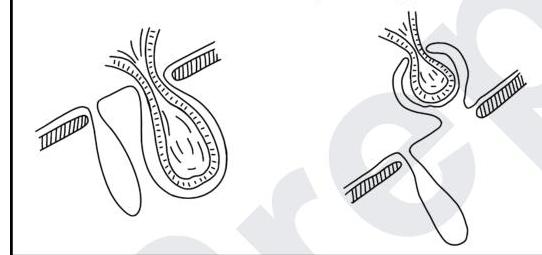
A surgeon examined a case of hernia and was able to retract the hernial sac on examination but not the contents. Identify the type of hernia depicted in the image.
Parastomal hernia is most frequently seen with:
Which of the following findings on physical exam suggests a strangulated inguinal hernia?
What is the treatment of choice for a patient presenting with carcinoma of the rectum and obstruction in an emergency setting?
Which of the following statements about the management of haematomas is NOT correct?
A 25-year-old male presents with inguinal swelling. He had surgery for acute abdomen 2 years ago but could not tell the reason behind it. Trauma to which structure during the surgery conducted 2 years ago would have resulted in this inguinal swelling?
Most common cause of acute intestinal obstruction in children is
In case of polytrauma with multiple injuries to the chest, neck, and abdomen, what is the highest priority intervention?
Explanation: ***Intestinal obstruction*** - **Intestinal obstruction due to strictures** is the most common indication for surgery in Crohn's disease, accounting for 40-70% of surgical interventions. - Chronic transmural inflammation leads to **fibrotic strictures** that cause recurrent obstructive symptoms including abdominal pain, distension, and vomiting. - When strictures become symptomatic and unresponsive to medical therapy or endoscopic balloon dilation, **surgical resection or stricturoplasty** becomes necessary. *Fistulas* - **Fistulas** are the second most common indication for surgery in Crohn's disease, occurring in 20-40% of surgical cases. - Complex fistulas (enterocutaneous, enterovesical, enterovaginal) often require surgical intervention when they are symptomatic or fail conservative management. - Internal fistulas may sometimes be managed conservatively if asymptomatic. *Perforation* - **Free perforation** is a serious but relatively rare complication of Crohn's disease requiring emergency surgery. - More commonly, Crohn's disease presents with contained perforations forming abscesses rather than free perforations. - Acute perforation represents only 1-2% of surgical indications. *Malignancy* - While patients with Crohn's disease have a slightly increased risk of **small bowel adenocarcinoma** and colorectal cancer, malignancy is a rare indication for surgery. - Surveillance and early detection programs aim to identify dysplasia before progression to invasive cancer. - Surgery for established malignancy represents less than 5% of operations in Crohn's disease patients.
Explanation: ***Dermatitis*** - **Peristomal dermatitis** is the most common early complication of an end ileostomy, typically occurring due to irritation from digestive enzymes in the ileostomy effluent. - The effluent is highly proteolytic and enzymatic, causing **skin breakdown** and inflammation around the stoma. *Necrosis* - While a serious complication, **stoma necrosis** is less common than dermatitis and usually manifests within the first few days post-operatively due to compromised blood supply. - It often presents with a **dark purple or black discoloration** of the stoma, indicating tissue death. *Prolapse* - **Stoma prolapse** is an uncommon early complication, more frequently seen weeks to months after surgery, particularly if there is increased intra-abdominal pressure. - It involves the bowel protruding excessively through the stoma opening. *Hernia* - A **parastomal hernia** is a late complication, typically developing months to years after surgery, due to weakening of the abdominal wall muscles around the stoma. - Clinical signs include a **bulge around the stoma**, which may be more noticeable when coughing or straining.
Explanation: ***Reduction en masse*** - This occurs when the **hernia sac** is reduced into the abdomen but the contents remain incarcerated within the sac, still outside the peritoneal cavity. The image clearly depicts the sac being pushed back, while the bowel loop within it remains constricted at the neck. - This is a dangerous situation because the **incarcerated bowel** is not visible externally, yet remains at risk of strangulation and is often unrecognized. *Sliding hernia* - A sliding hernia involves a portion of the **retroperitoneal organ** (like the colon or bladder) forming part of the posterior wall of the hernia sac. - This typically occurs gradually, and the sac itself is not mistakenly reduced without its contents while the contents remain trapped. *Incarcerated hernia* - An incarcerated hernia means the contents of the hernia sac are **trapped** and cannot be manually reduced back into the abdominal cavity. - While the image shows incarcerated contents, the specific problem here is that the *sac* has been reduced without its contents, which is a particular complication rather than just general incarceration. *Maydl's hernia* - Maydl's hernia (also known as a W-hernia) describes a scenario where **two loops of bowel** are contained within the hernia sac, with a connecting loop of bowel located within the abdominal cavity, forming a 'W' shape. - The illustration shows only one loop of bowel within the sac and does not suggest the specific 'W' configuration or intra-abdominal strangulation of the connecting segment.
Explanation: ***End colostomy*** - **End colostomies** are associated with the highest rates of parastomal hernias due to the larger fascial defect and often larger bowel segments brought through the abdominal wall, creating a wider potential space for herniation. - The permanent nature of an end colostomy means a longer duration of exposure to factors contributing to hernia formation, such as increased abdominal pressure and fascial weakening. *Loop colostomy* - While loop colostomies can develop parastomal hernias, their incidence is generally lower than with end colostomies due to the typically smaller fascial defect created for a loop. - **Loop colostomies** are often temporary, reducing the long-term exposure to risk factors for hernia development compared to permanent stomas. *End ileostomy* - **End ileostomies** have a lower incidence of parastomal hernias compared to colostomies because the small bowel mesentery is less bulky, and the fascial opening required is typically smaller. - The contents of an ileostomy are less solid and generally exert less pressure on the fascial opening than colostomy contents. *Loop ileostomy* - **Loop ileostomies**, similar to loop colostomies, are often temporary and involve a relatively small fascial defect, contributing to a lower risk of parastomal hernia compared to permanent stomas. - The infrequency of parastomal hernias in loop ileostomies is also attributed to the typically smaller bowel segment brought through the abdominal wall and its temporary nature.
Explanation: ***Non-reducible mass*** - A **non-reducible (irreducible) mass** is the **primary clinical finding** that differentiates a strangulated or incarcerated hernia from a simple reducible hernia. - When herniated contents cannot be returned to the abdominal cavity, it indicates **bowel or tissue entrapment** within the hernia sac. - This is the **earliest and most consistent sign** suggesting progression from a simple hernia to one at risk of or already experiencing strangulation. - **Non-reducibility is the hallmark** that prompts urgent surgical evaluation to prevent or treat strangulation. *Tender mass* - **Tenderness** indicates inflammation or ischemia and is an important additional finding in strangulation. - However, tenderness can also occur with simple incarceration or localized inflammation without strangulation. - Tenderness **combined with** non-reducibility strengthens the diagnosis, but non-reducibility is the more fundamental finding. *Cyanotic skin over mass* - **Cyanotic or dusky skin** is a **very late sign** indicating advanced tissue ischemia and necrosis. - While it definitively confirms strangulation, by this stage significant tissue damage has already occurred. - This is **not the primary finding** that initially "suggests" strangulation—the diagnosis should be made much earlier based on non-reducibility and tenderness. *Bowel sounds over mass* - The presence of **bowel sounds over the hernia** suggests viable bowel with intact peristalsis. - This typically indicates an **uncomplicated or recently incarcerated hernia** without established strangulation. - **Absence of bowel sounds** would be more concerning for strangulation, but presence suggests viability.
Explanation: ***Hartmann's procedure*** - In an emergency setting with **obstructing carcinoma of the rectum**, Hartmann's procedure is the **treatment of choice**. - This procedure involves **resection of the tumor** with formation of an **end colostomy** and closure of the distal rectal stump. - It achieves **dual objectives**: relieves the obstruction AND removes the primary tumor, allowing proper oncological staging and planning of adjuvant therapy. - While more extensive than simple diversion, it is the **standard emergency operation** for obstructing left-sided and rectal cancers in patients who can tolerate resection. - The colostomy can be reversed later after adjuvant treatment (if needed), though many remain permanent. *Defunctioning colostomy* - A proximal diverting colostomy only diverts the fecal stream without addressing the primary tumor. - This is a **temporizing measure**, not definitive treatment, and leaves the malignancy in situ. - It may be considered in **highly unstable patients** or for purely **palliative** intent when resection is not feasible. - Requires a second major operation for definitive tumor resection, increasing overall morbidity. *Total colectomy* - This involves removing the entire colon and is performed for conditions like **familial adenomatous polyposis** or **synchronous colon cancers**. - Not indicated for isolated rectal cancer with obstruction. - Would be excessively extensive and carry unnecessary morbidity in this setting. *Left hemi-colectomy* - This procedure removes the left colon (descending and sigmoid) but typically does not include the rectum. - Not appropriate for **rectal cancer**, as it would not address the primary pathology. - Used for tumors of the descending or sigmoid colon, not rectum.
Explanation: ***Haematoma must be operated.*** - This statement is **incorrect** because not all hematomas require surgical intervention. - The decision to operate depends on **size**, **location**, **neurological status**, **mass effect**, and rate of expansion. - Small, asymptomatic hematomas can be managed **conservatively** with serial imaging and close neurological monitoring. - Absolute statements like "must be operated" are incorrect in clinical practice where individualized management is essential. *Some haematomas require surgical intervention.* - This statement is **correct** - many hematomas necessitate surgical evacuation. - Indications for surgery include: **significant mass effect**, **midline shift >5mm**, **neurological deterioration**, **large volume** (>30mL for SDH, >50mL for ICH), or **posterior fossa hematomas** causing brainstem compression. - Surgical intervention aims to relieve intracranial pressure and prevent secondary brain injury. *GCS assessment is helpful in prognosis.* - This statement is **correct** - the **Glasgow Coma Scale (GCS)** is a critical prognostic tool. - GCS is used to assess severity of neurological injury and predict outcomes in head trauma patients. - Lower GCS scores (≤8) indicate severe injury with poorer prognosis, while higher scores suggest better outcomes. - GCS also guides management decisions including need for intubation and intensive monitoring. *CT scan is the investigation of choice for acute haemorrhage.* - This statement is **correct** - **Non-contrast CT (NCCT)** is the gold standard for acute intracranial hemorrhage. - CT is rapid, widely available, and highly sensitive for detecting acute blood. - It helps identify location, size, mass effect, and associated injuries like skull fractures. - MRI has limited role in acute settings but is useful for subacute/chronic hemorrhage and detecting diffuse axonal injury.
Explanation: ***Ilioinguinal nerve*** - Damage to the ilioinguinal nerve during abdominal surgery, especially an appendectomy, can lead to muscle weakness in the anterior abdominal wall. - This weakness predisposes the patient to the formation of an **inguinal hernia**, which manifests as an inguinal swelling. *Spermatic cord* - Trauma to the spermatic cord could lead to **testicular atrophy**, pain, or issues with fertility due to vascular or ductal damage. - It is not directly associated with the development of an inguinal hernia as a primary consequence of isolated trauma during non-hernia repairs. *Genital branch of genitofemoral nerve* - Injury to the genital branch of the genitofemoral nerve primarily affects the **cremasteric reflex** and sensation in the scrotum/inner thigh. - While it can cause sensory disturbances, it does not directly lead to weakness of the abdominal wall sufficient to cause an inguinal hernia. *Pampiniform plexus* - The pampiniform venous plexus is involved in regulating testicular temperature. Injury primarily causes a **hydrocele** or **varicocele** due to impaired venous drainage. - It would not cause an inguinal hernia, which involves protrusion of abdominal contents through a weakened abdominal wall.
Explanation: ***Intussusception*** - **Intussusception** is the most common cause of **acute intestinal obstruction** in children, particularly between 3 months and 3 years of age. - It occurs when a segment of the intestine telescopes into an adjacent segment, leading to obstruction and potentially **ischemia**. *Inguinal hernia* - While an **incarcerated inguinal hernia** can cause intestinal obstruction, it is less common than intussusception as the primary cause of acute obstruction in children generally. - It is more frequent in **neonates and infants** but overall incidence of obstruction is lower than intussusception. *Volvulus* - **Volvulus** refers to a twisting of the intestine on its mesentery, often associated with **malrotation**, leading to obstruction and vascular compromise. - While a serious cause of obstruction, especially in neonates, it is less common overall than intussusception in the pediatric population. *None of the options* - This option is incorrect because **intussusception** is a recognized and frequent cause of acute intestinal obstruction in children.
Explanation: ***Stabilization of the airway*** - Maintaining a **patent airway** is the absolute first priority in any trauma patient (following the **ABCDE approach**), as inadequate oxygenation and ventilation can rapidly lead to irreversible brain damage and death. - In a patient with injuries to the chest, neck, and abdomen, the airway is particularly vulnerable to compromise from direct trauma, swelling, or aspiration. *Vasopressors* - Vasopressors are used to support blood pressure in cases of **hypotensive shock**, but establishing adequate ventilation and oxygenation (airway, breathing) must precede circulatory support. - Administering vasopressors without a patent airway and efficient breathing will not be effective and can be detrimental. *Assessing disability* - Assessing disability (neurological status) is part of the **D** in the **ABCDE approach**, which comes after addressing airway, breathing, and circulation. - While important, it is not the highest priority intervention as an immediate threat to life takes precedence. *Stabilization of the cervical spine* - While crucial in trauma (especially with neck injuries) to prevent further neurological damage, **cervical spine stabilization** is often performed concurrently or immediately after airway assessment and control, under the **"A" for Airway with cervical spine protection** principle. - However, establishing a patent airway without moving the neck (if possible) still takes absolute priority over full stabilization, as a blocked airway is an immediate life threat.
Get full access to all questions, explanations, and performance tracking.
Start For Free