Which of the following is NOT a cause of secretory diarrhea?
Emergency management of Ulcerative colitis is by:
The most common complication of Zenker's diverticulum is:
What is the treatment of choice for a 70-year-old male patient who presents with peritonitis secondary to ruptured diverticulitis?
Which of the following stoma is formed in Hartmann's procedure?
Patient presents with peritonitis and during surgery a diverticular perforation is seen with fecal peritonitis. What is the Hinchey stage?
A patient presents with fecal peritonitis, and during laparotomy, a diverticular perforation is observed. According to Hinchey’s classification, which stage does this condition represent?
A patient has carcinoid tumour of appendix of size more than 2.5 cm. The management of choice is:
In a 65 year old, double contrast barium enema shows cancer of colon with an apple core appearance. Colonoscopic biopsy shows adenocarcinoma. What will be the next step of management?
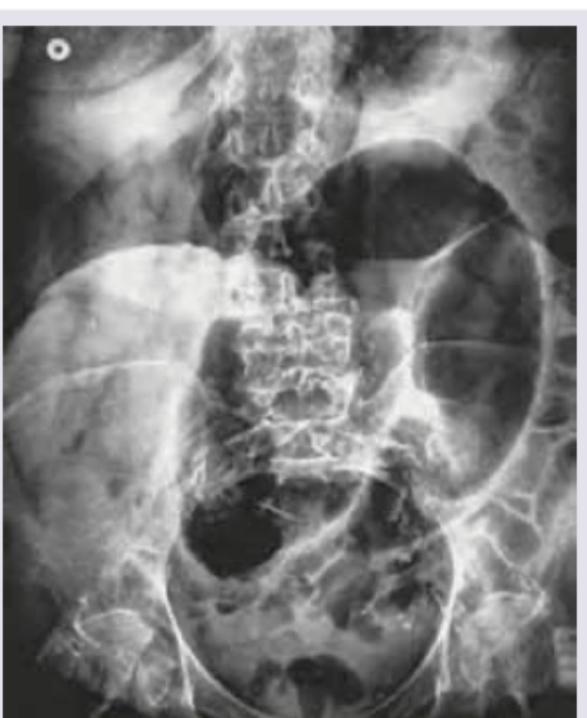
The diagnosis of this patient with left-sided abdominal pain and tyre-like feel of abdomen is?
Explanation: ***Inflammatory bowel disease (IBD)*** - IBD, which includes **Crohn's disease** and **ulcerative colitis**, primarily causes **inflammatory diarrhea**, characterized by damage to the intestinal lining and often with presence of blood or pus [1]. - While fluid secretion can occur, the predominant mechanism is altered absorption due to inflammation and mucosal damage, rather than active secretion. *Celiac disease* - Celiac disease causes **malabsorptive diarrhea** due to immune-mediated damage to the small intestine villi upon gluten ingestion [1]. - This leads to impaired absorption of nutrients and water, rather than active secretion [4]. *Lactose intolerance* - Lactose intolerance results in **osmotic diarrhea**, where undigested lactose in the gut draws water into the lumen [2]. - It does not involve active fluid secretion by the intestinal cells but rather an osmotic effect [3]. *Gastrinoma* - A gastrinoma is a neuroendocrine tumor that secretes excessive **gastrin**, leading to **Zollinger-Ellison syndrome**. - High gastrin levels cause increased gastric acid secretion, which overwhelms the intestine's neutralizing capacity, leading to inactivation of pancreatic enzymes and mucosal damage, all contributing to **secretory diarrhea**.
Explanation: ***Subtotal colectomy with end ileostomy*** - This is the **standard emergency procedure** for fulminant ulcerative colitis, toxic megacolon, perforation, or massive hemorrhage - Involves removal of the **entire colon** (from ileocecal junction to upper rectum) while **preserving the rectal stump** as a Hartmann's pouch - Creates an **end ileostomy** for fecal diversion - **Proctectomy is avoided** in the emergency setting due to higher morbidity, risk of pelvic sepsis, and technical difficulty in acutely ill patients - The rectal stump can be removed later (2nd stage) with consideration for **ileal pouch-anal anastomosis (IPAA)** after patient stabilization - This staged approach allows for optimization of the patient's condition and future reconstructive options *Total proctocolectomy with end ileostomy* - This involves removal of both the **colon and rectum** with permanent ileostomy - **NOT recommended in emergency settings** as proctectomy adds significant morbidity in critically ill patients - Requires pelvic dissection in inflamed tissues, increasing risk of complications - May be performed electively as a **second-stage procedure** or in patients not candidates for reconstructive surgery *Right hemicolectomy* - Removes only the **right side of the colon** (cecum, ascending colon, and part of transverse colon) - Inappropriate for ulcerative colitis, which is a **pan-colonic disease** that always involves the rectum and extends proximally - Inadequate resection would leave diseased colon in place *Left hemicolectomy* - Removes only the **left side of the colon** (descending colon and part of transverse colon) - Inadequate for ulcerative colitis as it doesn't address the **entire diseased colon** - Would leave inflamed segments and the **always-involved rectum** in place
Explanation: ***Aspiration pneumonia*** - **Aspiration pneumonia** is the **most common complication** of Zenker's diverticulum, occurring due to chronic regurgitation of food and secretions that accumulate in the diverticulum. - Patients frequently experience **nocturnal regurgitation** of undigested food, which is then *aspirated* into the airways, leading to recurrent pulmonary infections. - This is the primary reason for surgical intervention in symptomatic patients with Zenker's diverticulum. *Lung abscess* - **Lung abscess** is a more *severe* but **less common** complication that can develop as a consequence of chronic, recurrent aspiration pneumonia. - It represents a localized, necrotizing infection and is a **progression** from untreated or recurrent aspiration, rather than the initial or most frequent complication. *Dysphonia* - While **dysphonia** (hoarseness) can occur due to irritation from regurgitated contents or compression of the recurrent laryngeal nerve, it is **uncommon** as a complication. - Dysphonia is more typically associated with **GERD** or direct laryngeal pathology. *Perforation* - **Perforation** of Zenker's diverticulum is a **rare** complication that may occur spontaneously, due to impacted food, or iatrogenically during endoscopic procedures. - While serious, it is far less common than pulmonary complications from chronic aspiration.
Explanation: ***Hartmann's procedure*** - For **peritonitis secondary to ruptured diverticulitis** in an elderly patient, a Hartmann's procedure is often the safest choice, involving resection of the diseased bowel and creation of an **end colostomy**. - This procedure avoids a primary anastomosis in the presence of **sepsis** and inflammation, reducing the risk of anastomotic leak in a high-risk patient. *Conservative* - **Conservative management** with antibiotics is typically reserved for **uncomplicated diverticulitis** (i.e., no perforation or generalized peritonitis). - Given the presence of **peritonitis**, a surgical intervention is necessary to address the source of infection and contamination. *Primary resection and anastomosis* - While possible in select, hemodynamically stable patients with localized contamination, **primary anastomosis** carries a higher risk of **anastomotic leak** in the setting of diffuse peritonitis and inflammation. - This approach is generally avoided in elderly patients with significant contamination due to increased morbidity and mortality risks. *Whipple procedure* - The **Whipple procedure**, or pancreaticoduodenectomy, is a complex surgical operation to remove the **head of the pancreas**, duodenum, gallbladder, and part of the bile duct. - It is used to treat **pancreatic cancer** and other tumors of the periampullary region, and is completely unrelated to diverticular disease or peritonitis.
Explanation: ***End Colostomy*** - Hartmann's procedure involves resection of a diseased segment of the **colon**, typically the sigmoid colon, with the creation of a **proximal colostomy** and closure of the distal rectal stump. - The proximal end of the colon is brought out through the abdominal wall to form a **stoma**, which is a type of end colostomy. *End Ileostomy* - An end ileostomy involves bringing the **ileum** (small intestine) to the abdominal wall, which is not part of the standard Hartmann's procedure. - This is typically performed after a **total colectomy** or in cases of severe Crohn's disease affecting the colon. *Loop Ileostomy* - A loop ileostomy involves bringing a **loop of the ileum** to the surface of the abdomen, creating two openings that are then joined together. - This is often a **temporary diversion** and does not involve resection of the colon in the same manner as Hartmann's procedure. *Caecostomy* - A caecostomy is a stoma created from the **cecum**, the beginning of the large intestine. - This is typically performed for various reasons such as **bowel decompression** or management of fecal incontinence, and is not a component of Hartmann's procedure.
Explanation: **Diffuse fecal contamination (Grade IV)** * The Hinchey classification system for perforated diverticulitis grades the severity based on operative findings; **fecal peritonitis** indicates the highest grade due to gross contamination of the abdominal cavity. * **Hinchey Stage IV** is specifically defined by **diffuse fecal peritonitis**, which is a life-threatening condition requiring urgent surgical intervention. *Localized mesenteric or pericolic abscess (Grade I)* * This stage involves a **localized pericolic or mesenteric phlegmon or abscess** and does not involve diffuse peritonitis. * The presence of **fecal peritonitis** in the patient rules out this less severe stage. *Diffuse purulent contamination (Grade III)* * **Diffuse purulent peritonitis** (Hinchey Stage III) involves the presence of pus spread throughout the abdominal cavity, but without macroscopic fecal contamination. * The key finding of **fecal peritonitis** in the patient indicates a more severe form of contamination than purulent peritonitis. *Localized pelvic abscess (Grade II)* * This stage represents a **more extensive abscess** that may be located in the pelvis or retroperitoneum, but it is still localized, not diffuse. * **Fecal peritonitis** implies generalized contamination of the peritoneal cavity, which is much more severe than a localized abscess.
Explanation: ***Stage 4: Fecal peritonitis due to diverticular perforation*** - This stage is defined by the presence of **fecal peritonitis**, which is directly observed as the result of a **diverticular perforation** during laparotomy - Hinchey Stage 4 indicates the **most severe form** of complicated diverticulitis, characterized by gross contamination of the abdominal cavity with stool - Requires emergent surgical intervention with resection and often Hartmann's procedure *Stage 3: Generalized purulent peritonitis* - This stage involves **generalized purulent peritonitis**, meaning the abdominal cavity is diffusely contaminated with pus, but **not with fecal matter** - While purulent peritonitis is severe, it does not involve the direct spillage of feces, which is the key differentiating factor from Stage 4 - Typically results from microperforation with purulent exudate *Stage 1: Pericolic abscess* - This stage describes a **localized abscess** that is confined to the immediate vicinity of the inflamed diverticulum - There is no widespread peritonitis or fecal contamination in Stage 1; the infection is typically contained within the colonic mesentery or pericolic tissues - Often managed conservatively with antibiotics or percutaneous drainage *Stage 2: Distant intra-abdominal or pelvic abscess* - This stage involves an **intra-abdominal or pelvic abscess** that is located distant from the primary site of diverticular inflammation (e.g., retroperitoneal, pelvic, or remote intraperitoneal locations) - While it signifies a more disseminated infection than Stage 1, it still represents a contained abscess, not generalized peritonitis - May require percutaneous drainage or delayed surgical intervention
Explanation: **Right hemicolectomy** - For **carcinoid tumors of the appendix** larger than **2.0 cm (or 2.5 cm by some guidelines)**, a right hemicolectomy is the recommended management due to the increased risk of **lymph node metastasis** and distant spread. - This procedure ensures adequate tumor clearance and regional lymphadenectomy, which is crucial for staging and preventing recurrence in larger tumors. *Appendectomy* - An appendectomy alone is usually sufficient for **small carcinoid tumors (<1-2 cm)** that are **confined to the appendix**, without evidence of mesoappendiceal invasion or lymph node involvement. - For tumors exceeding 2.5 cm, the risk of metastasis is considerably higher, making appendectomy alone inadequate for complete oncological control. *Appendectomy and 24 hour urinary HIAA* - While a **24-hour urinary 5-hydroxyindoleacetic acid (5-HIAA)** measurement is useful for diagnosing and monitoring **carcinoid syndrome**, it does not influence the primary surgical management decision for an appendiceal tumor of this size. - The surgical approach is dictated by **tumor size** and the risk of metastasis, not by biochemical markers alone, unless the patient presents with symptoms of carcinoid syndrome. *Appendectomy and abdominal CT scan* - An abdominal **CT scan** is valuable for **staging** and detecting distant metastases or nodal involvement, especially in larger tumors, but it is a diagnostic tool, not a treatment itself. - While a CT scan would likely be performed as part of the work-up, an appendectomy alone is insufficient as the definitive surgical management for a tumor of this size without addressing the high risk of regional spread.
Explanation: ***CECT to stage disease*** - **CECT (Contrast-Enhanced CT) of chest, abdomen, and pelvis is the essential next step** after histological confirmation of colon adenocarcinoma. - **Staging is mandatory** before any treatment decision to determine: - **Local extent** of tumor (T stage) - **Lymph node involvement** (N stage) - **Distant metastases** (M stage - liver, lungs, peritoneum) - **Resectability** and surgical planning - Even with the "apple core" appearance indicating an advanced primary tumor, **treatment decisions cannot be made without knowing the overall disease burden**. - **CEA (Carcinoembryonic Antigen) levels** are also typically obtained during staging. *Surgery* - **Surgical resection is the definitive treatment** for localized, resectable colon cancer and would be performed **after staging**, not before. - Surgery involves removing the tumor with adequate margins and regional lymphadenectomy. - However, **staging must precede surgery** to: - Determine if the disease is metastatic (which would change surgical approach) - Plan the extent of resection - Counsel the patient appropriately - Decide on neoadjuvant therapy if indicated - The "apple core" appearance suggests an advanced primary but does not indicate acute obstruction requiring emergency surgery in this stable patient who has already undergone barium enema and colonoscopy. *Chemotherapy* - **Chemotherapy** is typically given as: - **Adjuvant therapy** after surgery for stage III (node-positive) or high-risk stage II disease - **Palliative therapy** for metastatic (stage IV) disease - **Neoadjuvant therapy** is not standard for colon cancer (unlike rectal cancer) - Chemotherapy is not the immediate next step; staging and then surgery (if resectable) come first. *Radiotherapy* - **Radiotherapy has limited role in colon cancer** (unlike rectal cancer where it is commonly used). - It may be used for: - **Palliation** of symptoms (pain, bleeding) in advanced disease - Rare cases of **locally advanced unresectable disease** - It is not a primary treatment modality and is not the next step in this case.
Explanation: ***Sigmoid volvulus*** - The image shows massively dilated loops of bowel forming an **omega loop** or "inverted U" appearance, characteristic of **sigmoid volvulus**. The "tyre-like feel" upon palpation is consistent with a distended, gas-filled colon. - Clinical presentation with **left-sided abdominal pain** and signs of **large bowel obstruction** further supports this diagnosis, especially with the characteristic radiological findings. *Diverticulitis* - Diverticulitis typically presents with **left lower quadrant pain**, fever, and localized tenderness, but not usually with the massive abdominal distension and "tyre-like" feel seen in major bowel obstruction. - Radiological findings in diverticulitis often include **pericolic fat stranding**, wall thickening, and diverticula, rather than dramatically dilated bowel loops. *Paralytic ileus* - **Paralytic ileus** involves generalized bowel distension due to decreased peristalsis, often affecting both small and large bowel, rather than the localized, massive dilation of a single segment as seen here. - While there is distension, the distinct "inverted U" or omega loop configuration pointing to a specific segment of the bowel causing obstruction is not a feature of paralytic ileus. *Intussusception* - **Intussusception** is more common in children and typically presents with intermittent abdominal pain, vomiting, and "current jelly" stools, not primarily with palpable mass or a "tyre-like" feel on the *sigmoid* colon as described. - Radiologically, intussusception might show a "target sign" on ultrasound or an absence of gas distal to the obstruction, not the massively dilated sigmoid loop seen in the radiograph.
Get full access to all questions, explanations, and performance tracking.
Start For Free