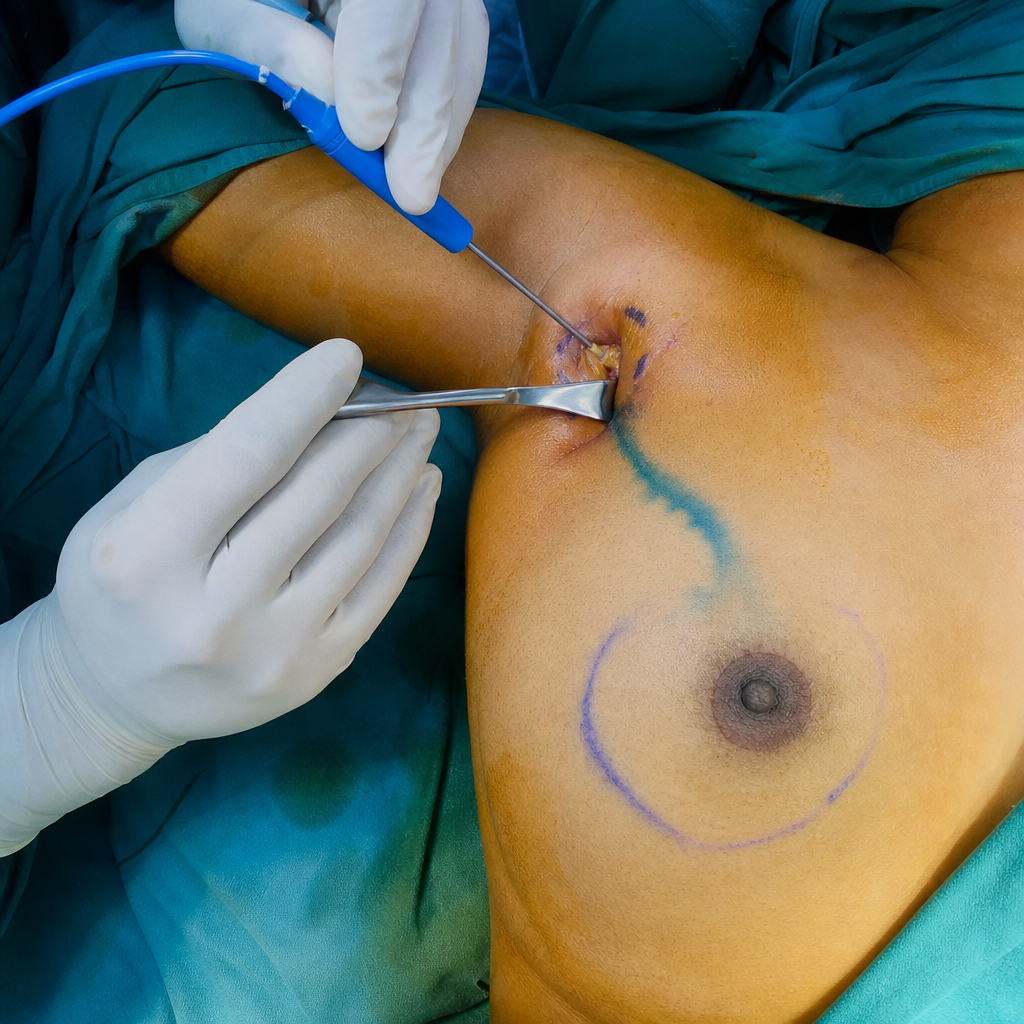
A 24-year-old woman presents with a palpable lump in her right breast noted over the past month. Her sister was diagnosed with poorly differentiated triple-negative breast cancer at age 31. Ultrasonography reveals a solid mass. Fine needle aspiration was non-diagnostic. Mammography shows a 1-cm density with clustered calcifications in the right breast, with no lesions in the contralateral breast. What is the most appropriate next step in management for this patient?
What is the drug of choice for HER2-neu positive breast cancer?
During a routine screening mammography, a 62-year-old teacher is informed that she has changes on her mammography and should consult her physician. Which of the following mammographic findings indicates a benign condition?
A 40-year-old female patient presented with a 2x2 cm mass in the right breast. Mammography showed 4 satellite nodules in the same breast. FNAC of the lesion proved to be carcinoma, and all 4 satellite nodules were positive for malignancy. What is the ideal management for her?
All of the following are risk factors for carcinoma of the breast except?
A 25-year-old female presents with a breast lump. What is the first investigation?
Secondary deposits from carcinoma breast are commonest in which of the following locations?
In carcinoma of the breast with HER-2/neu immunohistochemistry staining, which of the following scores necessitates further FISH study?
Which of the following statements is NOT true about Medullary breast carcinoma?
"Linguine sign" and "Stepladder sign" that are specific for intracapsular breast implant rupture are both seen in:
Explanation: ### Explanation **1. Why the Correct Answer (A) is Right:** The primary goal in evaluating any palpable breast lump is to rule out malignancy. This patient has several "red flags": a solid mass on USG, suspicious clustered calcifications on mammography, and a significant family history (sister with young-onset triple-negative breast cancer). The **Triple Assessment** (Clinical exam, Imaging, and Pathology) is the gold standard for breast lump evaluation. Since the Fine Needle Aspiration (FNA) was non-diagnostic, it cannot be used to rule out cancer. The next mandatory step is to obtain a definitive tissue diagnosis via **Core Needle Biopsy (CNB)** or excisional biopsy. In modern practice, CNB is preferred as it provides histological architecture (unlike FNA) and allows for receptor testing (ER/PR/HER2). **2. Why Incorrect Options are Wrong:** * **Option B:** Monthly self-examination is a screening/monitoring tool, not a diagnostic one. Delaying diagnosis in the presence of suspicious radiological findings (calcifications) is negligent. * **Option C:** While this patient is a candidate for genetic counseling and BRCA testing due to her family history, **diagnosis of the current lesion takes precedence** over genetic screening. Genetic results do not change the immediate need to biopsy a suspicious mass. * **Option D:** Tamoxifen is used for chemoprevention or treatment of ER-positive cancers. It is never initiated without a confirmed histological diagnosis and receptor status. **3. Clinical Pearls for NEET-PG:** * **Triple Assessment:** If any one component (Clinical, Imaging, or Pathology) is suspicious (BI-RADS 4 or 5), a biopsy is mandatory even if the others are benign. * **FNA vs. Core Biopsy:** FNA cannot distinguish between *In-situ* (DCIS) and Invasive carcinoma. Core biopsy is the investigation of choice for suspicious calcifications. * **Young Patients:** While fibroadenoma is the most common breast lump in women <30, a family history of early-onset breast cancer significantly increases the index of suspicion for hereditary syndromes (BRCA1/2).
Explanation: **Explanation:** **1. Why Trastuzumab is correct:** HER2 (Human Epidermal Growth Factor Receptor 2) is a proto-oncogene that, when overexpressed, leads to aggressive tumor growth. **Trastuzumab** is a recombinant DNA-derived humanized monoclonal antibody that specifically binds to the extracellular domain of the HER2 receptor. By blocking this receptor, it inhibits tumor cell proliferation and induces antibody-dependent cellular cytotoxicity (ADCC). It is the standard of care (Drug of Choice) for HER2-positive breast cancer in both adjuvant and metastatic settings. **2. Why the other options are incorrect:** * **Tamoxifen:** This is a Selective Estrogen Receptor Modulator (SERM). It is the drug of choice for **ER/PR-positive** breast cancer in **pre-menopausal** women. * **Exemestane:** This is an irreversible steroidal **Aromatase Inhibitor (AI)**. AIs are the drug of choice for **ER/PR-positive** breast cancer in **post-menopausal** women. * **Fulvestrant:** This is a Selective Estrogen Receptor Down-regulator (SERD). It is typically used as second-line therapy in metastatic ER-positive breast cancer that has progressed on other endocrine therapies. **3. High-Yield Clinical Pearls for NEET-PG:** * **Cardiotoxicity:** The most significant side effect of Trastuzumab is reversible cardiomyopathy (decrease in LVEF). Unlike Anthracyclines (Doxorubicin), it is **not** dose-dependent and usually improves upon discontinuation. * **Testing:** HER2 status is determined via **Immunohistochemistry (IHC)**. A score of 3+ is positive; 2+ is equivocal and requires **FISH (Fluorescence In Situ Hybridization)** for confirmation. * **Triple Negative Breast Cancer (TNBC):** Defined as ER, PR, and HER2-neu negative; it has the worst prognosis and is treated primarily with chemotherapy.
Explanation: **Explanation:** In breast imaging, the morphology and distribution of calcifications and masses are critical in distinguishing benign from malignant lesions. **Why Coarse Calcifications are Benign:** **Coarse calcifications** (often described as "popcorn-like") are typically larger than 0.5 mm. These are classic indicators of benign processes, most commonly a **degenerating fibroadenoma**. Other benign calcifications include "eggshell" or "rim" calcifications (seen in fat necrosis or cysts) and "railroad track" calcifications (vascular calcifications). Because they are large and well-defined, they do not suggest the rapid cell turnover or necrotic debris associated with malignancy. **Analysis of Incorrect Options:** * **A. Discrete, stellate mass:** A stellate or "spiculated" appearance is the hallmark of malignancy (e.g., Invasive Ductal Carcinoma). It represents the infiltration of cancer cells into surrounding stroma. * **B. Fine, clustered calcifications:** These are highly suspicious. "Pleomorphic" or "fine linear branching" calcifications (BI-RADS 4/5) often represent necrotic debris within ducts, characteristic of **Ductal Carcinoma in Situ (DCIS)**. * **D. Solid mass with irregular edges:** While "clearly defined" might sound reassuring, "irregular edges" or "microlobulations" are signs of architectural distortion and invasive growth, necessitating a biopsy. **NEET-PG High-Yield Pearls:** * **BI-RADS Scoring:** Remember that BI-RADS 1 is normal, 2 is benign (e.g., coarse calcifications), 3 is probably benign (short-interval follow-up), and 4/5 require biopsy. * **Most common cause of "Popcorn" calcification:** Involuting Fibroadenoma. * **Malignancy signs on Mammography:** Spiculation, architectural distortion, fine pleomorphic microcalcifications, and skin thickening (edema/peau d'orange).
Explanation: ### Explanation The correct management for this patient is **Modified Radical Mastectomy (MRM)**. **1. Why MRM is the correct choice:** The key clinical finding here is **multicentricity**. The presence of a primary mass with four satellite nodules in the same breast indicates that the tumor involves multiple quadrants or is widely dispersed. * **Multicentric disease** is a classic **absolute contraindication** to Breast Conservative Surgery (BCS). * In such cases, achieving negative surgical margins while maintaining an acceptable cosmetic result is impossible. Therefore, a total mastectomy with axillary lymph node dissection (MRM) is required to ensure local oncological control. **2. Why other options are incorrect:** * **Breast Conservative Surgery (BCS):** As mentioned, multicentricity and the inability to achieve clear margins make BCS inappropriate. BCS also requires postoperative radiotherapy; if a patient cannot undergo radiation or has multicentric disease, BCS is avoided. * **Chemotherapy only:** Chemotherapy is a systemic adjuvant or neoadjuvant treatment. It is not a definitive local treatment for operable breast cancer (Stage I/II). * **Simple Mastectomy:** This procedure removes the breast tissue but ignores the axilla. Since the FNAC confirmed carcinoma, the axillary status must be addressed (either via Sentinel Node Biopsy or Axillary Dissection). In a 40-year-old with multicentric disease, MRM is the standard surgical approach. **Clinical Pearls for NEET-PG:** * **Multicentric vs. Multifocal:** *Multifocal* means multiple tumors in the same quadrant; *Multicentric* means tumors in different quadrants. Both increase local recurrence risk, but multicentricity is a stricter contraindication for BCS. * **Absolute Contraindications for BCS:** 1. Multicentric disease. 2. Diffuse malignant-appearing microcalcifications on mammography. 3. History of prior radiation to the breast/chest wall. 4. Pregnancy (except in the third trimester where RT can be delayed). 5. Persistent positive margins after re-excision.
Explanation: **Explanation:** The primary driver for the development of breast cancer is **prolonged, cumulative exposure to estrogen**. Estrogen promotes the proliferation of mammary epithelial cells, increasing the likelihood of DNA mutations. **Why "Early full-term pregnancy" is the correct answer:** Early full-term pregnancy (typically defined as before age 20) is a **protective factor**, not a risk factor. Pregnancy and lactation induce terminal differentiation of the breast epithelium into a mature, secretory state. These differentiated cells are more resistant to oncogenic transformations compared to the undifferentiated cells found in nulliparous women. Additionally, pregnancy reduces the total number of lifetime ovulatory cycles. **Analysis of Incorrect Options (Risk Factors):** * **Early Menarche & Late Menopause:** Both conditions extend the "estrogen window." Starting periods early (e.g., <12 years) or ending them late (e.g., >55 years) increases the total number of ovulatory cycles and the duration of breast tissue exposure to cyclic estrogen and progesterone. * **Ovarian Cancer:** There is a strong genetic and hormonal link between breast and ovarian cancer. Patients with a history of ovarian cancer are at higher risk for breast cancer, often due to shared genetic mutations like **BRCA1 or BRCA2**. **NEET-PG High-Yield Pearls:** * **Nulliparity** and **Late age at first childbirth** (>30 years) are significant risk factors. * **Breastfeeding** is protective (reduces lifetime estrogen exposure). * **Atypical Ductal Hyperplasia (ADH)** increases risk by 4–5 times. * **LCIS (Lobular Carcinoma In Situ)** is considered a risk factor/marker for bilateral breast cancer, not just a precursor.
Explanation: In breast surgery, the choice of initial imaging is primarily determined by the **patient's age** and the **density of breast tissue**. ### **Why Ultrasound (USG) is the Correct Answer** In a 25-year-old female, the breast tissue is physiologically **dense**. On a mammogram, this dense glandular tissue appears white (radio-opaque), which can easily mask underlying lesions (also white). * **USG is the investigation of choice** for women **under 35-40 years** because it effectively differentiates between solid masses and fluid-filled cysts in dense breasts. * It involves no ionizing radiation, making it safer for younger patients. ### **Why Other Options are Incorrect** * **B. Mammogram:** This is the first-line investigation for women **over 40 years**. In older women, breast tissue undergoes fatty involution (appearing dark/translucent), making abnormalities easier to spot. In a 25-year-old, it has low sensitivity. * **C. MRI:** While highly sensitive, MRI is not a first-line tool. It is reserved for high-risk screening (e.g., BRCA mutations), assessing implant rupture, or staging occult primary breast cancer. * **D. PET scan:** This is used for detecting distant metastasis or systemic recurrence, not for the initial evaluation of a primary breast lump. ### **High-Yield Clinical Pearls for NEET-PG** * **Triple Assessment:** The gold standard for diagnosing a breast lump includes: 1. Clinical Examination, 2. Imaging (USG <40y; Mammogram >40y), and 3. Pathology (FNAC or Core Needle Biopsy). * **Best time for CBE:** Clinical Breast Examination should ideally be performed in the early follicular phase (Day 7–10 of the menstrual cycle). * **Gold Standard for Diagnosis:** Core Needle Biopsy (CNB) is preferred over FNAC as it maintains tissue architecture and allows for IHC (ER/PR/HER2) testing.
Explanation: **Explanation:** The most common site for distant metastasis in breast cancer is the **Bone (Option D)**. This occurs primarily via hematogenous spread. The axial skeleton is most frequently involved, specifically the lumbar spine, followed by the femur and pelvis. These lesions are typically **osteolytic**, though they can be osteoblastic or mixed. The preference for bone is often explained by the "Seed and Soil" hypothesis, where breast cancer cells express receptors (like CXCR4) that home into the bone marrow microenvironment. **Analysis of Incorrect Options:** * **Lung (Option A):** This is the second most common site of distant metastasis. While common, it occurs less frequently than bone involvement. Lung spread often presents as lymphangitis carcinomatosa or discrete nodules (cannonball metastases). * **Liver (Option B):** The liver is a frequent site for visceral metastasis, particularly in aggressive subtypes like HER2-positive or Triple Negative Breast Cancer (TNBC), but it ranks below bone and lung in overall frequency. * **Brain (Option C):** Brain metastasis is relatively rare as a primary site of spread and usually occurs late in the disease course. It is most commonly seen in patients with HER2-positive and TNBC subtypes. **High-Yield Clinical Pearls for NEET-PG:** * **Most common site of distant metastasis:** Bone. * **Most common visceral organ involved:** Lung. * **Batson’s Plexus:** A valveless vertebral venous plexus that facilitates the spread of breast cancer cells directly to the vertebrae without passing through the caval system. * **Tumor Marker:** CA 15-3 is the most specific marker used to monitor recurrence and treatment response in metastatic breast cancer. * **Investigation of Choice:** A **PET-CT** or **Bone Scan** (Technetium-99m) is used to screen for skeletal metastases.
Explanation: **Explanation:** The assessment of **HER-2/neu** status is a critical step in breast cancer management as it determines eligibility for targeted therapies like Trastuzumab. The standard initial screening method is **Immunohistochemistry (IHC)**, which measures protein expression on the cell surface. * **Why 2+ is the correct answer:** An IHC score of **2+** is considered **equivocal (borderline)**. It indicates weak to moderate complete membrane staining in >10% of tumor cells. Because this result is ambiguous, it necessitates reflex testing with **Fluorescence In Situ Hybridization (FISH)** to detect gene amplification. Only if the FISH study is positive is the patient considered HER-2 positive. **Analysis of Incorrect Options:** * **0 and 1+ (Negative):** A score of 0 (no staining) or 1+ (faint/incomplete staining) is considered **HER-2 negative**. No further molecular testing is required, and the patient is not a candidate for HER-2 targeted therapy. * **3+ (Positive):** A score of 3+ (strong, uniform, circumferential membrane staining in >10% of cells) is considered **strongly positive**. This is diagnostic on its own, and FISH is generally not required to initiate treatment. **High-Yield Clinical Pearls for NEET-PG:** * **HER-2/neu** is a proto-oncogene located on **Chromosome 17q**. * **Gold Standard:** While IHC is the initial screen, FISH is the gold standard for accuracy. * **Triple Negative Breast Cancer (TNBC):** Defined as being ER negative, PR negative, and HER-2 negative (IHC 0 or 1+). * **New Category:** "HER2-low" (IHC 1+ or 2+/FISH negative) is a recently recognized category that may respond to newer antibody-drug conjugates (e.g., Trastuzumab deruxtecan).
Explanation: **Explanation:** Medullary breast carcinoma is a distinct subtype of invasive ductal carcinoma characterized by a paradox: it appears histologically high-grade (aggressive) but clinically follows a relatively favorable course. **1. Why Option D is the correct answer (The "NOT True" statement):** The question asks for the incorrect statement. Option D is actually a **true** statement, but it is often misidentified by students. Medullary carcinoma is characterized by a "soft" or "fleshy" consistency (hence the name "medullary") because it exhibits **minimal to no desmoplasia** (fibrotic stromal reaction). In contrast, typical invasive ductal carcinoma (NOS) is hard and gritty due to significant desmoplasia. Therefore, the statement that it exhibits less desmoplasia is true, making it an incorrect choice for a "NOT true" question. *Note: If the question intended for D to be the answer, it likely contained a typo in the prompt or options. In standard pathology, Medullary CA is defined by its lack of desmoplasia.* **2. Analysis of other options:** * **Option A (Good prognosis):** True. Despite having high-grade nuclear features, it has a better 10-year survival rate (>90%) than typical infiltrating ductal carcinoma. * **Option B (3rd-4th decade):** True. It tends to occur in younger women (often <50 years) compared to other breast cancers. * **Option C (BRCA1 association):** True. There is a strong association; up to 13% of BRCA1-related breast cancers are medullary. **High-Yield NEET-PG Pearls:** * **Ridley’s Criteria (Histology):** 1. Syncytial growth pattern (>75%), 2. No glandular/tubular structures, 3. Dense lymphoplasmacytic infiltrate, 4. High mitotic grade, 5. Circumscribed margins. * **Triple Negative:** Most medullary carcinomas are ER, PR, and HER2/neu negative. * **Imaging:** Often mimics a benign lesion (like a fibroadenoma) on mammography due to its well-circumscribed borders.
Explanation: ### Explanation The diagnosis of breast implant rupture is a high-yield topic in surgery, categorized into **intracapsular** (rupture of the envelope with silicone contained by the fibrous capsule) and **extracapsular** (silicone leakage into breast tissue). **1. Why Option C is Correct:** * **Linguine Sign (MRI):** This is the most sensitive and specific sign for intracapsular rupture on MRI (the gold standard imaging). It represents the collapsed, wavy elastomer shell of the implant floating within the silicone gel inside the fibrous capsule. * **Stepladder Sign (USG):** On ultrasound, an intracapsular rupture appears as multiple parallel linear or curvilinear echogenic lines within the implant. This is the sonographic equivalent of the Linguine sign. **2. Why Other Options are Incorrect:** * **Mammography (Options A, B, D):** Mammography is poor at detecting intracapsular ruptures because the radio-opaque silicone obscures the internal shell. It is better suited for detecting **extracapsular** rupture (visible as dense globules in the axilla or breast parenchyma). * **Sequence Mismatch:** The Linguine sign is strictly an MRI finding, while the Stepladder sign is strictly a USG finding. Options A, B, and D misattribute these signs to the wrong modalities. **3. Clinical Pearls for NEET-PG:** * **Gold Standard Imaging:** MRI is the most accurate investigation for implant rupture. * **Snowstorm Appearance:** This refers to extracapsular silicone leakage on Ultrasound, appearing as intense echogenic noise with posterior shadowing. * **Teardrop Sign:** An MRI finding indicating a "silent" or uncollapsed rupture where silicone is trapped between the shell and the capsule. * **Key Distinction:** Intracapsular rupture does not change the physical contour of the breast, whereas extracapsular rupture may present as a palpable lump or change in breast shape.
Breast Anatomy and Physiology
Practice Questions
Benign Breast Diseases
Practice Questions
Breast Cancer Screening
Practice Questions
Breast Cancer: Diagnosis and Staging
Practice Questions
Surgical Management of Breast Cancer
Practice Questions
Oncoplastic Breast Surgery
Practice Questions
Sentinel Lymph Node Biopsy
Practice Questions
Axillary Surgery
Practice Questions
Breast Reconstruction Techniques
Practice Questions
Male Breast Disorders
Practice Questions
Phyllodes Tumors
Practice Questions
Management of Ductal Carcinoma In Situ
Practice Questions
Get full access to all questions, explanations, and performance tracking.
Start For Free