A 52 year old female underwent MRM (Modified Radical Mastectomy). After few years, she developed lymphedema of the ipsilateral arm. Which of the following malignancies can develop in her arm?
A 30 year old lady comes with history of bloody discharge from her right nipple while taking bath. On examination, there is a cystic swelling in the subareolar region. The clinical diagnosis would be:
Nottingham prognostic Index is used for:
Which of the following statements regarding lymphoedema following breast cancer treatment are correct? 1. Incidence has decreased due to rarely combined therapy of axillary LN dissection and radiotherapy 2. Precipitating cause like LN metastasis is a major determinant 3. The condition is often painful 4. Oedematous limb is susceptible to bacterial infection Select the correct answer using the code given below:
A 32-year-old woman presents with a 2 cm breast mass. Core needle biopsy shows invasive ductal carcinoma, ER+, PR+, HER2-. Sentinel lymph node biopsy reveals 2 positive nodes with no extracapsular extension. What is the most appropriate next step in management?
A 45-year-old woman with BRCA1 mutation has completed childbearing and requests prophylactic surgery. She has no evidence of breast or ovarian cancer. Her mother died of ovarian cancer at age 50, and her sister had breast cancer at age 35. Evaluate the optimal prophylactic surgical strategy.
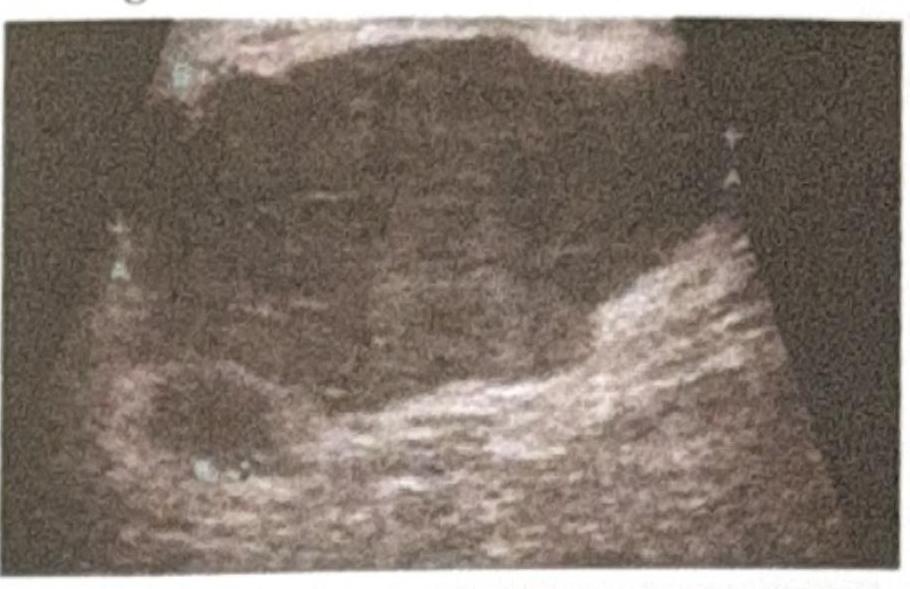
A patient presents to the OPD with a right-sided ulcerated breast lesion. Radiological imaging shows liver metastasis, as seen in the provided ultrasound image. What is the most appropriate management?
A patient presents with upper limb swelling after undergoing a modified radical mastectomy (MRM). What is the most likely cause?
Which of the following is not a relative contraindication for breast conservative surgery?
A 45-year-old woman with early-stage breast cancer is discussing treatment options with her surgeon. Which of the following statements regarding breast conservation surgery is NOT true?
Explanation: ***Lymphangiosarcoma*** - This is a rare, aggressive **vascular tumor** that can develop in chronically lymphedematous limbs, particularly after **mastectomy** for breast cancer. - The chronic lymphatic obstruction and inflammation are thought to be predisposing factors, leading to the condition known as **Stewart-Treves syndrome**. *Malignant Melanoma* - This cancer arises from **melanocytes** in the skin and is primarily associated with UV radiation exposure or existing nevi, not chronic lymphedema. - While it can occur anywhere on the body, there is no direct causal link between modified radical mastectomy and the development of melanoma in the arm. *Lymphoma* - Lymphoma is a cancer of the **lymphocytes** within the lymphatic system, typically presenting as swollen lymph nodes or B-symptoms. - Although lymphedema involves the lymphatic system, it generally predisposes to angiosarcoma rather than lymphoma in this specific clinical context. *Malignant fibrous histiocytoma* - This is a type of **soft tissue sarcoma** that can occur in various locations, but it is not specifically linked to chronic lymphedema following mastectomy. - While its etiology can be complex, it does not have the well-established association with chronic lymphedema that lymphangiosarcoma does.
Explanation: ***Intraductal papilloma*** - **Bloody nipple discharge**, especially unilateral and spontaneous, is the hallmark symptom of an **intraductal papilloma**. - The presence of a **subareolar cystic swelling** further supports this diagnosis, as papillomas are benign growths arising within the breast ducts. *Duct ectasia* - This condition typically presents with a **thick, sticky, multi-colored nipple discharge**, not usually bloody. - It is more common in **perimenopausal** or postmenopausal women and is often associated with inflammation and nipple retraction. *Fibrocystic disease* - Characterized by **cyclic breast pain**, tenderness, and multiple palpable masses, often bilateral. - Nipple discharge, if present, is usually **clear, green, or brown**, but rarely bloody. *Intraductal carcinoma* - While it can cause bloody nipple discharge, it is less common in this age group (30-year-old). - More likely to present with a **firm or hard palpable mass** rather than a cystic swelling, and often accompanied by skin changes or nipple retraction. - The benign cystic nature of the swelling makes intraductal papilloma more likely in this clinical scenario.
Explanation: ***Cancer breast*** - The **Nottingham Prognostic Index (NPI)** is a well-established tool used specifically for assessing the prognosis of **early invasive breast cancer**. - It combines three key pathological features: **tumor size**, **lymph node status**, and **histological grade**, to provide a prognostic score. *Cancer stomach* - Prognostic indices for gastric cancer typically involve factors like **tumor depth (T stage)**, **lymph node involvement (N stage)**, **metastasis (M stage)**, and **histological type**. - The NPI is not validated or used for gastric cancer. *Cancer colon* - Prognosis in colorectal cancer is primarily determined by the **Dukes' staging system** or the **TNM staging system**, which consider tumor invasion depth, lymph node spread, and distant metastasis. - The NPI is not applicable to colorectal cancer. *Cancer lung* - Lung cancer prognosis depends heavily on the **TNM staging system**, differentiating between **non-small cell lung cancer** and **small cell lung cancer**, and considering factors like tumor size, nodal involvement, and metastases. - There is no role for the NPI in assessing lung cancer prognosis.
Explanation: ***Correct: 1, 2 and 4*** **Statement 1 is correct:** The incidence of post-treatment lymphoedema has decreased primarily due to the shift from routine **axillary lymph node dissection (ALND)** to **sentinel lymph node biopsy (SLNB)**. The combined therapy of ALND and radiotherapy, historically a major risk factor, is now rarely used, significantly reducing lymphoedema incidence. **Statement 2 is correct:** The presence of **lymph node metastases** is a major precipitating factor as it necessitates more extensive surgery (ALND) and/or radiation therapy, increasing the risk of lymphatic damage and subsequent lymphoedema. **Statement 4 is correct:** The oedematous limb has impaired lymphatic drainage leading to reduced immune surveillance and skin changes, making it highly **susceptible to bacterial infections** like cellulitis and erysipelas. *Statement 3 is incorrect:* Lymphoedema itself is typically **not acutely painful** but may cause a feeling of heaviness, tightness, or discomfort. Pain usually indicates complications such as bacterial infection (cellulitis), not the lymphoedema itself. Therefore, statements 1, 2, and 4 are correct, making option **"1, 2 and 4"** the correct answer.
Explanation: **No further axillary surgery if planning whole breast radiation** - For patients with **T1/T2 breast cancer** and **1-2 positive sentinel lymph nodes** without extracapsular extension who are undergoing **breast-conserving surgery** with whole breast radiation, **completion axillary lymph node dissection (ALND)** is often omitted. - The **ACOSOG Z0011 trial** demonstrated that omitting ALND in these carefully selected patients does not compromise overall survival or locoregional control. *Completion axillary lymph node dissection* - This approach is generally reserved for patients with **more extensive axillary disease** (e.g., >2 positive sentinel nodes or evidence of extracapsular extension) or those not receiving whole breast radiation. - For the specific clinical scenario described, it would constitute overtreatment based on current evidence. *Repeat sentinel lymph node biopsy* - A repeat sentinel lymph node biopsy is generally **not indicated** after an initial positive sentinel lymph node biopsy, as it does not provide additional actionable information for treatment planning. - The initial biopsy successfully identified the positive nodes, guiding subsequent management decisions. *Radiation therapy to the axilla without further surgery* - While **axillary radiation** is a valid treatment option, it is typically considered as part of a comprehensive treatment plan, often in conjunction with surgery or as an alternative to ALND. - However, the standard approach based on Z0011 trial criteria would be whole breast radiation (which provides some axillary coverage) without completion ALND, rather than isolated axillary radiation.
Explanation: ***Bilateral mastectomy with immediate reconstruction and bilateral salpingo-oophorectomy*** - For a woman with a **BRCA1 mutation**, a strong family history of breast and ovarian cancer, and completed childbearing, **bilateral prophylactic mastectomy** significantly reduces the risk of breast cancer. - **Bilateral salpingo-oophorectomy (BSO)** is recommended to reduce the risk of **ovarian and fallopian tube cancer**, as well as a secondary reduction in breast cancer risk, especially after childbearing is complete. *Unilateral mastectomy with contralateral surveillance* - Unilateral mastectomy would only address one breast and leave the contralateral breast at a high risk for cancer development in a **BRCA1 carrier**. - **Surveillance alone** is less effective than prophylactic surgery in a high-risk individual and poses a higher cancer risk compared to bilateral prophylactic mastectomy. *Bilateral mastectomy only* - While bilateral mastectomy significantly reduces breast cancer risk, it does not address the high risk of **ovarian and fallopian tube cancer** associated with the BRCA1 mutation. - BRCA1 mutations confer a substantial lifetime risk of **ovarian cancer**, which is often aggressive and detected at an advanced stage. *Enhanced screening without prophylactic surgery* - This approach is generally insufficient for individuals with **BRCA1 mutations** due to the high lifetime cancer risks and the aggressive nature of BRCA-associated cancers. - While recommended in some cases, **enhanced screening** is not as effective as prophylactic surgery in preventing cancer and may lead to diagnostic delays.
Explanation: ***Neoadjuvant chemotherapy followed by surgery*** - The presence of **distant metastasis** (liver metastasis) indicates **Stage IV breast cancer**, where **systemic treatment is the primary goal**. - In Stage IV disease, **palliative systemic chemotherapy** is the mainstay of treatment to control distant disease and improve survival. - Surgery in metastatic breast cancer may be considered for **local control of symptomatic disease** (ulceration, bleeding, pain), typically after initiating systemic therapy. - The combination of systemic therapy followed by local surgery for the ulcerated lesion addresses both the metastatic disease and provides local symptom relief. *Simple mastectomy* - While this could provide local control of the ulcerated lesion, it does **not address the distant metastasis**. - In Stage IV disease, **systemic therapy must be prioritized** before considering any local surgical intervention. - Surgery alone without systemic treatment would be inadequate for metastatic disease. *Modified Radical Mastectomy (MRM)* - MRM involves removal of the entire breast tissue, skin, nipple-areolar complex, and level I and II axillary lymph nodes. - While this provides comprehensive local-regional control, it **does not address distant metastasis**. - In Stage IV disease, extensive locoregional surgery without systemic therapy first would be inappropriate, as the primary issue is systemic disease. *Radical mastectomy* - This extensive procedure involves removal of the breast, axillary lymph nodes, and pectoralis muscles. - It is **rarely performed today** due to significant morbidity and no survival benefit over less extensive procedures. - Like other surgical options alone, it fails to address the systemic nature of Stage IV disease.
Explanation: ***Upper limb Lymphedema*** - **Lymphedema** is a common complication after **modified radical mastectomy (MRM)** due to the removal of axillary lymph nodes and subsequent disruption of lymphatic drainage pathways. - This disruption leads to an accumulation of lymphatic fluid in the interstitial tissues, causing **swelling** in the ipsilateral upper limb. *Angiosarcoma* - **Angiosarcoma** (Stewart-Treves syndrome) is a very rare, aggressive tumor that can occur in the chronic lymphedematous limb after mastectomy. - It presents as multiple **violaceous nodules or plaques** in the affected limb, which is not described as the initial finding. *Recurrence* - **Recurrence** of breast cancer in the axilla or chest wall could cause swelling, but it would typically involve a palpable mass, skin changes, or pain, which are not mentioned as the primary symptom. - While recurrence can lead to lymphatic obstruction, **lymphedema** is a more direct and common post-operative complication. *Metastasis* - **Metastasis** to the axillary or supraclavicular lymph nodes could cause lymphatic obstruction and swelling. - However, lymphedema from direct surgical disruption of lymphatics is a more immediate and common cause of upper limb swelling following MRM, especially without other signs of widespread disease.
Explanation: ***Small tumor size (<3cm)*** ✓ - A small tumor size is **NOT a contraindication** for breast-conserving surgery; it is actually a **favorable condition** and an indication for breast conservation. - Small tumors allow for complete tumor removal with good cosmetic outcomes and adequate margins. - This is the **correct answer** as it is the only option that is NOT a relative contraindication. *Multicentric disease* - **Multicentric disease** refers to the presence of multiple tumor foci in **different quadrants** of the breast, making complete surgical removal challenging with breast-conserving surgery. - This is a **relative contraindication** as it increases the risk of **positive margins** and local recurrence, making mastectomy often a more appropriate option. *Previous radiation to breast* - Prior radiation therapy to the breast is a **contraindication** (often considered absolute) for subsequent breast radiation, which is an essential component of breast-conserving therapy. - Re-irradiation carries a high risk of severe **skin and tissue toxicity**, making further breast conservation unfeasible. *Large tumor size* - A large tumor size is a **relative contraindication** as it can make it difficult to achieve **clear surgical margins** while maintaining an acceptable cosmetic result. - However, **neoadjuvant chemotherapy** may downstage large tumors to make them suitable for breast-conserving surgery. - Without tumor reduction, it often requires **mastectomy**.
Explanation: ***Axillary dissection*** - **Axillary dissection is NOT a routine component of breast conservation surgery** for early-stage breast cancer. - In early-stage disease, **sentinel lymph node biopsy (SLNB)** has largely replaced routine axillary dissection as it provides accurate staging with significantly less morbidity. - Axillary dissection is only performed when there is **proven extensive lymph node involvement** or when SLNB shows metastatic disease requiring further assessment. - Therefore, this statement is **NOT true** regarding routine breast conservation surgery. *Wide local excision* - **Wide local excision (lumpectomy)** is the primary surgical component of breast conservation therapy. - It involves removing the cancerous tumor along with a margin of healthy breast tissue to achieve clear margins while preserving the breast. *Sentinel lymph node biopsy* - **SLNB** is a standard procedure performed with breast conservation surgery to assess for regional lymph node metastasis. - It identifies and removes the first few lymph nodes draining the tumor, allowing accurate staging with minimal morbidity. *Post-operative radiotherapy* - **Post-operative radiotherapy** to the preserved breast is a critical and essential component of breast conservation therapy. - It significantly reduces the risk of local recurrence by treating any microscopic tumor cells that may remain after surgery.
Breast Anatomy and Physiology
Practice Questions
Benign Breast Diseases
Practice Questions
Breast Cancer Screening
Practice Questions
Breast Cancer: Diagnosis and Staging
Practice Questions
Surgical Management of Breast Cancer
Practice Questions
Oncoplastic Breast Surgery
Practice Questions
Sentinel Lymph Node Biopsy
Practice Questions
Axillary Surgery
Practice Questions
Breast Reconstruction Techniques
Practice Questions
Male Breast Disorders
Practice Questions
Phyllodes Tumors
Practice Questions
Management of Ductal Carcinoma In Situ
Practice Questions
Get full access to all questions, explanations, and performance tracking.
Start For Free