Which of the following pathologic findings is the strongest contraindication to breast preservation (lumpectomy with breast radiation) as primary treatment for a newly diagnosed breast cancer?
Which of the following statements regarding Paget's disease of the breast is true, except?
Unilateral breast involvement with scaly skin around the nipple and intermittent bleeding is suggestive of:
Which of the following statements is FALSE regarding breast cancer during pregnancy?
A patient presents with carcinoma in the upper outer quadrant of the breast. Which of the following lymph node groups is LEAST likely to be a site of metastasis?
Fibrocystic disease of the breast has been associated with elevated blood levels of which hormone?
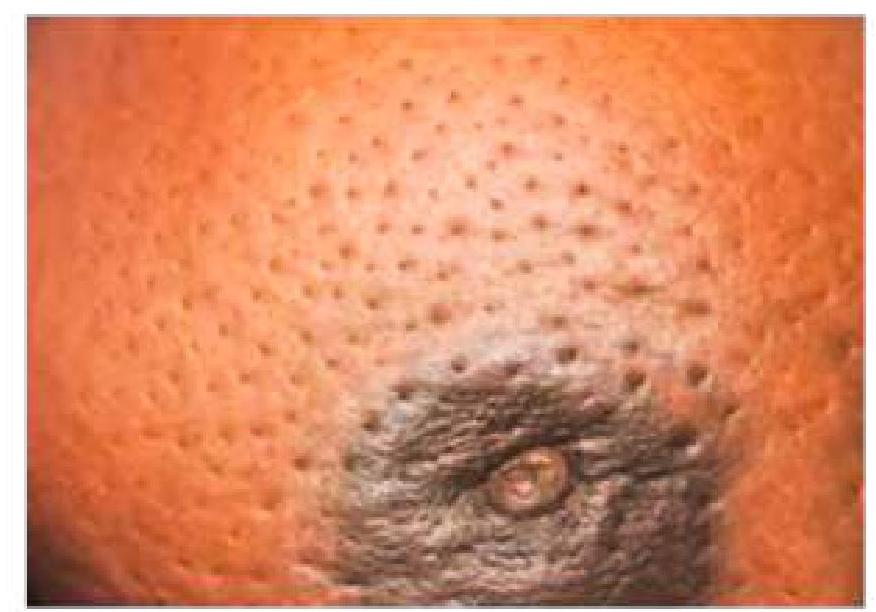
A 45-year-old lady presents with a lump in her right breast. The lump is 4 cm in diameter with evidence of cutaneous edema (peau d'orange), not fixed to the pectoralis major muscle. The axillary lymph nodes are not enlarged. What is the status of T in the TNM classification?
What is the most common site of metastasis for breast carcinoma?
BRCA-1 positive women have what percentage increased risk of breast carcinoma?
Phyllodes tumor most commonly presents in which decade of life?
Explanation: **Explanation:** Breast Conservation Therapy (BCT), consisting of lumpectomy followed by whole-breast irradiation, is the standard of care for early-stage breast cancer. The primary goal of BCT is to achieve oncological safety (equivalent to mastectomy) while preserving the breast. **Why Option D is Correct:** A **positive surgical margin** (ink on tumor) is the strongest contraindication to proceeding with breast preservation. It indicates that the tumor has not been completely excised, leading to an unacceptably high risk of local recurrence. If clear margins cannot be achieved after reasonable re-excision attempts, a total mastectomy becomes mandatory. **Why Other Options are Incorrect:** * **Option A (Grade 3 Tumor):** High-grade tumors are more aggressive but are not a contraindication to BCT. They simply necessitate adjuvant chemotherapy. * **Option B (Extensive Intraductal Component - EIC):** While EIC is associated with a higher risk of local recurrence if margins are narrow, it is not an absolute contraindication as long as negative margins are achieved. * **Option C (Tumor < 3 cm):** Small tumor size is actually an **indication** for BCT. The tumor-to-breast size ratio is the key factor; a 3 cm tumor in a large breast is ideal for lumpectomy. **High-Yield Clinical Pearls for NEET-PG:** * **Absolute Contraindications to BCT:** 1. Prior radiation to the breast or chest wall. 2. Pregnancy (Radiation is teratogenic; however, BCT can be done in the 3rd trimester if radiation is delayed until after delivery). 3. Diffuse suspicious microcalcifications on mammography. 4. Widespread multicentric disease (cancer in different quadrants). 5. Persistently positive pathological margins. * **Relative Contraindications:** Active connective tissue diseases (e.g., Scleroderma, SLE) due to poor tolerance of radiation. * **Margin Status:** For invasive cancer, the consensus is "no ink on tumor" (0 mm margin). For DCIS, a 2 mm margin is generally preferred.
Explanation: **Explanation:** Paget’s disease of the breast is a rare manifestation of breast cancer characterized by the infiltration of the epidermis by malignant cells (Paget cells). The question asks for the "false" statement, but since all options (A, B, and C) are clinically accurate, the correct answer is **"None of the above."** **1. Why the options are correct:** * **Option B (Represents underlying malignancy):** This is a hallmark of the disease. In over 95% of cases, Paget’s disease is associated with an underlying **Ductal Carcinoma In Situ (DCIS)** or invasive carcinoma. The Paget cells migrate from the underlying lactiferous ducts to the nipple skin. * **Option C (Presents as eczema):** The classic clinical presentation is a chronic, crusting, scaling, or eroding lesion of the nipple-areola complex that mimics **eczema**. A key differentiating factor is that Paget’s typically involves the **nipple first** and may spread to the areola, whereas cutaneous eczema usually involves the areola and spares the nipple. * **Option A (Treated by simple mastectomy):** While Breast Conserving Surgery (BCS) followed by radiotherapy is an option for localized disease, **Simple Mastectomy** (with or without axillary evaluation) remains a standard and definitive surgical treatment, especially when the underlying malignancy is multicentric. **High-Yield Clinical Pearls for NEET-PG:** * **Pathology:** Paget cells are large, pale cells with granular cytoplasm and pleomorphic nuclei. They are **PAS positive** (diastase resistant) and stain positive for **Her2/neu** and **CK7**. * **Diagnosis:** The gold standard for diagnosis is a **full-thickness punch biopsy** of the nipple-areola complex. * **Prognosis:** The prognosis depends entirely on the stage and characteristics of the underlying breast cancer, not the skin changes themselves.
Explanation: **Explanation:** The clinical presentation of unilateral, scaly, or eczematous lesions of the nipple-areola complex, especially when associated with intermittent bleeding or ulceration, is a classic hallmark of **Paget’s disease of the breast**. **1. Why Paget’s Disease is Correct:** Paget’s disease is an intraepidermal manifestation of an underlying breast malignancy (usually Ductal Carcinoma In Situ or invasive ductal carcinoma). Malignant "Paget cells" migrate from the lactiferous ducts into the epidermis of the nipple. Key diagnostic features include: * **Unilateral involvement** (unlike constitutional eczema). * **Destruction of the nipple-areola complex** (starts at the nipple and spreads to the areola). * **Palpable mass** present in approximately 50% of cases. **2. Why Other Options are Incorrect:** * **Eczema:** Typically **bilateral**, involves the areola first (sparing the nipple), and presents with intense pruritus without destruction of the nipple architecture. It responds to topical steroids, whereas Paget’s does not. * **Galactocoele:** A milk-containing cyst occurring in lactating women. It presents as a painless, fluctuant mass rather than a surface skin lesion. * **Sebaceous Cysts:** These are common cutaneous lumps that may occur on the breast skin but do not cause diffuse scaling or bleeding of the nipple-areola complex. **Clinical Pearls for NEET-PG:** * **Pathology:** Look for **Paget cells** (large, PAS-positive, pale-staining cells with prominent nucleoli) on skin biopsy. * **Management:** Mammography is mandatory to locate the underlying malignancy. * **Rule of Thumb:** Any "eczema" of the nipple that does not heal with topical treatment within 2–3 weeks must be biopsied to rule out Paget’s disease.
Explanation: **Explanation:** Breast cancer during pregnancy (BCP) is defined as cancer diagnosed during pregnancy or within one year of delivery. It presents unique diagnostic and therapeutic challenges. **Why Option B is the Correct Answer (The False Statement):** While it is a common misconception that mammography is ineffective, it actually maintains a **high sensitivity (70-90%)** during pregnancy. Although increased breast density and water content can slightly obscure findings, mammography remains a safe and valuable tool when used with fetal shielding. Therefore, stating it has "reduced sensitivity" to the point of being the primary false characteristic is clinically incorrect compared to the other established facts. **Analysis of Other Options:** * **Option A:** True. Most women with BCP present with advanced stages. Axillary lymph node involvement is found in approximately **75%** of cases, largely due to delays in diagnosis caused by physiological breast changes. * **Option C:** True. Radiation therapy is **contraindicated** during pregnancy due to the high risk of fetal malformations, childhood hematological malignancies, and intellectual disability, especially in the first and second trimesters. * **Option D:** True. The majority of breast lumps discovered during pregnancy are benign (e.g., fibroadenomas, galactoceles, or abscesses). **Less than 25%** of biopsied nodules turn out to be malignant. **NEET-PG High-Yield Pearls:** * **Investigation of Choice:** Ultrasound is the initial imaging modality of choice. * **Surgery:** Modified Radical Mastectomy (MRM) is preferred if the patient is in the 1st trimester (to avoid radiation). Breast Conserving Surgery (BCS) can be considered in the 3rd trimester, delaying radiation until postpartum. * **Chemotherapy:** Contraindicated in the 1st trimester (teratogenic); can be safely administered in the 2nd and 3rd trimesters. * **Termination:** Therapeutic abortion does not improve the maternal prognosis or survival rates.
Explanation: **Explanation:** The lymphatic drainage of the breast is highly directional and follows specific anatomical pathways. Approximately **75% of the lymph** from the breast drains into the **axillary lymph nodes**, while the remaining 25% (primarily from the medial quadrants) drains into the internal mammary (parasternal) nodes. **Why Parasternal nodes is the correct answer:** The **upper outer quadrant (UOQ)** is the most common site for breast cancer. Lymph from this quadrant drains almost exclusively into the axillary system, starting with the anterior (pectoral) group. **Parasternal nodes** primarily receive drainage from the **medial quadrants** (inner half) of the breast. While they can be involved in UOQ tumors, they are the *least likely* site compared to the primary axillary groups. **Analysis of Incorrect Options:** * **A. Anterior (Pectoral) nodes:** These are the primary "sentinel" stations for the majority of the breast, especially the UOQ. They are usually the first to be involved. * **B. Central nodes:** These receive lymph from the anterior, posterior, and lateral groups. They are a common secondary site of metastasis as lymph moves toward the apex of the axilla. * **C. Lateral (Brachial) nodes:** These are part of the Level I axillary nodes. While they primarily drain the upper limb, they are anatomically situated within the axillary pathway and are more frequently involved in lateral breast cancers than the distant parasternal chain. **High-Yield Clinical Pearls for NEET-PG:** * **Berg’s Levels of Axillary Nodes:** Defined by their relation to the **Pectoralis Minor** muscle (Level I: Lateral; Level II: Posterior/Deep; Level III: Medial/Apical). * **Sorgius Node:** The largest node of the anterior group, often the first palpable node in breast cancer. * **Rotter’s Nodes:** Interpectoral nodes located between the Pectoralis Major and Minor muscles. * **Most common site of Breast Cancer:** Upper Outer Quadrant (due to the maximum volume of glandular tissue, the "Axillary Tail of Spence").
Explanation: ### Explanation **Correct Answer: C. Estrogen** **Medical Concept:** Fibrocystic disease (also known as Fibrocystic Change or ANDI—Aberrations of Normal Development and Involution) is the most common benign condition of the breast. The primary pathophysiology involves an **imbalance between estrogen and progesterone**, specifically characterized by **hyperestrogenism** (elevated estrogen) and a relative deficiency of progesterone. Estrogen promotes the proliferation of mammary ducts and connective tissue, leading to the formation of cysts, fibrosis, and adenosis. This is why symptoms typically fluctuate with the menstrual cycle and regress after menopause when estrogen levels decline. **Analysis of Incorrect Options:** * **A. Testosterone:** Androgens generally have an inhibitory effect on breast tissue proliferation. Elevated testosterone is more commonly associated with conditions like PCOS, not fibrocystic breast disease. * **B. Progesterone:** While progesterone is involved in the luteal phase, fibrocystic disease is associated with a **deficiency** or lack of progesterone to counteract the proliferative effects of estrogen, rather than elevated levels. * **D. Luteinizing Hormone (LH):** LH primarily triggers ovulation and the formation of the corpus luteum. While it influences the menstrual cycle, it does not have a direct stimulatory effect on breast parenchyma compared to the peripheral effects of estrogen. **High-Yield Clinical Pearls for NEET-PG:** * **Presentation:** Typically presents as "lumpy" breasts with cyclical mastalgia (pain) that worsens during the premenstrual phase. * **Most Common Site:** Upper outer quadrant. * **Aspiration:** If a cyst is aspirated, the fluid is often "straw-colored" or greenish-blue (**Blue-domed cysts of Bloodgood**). * **Risk of Malignancy:** Most changes are non-proliferative and carry no increased risk of cancer. However, **atypical ductal or lobular hyperplasia** increases the risk of breast cancer by 4–5 times. * **Management:** Reassurance, caffeine restriction, and in severe cases, Danazol or Evening Primrose Oil.
Explanation: **Explanation:** The correct answer is **D (T4)**. In the TNM staging of breast cancer, the "T" (Tumor) category is determined by size until certain clinical features are present. Once a tumor exhibits direct extension to the chest wall or specific skin changes, it is automatically classified as **T4**, regardless of its objective size. **Why T4 is correct:** The presence of **Peau d'orange** (cutaneous edema) is a hallmark clinical sign of inflammatory changes or lymphatic obstruction by the tumor. According to the AJCC staging system: * **T4b** includes tumors with edema (including peau d'orange), ulceration of the skin, or satellite skin nodules. * Since the patient has peau d'orange, the 4 cm size becomes irrelevant for staging; the skin involvement mandates a T4 classification. **Why other options are incorrect:** * **T1, T2, and T3** are based strictly on the maximum diameter of the tumor (≤2 cm, 2–5 cm, and >5 cm respectively) **only if** there is no involvement of the chest wall or skin. * While this tumor is 4 cm (which would typically be T2), the skin involvement "upstages" it to T4. **NEET-PG High-Yield Pearls:** 1. **T4a:** Extension to the chest wall (ribs, intercostals, serratus anterior; pectoralis muscle involvement alone does *not* constitute T4). 2. **T4b:** Edema (peau d'orange), ulceration, or satellite skin nodules. 3. **T4c:** Both 4a and 4b. 4. **T4d:** Inflammatory carcinoma (characterized by diffuse erythema and edema). 5. **Peau d'orange** occurs due to the obstruction of superficial lymphatics by tumor cells, leading to skin thickening around tethered hair follicles.
Explanation: **Explanation:** Breast carcinoma is known for its predilection for hematogenous spread to the skeletal system. Bone is the most common site of distant metastasis, occurring in approximately 70% of patients with advanced disease. **Why Lumbar Vertebra is Correct:** The primary route for spinal metastasis in breast cancer is the **Batson’s venous plexus** (a valveless vertebral venous system). This plexus connects the deep pelvic veins and thoracic veins directly to the internal vertebral venous plexus without passing through the lungs or the portal system. Due to the effects of gravity and intra-abdominal pressure, the **Lumbar vertebrae** are the most frequently involved segment of the spine, followed by the thoracic vertebrae. **Analysis of Incorrect Options:** * **Thoracic vertebra (A):** While the thoracic spine is the second most common site of spinal metastasis, it is statistically less frequent than the lumbar region. * **Pelvis (B):** The pelvis is a common site for bony metastasis, but it ranks lower in frequency compared to the axial skeleton (spine). * **Femur (C):** The femur is the most common site for metastasis in the **appendicular skeleton**, but overall, it is less common than spinal involvement. **High-Yield Clinical Pearls for NEET-PG:** * **Most common site of distant metastasis:** Bone (specifically the Lumbar spine). * **Most common organ for metastasis:** Lungs (followed by Liver). * **Nature of lesions:** Breast cancer bone metastases are typically **osteolytic**, though they can be osteoblastic (especially in certain subtypes). * **Batson’s Plexus:** This is the key anatomical structure explaining why breast, prostate, and thyroid cancers frequently metastasize to the spine while bypassing the caval system.
Explanation: **Explanation:** The correct answer is **60% (Option D)**. BRCA1 and BRCA2 are tumor suppressor genes involved in DNA repair via homologous recombination. Mutations in these genes significantly elevate the lifetime risk of developing breast and ovarian cancers compared to the general population (whose lifetime risk is approximately 12%). * **BRCA1:** Carries a lifetime breast cancer risk of approximately **60% to 80%**. It is also associated with a 40% risk of ovarian cancer and a higher prevalence of "Triple Negative" (ER/PR/HER2 negative) breast cancers. * **BRCA2:** Carries a slightly lower lifetime breast cancer risk of approximately **45% to 55%** and an ovarian cancer risk of about 20%. It is more commonly associated with male breast cancer. **Analysis of Incorrect Options:** * **Options A & B (10-20%):** These percentages are too low. While 10% of all breast cancers are hereditary, the individual risk for a mutation carrier is much higher. * **Option C (40%):** This is closer to the risk associated with BRCA2 or the ovarian cancer risk for BRCA1, but underestimates the penetrance for breast carcinoma in BRCA1 carriers. **High-Yield Clinical Pearls for NEET-PG:** 1. **Surveillance:** For BRCA-positive women, annual screening with **Contrast-Enhanced MRI** (starting at age 25) and Mammography (starting at age 30) is recommended. 2. **Prophylaxis:** Bilateral Salpingo-oophorectomy (BSO) reduces the risk of ovarian cancer by 90% and breast cancer by 50% if performed pre-menopausally. 3. **Molecular Subtype:** BRCA1 is most frequently associated with **Medullary Carcinoma** and Basal-like (Triple Negative) subtypes. 4. **Treatment:** **PARP inhibitors** (e.g., Olaparib) are specifically effective in BRCA-mutated cancers due to "synthetic lethality."
Explanation: **Explanation:** **Phyllodes Tumor (Cystosarcoma Phyllodes)** is a rare fibroepithelial breast tumor. The correct answer is the **sixth decade (50s)** because, unlike fibroadenomas which occur in younger women, Phyllodes tumors typically present in an older age group. The peak incidence is between **45 and 55 years**. * **Why Option D is Correct:** Large-scale clinical studies and standard textbooks (like Bailey & Love) indicate that the median age of presentation is approximately 45–50 years. While it can occur at any age, the "sixth decade" represents the peak statistical frequency. * **Why Options A, B, and C are Incorrect:** * **Second and Third Decades (10s–20s):** This is the classic age group for **Fibroadenomas**. While "Juvenile Phyllodes" exists, it is extremely rare. * **Fourth Decade (30s):** This is a transitional period where benign breast diseases are common, but the incidence of Phyllodes is still lower than in the perimenopausal period. **High-Yield Clinical Pearls for NEET-PG:** 1. **Origin:** It arises from the **periductal stromal cells**, not the ducts themselves. 2. **Clinical Feature:** Presents as a large, painless, mobile mass with **stretched, shiny skin** and prominent superficial veins. It shows rapid growth. 3. **Pathology:** Characterized by a **"leaf-like"** appearance on histology (Phyllon = leaf). 4. **Classification:** Can be Benign, Borderline, or Malignant based on stromal cellularity, atypia, and mitotic index. 5. **Management:** Wide local excision with a **1 cm margin** is the gold standard. Lymphadenectomy is not routine as it spreads via the hematogenous route (like a sarcoma), not lymphatics.
Breast Anatomy and Physiology
Practice Questions
Benign Breast Diseases
Practice Questions
Breast Cancer Screening
Practice Questions
Breast Cancer: Diagnosis and Staging
Practice Questions
Surgical Management of Breast Cancer
Practice Questions
Oncoplastic Breast Surgery
Practice Questions
Sentinel Lymph Node Biopsy
Practice Questions
Axillary Surgery
Practice Questions
Breast Reconstruction Techniques
Practice Questions
Male Breast Disorders
Practice Questions
Phyllodes Tumors
Practice Questions
Management of Ductal Carcinoma In Situ
Practice Questions
Get full access to all questions, explanations, and performance tracking.
Start For Free