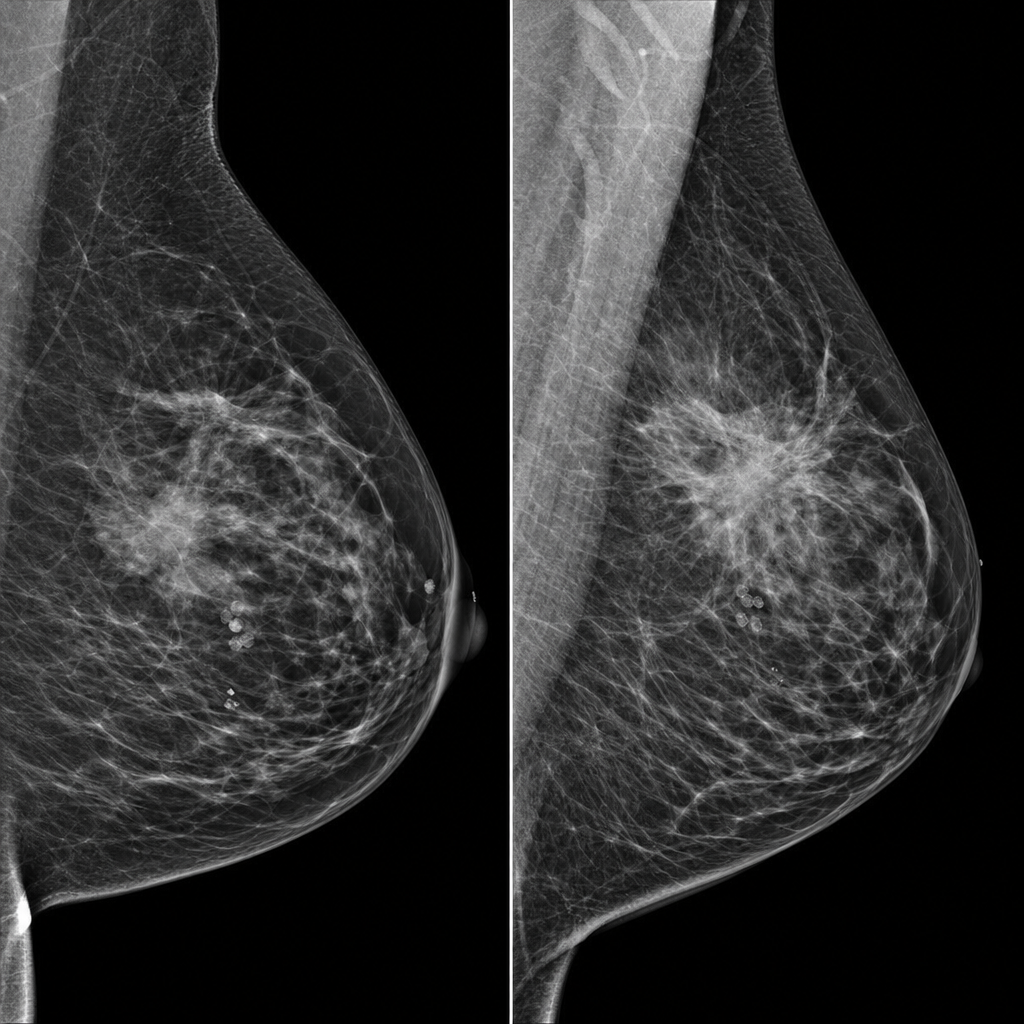
Which of the following groups of lymph nodes are involved in breast carcinoma?
Which of the following is LEAST related to breast cancer in females?
For which one of the following conditions is breast conservation surgery indicated in breast cancer?
What is the most common presentation of lobular carcinoma?
Triple assessment of the breast includes all the following except?
A 45-year-old female presents with a painless breast lump measuring 6.2x4.5 cm. A Trucut biopsy confirmed carcinoma of the breast. Surgical removal was performed, and the post-operative biopsy revealed carcinoma of the breast with high-grade necrosis and margins of 4 mm. Which of the following is indicated?
Which of the following are established risk factors for carcinoma of the breast?
What is true about Paget's disease of the nipple?
What is the most common type of cancer found in the male breast?
As per AJCC breast cancer staging, what does T4 signify?
Explanation: The lymphatic drainage of the breast is a high-yield topic in surgery, as it dictates the staging and surgical management of breast carcinoma. ### **Explanation of the Correct Answer** The question asks which group of lymph nodes is **not** typically involved in the primary lymphatic drainage of the breast. The **Pretracheal lymph nodes (Option B)** are located in the neck, anterior to the trachea, and primarily drain the thyroid gland, trachea, and larynx. They are not part of the standard lymphatic pathways for the breast. ### **Analysis of Incorrect Options** * **Axillary Lymph Nodes (Option C):** These are the primary site of drainage, receiving approximately **75%** of the lymph from the breast (primarily from the lateral quadrants). * **Internal Mammary Nodes (Option D):** These receive about **20-25%** of the drainage, primarily from the medial quadrants of the breast. * **Supraclavicular Nodes (Option A):** These are considered Level IV nodes in some classifications and represent a progression of disease from the axillary or internal mammary chains. In the TNM staging system, involvement of ipsilateral supraclavicular nodes is classified as **N3 disease**. ### **NEET-PG High-Yield Pearls** * **Sentinel Lymph Node (SLN):** The first node(s) to receive drainage from the tumor site. Biopsy of the SLN is the gold standard for axillary staging in clinically node-negative (cN0) patients. * **Rotter’s Nodes:** These are interpectoral nodes located between the pectoralis major and minor muscles. * **Berg’s Levels of Axillary Nodes:** * **Level I:** Lateral to pectoralis minor. * **Level II:** Behind pectoralis minor (includes Rotter’s nodes). * **Level III:** Medial to pectoralis minor (apical nodes). * **Most common site of distant metastasis:** Bone (specifically the lumbar spine via Batson’s plexus).
Explanation: **Explanation:** The question asks for the condition **least** related to breast cancer. While all four options are associated with an increased risk of breast cancer, **Ataxia-telangiectasia (AT)** represents the lowest relative risk among the choices provided in a clinical and examination context. 1. **Why Ataxia-telangiectasia (Option D) is the correct answer:** AT is an autosomal recessive disorder caused by mutations in the **ATM gene**. While female carriers (heterozygotes) have a 2-to-3-fold increased risk of breast cancer compared to the general population, this risk is significantly lower than that associated with BRCA mutations or Li-Fraumeni syndrome. In the hierarchy of "high-penetrance" breast cancer genes, ATM is considered a **moderate-penetrance** gene. 2. **Analysis of Incorrect Options:** * **BRCA-1 (Option A):** A high-penetrance tumor suppressor gene. Lifetime risk of breast cancer is approximately **65-80%**. It is also strongly linked to ovarian cancer. * **BRCA-2 (Option B):** Similar to BRCA-1, it carries a high lifetime risk (**45-85%**). It is the most significant gene associated with **male breast cancer**. * **Li-Fraumeni Syndrome (Option C):** Caused by a germline mutation in the **TP53 gene**. It carries an extremely high risk of early-onset breast cancer (often before age 30), along with sarcomas, leukemia, and adrenocortical tumors. **NEET-PG High-Yield Pearls:** * **Most common gene** mutated in hereditary breast cancer: **BRCA-1**. * **Cowden Syndrome:** Mutation in **PTEN** gene; associated with breast cancer, thyroid cancer, and hamartomas. * **Peutz-Jeghers Syndrome:** Mutation in **STK11**; carries an increased risk of breast and GI cancers. * **Screening:** For BRCA carriers, annual MRI starting at age 25 and annual mammography starting at age 30 is recommended.
Explanation: **Explanation:** Breast Conservation Surgery (BCS), which includes lumpectomy and axillary staging followed by radiotherapy, is the preferred treatment for **Early Breast Cancer (EBC)** where the goal is to achieve oncological safety while maintaining cosmesis. **Why T1 is the correct answer:** * **T1 tumors (≤ 2 cm)** are ideal candidates for BCS because the tumor-to-breast size ratio allows for the excision of the tumor with a clear margin (1-2 mm) without causing significant cosmetic deformity. * The primary requirement for BCS is the ability to achieve **negative surgical margins** and the patient's eligibility for postoperative **radiotherapy**, which is mandatory after BCS to reduce local recurrence. **Why the other options are incorrect:** * **B. Multicentric tumor:** This refers to multiple tumors in different quadrants of the breast. It is an **absolute contraindication** for BCS because it is impossible to remove all foci through a single incision with good cosmesis, and it carries a high risk of local recurrence. * **C. Extensive in situ cancer:** Extensive Ductal Carcinoma in Situ (DCIS) makes it difficult to achieve clear margins. If the microcalcifications are widespread, a mastectomy is required. * **D. T4b breast tumor:** T4 tumors (involving skin or chest wall) represent **Locally Advanced Breast Cancer (LABC)**. These patients require Neoadjuvant Chemotherapy (NACT) first. While some may downstage to become candidates for BCS, T4b is generally an indication for Modified Radical Mastectomy (MRM). **NEET-PG High-Yield Pearls:** * **Absolute Contraindications to BCS:** Pregnancy (first/second trimester due to radiation risk), Multicentricity, Prior radiation to the breast/chest wall, and Persistent positive margins after re-excision. * **Relative Contraindications:** Collagen vascular diseases (e.g., Scleroderma), Large tumor in a small breast. * **Standard of Care:** BCS + Radiotherapy has an equivalent long-term survival rate compared to Mastectomy for early-stage breast cancer.
Explanation: **Explanation:** Invasive Lobular Carcinoma (ILC) is the second most common type of breast cancer after Invasive Ductal Carcinoma (IDC). Despite its unique growth pattern, the **most common clinical presentation remains a palpable breast mass.** **Why "Breast Mass" is correct:** ILC is characterized by a "single-file" pattern of cell infiltration due to the loss of E-cadherin. Because it does not typically form a dense, circumscribed tumor, it often presents as a **vague thickening** or an ill-defined induration rather than a discrete, hard lump. However, in clinical practice and for examination purposes, this is categorized as a breast mass. **Analysis of Incorrect Options:** * **Nipple discharge:** This is more commonly associated with intraductal pathologies like ductal papilloma or ductal carcinoma in situ (DCIS), rather than lobular lesions. * **Mammographic calcification:** This is a classic feature of DCIS. ILC is notorious for being "mammographically silent" because it lacks a central mass effect and rarely produces microcalcifications, making it harder to detect on screening. * **Nipple retraction:** While this can occur if the tumor involves the subareolar area or causes significant desmoplasia, it is a late sign and not the primary presentation. **High-Yield Clinical Pearls for NEET-PG:** * **Molecular Hallmark:** Loss of **E-cadherin** expression (CDH1 gene mutation). * **Multicentricity & Bilaterality:** ILC has a much higher incidence of being bilateral and multicentric compared to IDC. * **Metastatic Pattern:** Unlike IDC, ILC tends to spread to unusual sites such as the **peritoneum, GI tract, and ovaries.** * **Imaging:** MRI is more sensitive than mammography for determining the true extent of ILC.
Explanation: **Explanation:** The **Triple Assessment** is the gold standard protocol for the evaluation of any palpable breast lump. It is designed to achieve a diagnostic accuracy of over 99%. The three components are: 1. **Clinical Assessment (Option A):** This involves a detailed clinical history and a thorough physical examination (inspection and palpation) of both breasts and the axillary lymph nodes. 2. **Imaging (Option B):** The choice of imaging depends on the patient's age. * **Ultrasonography (USG):** Preferred in women **<35 years** (due to dense breast tissue). * **Mammography:** Preferred in women **>35 years**. 3. **Pathology/Histology (Option C):** This involves obtaining a tissue sample for microscopic examination. * **Fine Needle Aspiration Cytology (FNAC):** Provides cytological details. * **Core Needle Biopsy (CNB):** Provides histological architecture (preferred as it can distinguish between invasive and in-situ carcinoma and allows for ER/PR/HER2 testing). **Laboratory investigations (Option D)**, such as Complete Blood Count (CBC) or Liver Function Tests (LFT), are not part of the initial triple assessment used to diagnose a breast lump. While they may be used later for preoperative workup or metastatic screening, they do not contribute to the primary diagnosis of the lesion itself. **High-Yield Clinical Pearls for NEET-PG:** * **Accuracy:** If all three components of the triple assessment suggest malignancy, the positive predictive value is **>99.9%**. * **Discordance:** If there is a "discordant" result (e.g., imaging suggests cancer but biopsy is benign), an **Excisional Biopsy** is mandatory. * **Modified Triple Assessment:** Includes Clinical Exam, Imaging, and **Core Needle Biopsy** (replacing FNAC in modern practice).
Explanation: ### **Explanation** The management of breast cancer post-surgery depends on the risk of local recurrence and systemic spread. In this case, the patient requires **Adjuvant Chemoradiotherapy** due to several high-risk features. **1. Why Adjuvant Chemoradiotherapy is Correct:** * **Tumor Size (T3):** The lump measures 6.2 cm. According to TNM staging, any tumor >5 cm is classified as **T3**. Large tumors have a high risk of systemic micrometastasis and local recurrence, necessitating both chemotherapy and radiotherapy. * **High-Grade Necrosis:** This is a marker of aggressive tumor biology and rapid cell turnover, which correlates with a higher risk of recurrence. * **Adjuvant Chemotherapy:** Indicated for tumors >1 cm (especially T3/T4) or node-positive disease to address systemic risk. * **Adjuvant Radiotherapy:** Indicated for tumors >5 cm (T3), involvement of margins, or ≥4 positive lymph nodes to ensure local control. **2. Why Other Options are Incorrect:** * **Option A (Chemotherapy only):** While necessary, it does not address the high risk of local recurrence associated with a 6.2 cm tumor. * **Option B (Radiotherapy only):** Radiotherapy provides local control but fails to address the systemic risk posed by a T3 lesion and high-grade features. * **Option D (No treatment):** This is incorrect as the patient has high-risk features (Size >5 cm, high grade) that mandate adjuvant therapy to improve survival. **3. NEET-PG High-Yield Pearls:** * **TNM Staging:** T1 (≤2 cm), T2 (2–5 cm), **T3 (>5 cm)**, T4 (Chest wall/skin involvement). * **Indications for Post-Mastectomy Radiotherapy (PMRT):** Tumor >5 cm, positive margins, or ≥4 positive axillary nodes. * **Margins:** In Breast Conserving Surgery (BCS), a margin of "no ink on tumor" is generally acceptable for invasive cancer, but high-grade features often prompt more aggressive adjuvant protocols. * **Standard Sequence:** Usually, chemotherapy is administered first, followed by radiotherapy.
Explanation: **Explanation** The risk of breast cancer is heavily influenced by cumulative lifetime exposure to estrogen. Factors that increase the number of menstrual cycles (early menarche, late menopause, and nulliparity) increase this risk. * **Nulliparity:** Women who have never carried a pregnancy to term have higher cumulative estrogen exposure compared to those who have. Pregnancy induces terminal differentiation of breast epithelium, which is protective. * **BRCA1 Mutation:** This is a high-penetrance germline mutation in a tumor suppressor gene. Carriers have a 60-80% lifetime risk of developing breast cancer. * **Family History:** A first-degree relative with breast cancer significantly increases risk, especially if the relative was diagnosed at a young age or had bilateral disease. * **Multiparity:** This is actually a **protective factor**. Multiple pregnancies and prolonged breastfeeding reduce the total number of ovulatory cycles and estrogen exposure, thereby lowering the risk. **Analysis of Options:** * **Option C is correct** because it accurately identifies Nulliparity, BRCA1, and Family History as risks, while correctly excluding Multiparity. * **Options A, B, and D are incorrect** because they either misidentify Multiparity as a risk factor or incorrectly label established risks like Family History or Nulliparity as false. **High-Yield Clinical Pearls for NEET-PG:** * **Most common site:** Upper Outer Quadrant (due to the maximum amount of glandular tissue). * **Gail Model:** The most commonly used tool for assessing individual breast cancer risk. * **Protective Factors:** Multiparity, early pregnancy (<20 years), breastfeeding, and physical activity. * **Li-Fraumeni Syndrome:** Associated with p53 mutations; breast cancer is a core component.
Explanation: ### Explanation: Paget’s Disease of the Nipple Paget’s disease of the nipple is a rare manifestation of breast cancer characterized by an eczematous-like lesion of the nipple-areola complex. **1. Why Option A is Correct:** Paget’s disease is virtually always associated with an **underlying breast carcinoma**. In approximately 90-100% of cases, there is either an underlying **Infiltrating Ductal Carcinoma (IDC)** or **Ductal Carcinoma in Situ (DCIS)**. The disease occurs when malignant cells (Paget cells) migrate from the underlying lactiferous ducts into the epidermis of the nipple. **2. Why Other Options are Incorrect:** * **Option B:** Eczema of the nipple is typically **bilateral** and involves the areola first, often seen in younger, lactating women. In contrast, Paget’s disease is almost always **unilateral** and starts at the nipple. * **Option C:** Histology reveals **Paget cells**, which are large, pale, ovoid cells with prominent nucleoli and abundant granular cytoplasm. They are PAS-positive (diastase resistant). Giant cells are characteristic of granulomatous conditions, not Paget’s. * **Option D:** While it indicates an underlying malignancy, the prognosis of Paget’s disease itself depends entirely on the stage and nature of the underlying tumor, rather than being "highly malignant" in its own right. **Clinical Pearls for NEET-PG:** * **Clinical Presentation:** Persistent, unilateral, itchy, or crusting lesion of the nipple that does not respond to topical steroids. * **Key Diagnostic Feature:** Unlike simple eczema, Paget’s disease **destroys the nipple**. * **Diagnosis:** Confirmed by a **punch biopsy** or wedge biopsy of the nipple. * **Management:** Treatment follows the protocol for the underlying breast cancer (usually Modified Radical Mastectomy or Breast Conserving Surgery with radiotherapy).
Explanation: **Explanation:** **1. Why Infiltrating Ductal Carcinoma (IDC) is correct:** Infiltrating Ductal Carcinoma (IDC) is the most common histological subtype of male breast cancer, accounting for approximately **85-90% of cases**. This is because the male breast primarily consists of rudimentary ductal elements without well-developed lobules. Since cancer arises from these pre-existing structures, ductal morphology is the predominant finding. **2. Why the other options are incorrect:** * **Lobular carcinoma in situ (LCIS) / Invasive Lobular Carcinoma:** These are extremely rare in males (less than 1-2%). The male breast lacks **acini and lobules** under normal physiological conditions. Lobular carcinoma usually only occurs in males if there is significant hormonal stimulation leading to lobular development (e.g., severe gynecomastia or estrogen therapy). * **Ductal carcinoma in situ (DCIS):** While DCIS does occur in males, it is far less common than the invasive (infiltrating) form at the time of diagnosis. Most male breast cancers present at a later stage as a palpable mass, by which time they have already become invasive. **3. High-Yield Clinical Pearls for NEET-PG:** * **Risk Factors:** The most significant risk factor is **BRCA2 mutation** (more common than BRCA1 in males) and **Klinefelter Syndrome (47, XXY)**. * **Presentation:** Usually presents as a painless, firm subareolar mass. Eccentric masses are more likely to be gynecomastia. * **Staging & Treatment:** Staging is the same as in females. The standard surgical treatment is **Modified Radical Mastectomy (MRM)** because the small size of the male breast makes breast-conserving surgery difficult. * **Prognosis:** Often worse than in females, primarily due to delayed diagnosis and early involvement of the skin and chest wall.
Explanation: **Explanation:** The AJCC (American Joint Committee on Cancer) TNM staging system for breast cancer is a critical high-yield topic for NEET-PG. The **T (Tumor)** category is primarily based on the maximum dimension of the tumor, but **T4** is a unique category defined by **extension** rather than size. **1. Why Option B is Correct:** T4 signifies a tumor of any size that has directly invaded the surrounding structures. It is subdivided into: * **T4a:** Extension to the **chest wall** (ribs, intercostal muscles, or serratus anterior; pectoralis muscle involvement alone does *not* constitute T4). * **T4b:** Edema (including **peau d'orange**), **ulceration** of the skin, or satellite skin nodules confined to the same breast. * **T4c:** Both T4a and T4b. * **T4d:** **Inflammatory carcinoma** (a clinical diagnosis). **2. Why Other Options are Incorrect:** * **Option A:** Distant metastasis is classified as **M1** (Stage IV). * **Option C:** Spread to contralateral axillary lymph nodes is considered **M1** (Distant Metastasis), not T-stage or N-stage. (Note: Ipsilateral axillary nodes are N1-N2). * **Option D:** Sentinel lymph node involvement relates to the **N (Node)** category (specifically N1mi or N1 depending on the size of the deposit). **Clinical Pearls for NEET-PG:** * **T1:** ≤ 2 cm; **T2:** > 2 cm to 5 cm; **T3:** > 5 cm. * **Pectoralis major involvement** does NOT make it T4; it must reach the ribs or deeper muscles. * **Peau d'orange** (T4b) is caused by dermal lymphatic obstruction, giving the skin an orange-peel appearance. * Any T4 tumor (except some T4b) is automatically at least **Stage IIIB**.
Breast Anatomy and Physiology
Practice Questions
Benign Breast Diseases
Practice Questions
Breast Cancer Screening
Practice Questions
Breast Cancer: Diagnosis and Staging
Practice Questions
Surgical Management of Breast Cancer
Practice Questions
Oncoplastic Breast Surgery
Practice Questions
Sentinel Lymph Node Biopsy
Practice Questions
Axillary Surgery
Practice Questions
Breast Reconstruction Techniques
Practice Questions
Male Breast Disorders
Practice Questions
Phyllodes Tumors
Practice Questions
Management of Ductal Carcinoma In Situ
Practice Questions
Get full access to all questions, explanations, and performance tracking.
Start For Free