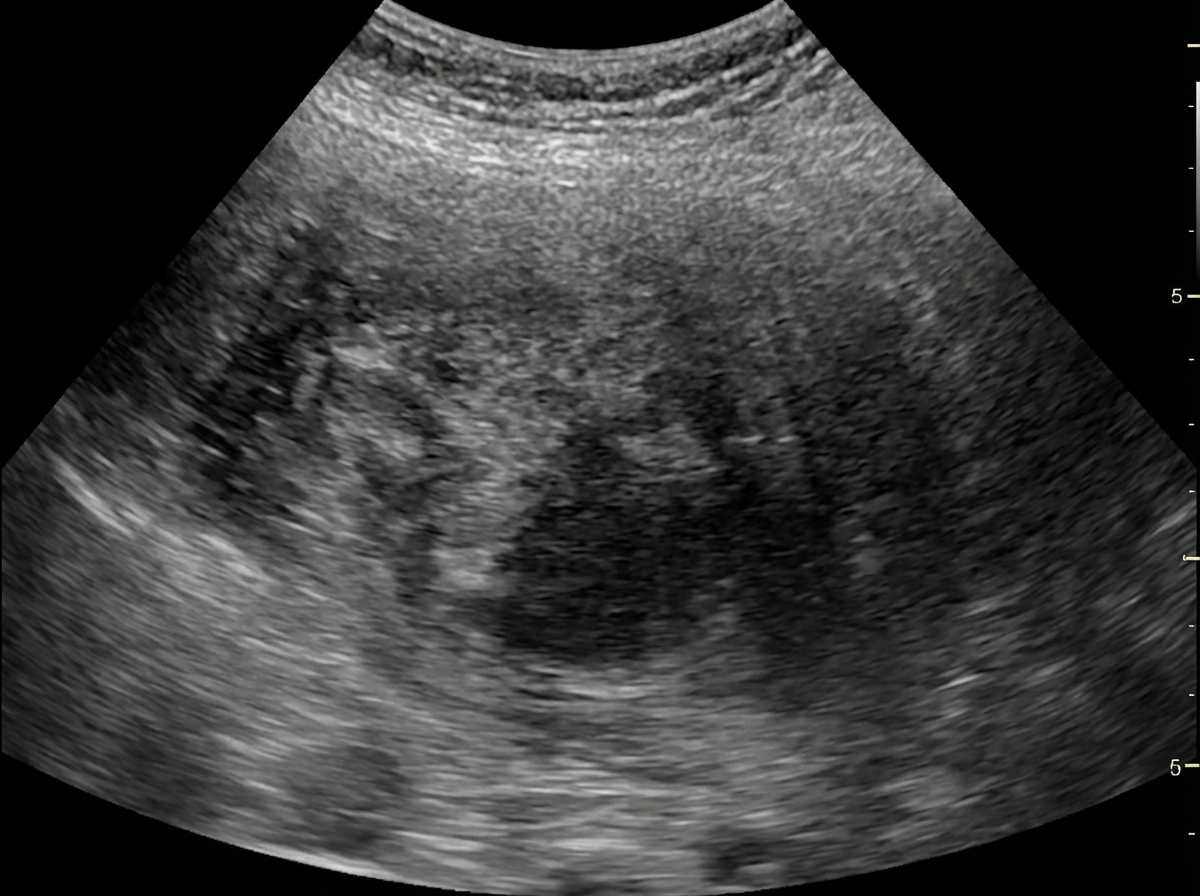
Which of the following is a characteristic first-trimester ultrasound finding suggestive of Down syndrome?
Pseudo-flow Doppler signal (continuous flow) in the hepatic vein in the setting of Budd-Chiari syndrome indicates what?
TI-RADS is a reporting system for thyroid nodules. It is based on the following properties, except:
What is the best imaging modality to differentiate between medical and surgical jaundice?
What is the main distinctive sign on ultrasound for corpus callosum degeneration?
What are the true features of cholecystitis on ultrasonography?
Which of the following organs/cavities is typically NOT scanned using FAST (Focused Assessment with Sonography for Trauma) ultrasound?
A solitary hypoechoic lesion of the liver without septa or debris is most likely to be what?
What is the investigation of choice for testicular swelling?
Fetal cardiac activity can be detected by vaginal ultrasound by how many weeks after LMP?
Explanation: **Explanation:** **Nuchal Translucency (NT)** is the correct answer because it is the most sensitive and specific first-trimester (11 to 13+6 weeks) ultrasound marker for Down syndrome (Trisomy 21). It refers to the physiological subcutaneous collection of fluid behind the fetal neck. An increased NT measurement (typically >3.0 mm or >95th percentile for crown-rump length) is associated with chromosomal aneuploidies, most notably Down syndrome, as well as congenital heart defects. **Analysis of Incorrect Options:** * **A. Nuchal thickening:** While similar in name, this refers to the **Nuchal Fold** thickness. This is a **second-trimester** marker (measured between 18–22 weeks). A measurement of ≥6 mm is a "soft marker" for Down syndrome but is not a first-trimester finding. * **C & D. Cardiac and Gastrointestinal anomalies:** While these (e.g., Atrioventricular Septal Defects or Duodenal Atresia) are strongly associated with Down syndrome, they are structural malformations typically diagnosed during the **second-trimester** anomaly scan (Level II scan). They are not primary screening markers in the first trimester. **High-Yield Clinical Pearls for NEET-PG:** * **Combined Screening:** The most effective first-trimester screening for Down syndrome includes NT measurement + PAPP-A (decreased) + β-hCG (increased). * **Nasal Bone:** The absence of the fetal nasal bone in the first trimester is another highly specific marker for Down syndrome. * **Timing:** NT must be measured when the Crown-Rump Length (CRL) is between **45 mm and 84 mm**. * **Ductus Venosus:** Reversal of 'a' wave in the ductus venosus flow is an additional first-trimester marker for aneuploidy.
Explanation: **Explanation:** **1. Why Option A is Correct:** In a normal physiological state, the hepatic vein (HV) waveform is **triphasic**, reflecting pressure changes in the right atrium. In **Budd-Chiari Syndrome (BCS)**, there is an obstruction to the hepatic venous outflow (at the level of the HVs or the suprahepatic IVC). When an obstruction occurs, the normal transmitted atrial pulsations are lost. The Doppler signal becomes **monophasic** or shows a **"pseudo-flow" (continuous flow)** pattern. This occurs because the pressure gradient between the liver and the heart is dampened by the physical block or by the development of small, high-resistance collateral vessels that bypass the obstruction. **2. Why Other Options are Incorrect:** * **Option B:** While a congenital web in the IVC is a *cause* of Budd-Chiari Syndrome, the question asks what the "pseudo-flow" signal *indicates* pathophysiologically. The signal itself represents the hemodynamic consequence of the obstruction, regardless of whether the cause is a web, a thrombus, or a tumor. * **Option C:** Portal vein thrombosis affects the inflow to the liver. It would typically show an absent or reversed flow in the portal vein, but it does not primarily cause the loss of phasicity in the hepatic veins. * **Option D:** Renal vein thrombosis is unrelated to hepatic venous outflow and would present with symptoms like hematuria or flank pain, with Doppler changes isolated to the renal vasculature. **3. High-Yield Clinical Pearls for NEET-PG:** * **Normal HV Waveform:** Triphasic (two large antegrade waves toward the heart, one small retrograde wave). * **BCS Triad:** Abdominal pain, ascites, and hepatomegaly. * **USG Hallmark of BCS:** Non-visualization of HVs, presence of intrahepatic collaterals (comma-shaped vessels), and caudate lobe hypertrophy (as its venous drainage into the IVC is often spared). * **Most sensitive test:** Hepatic Venography (Gold Standard).
Explanation: **Explanation:** The **ACR TI-RADS (Thyroid Imaging Reporting and Data System)** is a standardized scoring system used to assess the risk of malignancy in thyroid nodules and determine the need for Fine Needle Aspiration (FNA). **Why Vascularity is the correct answer:** Unlike the BI-RADS system for breast imaging, the ACR TI-RADS **does not include vascularity** (Doppler findings) in its scoring criteria. While internal vascularity was historically considered a risk factor, large-scale studies have shown it is not a reliable independent predictor of thyroid cancer. Therefore, it is excluded from the point-based calculation. **Analysis of other options (The 5 TI-RADS Categories):** The ACR TI-RADS scores nodules based on five specific ultrasound features: 1. **Composition:** (e.g., cystic, spongiform, or solid). 2. **Echogenicity (Option B):** (e.g., hyperechoic, isoechoic, or highly hypoechoic). 3. **Shape (Option D):** Specifically looking for a **"Taller-than-wide"** orientation (highly suspicious). 4. **Margin (Option A):** (e.g., smooth, ill-defined, lobulated, or extrathyroidal extension). 5. **Echogenic Foci:** (e.g., punctate echogenic foci/microcalcifications). **High-Yield Clinical Pearls for NEET-PG:** * **Most Suspicious Feature:** A "Taller-than-wide" shape and "Punctate echogenic foci" (microcalcifications) carry the highest points (3 points each). * **Highly Hypoechoic:** This is a strong indicator of malignancy compared to simple hypoechogenicity. * **Management:** Points from all five categories are summed to categorize the nodule from TR1 (Benign) to TR5 (Highly Suspicious), which then dictates the size threshold for FNA. * **Note:** If a question mentions **EU-TIRADS** or **K-TIRADS**, vascularity is also generally excluded, making this a consistent high-yield fact across different systems.
Explanation: **Explanation:** The primary objective in evaluating a jaundiced patient is to distinguish between **Medical Jaundice** (Hepatocellular/Intrahepatic) and **Surgical Jaundice** (Obstructive/Extrahepatic). **Why Ultrasound is the Correct Answer:** Ultrasound (USG) is the **initial and best screening modality** because of its high sensitivity in detecting **biliary ductal dilatation**. * **Surgical Jaundice:** Characterized by dilated intrahepatic biliary radicles (IHBRD) or a dilated common bile duct (CBD) due to mechanical obstruction (e.g., gallstones, malignancy). * **Medical Jaundice:** Characterized by non-dilated ducts, as the pathology lies at the cellular level (e.g., hepatitis, cirrhosis). USG is non-invasive, cost-effective, and lacks ionizing radiation, making it the gold standard for the first-line anatomical assessment of the biliary tree. **Analysis of Incorrect Options:** * **Options A, B, and C:** These represent biochemical markers. While Alkaline Phosphatase (ALP) and Bilirubin levels help confirm the *presence* of cholestasis, they cannot definitively differentiate between intrahepatic cholestasis (medical) and extrahepatic obstruction (surgical) as reliably as imaging. They provide functional data, whereas USG provides the necessary anatomical data to guide surgical intervention. **High-Yield Clinical Pearls for NEET-PG:** * **First Investigation:** Ultrasound. * **Gold Standard for CBD Stones:** MRCP (Non-invasive) or ERCP (Invasive/Therapeutic). * **Double Duct Sign:** Dilatation of both the CBD and Pancreatic duct on imaging; highly suggestive of Periampullary Carcinoma or Carcinoma Head of Pancreas. * **Shotgun Sign:** On USG, the parallel appearance of a dilated bile duct next to the portal vein (also called the "Double Barrel" sign).
Explanation: ### Explanation **Correct Answer: A. Tear drop sign** The **Tear drop sign** is the classic sonographic hallmark of **Agenesis of the Corpus Callosum (ACC)**. When the corpus callosum is absent, the lateral ventricles are displaced laterally and develop a characteristic shape: the anterior horns are narrow and pointed, while the posterior horns (occipital horns) are disproportionately dilated. This posterior dilatation is known as **colpocephaly**, which gives the ventricles a "tear drop" appearance on axial or coronal ultrasound scans. Additionally, the third ventricle is often displaced superiorly between the lateral ventricles. **Analysis of Incorrect Options:** * **B. Lemon sign:** Refers to the inward scalloping of the frontal bones seen on fetal ultrasound. it is a classic sign of **Spina Bifida** (specifically myelomeningocele) and Chiari II malformation. * **C. Banana sign:** Refers to the flattening and anterior curvature of the cerebellum, which obliterates the cisterna magna. Like the lemon sign, it is highly suggestive of **Chiari II malformation**. * **D. Ring sign:** In radiology, this can refer to several conditions (e.g., a "tubal ring" in ectopic pregnancy or "ring-enhancing lesions" in the brain), but it is not a feature of corpus callosum pathology. **High-Yield Clinical Pearls for NEET-PG:** * **Viking Helmet Sign:** On coronal ultrasound/MRI, the widely spaced and everted frontal horns in ACC resemble a Viking helmet. * **Bundles of Probst:** These are longitudinal white matter tracts that run parallel to the interhemispheric fissure in patients with ACC; they represent axons that failed to cross the midline. * **Sunburst Appearance:** On sagittal imaging, the gyri and sulci radiate outward from the roof of the third ventricle due to the absence of the cingulate gyrus.
Explanation: **Explanation:** Acute cholecystitis is a common surgical emergency, and ultrasonography (USG) is the initial imaging modality of choice due to its high sensitivity and specificity. The diagnosis is based on a combination of morphological changes in the gallbladder (GB) wall and the presence of obstructing calculi. **Analysis of Options:** * **Thickened GB Wall:** A wall thickness of **>3 mm** is a hallmark of cholecystitis. In chronic cases, this wall may become **fibrosed** and irregular. In acute phases, the thickening is often due to edema. * **Stone impacted at the neck:** Approximately 90-95% of cholecystitis cases are "calculous." A stone firmly lodged in the GB neck or cystic duct leads to luminal distension and inflammation. * **Perigallbladder halo:** This represents subserosal edema or localized fluid collection around the gallbladder, often seen as a hypoechoic (dark) rim. It is a specific sign of significant inflammation. Since all three features are classic sonographic markers of the disease, **Option D** is correct. **High-Yield Clinical Pearls for NEET-PG:** 1. **Sonographic Murphy’s Sign:** This is the most specific sign (92% specificity). It is positive when maximal tenderness is elicited by pressing the USG probe directly over the visualized gallbladder. 2. **Distended GB:** A transverse diameter **>4 cm** is considered abnormal. 3. **Emphysematous Cholecystitis:** Look for "dirty shadowing" or "ring-down artifacts" caused by gas within the GB wall/lumen (common in diabetics). 4. **Gangrenous Cholecystitis:** Suggested by asymmetric wall thickening and intraluminal membranes.
Explanation: **Explanation:** The **FAST (Focused Assessment with Sonography for Trauma)** exam is a rapid bedside ultrasound protocol used in the emergency department to identify **free intraperitoneal or intrathoracic fluid (blood)** in hemodynamically unstable trauma patients. **Why Option B is correct:** The traditional FAST exam focuses on four specific areas to detect hemoperitoneum and hemopericardium. While the **eFAST (Extended FAST)** includes the pleural cavity to look for pneumothorax and hemothorax, the **standard FAST** protocol is limited to the subxiphoid, RUQ, LUQ, and pelvic views. Therefore, in the context of a standard FAST exam, the pleural cavity is technically the "odd one out" compared to the abdominal and pericardial assessments. **Analysis of Incorrect Options:** * **A. Pericardium:** Scanned via the **Subxiphoid (Subcostal) view** to rule out cardiac tamponade. * **C. Spleen:** Assessed via the **Left Upper Quadrant (LUQ) view** (perisplenic space/splenorenal recess) to detect perisplenic fluid. * **D. Liver:** Assessed via the **Right Upper Quadrant (RUQ) view** (Morison’s Pouch/hepatorenal recess), which is the most sensitive area for detecting free intraperitoneal fluid. **High-Yield Clinical Pearls for NEET-PG:** * **Standard FAST Views (4):** 1. Subxiphoid (Pericardium), 2. RUQ (Morison’s Pouch), 3. LUQ (Splenorenal), 4. Suprapubic (Pouch of Douglas/Retrovesical). * **eFAST:** Adds bilateral thoracic views to detect **Pneumothorax** (loss of lung sliding/barcode sign) and **Hemothorax**. * **Sensitivity:** FAST is excellent for free fluid but **poor at identifying solid organ injuries** (lacerations) or retroperitoneal bleeds. * **Gold Standard:** In hemodynamically **stable** patients with blunt trauma, **Contrast-Enhanced CT (CECT)** remains the gold standard.
Explanation: **Explanation:** The correct answer is **Simple Cyst (Option D)**. In ultrasonography, a simple hepatic cyst typically presents as a **well-circumscribed, solitary, anechoic (hypoechoic) lesion** with smooth, thin walls. A defining feature of a simple cyst is the absence of internal echoes, septations, or debris, accompanied by **posterior acoustic enhancement**, which occurs because sound waves travel through fluid with minimal attenuation. **Why other options are incorrect:** * **Hydatid Cyst (Option A):** These usually exhibit a more complex internal architecture, such as "daughter cysts" (honeycomb appearance), floating membranes (water-lily sign), or a thick, calcified wall. * **Caroli’s Disease (Option B):** This is characterized by multifocal, segmental dilatation of the intrahepatic bile ducts. On USG, it presents as saccular structures communicating with the biliary tree, often showing the "central dot sign" (portal vein branch surrounded by dilated bile duct). * **Liver Abscess (Option C):** Abscesses are typically "dirty" cysts. They contain internal echoes, debris, or gas bubbles (hyperechoic foci) and often have thick, irregular, or shaggy walls due to inflammation and necrosis. **NEET-PG High-Yield Pearls:** * **Simple Cyst:** Most common benign liver lesion; anechoic + posterior enhancement + no septa. * **Amoebic Liver Abscess:** Classically described as having "anchovy sauce" pus; USG shows a round/oval lesion with low-level internal echoes. * **Hemangioma:** The most common benign solid tumor of the liver; typically appears as a **hyperechoic**, well-defined mass. * **Posterior Acoustic Enhancement:** A key sign that a lesion is fluid-filled (cystic) rather than solid.
Explanation: **Explanation:** **Ultrasonography (USG)**, specifically high-frequency scrotal ultrasound with **Color Doppler**, is the gold standard and initial investigation of choice for any testicular swelling. Its high sensitivity (nearly 100%) allows for the differentiation between intra-testicular and extra-testicular lesions, which is the most critical step in diagnosis. Intra-testicular masses are highly suspicious for malignancy, whereas extra-testicular masses are usually benign (e.g., hydrocele, epididymal cyst). **Why other options are incorrect:** * **FNAC:** It is generally **contraindicated** in suspected testicular tumors due to the risk of **scrotal seeding** (disrupting the lymphatic drainage and spreading cancer cells to the inguinal lymph nodes). Diagnosis is confirmed via orchidectomy. * **CECT:** While CECT of the abdomen and pelvis is the investigation of choice for **staging** a diagnosed testicular germ cell tumor (to check for retroperitoneal lymphadenopathy), it is not the primary tool for evaluating the swelling itself. * **MRI:** Though highly accurate, it is expensive and not readily available. It is reserved as a problem-solving tool when USG findings are inconclusive. **High-Yield Clinical Pearls for NEET-PG:** * **Testicular Torsion:** USG with Color Doppler shows **absent or decreased blood flow** (Investigation of choice). * **Epididymo-orchitis:** USG shows an enlarged, hypoechoic testis with **increased vascularity** (Hyperemia). * **Tumor Marker Triad:** For testicular tumors, always correlate USG findings with **AFP, beta-hCG, and LDH**. * **Microlithiasis:** Seen as multiple "starry sky" punctate calcifications on USG; it is a known risk factor for malignancy.
Explanation: **Explanation:** The detection of fetal cardiac activity is a critical milestone in early pregnancy ultrasound. Using **Transvaginal Sonography (TVS)**, fetal cardiac activity is typically visible when the embryo reaches a Crown-Rump Length (CRL) of 2–5 mm, which corresponds to approximately **6 weeks of gestation** (calculated from the Last Menstrual Period). * **Why 6 weeks is correct:** By the end of the 5th week and the beginning of the 6th week, the primitive heart tube begins to beat. TVS, due to its higher frequency and proximity to the pelvic organs, can detect these pulsations as early as 5.5 to 6 weeks. * **Why 4 weeks is incorrect:** At 4 weeks, only the decidual reaction or a tiny gestational sac may be visible. The embryo has not yet developed a detectable heart. * **Why 5 weeks is incorrect:** At 5 weeks, the gestational sac and yolk sac are usually visible, but the fetal pole (embryo) and its heartbeat are often still too small to be resolved, even by TVS. * **Why 8 weeks is incorrect:** While cardiac activity is clearly visible at 8 weeks, it is detectable much earlier. 8 weeks is closer to the timeline for **Transabdominal Sonography (TAS)**, which generally lags behind TVS by about 1 week. **High-Yield Clinical Pearls for NEET-PG:** * **TVS vs. TAS:** Cardiac activity is seen at **6 weeks by TVS** and **7 weeks by TAS**. * **Discriminatory CRL:** If the CRL is **>7 mm** and no cardiac activity is detected, it is diagnostic of a non-viable pregnancy (missed abortion). * **First Sign of Pregnancy:** The first sonographic sign is the **Gestational Sac** (at ~4.5–5 weeks). * **First Sign of Intrauterine Pregnancy:** The **Yolk Sac** (at ~5–5.5 weeks) confirms an intrauterine location.
Physics of Ultrasound
Practice Questions
Instrumentation and Techniques
Practice Questions
Abdominal Ultrasonography
Practice Questions
Pelvic Ultrasonography
Practice Questions
Obstetric Ultrasonography
Practice Questions
Small Parts Ultrasonography
Practice Questions
Musculoskeletal Ultrasonography
Practice Questions
Vascular Ultrasonography
Practice Questions
Pediatric Ultrasonography
Practice Questions
Contrast-Enhanced Ultrasound
Practice Questions
Ultrasound-Guided Interventions
Practice Questions
Doppler Ultrasound Principles and Applications
Practice Questions
Get full access to all questions, explanations, and performance tracking.
Start For Free