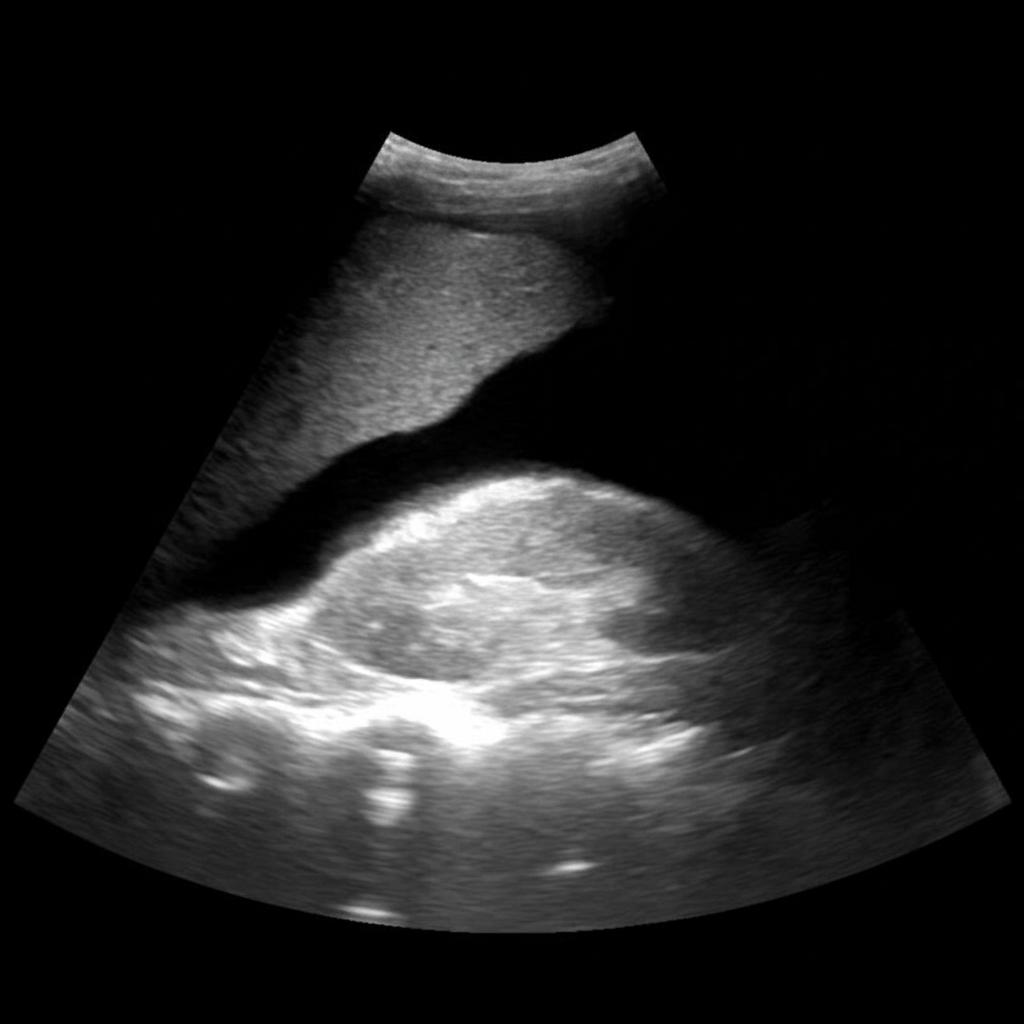
The "lambda sign" or "twin peak sign" is seen in which type of twin pregnancy?
Snow storm appearance on USG is seen in which of the following conditions?
In the suppurative phase, a pyogenic liver abscess will appear as what on ultrasound?
What condition is characterized by the 'banana sign' on ultrasound?
What is the characteristic of USG velocity?
What is the most important investigation for pericardial effusion?
Which of the following imaging modalities utilizes the piezoelectric effect?
Which of the following is NOT an ultrasound finding suspicious of malignancy in the thyroid?
Posterior acoustic enhancement is seen with which of the following?
The finding of a single umbilical artery on ultrasound is:
Explanation: ### Explanation The **Lambda sign** (also known as the **Twin Peak sign**) is a crucial sonographic marker used to determine chorionicity in twin pregnancies, typically between 10 and 14 weeks of gestation. **1. Why Dichorionic Diamniotic (DCDA) is correct:** In a DCDA pregnancy, each fetus has its own placenta and gestational sac. Where the two placentas meet, the intervening membrane is thick because it consists of four layers (two layers of chorion and two layers of amnion). This results in a **triangular projection of placental tissue** extending into the base of the inter-twin membrane, resembling the Greek letter lambda (λ). This sign confirms that there are two separate placentas (even if they appear fused). **2. Why the other options are incorrect:** * **Diamniotic Monochorionic (MCDA):** These twins share a single placenta. The inter-twin membrane is thin (only two layers of amnion) and joins the placenta abruptly without any intervening placental tissue. This creates a **"T-sign"** rather than a lambda sign. * **Monoamniotic Monochorionic (MCMA):** These twins share both a placenta and an amniotic sac. There is no inter-twin membrane at all; therefore, neither the lambda nor the T-sign is present. ### High-Yield Clinical Pearls for NEET-PG: * **Timing:** Chorionicity is most accurately determined in the **first trimester** (10–14 weeks). As the pregnancy progresses, the lambda sign may disappear (the "vanishing lambda sign"), making early scans vital. * **Membrane Thickness:** A membrane thickness of **>2 mm** usually indicates DCDA, while **<2 mm** suggests MCDA. * **Significance:** Determining chorionicity is the most important step in managing twin pregnancies, as monochorionic twins are at high risk for **Twin-to-Twin Transfusion Syndrome (TTTS)**.
Explanation: **Explanation:** The **"Snowstorm appearance"** is a classic radiological hallmark of a **Hydatidiform Mole** (specifically a Complete Mole). This appearance is caused by the presence of multiple hydropic (fluid-filled) chorionic villi. On ultrasound, these vesicles appear as numerous small, echo-free (anechoic) cystic spaces interspersed with echogenic areas, mimicking the look of falling snow. In a complete mole, there is no identifiable fetal tissue or amniotic sac. **Analysis of Options:** * **A. Hydatidiform mole (Correct):** As described, the proliferation of trophoblastic tissue and villous edema creates the characteristic speckled, multicystic pattern. * **B. Ectopic pregnancy:** The most common USG finding is an adnexal mass (e.g., "Tubal ring sign") or a "Pseudosac" in the uterus. It does not produce a snowstorm pattern. * **C. Anencephaly:** This is a neural tube defect characterized by the absence of the cranial vault. The classic USG sign is the **"Frog-eye appearance"** or "Mickey Mouse sign" due to prominent orbits and lack of frontal bone. **High-Yield Clinical Pearls for NEET-PG:** * **Theca Lutein Cysts:** Often seen bilaterally in the ovaries due to excessively high hCG levels associated with molar pregnancies. * **Serum hCG:** Levels are disproportionately high for the gestational age. * **Partial Mole:** Unlike a complete mole, a partial mole may show a thickened placenta with some cystic spaces and identifiable fetal parts (triploidy). * **Management:** Suction and evacuation is the treatment of choice. Follow-up with serial hCG monitoring is crucial to rule out Gestational Trophoblastic Neoplasia (GTN).
Explanation: **Explanation:** The sonographic appearance of a pyogenic liver abscess is dynamic and depends entirely on its stage of evolution. **Why Hyperechoic is Correct:** During the **early/suppurative phase** (also known as the formative or phlegmonous stage), the abscess consists of an inflammatory cell infiltrate, localized edema, and tissue congestion without a well-defined liquid center. This solid, heterogeneous inflammatory mass creates numerous acoustic interfaces, which reflect the ultrasound beam, resulting in a **hyperechoic** (bright) appearance. At this stage, it may mimic a solid tumor. **Why Other Options are Incorrect:** * **Hypoechoic/Cystic:** These appearances occur in the **liquefactive phase**. As the abscess matures, central necrosis and liquefaction occur, leading to a fluid-filled cavity that appears hypoechoic or anechoic (cystic) with posterior acoustic enhancement. * **Isoechoic:** While possible in very early stages, it is rarely the classic description for the suppurative phase and is difficult to distinguish from normal liver parenchyma. **High-Yield NEET-PG Pearls:** * **Most Common Cause:** In adults, the most common source is biliary tract disease (e.g., ascending cholangitis). * **Microbiology:** *E. coli* is the most common aerobic organism; *Klebsiella* is increasingly common in diabetics. * **Gas Formation:** If gas-forming organisms are present, you may see highly echogenic foci with **"dirty" shadowing** or the **"ring-down" artifact**. * **Amoebic vs. Pyogenic:** Amoebic abscesses are typically solitary, located in the right lobe, and usually present as well-defined hypoechoic masses (rarely hyperechoic).
Explanation: ### Explanation The **'Banana sign'** is a classic sonographic marker of the fetal head, typically seen in the second trimester. It is highly associated with **Arnold-Chiari Type II malformation**, which is almost always seen in conjunction with **open spina bifida** (myelomeningocele). **1. Why Arnold-Chiari Malformation is correct:** In Arnold-Chiari II, there is a downward displacement of the hindbrain through the foramen magnum. This caudal traction pulls the **cerebellum** downward and wraps it tightly around the brainstem. On a transverse ultrasound view of the fetal head, the cerebellum loses its normal "dumbbell" shape and appears curved and elongated, resembling a **banana**. This is often accompanied by the **'Lemon sign'** (scalloping of the frontal bones). **2. Why the other options are incorrect:** * **Holoprosencephaly:** Characterized by the failure of the forebrain to divide into two hemispheres. Key USG findings include a single primitive ventricle ("monoventricle") and fused thalami. * **Dandy-Walker Malformation:** Characterized by agenesis or hypoplasia of the cerebellar vermis and cystic dilatation of the fourth ventricle. The cerebellum is small/separated, not banana-shaped. * **Anencephaly:** A neural tube defect characterized by the complete absence of the cranial vault and cerebral hemispheres (the "frog-eye" appearance). **3. NEET-PG High-Yield Pearls:** * **Banana Sign:** Indicates Arnold-Chiari II (Cerebellum). * **Lemon Sign:** Indicates Arnold-Chiari II (Frontal bones); note that the lemon sign may disappear in the third trimester, while the banana sign persists. * **Key Association:** If you see a banana sign, always scan the fetal spine to look for **Spina Bifida**. * **Ventriculomegaly:** Often co-exists due to the obstruction of CSF flow.
Explanation: **Explanation:** The velocity (speed) of ultrasound is determined solely by the **physical properties of the medium** through which it travels—specifically its density and stiffness (bulk modulus). 1. **Why Option D is Correct:** Sound travels faster through rigid, stiff materials and slower through compressible ones. **Fat** is highly compressible and less dense than muscle or bone, resulting in a lower propagation speed (approx. **1450 m/s**). Similarly, water has a lower velocity than most solid soft tissues. For reference, the average speed of sound in soft tissue is standardized at **1540 m/s**. 2. **Why Other Options are Incorrect:** * **Option A:** Velocity is independent of frequency. If frequency increases, the wavelength must decrease to keep the velocity constant ($V = f \times \lambda$). * **Options B & C:** Velocity is a product of frequency and wavelength ($V = f \lambda$). It is not "equal" to either parameter individually; they are inversely proportional to each other for a given medium. **High-Yield Clinical Pearls for NEET-PG:** * **Speed in different media (Increasing order):** Air (330 m/s) < Fat (1450 m/s) < **Soft Tissue (1540 m/s)** < Muscle (1580 m/s) < Bone (3500–4000 m/s). * **Acoustic Impedance (Z):** Defined as Density $\times$ Velocity ($Z = \rho V$). Large differences in impedance at tissue interfaces (e.g., Tissue-Air) cause total reflection, which is why USG gel is required. * **Frequency vs. Resolution:** Higher frequency = Better resolution but lower penetration. Lower frequency = Better penetration but lower resolution.
Explanation: ### Explanation **Echocardiography (Option C)** is the gold standard and the most important investigation for pericardial effusion. It is highly sensitive, non-invasive, and can detect as little as 15–20 mL of fluid. Beyond simple detection, it allows for the assessment of hemodynamic significance (e.g., cardiac tamponade) by visualizing right ventricular collapse during diastole or right atrial collapse during systole. **Why other options are incorrect:** * **Ultrasound (Option B):** While echocardiography is technically a specialized form of ultrasound, in medical exams, "Echocardiography" is the more specific and correct clinical term for cardiac evaluation. * **X-ray Chest (Option D):** A chest X-ray can show a "Water-bottle" or "Money-bag" heart silhouette, but only after a significant amount of fluid (usually >250 mL) has accumulated. It cannot differentiate between cardiomegaly and effusion. * **Cardiac Catheterization (Option A):** This is an invasive procedure used to measure intracardiac pressures. While it can show "equalization of pressures" in tamponade, it is not a primary diagnostic tool for effusion. **High-Yield Clinical Pearls for NEET-PG:** * **Initial Investigation of Choice:** Echocardiography. * **Earliest Sign on Echo:** Echo-free space behind the posterior wall of the left ventricle. * **Swinging Heart Syndrome:** Seen on Echo in large effusions, leading to **Electrical Alternans** on ECG. * **Beck’s Triad (Cardiac Tamponade):** Hypotension, Jugular Venous Distension (JVD), and muffled heart sounds. * **Pericardiocentesis:** Usually performed under ultrasound/echo guidance for safety.
Explanation: **Explanation:** The correct answer is **Ultrasound**. **Underlying Concept:** The **piezoelectric effect** is the fundamental principle behind ultrasound imaging. It occurs within the transducer probe, which contains lead zirconate titanate (PZT) crystals. 1. **Reverse Piezoelectric Effect:** When an electric current is applied to these crystals, they vibrate and change shape, converting electrical energy into mechanical sound waves (ultrasound pulses) that enter the body. 2. **Piezoelectric Effect:** When the reflected echoes return from the body tissues and strike the crystals, the mechanical pressure deforms the crystals, generating an electrical signal that the machine processes into an image. **Why other options are incorrect:** * **CT Scan & X-ray:** Both utilize **ionizing radiation** (photons). X-rays are produced by the interaction of high-speed electrons with a metal anode (Tungsten) in a vacuum tube. * **MRI:** Utilizes **Nuclear Magnetic Resonance**. It relies on the behavior of hydrogen protons in a strong magnetic field when subjected to Radiofrequency (RF) pulses. **High-Yield Clinical Pearls for NEET-PG:** * **Transducer Material:** Lead Zirconate Titanate (PZT) is the most common synthetic ceramic used. * **Curie Point:** The temperature above which a crystal loses its piezoelectric properties. Ultrasound probes should **never** be autoclaved for this reason. * **A-Mode (Amplitude):** Used in ophthalmology for axial length measurement. * **B-Mode (Brightness):** The standard 2D grayscale imaging used in clinical practice. * **M-Mode (Motion):** Used to assess moving structures, primarily in fetal heart rate monitoring and echocardiography.
Explanation: In thyroid ultrasonography, distinguishing between benign and malignant nodules is crucial for determining the need for Fine Needle Aspiration Cytology (FNAC). **Explanation of the Correct Answer:** The question asks for the finding **NOT** suspicious of malignancy. However, there is a discrepancy in the provided key: **Microcalcifications** are actually one of the most specific indicators of papillary thyroid carcinoma (representing psammoma bodies). The correct answer to this question should be **B. Hyperechoic**. * **Hyperechoic** (or isoechoic) nodules are generally a sign of **benignity**. Malignant nodules are typically **hypoechoic** (darker than the surrounding thyroid parenchyma). **Analysis of Suspicious (Malignant) Features:** * **Microcalcifications (Option A):** Highly specific for malignancy (especially Papillary Thyroid Carcinoma). They appear as punctate echogenic foci without posterior shadowing. * **Hypervascularity (Option C):** Central (intranodular) vascularity is suspicious, whereas peripheral (halo) vascularity is more common in benign lesions. * **Taller than wider (Option D):** An anteroposterior diameter greater than the transverse diameter is a highly specific predictor of malignancy, indicating the growth of the tumor across tissue planes. **High-Yield Clinical Pearls for NEET-PG:** * **TI-RADS (Thyroid Imaging Reporting and Data System):** Used to stratify the risk of malignancy based on ultrasound features. * **Most specific feature for malignancy:** Taller-than-wide shape. * **Most common thyroid cancer:** Papillary carcinoma (associated with microcalcifications). * **Benign features:** "Spongiform" appearance, "Comet-tail" artifacts (colloid), and a complete thin peripheral halo.
Explanation: ### Explanation **Posterior Acoustic Enhancement** (also known as distal acoustic enhancement) is an ultrasound artifact that occurs when sound waves travel through a structure with **low attenuation** (low resistance). **1. Why "Cyst" is Correct:** Cysts are fluid-filled structures. Fluid attenuates (absorbs/scatters) ultrasound waves much less than the surrounding solid tissues. Consequently, the sound beam reaching the area behind the cyst is stronger and has higher intensity compared to the beams traveling through adjacent solid tissue. The ultrasound machine interprets this increased intensity as increased brightness, resulting in a **hyperechoic (white) area** deep to the cyst. This is a classic sign of a simple cyst (e.g., hepatic cyst, renal cyst, or distended gallbladder). **2. Why the Other Options are Incorrect:** * **Bone and Calcification (B & D):** These are high-density structures that cause **high attenuation**. They reflect or absorb almost all ultrasound waves, leaving no sound to pass through to the deeper tissues. This results in **Posterior Acoustic Shadowing** (a dark/black area behind the structure). * **Air (A):** Air has a very high acoustic impedance mismatch with soft tissue. It reflects sound waves almost entirely and causes **Dirty Shadowing** or **Reverberation artifacts** (like "ring-down" artifacts), rather than enhancement. **Clinical Pearls for NEET-PG:** * **Posterior Acoustic Enhancement** is a key diagnostic feature used to differentiate a **simple cyst** from a solid hypoechoic mass. * **Posterior Acoustic Shadowing** is characteristic of gallstones, kidney stones, and calcified masses. * **"Clean" Shadowing:** Seen with stones/calcification. * **"Dirty" Shadowing:** Seen with air/gas (e.g., emphysematous cholecystitis).
Explanation: **Explanation:** The umbilical cord normally contains **two arteries and one vein** (the "Mickey Mouse" sign on cross-section). A **Single Umbilical Artery (SUA)**, also known as a 2-vessel cord, occurs due to either primary agenesis or secondary atrophy of one artery (usually the left). **Why Option C is Correct:** While SUA can be an isolated finding, it is a significant sonographic marker because it is associated with a **considerably increased incidence (approx. 20-30%) of major structural malformations**. The most common associations include **genitourinary** (renal agenesis), **cardiovascular** (VSD), and **gastrointestinal** anomalies. It also increases the risk of chromosomal abnormalities (Trisomy 18 and 13) and Intrauterine Growth Restriction (IUGR). **Analysis of Incorrect Options:** * **Option A:** It is not insignificant; its discovery necessitates a detailed Level-II "Targeted" ultrasound (anomaly scan) and fetal echocardiography to rule out associated defects. * **Option B:** The incidence is much lower, occurring in approximately **0.5% to 1%** of singleton pregnancies and about 5% of twin pregnancies. * **Option D:** SUA is significantly **more common** (3-4 times higher incidence) in infants of **diabetic mothers** compared to non-diabetic mothers. **High-Yield Clinical Pearls for NEET-PG:** * **Most common associated anomaly:** Renal anomalies. * **Side Predilection:** The **left** umbilical artery is more commonly absent than the right. * **Management:** If SUA is isolated (no other markers), the prognosis is generally good, but serial growth scans are required to monitor for IUGR. * **The "Mickey Mouse" Sign:** The two ears are the arteries, and the head is the vein. In SUA, one "ear" is missing.
Physics of Ultrasound
Practice Questions
Instrumentation and Techniques
Practice Questions
Abdominal Ultrasonography
Practice Questions
Pelvic Ultrasonography
Practice Questions
Obstetric Ultrasonography
Practice Questions
Small Parts Ultrasonography
Practice Questions
Musculoskeletal Ultrasonography
Practice Questions
Vascular Ultrasonography
Practice Questions
Pediatric Ultrasonography
Practice Questions
Contrast-Enhanced Ultrasound
Practice Questions
Ultrasound-Guided Interventions
Practice Questions
Doppler Ultrasound Principles and Applications
Practice Questions
Get full access to all questions, explanations, and performance tracking.
Start For Free