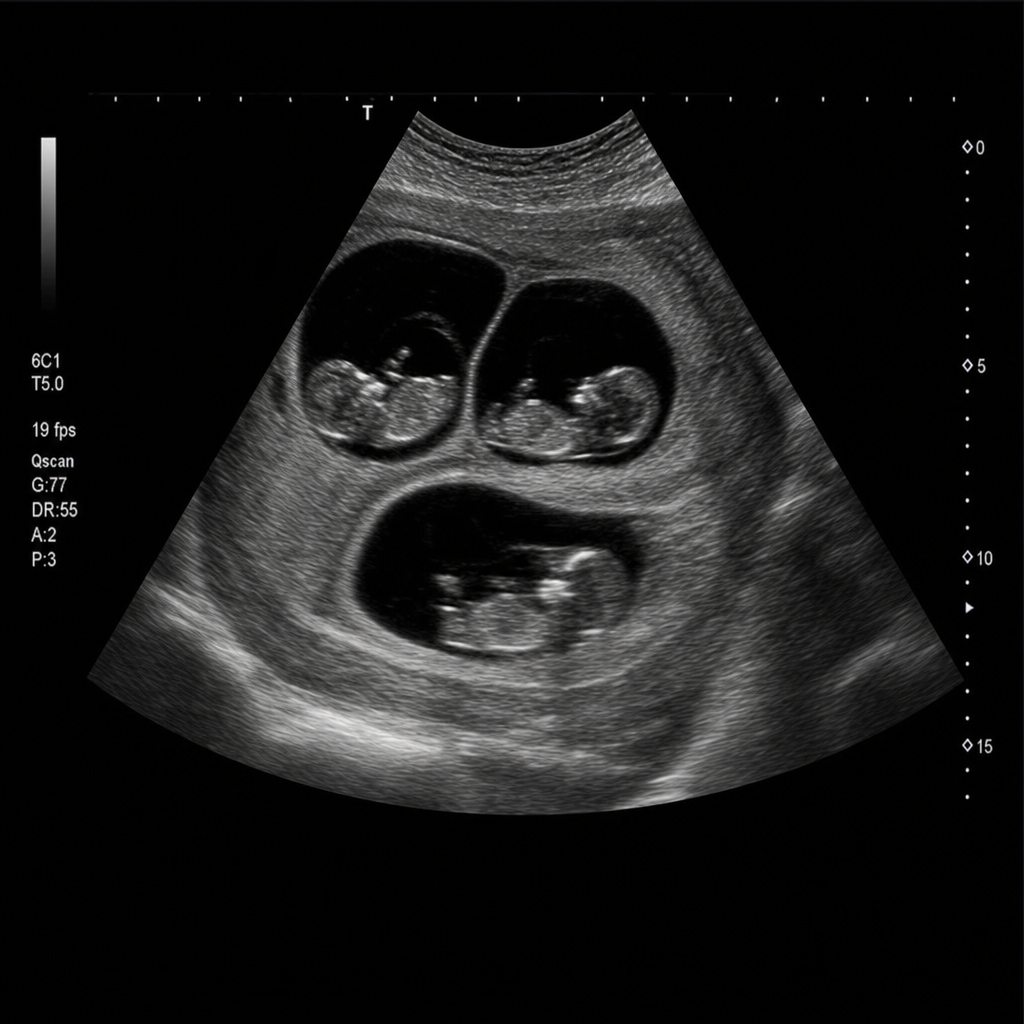
Which ultrasound finding has the highest association with aneuploidy?
Comet tail artifact in USG is typically seen in which of the following conditions?
Which one of the following regarding antenatal assessment of umbilical arteries by color Doppler study is TRUE?
Placental grading on ultrasound is based on which of the following criteria?
HIFU stands for?
Harmonic imaging is primarily used in which imaging modality?
Earliest detection of pregnancy by ultrasound is by:
Which sign is seen on ultrasound when the femoral vein meets the great saphenous vein and femoral artery at the saphenofemoral junction?
What material is typically found in an ultrasonography transducer?
Diagnosis of structural diseases of the heart, such as valvular heart disease, is best shown by?
Explanation: **Explanation:** **Cystic hygroma** is the correct answer because it has the strongest association with chromosomal abnormalities (aneuploidy) among the listed options. It is a congenital malformation of the lymphatic system, typically presenting as a fluid-filled sac in the posterior neck. Approximately **50-60%** of fetuses diagnosed with cystic hygroma in the first trimester have an underlying aneuploidy, most commonly **Turner syndrome (45,X)**, followed by Trisomy 21, 18, and 13. **Analysis of Incorrect Options:** * **Nuchal Translucency (NT):** While an increased NT is a major screening marker for Trisomy 21, it is often transient and can be seen in normal fetuses. Its association with aneuploidy is significant but statistically lower than that of a true cystic hygroma. * **Choroid Plexus Cyst (CPC):** These are considered "soft markers." While they are associated with Trisomy 18, the vast majority (over 95%) of CPCs occur in chromosomally normal fetuses and usually resolve by 26 weeks. * **Single Umbilical Artery (SUA):** This is the most common umbilical cord anomaly. While it increases the risk for renal and cardiac anomalies, its isolated presence has a very low correlation with aneuploidy. **Clinical Pearls for NEET-PG:** * **Turner Syndrome** is the most common association with cystic hygroma in the second trimester. * If a cystic hygroma is detected, the next best step is **karyotyping** (via CVS or Amniocentesis). * **Hydrops fetalis** often develops as a complication of cystic hygroma, leading to a poor prognosis.
Explanation: **Explanation:** **1. Why Adenomyomatosis is correct:** The **Comet tail artifact** is a form of reverberation artifact. In the context of the gallbladder, it is the hallmark sign of **Adenomyomatosis**. This condition involves the overgrowth of the mucosa and thickening of the muscularis layer, leading to the formation of intramural diverticula known as **Rokitansky-Aschoff sinuses**. When cholesterol crystals become trapped within these narrow, fluid-filled sinuses, they act as highly reflective interfaces. The ultrasound beam bounces back and forth within these crystals, creating a series of closely spaced reflections that appear as a tapering, bright "fan-like" tail extending from the gallbladder wall. **2. Why the other options are incorrect:** * **Cholesterosis (Strawberry Gallbladder):** This involves cholesterol deposits within macrophages in the lamina propria. While it may show small, non-shadowing polyps, it typically does not produce the classic comet-tail artifact. * **Porcelain Gallbladder:** This refers to extensive calcification of the gallbladder wall. It produces a dense echogenic line with **posterior acoustic shadowing**, which obscures the gallbladder contents (unlike the reverberation seen in comet tails). * **Acute Cholecystitis:** Key findings include gallbladder wall thickening, pericholecystic fluid, and a positive sonographic Murphy’s sign. It does not inherently produce comet-tail artifacts unless complicated by emphysematous changes (which produce "dirty" shadowing). **High-Yield Clinical Pearls for NEET-PG:** * **Comet Tail vs. Ring Down:** Comet tail is caused by small highly reflective objects (like crystals or metal); Ring-down artifact is typically caused by **gas bubbles** (e.g., Emphysematous cholecystitis). * **V-shaped:** Comet tail artifacts are narrow and dissipate quickly, resembling a "V". * **Adenomyomatosis** is a benign, degenerative condition and is generally not considered premalignant, unlike Porcelain Gallbladder.
Explanation: ### Explanation: Umbilical Artery Doppler in Antenatal Assessment **Correct Answer: C. The flow velocities and the S/D ratio are useful to evaluate high-risk pregnancies.** **Underlying Medical Concept:** Umbilical artery Doppler is a non-invasive tool used to assess feto-placental vascular resistance. In a normal pregnancy, as the placenta develops, vascular resistance decreases, leading to an increase in end-diastolic flow. The **Systolic/Diastolic (S/D) ratio** is a primary index used to quantify this. In high-risk pregnancies (e.g., Fetal Growth Restriction (FGR) or Preeclampsia), placental resistance increases, causing a **high S/D ratio**. This makes Doppler studies invaluable for monitoring fetal well-being and deciding the timing of delivery in high-risk cases. **Analysis of Incorrect Options:** * **Options A & D:** Smoking and nicotine abuse cause **vasoconstriction** of the placental vessels. This increases vascular resistance, which leads to an **increased S/D ratio**, not a decreased one. An increased S/D ratio in smokers is a sign of placental insufficiency, not a "normal" finding. * **Option B:** In a healthy pregnancy at term, there should be high diastolic flow (low resistance). **Reduced, absent, or reversed end-diastolic flow (AREDF)** is a marker of severe fetal compromise and is associated with a **poor prognosis**, high perinatal mortality, and the need for urgent intervention. **High-Yield Clinical Pearls for NEET-PG:** * **Normal Trend:** The S/D ratio normally **decreases** as gestational age increases (due to increasing diastolic flow). * **Abnormal S/D Ratio:** A ratio **>3.0 after 30 weeks** of gestation is considered abnormal. * **Absent End-Diastolic Flow (AEDF):** Indicates that approximately 70% of the placental arterial tree is damaged/obstructed. * **Reversed End-Diastolic Flow (REDF):** An ominous sign indicating imminent fetal demise; usually an indication for immediate delivery if the fetus is viable.
Explanation: **Explanation:** Placental grading, commonly known as the **Grannum Classification**, is used to assess the maturity of the placenta via ultrasound. This system evaluates the physiological changes and calcification patterns that occur as a pregnancy progresses. **Why the correct answer is right:** The Grannum classification is based on three specific anatomical components of the placenta: 1. **Chorionic Plate:** Evaluated for the presence and depth of **undulations** (indentations). 2. **Placental Substance:** Evaluated for the presence of echogenic densities (calcifications). 3. **Basal Layer:** Evaluated for the presence of basal calcifications (comma-like densities). As the placenta matures (Grade 0 to Grade III), the chorionic plate becomes increasingly interrupted by deep indentations that eventually reach the basal layer. **Why the incorrect options are wrong:** * **A & B (Location and Dimension):** While these are critical parameters in an obstetric ultrasound (e.g., to rule out Placenta Previa or Placental Megaly), they do not determine the "grade" or maturity of the placenta. * **C (Amniotic fluid ratio):** Amniotic fluid volume (AFI) is a component of the Biophysical Profile (BPP) and reflects fetal well-being and renal function, but it is not a criterion for placental grading. **High-Yield Facts for NEET-PG:** * **Grade 0:** Smooth chorionic plate; homogenous substance (Typical of early pregnancy). * **Grade I:** Subtle undulations; scattered calcifications. * **Grade II:** Deep undulations; comma-shaped densities in the substance. * **Grade III:** Indentations reach the basal plate, dividing the placenta into **cotyledons**; significant calcification with "fallout" areas (Typical after 37-38 weeks). * **Clinical Significance:** Presence of a Grade III placenta before 34 weeks may indicate **placental insufficiency**, often associated with Preeclampsia or IUGR.
Explanation: **Explanation:** **HIFU** stands for **High Intensity Focused Ultrasound**. It is a non-invasive therapeutic technique that uses acoustic energy to treat various medical conditions. **1. Why Option B is Correct:** The core principle of HIFU involves focusing multiple beams of ultrasound energy onto a specific, small target area (the "focal point"). While individual beams pass through superficial tissues without causing damage, their convergence at the focal point generates intense heat (thermal ablation) and mechanical pressure (cavitation). This leads to **coagulative necrosis** of the target tissue (e.g., a tumor) without the need for surgical incisions. **2. Why Other Options are Incorrect:** * **Option A (Fluoroscopic):** Fluoroscopy is an X-ray-based real-time imaging modality; it is not combined with ultrasound in this context. * **Option C (Fractionated):** "Fractionated" is a term typically associated with Radiotherapy (dividing the total dose into several sessions), not the fundamental naming of this ultrasound technology. * **Option D (Fragmented):** This is a distractor; while ultrasound can fragment stones (Lithotripsy), "Fragmented Ultrasound" is not a recognized medical term. **3. Clinical Pearls for NEET-PG:** * **Primary Uses:** Most commonly used for **Uterine Fibroids** (leiomyomas), **Prostate Cancer**, and essential tremors (MR-guided). * **Guidance:** HIFU is usually performed under the guidance of **MRI** (MRgFUS) or **Ultrasound** (USgFUS) to ensure precise targeting and real-time temperature monitoring. * **Advantage:** It is an outpatient procedure with no ionizing radiation and minimal recovery time compared to conventional surgery.
Explanation: **Explanation:** **Tissue Harmonic Imaging (THI)** is a specialized technique used in **Ultrasonography (USG)** to improve image quality. It relies on the principle of non-linear propagation of sound waves through tissues. As ultrasound waves travel, they become distorted and generate "harmonics"—frequencies that are integer multiples of the original transmitted (fundamental) frequency. The ultrasound machine filters out the fundamental frequency and processes only the higher-frequency harmonic signals. This significantly reduces artifacts (like side-lobe artifacts), improves lateral resolution, and enhances the signal-to-noise ratio, making it particularly useful in technically difficult patients (e.g., obese patients). **Why other options are incorrect:** * **Computed Tomography (CT):** CT uses X-rays and relies on differential attenuation of radiation. It does not utilize wave frequency harmonics. * **Magnetic Resonance Imaging (MRI) & MRCP:** These modalities rely on the precession of protons in a magnetic field and radiofrequency pulses. While MRI uses complex signal processing, the specific term "Harmonic Imaging" is a hallmark of acoustic physics in ultrasound. **High-Yield Clinical Pearls for NEET-PG:** * **Contrast-Enhanced Ultrasound (CEUS):** Harmonic imaging is the foundation for using microbubble contrast agents, as these bubbles resonate strongly at harmonic frequencies. * **Benefits:** THI is excellent for visualizing **cysts** (clears internal echoes/debris), identifying **gallstones**, and improving the endocardial border definition in **Echocardiography**. * **Trade-off:** The primary disadvantage of THI is a slight decrease in depth penetration compared to fundamental imaging.
Explanation: **Explanation:** The earliest sonographic sign of pregnancy is the **Gestational Sac**. It appears as a small, eccentric fluid collection within the thickened decidua (endometrium). 1. **Why Gestational Sac is Correct:** In a normal intrauterine pregnancy, the gestational sac can be visualized via **Transvaginal Sonography (TVS)** as early as **4.5 to 5 weeks** of gestation (when the Mean Sac Diameter is approx. 2-3 mm). It is typically seen when the serum β-hCG levels reach the "discriminatory zone" (1,500–2,000 mIU/mL). 2. **Analysis of Incorrect Options:** * **Fetal Skeleton:** This is a late finding. Mineralization of the fetal skeleton begins around the 8th week but is clearly visible on ultrasound/X-ray much later (usually after 11-12 weeks). * **Fetal Node (Fetal Pole):** This refers to the earliest visualization of the embryo. It appears *after* the gestational sac and yolk sac, typically at **5.5 to 6 weeks** via TVS. * **FSH:** Follicle Stimulating Hormone is a pituitary hormone involved in the menstrual cycle, not a marker for detecting pregnancy on ultrasound. **High-Yield Clinical Pearls for NEET-PG:** * **Order of Appearance (TVS):** Gestational Sac (4.5-5 wks) → Yolk Sac (5.5 wks) → Fetal Pole with Cardiac Activity (6 wks). * **Yolk Sac:** Its presence confirms an intrauterine pregnancy and rules out a "pseudogestational sac" seen in ectopic pregnancies. * **Double Decidual Sign:** A classic ultrasound feature of an early gestational sac, helping distinguish it from intrauterine fluid or blood. * **TVS vs. TAS:** TVS can detect pregnancy markers approximately **1 week earlier** than Transabdominal Sonography (TAS).
Explanation: **Explanation:** **1. Why "Mickey Mouse sign" is correct:** The **Mickey Mouse sign** is a classic sonographic landmark seen in a transverse (short-axis) view of the groin at the level of the **saphenofemoral junction (SFJ)**. The arrangement of three circular structures resembles the head of the famous cartoon character: * **The Head:** Common Femoral Vein (CFV). * **The Right Ear:** Great Saphenous Vein (GSV) as it joins the CFV. * **The Left Ear:** Common Femoral Artery (CFA). This landmark is crucial for identifying the deep venous system before performing venous Doppler or ultrasound-guided procedures. **2. Why the other options are incorrect:** * **String sign:** Seen in Radiology as a thin line of contrast in the terminal ileum (Crohn’s disease) or a severely narrowed carotid artery. * **Tillaux sign:** A clinical sign in surgery where a mesenteric cyst is mobile only in a direction perpendicular to the line of the mesenteric attachment. * **Stemmer's sign:** A clinical sign for **Lymphedema**; it is the inability to pinch the skin on the dorsal surface of the base of the second toe or finger. **3. High-Yield Clinical Pearls for NEET-PG:** * **Reverse Mickey Mouse Sign:** In some contexts, the "Mickey Mouse sign" is also used in the **porta hepatis** (Transverse view): Head = Portal Vein; Right Ear = Common Bile Duct; Left Ear = Hepatic Artery. * **Compressibility:** During a DVT scan, the "Mickey Mouse" structures should be easily compressed. Failure to compress the "head" (CFV) indicates a proximal Deep Vein Thrombosis. * **Midbrain Mickey Mouse:** On axial MRI, the midbrain can also resemble Mickey Mouse, where the peduncles form the ears.
Explanation: **Explanation:** The core component of an ultrasound transducer is the **piezoelectric crystal**. These materials possess the unique ability to convert electrical energy into mechanical vibrations (ultrasound waves) and vice versa—a phenomenon known as the **Piezoelectric Effect**. **Why Lead Zirconate is Correct:** The most commonly used material in modern medical ultrasound transducers is **Lead Zirconate Titanate (PZT)**. It is a synthetic ceramic preferred because of its high conversion efficiency (high electromechanical coupling coefficient) and stability. While the option lists "Lead Zirconate," it refers to the PZT compound, which is the gold standard in clinical practice. **Analysis of Incorrect Options:** * **Barium Titanate:** This was the first ceramic material used for piezoelectric transducers. While it is a piezoelectric material, it has largely been replaced by PZT in modern medicine due to its lower sensitivity and lower Curie temperature (the temperature at which it loses its piezoelectric properties). * **Sodium Fluoride & Caesium Fluoride:** These are halide salts. Sodium fluoride is used in dental prophylaxis and PET imaging (as a bone tracer), while Caesium compounds are often used in radiation detectors or as contrast agents in research, but neither possesses piezoelectric properties. **High-Yield Clinical Pearls for NEET-PG:** * **Curie Point:** The critical temperature above which a crystal loses its piezoelectric properties. This is why ultrasound probes **cannot be autoclaved** (heat sterilization destroys the crystal). * **Matching Layer:** Positioned in front of the crystal to reduce the acoustic impedance mismatch between the crystal and the patient's skin, ensuring maximum sound transmission. * **Damping Material:** Placed behind the crystal to stop the vibration quickly, resulting in shorter pulses and better **axial resolution**.
Explanation: **Explanation:** **Transesophageal Echocardiography (TEE)** is the gold standard among the given options for diagnosing structural heart diseases. Unlike Transthoracic Echocardiography (TTE), the TEE probe is placed in the esophagus, directly behind the heart. This eliminates interference from the lungs and chest wall, providing high-resolution images of posterior structures like the **left atrium, mitral valve, and thoracic aorta**. It is particularly superior for detecting valvular vegetations (endocarditis), atrial thrombi, and prosthetic valve dysfunction. **Analysis of Incorrect Options:** * **Esophageal Doppler:** This technique is primarily used for hemodynamic monitoring (measuring cardiac output and stroke volume) by assessing blood flow velocity in the descending aorta. It does not provide structural imaging of the valves. * **Thoracic Bioimpedance:** A non-invasive method to estimate cardiac output and fluid status by measuring electrical resistance across the chest. It cannot visualize cardiac anatomy or valves. * **Pulmonary Artery Catheterization (Swan-Ganz):** An invasive procedure used to measure pressures (PCWP, PAP) and cardiac output. While it provides functional data on heart failure or shunts, it is not an imaging modality for structural defects. **High-Yield Clinical Pearls for NEET-PG:** * **Best initial test** for valvular disease: Transthoracic Echocardiography (TTE). * **Most sensitive test** for Left Atrial Appendage (LAA) thrombus: TEE. * **Gold standard** for diagnosing Infective Endocarditis (IE) in patients with prosthetic valves: TEE. * **Contraindication for TEE:** Esophageal stricture, perforation, or active upper GI bleed.
Physics of Ultrasound
Practice Questions
Instrumentation and Techniques
Practice Questions
Abdominal Ultrasonography
Practice Questions
Pelvic Ultrasonography
Practice Questions
Obstetric Ultrasonography
Practice Questions
Small Parts Ultrasonography
Practice Questions
Musculoskeletal Ultrasonography
Practice Questions
Vascular Ultrasonography
Practice Questions
Pediatric Ultrasonography
Practice Questions
Contrast-Enhanced Ultrasound
Practice Questions
Ultrasound-Guided Interventions
Practice Questions
Doppler Ultrasound Principles and Applications
Practice Questions
Get full access to all questions, explanations, and performance tracking.
Start For Free