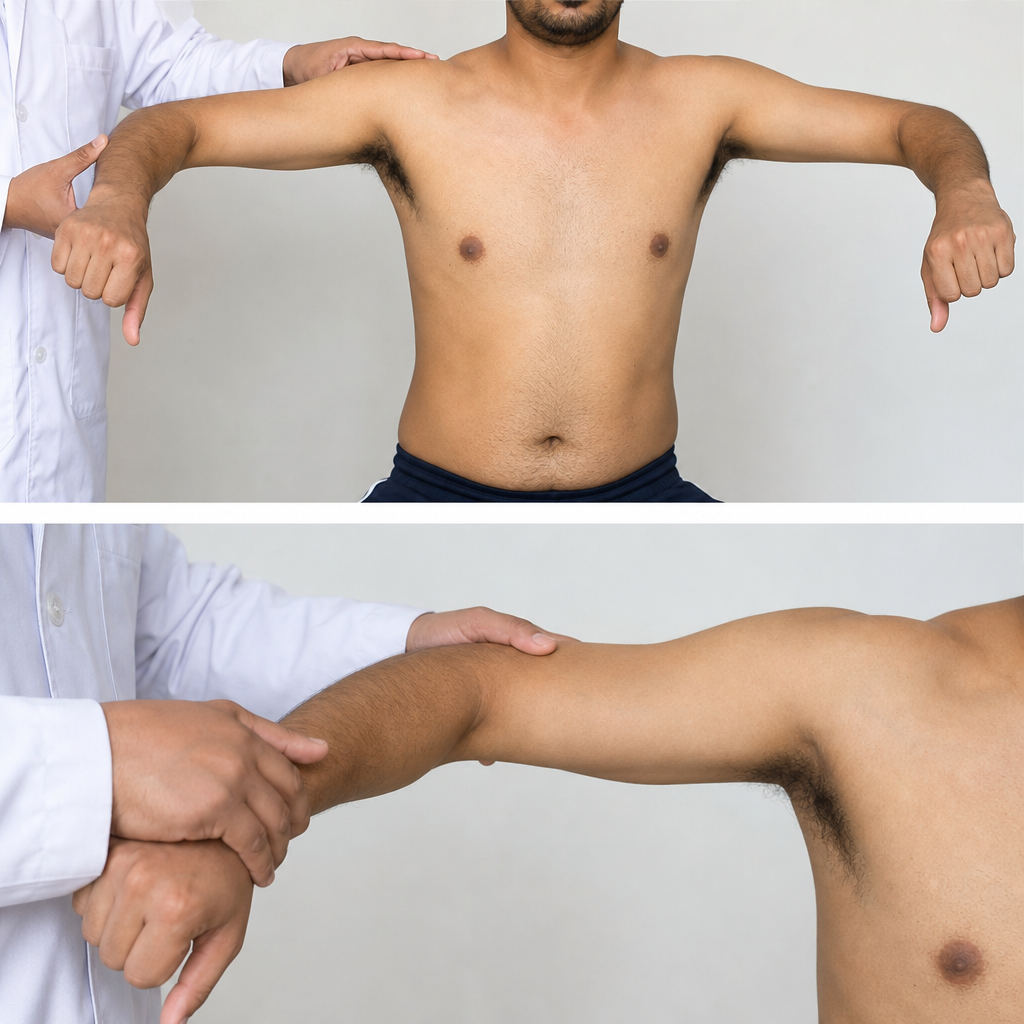
Deltoid ligament is attached to all, except which structure?
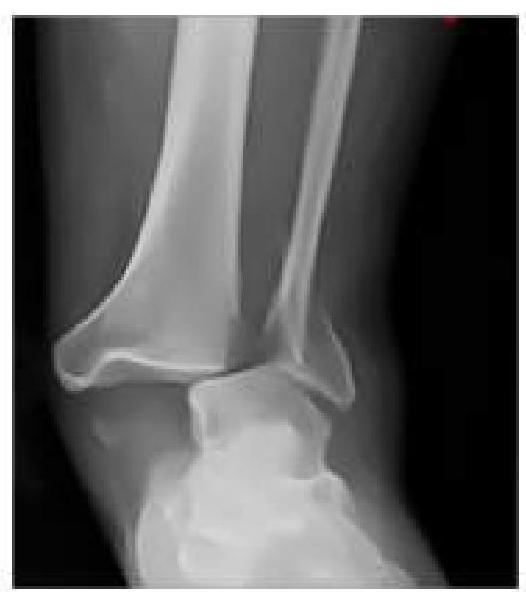
An RTA patient presented to the emergency department with severe pain in the ankle. An X-ray was performed, given below. What is the best next step in management?
Which of the following is not a diarthrosis?
Rupture of extensor pollicis longus tendon occurs in all of the following except -
Which of the following is an intra-articular tendon?
Which is not echogenic while doing ultrasonography:
In a child, non-functioning kidney is best diagnosed by
Transrectal ultrasonography in carcinoma prostate is most useful for –
Which of the following ultrasound features of a thyroid nodule is not suggestive of malignancy?
Which of the following liver metastases appear hypoechoic on ultrasound?
Explanation: ***Medial cuneiform*** - The **deltoid ligament** is located on the **medial side of the ankle** and primarily connects the **tibia** to several tarsal bones. It does not attach to the medial cuneiform. - The **medial cuneiform** is a midfoot bone primarily involved in the **tarsometatarsal joint** and is not a direct attachment site for the deltoid ligament. *Medial malleolus* - The **medial malleolus**, the distal end of the **tibia**, serves as the **proximal attachment point** for all four parts of the deltoid ligament. - This strong connection is crucial for **stabilizing the ankle joint** medially. *Navicular bone* - The **tibionavicular part** of the deltoid ligament attaches to the **tuberosity of the navicular bone**. - This attachment helps **limit excessive abduction** and **eversion** of the foot. *Sustentaculum tali* - The **tibiocalcaneal part** of the deltoid ligament attaches to the **sustentaculum tali** on the calcaneus. - This attachment provides significant stability to the **subtalar joint**.
Explanation: ***Neurovascular Assessment and Closed reduction with slab application*** - The X-ray shows an **ankle dislocation without an obvious fracture**, making **closed reduction** the appropriate initial treatment. - A **slab (splint)** is preferred over a full cast initially for acute injuries to accommodate for swelling, reducing the risk of compartment syndrome, and allowing for serial neurovascular checks. *Neurovascular Assessment and Closed reduction with cast application* - While closed reduction is correct, applying a **full cast** immediately after an acute injury carries a risk of **compartment syndrome** due to potential swelling that cannot be accommodated by a rigid cast. - A cast would typically be applied after the initial swelling has subsided, usually a few days to a week after initial reduction and splinting. *Neurovascular Assessment and Immediate surgery* - **Immediate surgery** is generally reserved for **open fractures/dislocations**, dislocations that cannot be reduced closed (irreducible dislocations), or those with significant associated fractures that require surgical fixation to stabilize the joint. - In this case, the dislocation appears to be isolated and amenable to closed reduction, making surgery not the immediate next step. *Neurovascular Assessment and Immediate open reduction* - **Open reduction** is performed when closed reduction fails or is contraindicated, for example, due to soft tissue interposition or highly unstable fracture patterns. - Since closed reduction has not yet been attempted, immediate open reduction is premature and unnecessary for an apparently simple dislocation.
Explanation: ***Skull sutures*** - **Skull sutures** are **fibrous joints** (synarthroses) that primarily function to protect the brain and provide structural integrity to the skull. - They allow for **minimal to no movement** in adults, which is a key characteristic differentiating them from diarthroses. *Elbow joint* - The elbow joint is a classic example of a **hinge joint**, which is a type of **diarthrosis** (freely movable joint). - It allows for significant movement in **flexion and extension** of the forearm. *Interphalangeal joint* - **Interphalangeal joints** (between phalanges) are also **hinge joints**, permitting **flexion and extension** of the fingers and toes. - As such, they are classified as **diarthroses** due to their synovial structure and free movement. *Hip joint* - The hip joint is a **ball-and-socket joint**, allowing for a wide range of motion in multiple planes (flexion, extension, abduction, adduction, rotation). - It is a prominent example of a **diarthrosis**, characterized by its joint capsule, synovial fluid, and articular cartilage.
Explanation: ***De Quervain's disease*** - This condition involves **tenosynovitis** of the **extensor pollicis brevis** and **abductor pollicis longus** tendons, not a rupture of the extensor pollicis longus. - The pathology is an inflammation and thickening of the tendon sheaths, distinct from a tendon tear. *Rheumatoid arthritis* - **Chronic inflammation** in rheumatoid arthritis can lead to weakening and eventual rupture of tendons, including the **extensor pollicis longus**, often due to synovitis eroding the tendon. - The condition creates an environment where tendons are vulnerable to **attrition** and damage, making rupture a recognized complication. *Drummers* - Repetitive, high-force movements involved in drumming can cause significant **stress** and microscopic damage to tendons, including the **extensor pollicis longus**. - Over time, this cumulative trauma can lead to inflammation, degeneration, and eventual **rupture** due to overuse. *Colles' fracture* - A **Colles' fracture** of the distal radius can cause a delayed rupture of the **extensor pollicis longus (EPL)** tendon. - This occurs due to attrition of the tendon as it rubs over the **roughened fracture site** or due to *avascular necrosis* of the tendon as it passes through a narrow osteofibrous tunnel.
Explanation: ***Popliteus*** - The **popliteus tendon** originates within the knee capsule (intra-articular) before emerging to insert onto the posterior tibia. - It plays a crucial role in **unlocking the knee joint** from full extension and contributes to posterior stability. *Anconeus* - The **anconeus muscle** is located on the posterior aspect of the elbow, extending from the lateral epicondyle of the humerus to the ulna. - It is an **extra-articular muscle** that assists in elbow extension and stabilization. *Semitendinosus* - The **semitendinosus** is one of the hamstring muscles, located in the posterior thigh. - Its tendon contributes to the **pes anserinus**, inserting on the medial aspect of the tibia distal to the knee joint, making it an extra-articular tendon. *Sartorius* - The **sartorius** is the longest muscle in the body, running obliquely across the anterior aspect of the thigh. - Its tendon also contributes to the **pes anserinus**, inserting medially to the knee joint, and is considered extra-articular.
Explanation: ***Bile*** - Bile is largely composed of **water**, which allows ultrasound waves to pass through it with minimal reflection, appearing **anechoic** (black) on ultrasound. - This property makes the gallbladder lumen, when filled with bile, appear anechoic, which is crucial for identifying structures like gallstones. *Bone* - **Bone** is highly dense and reflects a significant portion of ultrasound waves, making it appear very **echogenic** (bright) on ultrasonography. - Due to its high reflectivity, bone often produces a strong **acoustic shadow** behind it, obscuring deeper structures. *Gas* - **Gas** (air) is a strong reflector of ultrasound waves and appears brightly echogenic, often with a characteristic **dirty shadowing** or **reverberation artifact**. - The presence of gas can significantly hinder visualization of underlying tissues due to its strong reflection and scatter of the ultrasound beam. *Gall stones* - **Gallstones** are solid concretions that are highly reflective of ultrasound waves, appearing as bright, **echogenic foci** within the gallbladder lumen. - A classic ultrasound sign of gallstones is an echogenic structure with strong **posterior acoustic shadowing**.
Explanation: ***DTPA renogram*** - A **DTPA renogram** (diethylene triamine pentaacetic acid scan) is a nuclear medicine study that assesses **renal blood flow** and **glomerular filtration rate (GFR)**. - It is highly effective in determining if a kidney is non-functioning because it directly measures the **uptake and excretion of a radiotracer** by the kidney, providing quantitative data on its functional capacity. *Creatinine clearance* - **Creatinine clearance** is a measure of overall kidney function, reflecting the GFR of **both kidneys combined**. - It cannot specifically identify a non-functioning individual kidney, as the other kidney might compensate for the non-functioning one, leading to a near-normal overall creatinine clearance. *Ultrasonography* - **Ultrasonography** is excellent for evaluating **renal anatomy**, such as size, shape, and presence of cysts, hydronephrosis, or stones. - While it can show structural abnormalities, it provides limited direct information about the **functional status** of the kidney, and a structurally normal kidney can still be non-functional. *IVU (Intravenous Urography)* - **Intravenous Urography (IVU)** uses contrast dye injected intravenously to visualize the kidneys, ureters, and bladder, assessing both anatomy and some aspects of function. - If a kidney is non-functioning, it would show **no uptake or excretion of the contrast dye**, but IVU involves radiation exposure and nephrotoxic contrast, making DTPA renogram often preferred in children for functional assessment.
Explanation: ***Guided prostatic biopsies*** - **Transrectal ultrasonography (TRUS)** provides real-time visualization of the prostate, allowing for precise guidance during **prostatic biopsies**. - This guidance ensures that tissue samples are taken from suspicious areas, increasing the diagnostic yield for **prostate cancer**. *To detect hypoechoic area* - While TRUS can identify **hypoechoic areas** in the prostate, which may suggest malignancy, these are **not specific** to cancer and can be caused by other conditions like inflammation. - The primary utility of TRUS in prostate cancer is not merely detection of these areas, but rather using this information for targeted sampling. *Seminal vesicle involvement* - TRUS can visualize the seminal vesicles, but its accuracy in definitively determining **seminal vesicle invasion** is limited compared to more advanced imaging like **MRI**. - **MRI** is generally preferred for assessing extraprostatic extension and seminal vesicle involvement due to its superior soft tissue contrast. *Measurement of prostatic volume* - TRUS is used to measure **prostatic volume**, which is important for calculating **PSA density** and for treatment planning in benign prostatic hyperplasia (BPH). - However, in the context of prostate cancer, while volume measurement is possible, guided biopsy is its most crucial role for diagnosis.
Explanation: ***Hyperechogenicity*** - A **hyperechoic** thyroid nodule appears brighter than the surrounding parenchyma on ultrasound, typically indicating a benign lesion, such as a **colloid nodule**. - This feature suggests a higher reflection of sound waves, characteristic of tissues rich in **fluid or colloid material**. *Hypoechogenicity* - **Hypoechoic** nodules appear darker than the surrounding thyroid tissue, which is a strong indicator of malignancy due to their often dense cellular structure. - This feature is associated with a higher risk of thyroid cancer and often prompts further investigation with **fine-needle aspiration (FNA)**. *Microcalcification* - The presence of **microcalcifications** (tiny, bright spots) within a thyroid nodule is one of the most specific ultrasound signs of **papillary thyroid carcinoma**. - These calcifications, often punctate, represent psammoma bodies, which are a histopathological hallmark of this common thyroid cancer. *Nonhomogeneous* - A **nonhomogeneous** (heterogeneous) echotexture within a thyroid nodule, characterized by irregular internal architecture, can be suggestive of malignancy. - This often indicates disorganized cellular growth, fibrosis, or cystic degeneration with solid components, which are features seen in various thyroid cancers.
Explanation: **Breast cancer** - Liver metastases from **breast cancer** frequently present as **hypoechoic lesions** on ultrasound, due to the tumor's cellular composition and vascularity. - This appearance helps differentiate them from other more commonly echogenic or mixed metastatic patterns. *RCC* - **Renal cell carcinoma (RCC)** metastases to the liver often appear **hyperechoic** or **mixed echogenicity** on ultrasound due to their rich vascularity. - This is a distinct characteristic, different from the predominantly hypoechoic nature seen with breast cancer metastases. *Colon cancer* - Liver metastases from **colon cancer** are typically **echogenic** or **mixed echogenicity** on ultrasound, sometimes with a hypoechoic rim ("target sign"). - Their presentation is generally not purely hypoechoic, making them distinguishable from breast cancer metastases. *Mucinous adenocarcinoma* - Liver metastases from **mucinous adenocarcinoma** can be quite variable, but they often appear **complex**, possibly with **cystic components** or mixed echogenicity, rather than uniformly hypoechoic. - The mucin content can create a distinct internal architecture on ultrasound that differs from solid hypoechoic lesions.
Get full access to all questions, explanations, and performance tracking.
Start For Free