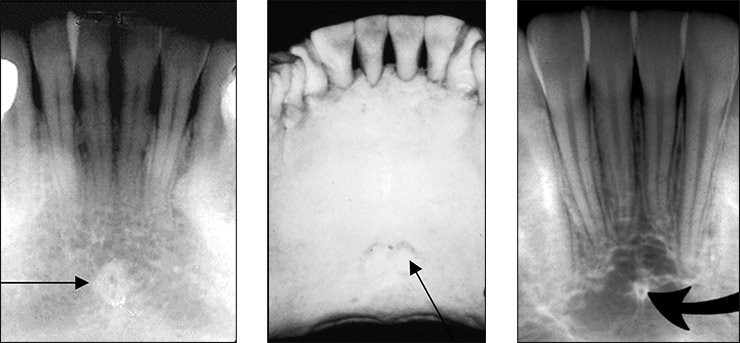
Which of the following can be most accurately identified on an X-ray?
For viewing the superior orbital fissure, what is the best radiographic view?
Which of the following radiographs is best for diagnosing a growth in the maxillary sinus?
What is the imaging study of choice for the paranasal sinuses?
Radiographically, the mental foramen lies between the roots of which teeth?
Which radiological view is best suited for examining fractures of the condylar neck of the mandible?
Which X-ray view is used to visualize the optic foramen?
Which of the following conditions or devices is generally considered safe for an MRI scan?
What is the primary basis for Magnetic Resonance Imaging (MRI)?
The following radiographs are most likely associated with which condition?

Explanation: **Explanation:** The **Mental foramen** is the correct answer because it is a normal anatomical structure—a bilateral opening in the mandible that allows for the passage of the mental nerve and vessels. On an X-ray (specifically an intraoral periapical or panoramic view), it appears as a well-defined, **radiolucent (dark) round or oval area** typically located near the apices of the mandibular premolars. Because it is a distinct bony canal, it is consistently identifiable on plain radiographs. **Why the other options are incorrect:** * **Acute Pulpitis (A):** This is an inflammation of the dental pulp. Since the pulp is soft tissue confined within the hard dentin, early inflammation does not cause changes in bone density. Therefore, acute pulpitis **cannot be seen on an X-ray**; the diagnosis is purely clinical. * **Periapical Granuloma (B):** While this appears as a radiolucency at the root apex, it is radiographically indistinguishable from a periapical cyst or abscess. A definitive diagnosis requires histopathological examination, not just an X-ray. * **Cementoma (D):** Now often referred to as Periapical Cemento-osseous Dysplasia (PCOD), its appearance varies significantly depending on its stage (radiolucent in early stages, radiopaque in late stages). It can often be confused with other lesions, making the mental foramen a more "accurately identifiable" anatomical landmark. **NEET-PG High-Yield Pearls:** * **Mental Foramen Mimicry:** The mental foramen can sometimes be superimposed over the apex of a premolar, mimicking a periapical lesion (like a granuloma). To differentiate, use the **SLOB rule** (Same Lingual, Opposite Buccal) or check for the continuity of the **Lamina Dura**; if the lamina dura is intact, it is likely the foramen and not pathology. * **Radiolucent vs. Radiopaque:** Remember, "LUCENT" is "LOOSE" (darker/less dense), and "OPAQUE" is "OBSTRUCTIVE" (whiter/more dense).
Explanation: ### Explanation The **Caldwell view** (Occipitofrontal projection) is the gold standard for visualizing the **superior orbital fissure (SOF)**. In this view, the patient’s forehead and nose touch the film, and the X-ray beam is angled 15° caudad. This specific angulation projects the petrous ridges of the temporal bone into the lower third of the orbits, leaving the upper two-thirds clear. This provides an unobstructed, symmetrical view of the SOF, the ethmoid and frontal sinuses, and the orbital rims. **Analysis of Incorrect Options:** * **Plain AP View:** Without the 15° caudal angulation, the dense petrous ridges overlap directly with the orbits, obscuring the superior orbital fissure and other internal orbital structures. * **Towne View (30° AP Axial):** This view is primarily used to visualize the **occipital bone**, the foramen magnum, and the petrous pyramids. It is the best view for the posterior fossa, not the orbits. * **Basal View (Submentovertex):** This view is used to visualize the **skull base**, the sphenoid sinus, and the zygomatic arches. While it shows the foramina of the skull base (like Foramen Ovale and Spinosum), it is not ideal for the SOF. **High-Yield Clinical Pearls for NEET-PG:** * **Water’s View (Occipitomental):** Best for the **maxillary sinus** and visualizing the orbital floor (blow-out fractures). * **Caldwell View:** Best for the **frontal and ethmoid sinuses** and the superior orbital fissure. * **Structures passing through the SOF:** CN III, IV, VI, and the ophthalmic branch of CN V (V1), plus the superior ophthalmic vein. * **Rhese View:** Specifically used to visualize the **optic canal**.
Explanation: **Explanation:** The **Water’s view (Occipitomental projection)** is the gold standard radiographic projection for evaluating the **maxillary sinuses**. In this view, the patient’s head is tilted back (chin touching the film, nose 1–2 cm away), which displaces the dense petrous part of the temporal bone downward, below the floor of the maxillary sinuses. This provides a clear, unobstructed view of the maxillary antrum, making it ideal for detecting opacities, air-fluid levels (sinusitis), or soft tissue masses (growths). **Analysis of Incorrect Options:** * **A. Lateral Cephalogram:** Primarily used in orthodontics to assess facial growth and skeletal relationships. While it shows the sinuses, the left and right maxillary sinuses are superimposed, making it impossible to localize a growth to one side. * **B. PA View of Skull:** In a standard Posteroanterior view, the petrous pyramids are superimposed over the orbits and the maxillary sinuses, obscuring the detail required to diagnose a growth. * **C. Reverse Towne’s View:** This is specifically used to visualize the **condylar neck and ramus of the mandible**. It is the projection of choice for suspected condylar fractures. **High-Yield Clinical Pearls for NEET-PG:** * **Caldwell’s View (Occipitofrontal):** Best for visualizing the **Frontal and Ethmoid sinuses**. * **Submentovertex (SMV) View:** Best for the **Sphenoid sinus** and the zygomatic arches (Jug-handle view). * **Open-mouth Water’s View:** Allows visualization of the **Sphenoid sinus** through the open mouth. * **Gold Standard Imaging:** While Water’s view is the best plain radiograph, **Non-Contrast CT (NCCT) of the Paranasal Sinuses** is the overall gold standard for sinus pathology.
Explanation: **Explanation:** **1. Why CT Scan is the Correct Answer:** Non-Contrast Computed Tomography (NCCT) is the **gold standard** and imaging study of choice for the paranasal sinuses (PNS). The primary reason is its superior ability to provide high-resolution visualization of the complex bony anatomy and the **ostiomeatal complex (OMC)**. It accurately depicts mucosal thickening, fluid levels, and bony erosions, which is essential for diagnosing chronic sinusitis and planning Functional Endoscopic Sinus Surgery (FESS). **2. Analysis of Incorrect Options:** * **USG (A):** Ultrasound has no role in routine PNS imaging due to the air-filled nature of the sinuses, which reflects sound waves, preventing visualization of deeper structures. * **X-ray PNS (C):** While historically used (e.g., Waters' view for maxillary sinuses), X-rays are now considered obsolete for definitive diagnosis due to significant bony overlap and low sensitivity for early mucosal changes. * **FDG PET scan (D):** This is a functional imaging modality used primarily for staging and detecting metastasis in malignancies. It is not used for routine anatomical evaluation of the sinuses. **3. High-Yield Clinical Pearls for NEET-PG:** * **Standard View:** The **Coronal plane** is the most important for CT PNS as it best demonstrates the ostiomeatal complex. * **MRI vs. CT:** While CT is best for bone, **MRI** is the investigation of choice for suspected **fungal sinusitis** (shows signal void on T2) or when evaluating the intracranial/intraorbital extension of a tumor. * **Waters' View:** Also known as the Occipitomental view; it is the best X-ray view for the Maxillary sinus. * **Caldwell View:** Best X-ray view for the Frontal and Ethmoid sinuses.
Explanation: **Explanation:** The **mental foramen** is a critical anatomical landmark in the mandible that serves as the exit point for the mental nerve and vessels. **1. Why the Correct Answer is Right:** In the majority of the population (approximately 50-70%), the mental foramen is radiographically located **between the apices of the first and second mandibular premolars**. However, its position can vary slightly based on age, ethnicity, and tooth loss. It is typically situated halfway between the alveolar crest and the lower border of the mandible. On an intraoral periapical (IOPA) radiograph, it appears as a well-defined circular or oval radiolucency. **2. Why Incorrect Options are Wrong:** * **Option A (Canine and first premolar):** This is too anterior. While the mental canal originates near the incisors, the foramen itself rarely exits this far forward. * **Option C (Second premolar and first molar):** This is the second most common location (common in certain ethnic groups), but statistically, the position between the premolars is the standard "textbook" answer for exams. * **Option D (Incisor region):** This area contains the **incisive foramen** (on the lingual aspect) or the mental fossa, but not the mental foramen. **3. Clinical Pearls & High-Yield Facts for NEET-PG:** * **Radiographic Mimicry:** The mental foramen can sometimes be superimposed over the apex of a premolar, mimicking a **periapical granuloma or cyst**. To differentiate, look for an intact **lamina dura** around the tooth root; if the lamina dura is intact, the radiolucency is likely the foramen. * **Nerve Block:** The mental nerve is a branch of the **inferior alveolar nerve**. A mental nerve block provides anesthesia to the lower lip and chin but *not* the teeth (which require an incisive nerve block or IANB). * **Age Changes:** In edentulous (toothless) patients, due to bone resorption, the mental foramen appears closer to the **superior border** of the mandible.
Explanation: **Explanation:** The **Reverse-Townes view** is the gold standard radiographic projection for visualizing the **condylar neck and head of the mandible**. In a standard AP or PA view, the condyles are often obscured by the dense petrous part of the temporal bone. The Reverse-Townes view uses a specific angulation (the head is tilted down so the forehead and nose touch the film) which displaces the condyles laterally and downward, projecting them clear of the zygomatic arches and petrous bones. This allows for the clear detection of medial or lateral displacement of condylar fractures. **Analysis of Incorrect Options:** * **Lateral jaw projection:** Useful for the body and ramus of the mandible, but the condylar neck is often superimposed by the cervical spine or the contralateral side of the mandible. * **Lateral skull projection:** Primarily used for the cranium and sella turcica; it results in significant superimposition of both sides of the mandible, making it poor for specific condylar assessment. * **Waters projection:** The primary view for **maxillary sinuses** and mid-facial fractures (Le Fort injuries). It does not provide an unobstructed view of the mandibular condyles. **High-Yield Clinical Pearls for NEET-PG:** * **Townes View vs. Reverse-Townes:** Townes is AP; Reverse-Townes is PA. Reverse-Townes is preferred for the mandible as it reduces radiation dose to the eyes and provides better magnification. * **OPG (Orthopantomogram):** The best initial screening tool for all mandibular fractures. * **Guardsman Fracture:** A midline symphysis fracture associated with bilateral condylar fractures (often from a fall on the chin). * **Subcondylar fracture:** The most common site of fracture in the mandible (due to its inherent structural weakness).
Explanation: **Explanation:** The correct answer is **A. Optic foramen**. The specific radiographic projection used to visualize the optic foramen is the **Rhese view** (also known as the Parieto-orbital oblique projection). In this view, the patient’s head is positioned such that the orbit being examined is closest to the film, with the chin, cheek, and nose touching the cassette (the "three-point landing"). This aligns the optic canal perpendicular to the film, allowing it to appear as a distinct ring in the lower outer quadrant of the orbit. **Analysis of Incorrect Options:** * **B. Internal acoustic canal:** This is best visualized using the **Stenvers view** (oblique view of the petrous temporal bone) or the **Towne’s view**. * **C. Sella turcica:** This is best evaluated on a **Lateral view** of the skull, which provides a clear profile of the pituitary fossa and the clinoid processes. * **D. Inferior orbital foramen:** This is typically seen on a **Waters view** (Parietoacanthial projection), which is the gold standard for visualizing the maxillary sinuses and the orbital floor. **High-Yield Clinical Pearls for NEET-PG:** * **Rhese View:** Essential for detecting fractures of the optic canal or tumors (like optic nerve gliomas) that cause enlargement of the foramen. * **Waters View:** Best for the Maxillary sinus and evaluating "Blow-out" fractures of the orbital floor. * **Caldwell View:** Best for the Frontal and Ethmoid sinuses. * **Submentovertex (SMV) View:** Best for the Zygomatic arch and the Base of the Skull (Foramen Ovale and Spinosum).
Explanation: **Explanation:** **Why Pregnancy is the Correct Answer:** MRI is generally considered safe during pregnancy as it does not involve ionizing radiation (unlike X-rays or CT scans). While the first trimester is approached with caution due to organogenesis, there is no documented evidence of fetal harm or teratogenicity from MRI exposure. It is the imaging modality of choice for complex maternal or fetal conditions when ultrasound is inconclusive. However, **Gadolinium contrast is avoided** in pregnancy as it crosses the placenta and can be toxic to the fetal kidneys. **Why the Other Options are Incorrect:** * **A. Cardiac Pacemakers:** Most traditional pacemakers are **MRI-contraindicated** because the strong magnetic field can cause lead heating, displacement, or malfunction of the pulse generator. (Note: Modern "MRI-conditional" pacemakers exist but require specific programming and safety protocols). * **B. Insulin Pumps:** These are electronic devices containing metallic components and motors. The magnetic field can cause mechanical failure, unintended insulin delivery, or permanent damage to the device. * **C. Cochlear Implants:** These are generally a **strict contraindication**. The magnetic field can demagnetize the internal magnet, cause electrode displacement, or induce electrical currents that may damage the auditory nerve. **High-Yield Clinical Pearls for NEET-PG:** * **MRI Safety Zones:** Zone IV is the actual magnet room (highest risk). * **Quenching:** The rapid transition of liquid cryogen (helium) to gas, used to shut down the magnetic field in emergencies. * **Specific Absorption Rate (SAR):** Measures the RF energy absorbed by the body (monitored to prevent tissue heating). * **Absolute Contraindications:** Metallic intraocular foreign bodies, older intracranial aneurysm clips, and non-MRI-compatible electronic implants.
Explanation: **Explanation:** **Why Hydrogen atoms is the correct answer:** MRI relies on the magnetic properties of atomic nuclei. The **Hydrogen nucleus (proton)** is the primary basis for MRI because it possesses a property called "spin" and acts like a tiny bar magnet (magnetic dipole). Hydrogen is the most abundant element in the human body, found in water ($H_2O$) and fat molecules. When placed in a strong external magnetic field ($B_0$), these protons align themselves. A radiofrequency (RF) pulse is then applied to displace them; as they return to their original state (relaxation), they emit signals that are processed to create an image. **Analysis of Incorrect Options:** * **B. X-rays:** These are the basis for Conventional Radiography and CT scans. They use ionizing electromagnetic radiation to create images based on tissue density (attenuation). * **C. Helium ions:** While liquid Helium is used in MRI machines, its role is purely as a **cryogen** to cool the superconducting magnets to near absolute zero; it is not the source of the imaging signal. * **D. Radioactivity:** This is the basis for Nuclear Medicine (e.g., PET or SPECT scans), where radiopharmaceuticals (like Technetium-99m) are injected into the patient to emit gamma rays. **High-Yield Clinical Pearls for NEET-PG:** * **Larmor Equation:** $f = \gamma B_0$ (Precessional frequency is proportional to magnetic field strength). * **T1 Relaxation:** Also called "Spin-Lattice" relaxation (longitudinal). * **T2 Relaxation:** Also called "Spin-Spin" relaxation (transverse). * **Contraindications:** MRI is contraindicated in patients with non-compatible cardiac pacemakers, metallic intraocular foreign bodies, or cochlear implants. * **Gadolinium:** The most common intravenous contrast agent used in MRI, which works by shortening T1 relaxation times.
Explanation: ***Hyperparathyroidism*** - Classic radiological features include **subperiosteal bone resorption** (especially in phalanges), **salt-and-pepper skull** appearance, and **brown tumors**. - Additional findings may include **rugger jersey spine**, **loss of dental lamina dura**, and **osteoporosis** due to excessive **parathyroid hormone (PTH)** secretion. *Hyperpituitarism* - Radiographic changes primarily involve **enlarged sella turcica** and **acromegalic features** like enlarged hands, feet, and jaw. - Bone changes are typically **thickening and coarsening** rather than the resorptive patterns seen in hyperparathyroidism. *Hypoparathyroidism* - Characterized by **increased bone density** and **sclerotic changes** due to low PTH levels and calcium deposition. - May show **basal ganglia calcifications** and **cataracts**, but lacks the bone resorptive features typical of hyperparathyroidism. *Hyperthyroidism* - Radiological findings include **osteoporosis** and **accelerated bone turnover**, but without specific resorptive patterns. - May show **thyroid enlargement** on chest X-ray, but lacks the characteristic **subperiosteal resorption** seen in hyperparathyroidism.
Radiographic Anatomy of Skull and Face
Practice Questions
Radiographic Anatomy of Spine
Practice Questions
Radiographic Anatomy of Chest
Practice Questions
Radiographic Anatomy of Abdomen
Practice Questions
Radiographic Anatomy of Extremities
Practice Questions
Cross-sectional Anatomy: Brain and Head
Practice Questions
Cross-sectional Anatomy: Neck
Practice Questions
Cross-sectional Anatomy: Thorax
Practice Questions
Cross-sectional Anatomy: Abdomen and Pelvis
Practice Questions
Vascular Anatomy
Practice Questions
Developmental Anatomy Variations
Practice Questions
Anatomic Landmarks for Interventional Procedures
Practice Questions
Get full access to all questions, explanations, and performance tracking.
Start For Free