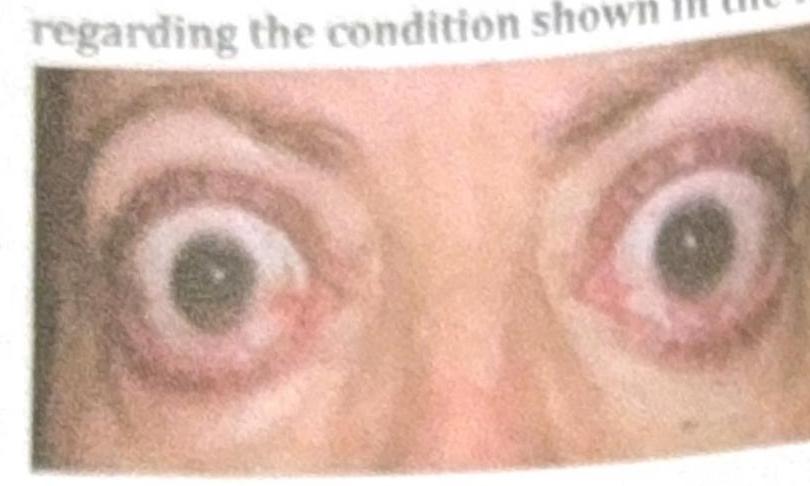
Which of the following statements about thyroid eye disease is false?
Radiation mediates its effect by
Cell most sensitive to radiation –
Which part of DNA is most susceptible to radiation?
HNPCC has defect in which
A patient presents with a skin rash that is exaggerated on sun exposure. What is the repair mechanism involved in this condition?
Cells are most sensitive to ionizing radiation during which phase?
The component of cell most affected by radiation?
Radiation causes cell death by:
Which of the following is not a risk factor for cholangiocarcinoma?
Explanation: ***The management corresponds to improvement in thyrotoxic state*** - Thyroid eye disease (TED) is an **autoimmune condition** that runs independently of the thyroid's hormonal status [1]. While hyperthyroidism can trigger or worsen TED, treating the hyperthyroidism does not necessarily resolve or improve the eye symptoms [2]. - The disease course of TED is often **biphasic**, with an active inflammatory phase followed by a quiescent phase. Treatment decisions for TED are based on the severity and activity of the eye disease itself, not solely on the thyroid hormone levels. *NOSPECS score is used to classify thyroid eye disease* - The **NOSPECS classification system** is a well-established method for grading the severity of thyroid eye disease. - This acronym stands for **N**o signs or symptoms, **O**nly signs (e.g., lid retraction) no symptoms, **S**oft tissue involvement, **P**roptosis, **E**xtraocular muscle involvement, **C**orneal involvement, and **S**ight loss (optic neuropathy). *Can lead to visual loss* - Thyroid eye disease can cause **optic nerve compression** due to enlarged extraocular muscles or increased orbital fat, leading to **compressive optic neuropathy** and potentially irreversible visual loss. - Severe **corneal exposure** from proptosis and lid retraction can also lead to corneal ulceration, infection, and scaring, affecting vision. *Seen in more than 10% of patients with hyperthyroidism* - Thyroid eye disease is the **most common extrathyroidal manifestation** of Graves' disease, occurring in approximately 25-50% of patients with Graves' hyperthyroidism [1]. - While it is less common in other forms of hyperthyroidism or euthyroid individuals, the prevalence in Graves' disease alone is significantly higher than 10%.
Explanation: ***Ionization of the molecules*** - Radiation, particularly **ionizing radiation**, interacts with biological molecules by ejecting electrons, leading to the formation of highly reactive **ions and free radicals** [1]. - This **ionization** process is the primary mechanism by which radiation damages cellular components, including **DNA** [2]. *Protein coagulation* - While radiation can cause protein damage, **coagulation** is not its primary or direct mechanism, especially at clinically relevant doses. - Protein coagulation is more typically associated with **heat** or certain strong chemical agents. *Osmolysis of cells* - **Osmolysis** refers to the rupture of cells due to excessive water influx, often caused by changes in osmotic pressure. - Radiation does not directly induce **osmotic imbalances** leading to cell lysis. *Denaturation of DNA* - While radiation ultimately leads to **DNA damage**, denaturation (unfolding) is a specific type of damage, often caused by heat or extreme pH. - The direct effect of radiation is **ionization**, which then indirectly causes various forms of DNA damage including breaks, cross-links, and base modifications, but not solely "denaturation" [1]. **References:** [1] Cross SS. Underwood's Pathology: A Clinical Approach. 6th ed. (Basic Pathology) introduces the student to key general principles of pathology, both as a medical science and as a clinical activity with a vital role in patient care. Part 2 (Disease Mechanisms) provides fundamental knowledge about the cellular and molecular processes involved in diseases, providing the rationale for their treatment. Part 3 (Systematic Pathology) deals in detail with specific diseases, with emphasis on the clinically important aspects., pp. 101-102. [2] Kumar V, Abbas AK, et al.. Robbins and Cotran Pathologic Basis of Disease. 9th ed. Central Nervous System Synapse, pp. 436-437.
Explanation: ***Lymphocytes*** - **Lymphocytes** are the most sensitive hematopoietic cells to radiation due to their rapid turnover and intrinsic radiosensitivity [1]. - Exposure to even low doses of radiation can lead to rapid **apoptosis** and a decrease in lymphocyte count. *Platelets* - **Platelets** are relatively radioresistant, and their numbers decrease more slowly after radiation exposure compared to lymphocytes. - The primary impact on platelets is often indirect, affecting their production by **megakaryocytes** which are also somewhat radioresistant. *Neutrophils* - **Neutrophils** are more radiosensitive than platelets but less so than lymphocytes. Their numbers typically decline after lymphocytes but before red blood cells [2]. - The lifespan of neutrophils is relatively short, and radiation primarily affects the **myeloid precursors** in the bone marrow [2]. *Basophils* - **Basophils** are present in low numbers in the blood and their radiosensitivity is not as well-documented as other white blood cells. - While sensitive, they are generally considered less radiosensitive than lymphocytes. **References:** [1] Cross SS. Underwood's Pathology: A Clinical Approach. 6th ed. (Basic Pathology) introduces the student to key general principles of pathology, both as a medical science and as a clinical activity with a vital role in patient care. Part 2 (Disease Mechanisms) provides fundamental knowledge about the cellular and molecular processes involved in diseases, providing the rationale for their treatment. Part 3 (Systematic Pathology) deals in detail with specific diseases, with emphasis on the clinically important aspects., pp. 111-112. [2] Cross SS. Underwood's Pathology: A Clinical Approach. 6th ed. (Basic Pathology) introduces the student to key general principles of pathology, both as a medical science and as a clinical activity with a vital role in patient care. Part 2 (Disease Mechanisms) provides fundamental knowledge about the cellular and molecular processes involved in diseases, providing the rationale for their treatment. Part 3 (Systematic Pathology) deals in detail with specific diseases, with emphasis on the clinically important aspects., pp. 112-113.
Explanation: ***Nucleotides*** - Radiation primarily damages DNA at the **nucleotide level**, with the deoxyribose sugar component being most susceptible to ionizing radiation. - Radiation causes **hydroxyl radical formation** that attacks the sugar-phosphate backbone, leading to single-strand and double-strand breaks. - Purine and pyrimidine bases within nucleotides can also undergo radiation-induced modifications, causing **mutations** and loss of genetic information. *Nucleosides* - Nucleosides (base + sugar without phosphate) are not the functional unit within DNA strands. - While the sugar moiety is susceptible, nucleosides as isolated units are not the primary consideration when discussing **DNA strand damage**. - Radiation damage occurs to nucleotides as they exist in the DNA polymer, not to free nucleosides. *Double helix* - The double helix is the **overall structural configuration** of DNA, not a specific chemical component. - Radiation damages the double helix by affecting its constituent nucleotides, particularly through **sugar-phosphate backbone breaks**. - Double helix disruption is a consequence of nucleotide-level damage. *Phosphate groups* - Phosphate groups link nucleotides together but are relatively **less susceptible** to direct radiation damage compared to the deoxyribose sugar. - The phosphodiester bonds can be broken as a secondary effect of **sugar radical formation**, rather than being the primary target of radiation.
Explanation: ***Mismatch repair gene*** - **HNPCC (hereditary non-polyposis colorectal cancer)**, also known as Lynch syndrome, is caused by inherited mutations in genes responsible for **DNA mismatch repair** [1]. - These genes, such as **MLH1, MSH2, MSH6, and PMS2**, normally correct errors that occur during DNA replication, preventing the accumulation of mutations. *Base pair excision* - **Base excision repair** is a distinct DNA repair pathway that primarily fixes small base lesions, such as damaged or modified bases. - This mechanism is not primarily implicated in the development of HNPCC. *Point mutation* - A **point mutation** refers to a single nucleotide change in a DNA sequence, which can be the *result* of a defective repair mechanism but is not the defect itself. - While mismatch repair defects lead to an increased rate of point mutations, the underlying *defect* in HNPCC is in the repair system, not in the mutation type. *Nucleotide excision* - **Nucleotide excision repair** is a major pathway for removing bulky, helix-distorting DNA lesions, such as those caused by UV radiation. - Defects in this pathway are associated with conditions like **xeroderma pigmentosum**, not HNPCC. **References:** [1] Kumar V, Abbas AK, et al.. Robbins and Cotran Pathologic Basis of Disease. 9th ed. The Gastrointestinal Tract, p. 817.
Explanation: ***Nucleotide excision repair*** - This mechanism is responsible for repairing **bulky lesions** in DNA, such as **pyrimidine dimers** caused by **UV radiation** from sun exposure. - Patients with defects in nucleotide excision repair (e.g., **xeroderma pigmentosum**) are highly sensitive to sunlight and develop skin rashes, pigment changes, and skin cancers. *Base excision repair* - This pathway primarily corrects **small damaged bases** that do not cause significant distortion of the DNA helix, such as deaminated, oxidized, or alkylated bases. - It does not primarily address the bulky lesions induced by UV light that cause exaggerated sun sensitivity. *Mismatch repair* - This system corrects errors, like **mismatched base pairs**, that are incorporated during DNA replication. - It is not directly involved in repairing DNA damage caused by environmental factors like UV radiation. *Double stranded DNA break repair* - This mechanism repairs **double-strand breaks** in DNA, which are highly deleterious lesions caused by ionizing radiation or oxidative stress. - While critical for genome stability, it is not the primary repair pathway for UV-induced DNA lesions or the direct cause of sun sensitivity.
Explanation: ***G2M phase*** - Cells are most sensitive to ionizing radiation during the **G2 phase** and **M phase** (mitosis) due to the highly condensed chromatin structure and active DNA repair mechanisms being less efficient [2], [3]. - During G2, DNA synthesis is complete, and the cell is preparing for division, making DNA damage particularly detrimental and harder to repair without compromising cell viability [2]. *S phase* - Cells in the **S phase** (DNA synthesis phase) are relatively radioresistant because of active **DNA replication** and associated repair mechanisms. - These repair pathways are highly efficient at correcting DNA damage during replication, making the cell less susceptible to radiation-induced lethality. *G1 phase* - Cells in the **G1 phase** (first gap phase) show intermediate radiosensitivity. - While less sensitive than G2/M phases, G1 cells are more vulnerable than those in late S phase due to active metabolic preparation for DNA synthesis [1]. *G0 phase* - Cells in the **G0 phase** (quiescent phase) are generally **radioresistant** because they are not actively dividing or synthesizing DNA [3]. - They have ample time for DNA repair before re-entering the cell cycle, and their DNA structure is less vulnerable than during active division [3]. **References:** [1] Kumar V, Abbas AK, et al.. Robbins and Cotran Pathologic Basis of Disease. 9th ed. Neoplasia, pp. 302-303. [2] Kumar V, Abbas AK, et al.. Robbins and Cotran Pathologic Basis of Disease. 9th ed. With Illustrations By, pp. 37-38. [3] Kumar V, Abbas AK, et al.. Robbins and Cotran Pathologic Basis of Disease. 9th ed. Central Nervous System Synapse, pp. 436-437.
Explanation: ***DNA*** - **DNA** is the primary target for radiation-induced damage due to its critical role in cellular function and its complex structure, making it susceptible to breaks and mutations [1], [2]. - Damage to **DNA** can lead to **cell cycle arrest**, **apoptosis**, or **uncontrolled cell proliferation** (carcinogenesis) if not properly repaired [1], [2]. *Cell wall* - The **cell wall** is a rigid outer layer found in plants, fungi, and bacteria, not typically in human cells, and its primary role is structural support and protection, not a common target for direct radiation effects. - Animal cells, which are primarily affected by human-relevant radiation doses, lack a **cell wall**. *Cell membrane* - While the **cell membrane** can be affected by radiation, leading to changes in permeability and ion transport, these effects are generally secondary to **DNA damage** in terms of severe cellular consequences [2]. - The cell membrane primarily functions in **cell signaling** and **transport**, and direct damage often requires higher radiation doses to cause significant cellular death compared to DNA. *Cytoplasm* - The **cytoplasm** contains various organelles and cytosol, and while radiation can cause **oxidative stress** and damage to cytoplasmic components, the most critical and irreparable damage is typically to the **DNA** within the nucleus [2]. - Damage to cytoplasmic components often has less severe and more readily repairable consequences for cell survival compared to direct nuclear DNA damage. **References:** [1] Cross SS. Underwood's Pathology: A Clinical Approach. 6th ed. (Basic Pathology) introduces the student to key general principles of pathology, both as a medical science and as a clinical activity with a vital role in patient care. Part 2 (Disease Mechanisms) provides fundamental knowledge about the cellular and molecular processes involved in diseases, providing the rationale for their treatment. Part 3 (Systematic Pathology) deals in detail with specific diseases, with emphasis on the clinically important aspects., pp. 101-102. [2] Kumar V, Abbas AK, et al.. Robbins and Cotran Pathologic Basis of Disease. 9th ed. Central Nervous System Synapse, pp. 436-439.
Explanation: ***Ionization*** - Radiation, particularly **ionizing radiation**, causes cell death by directly or indirectly damaging cellular components through the process of **ionization**. [1] - This involves the removal of electrons from atoms or molecules, leading to the formation of highly reactive **free radicals** (especially hydroxyl radicals from water radiolysis) that can damage DNA, proteins, and lipids. [1] - The most critical lethal lesion is **DNA double-strand breaks**, which are difficult to repair and trigger apoptosis or mitotic catastrophe. [1] *Charring of nucleoproteins* - **Charring** typically refers to the combustion or burning of organic matter, which is not the mechanism of cell death caused by therapeutic radiation doses. - While radiation can cause protein denaturation, it does not lead to the macroscopic charring of nucleoproteins within cells. *Disruption of cytosol* - While severe radiation damage can impact the entire cell, direct and selective **disruption of the cytosol** is not the primary or most impactful mechanism of radiation-induced cell death. - The critical targets for radiation-induced cell death are primarily the **nucleus** and its DNA, not the cytoplasm. [2] *Destroying their mitochondria* - Although radiation can induce **mitochondrial dysfunction** and contribute to cell death through apoptosis, it is not the initial or primary mechanism of cell destruction. - The most critical and direct damage leading to cell death is inflicted upon the **DNA** in the nucleus, particularly causing double-strand breaks. [1] **References:** [1] Cross SS. Underwood's Pathology: A Clinical Approach. 6th ed. (Basic Pathology) introduces the student to key general principles of pathology, both as a medical science and as a clinical activity with a vital role in patient care. Part 2 (Disease Mechanisms) provides fundamental knowledge about the cellular and molecular processes involved in diseases, providing the rationale for their treatment. Part 3 (Systematic Pathology) deals in detail with specific diseases, with emphasis on the clinically important aspects., pp. 100-102. [2] Kumar V, Abbas AK, et al.. Robbins and Cotran Pathologic Basis of Disease. 9th ed. Central Nervous System Synapse, pp. 438-439.
Explanation: ***Aflatoxin*** - **Aflatoxin** is a potent **hepatocarcinogen** produced by *Aspergillus* species that is specifically and strongly linked to **hepatocellular carcinoma (HCC)** [1], NOT cholangiocarcinoma. - This is the **most clearly unrelated** risk factor to cholangiocarcinoma among the options, as its carcinogenic mechanism targets hepatocytes specifically [1], [2]. - It contaminates crops in warm, humid regions and is a well-established cause of liver cancer in endemic areas [1]. *Thorotrast* - **Thorotrast** (thorium dioxide) was a radioactive contrast agent used until the 1950s that **IS a known risk factor** for cholangiocarcinoma. - Due to prolonged retention in the liver and biliary system, it significantly increases the risk of both **cholangiocarcinoma** and **hepatic angiosarcoma** [3]. - Its use was discontinued precisely because of its strong carcinogenic potential. *Radon* - **Radon** is a naturally occurring radioactive gas that is primarily and overwhelmingly associated with **lung cancer** from inhalation exposure. - While a potent carcinogen, it has **no established epidemiological link** to cholangiocarcinoma due to its route of exposure and target organ. *Dioxin* - **Dioxins** are environmental pollutants with documented carcinogenic effects. - While some studies have explored potential links to various cancers, dioxin is **not recognized as an established risk factor** for cholangiocarcinoma in major medical references. **References:** [1] Kumar V, Abbas AK, et al.. Robbins and Cotran Pathologic Basis of Disease. 9th ed. Liver and Gallbladder, pp. 876-877. [2] Kumar V, Abbas AK, et al.. Robbins and Cotran Pathologic Basis of Disease. 9th ed. Neoplasia, pp. 331-332. [3] Cross SS. Underwood's Pathology: A Clinical Approach. 6th ed. (Basic Pathology) introduces the student to key general principles of pathology, both as a medical science and as a clinical activity with a vital role in patient care. Part 2 (Disease Mechanisms) provides fundamental knowledge about the cellular and molecular processes involved in diseases, providing the rationale for their treatment. Part 3 (Systematic Pathology) deals in detail with specific diseases, with emphasis on the clinically important aspects., pp. 216-217.
Get full access to all questions, explanations, and performance tracking.
Start For Free