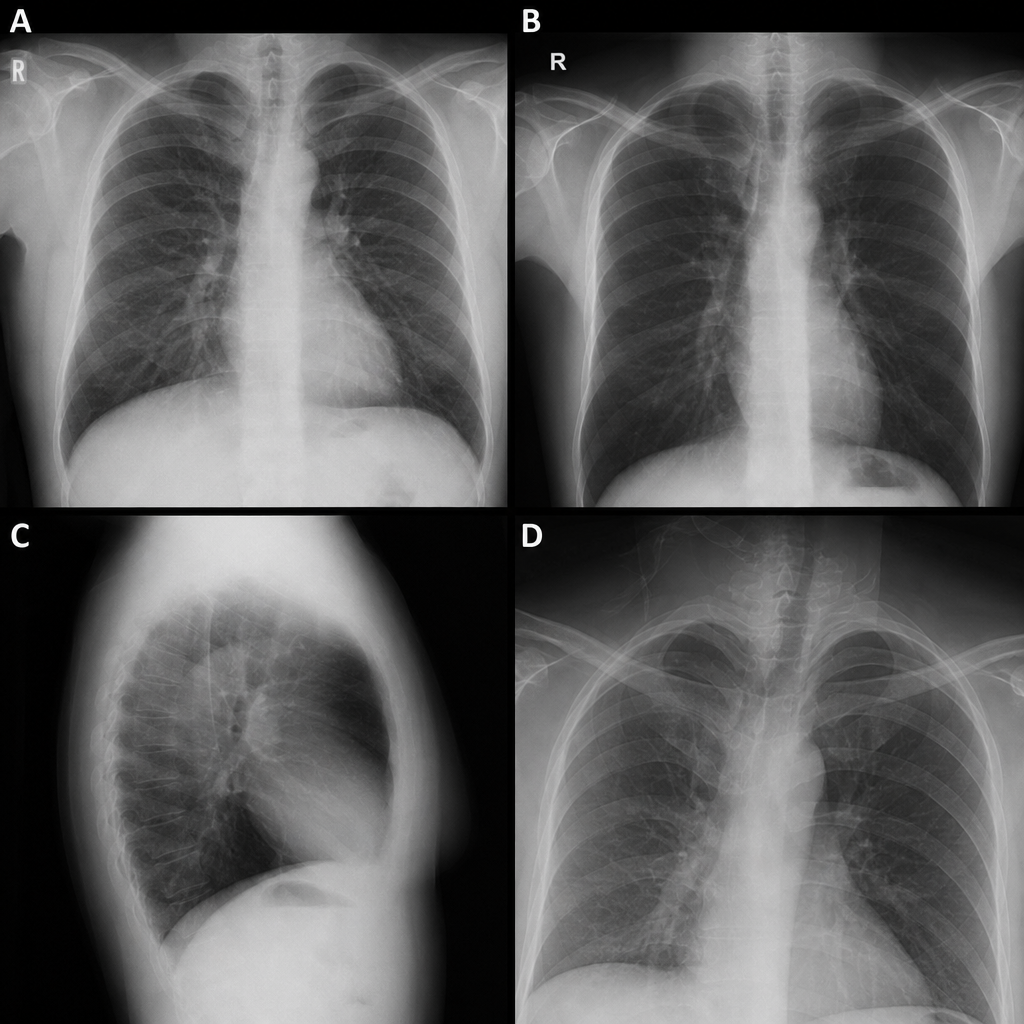
Which of the following is electromagnetic radiation?
What is true regarding permissible radiation exposure limits?
What is the unit of measurement for absorbed dose in X-ray?
Which of the following non-ionizing radiations is used in thermography?
Curie is the unit for which of the following quantities?
The 10-day rule is related to which of the following?
Which of the following has the maximum ionization potential?
Radio frequency waves are used in which of the following imaging modalities?
What is the SI unit of absorbed radiation dose?
Grid is used in radiography to:
Explanation: ### Explanation **Correct Answer: A. X-rays** **1. Why X-rays are the Correct Answer:** Radiation is broadly classified into two types: **Electromagnetic (EM)** and **Particulate**. Electromagnetic radiation consists of waves of electric and magnetic energy moving together through space at the speed of light. They have **no mass** and **no charge**. X-rays, along with Gamma rays, UV rays, visible light, and radio waves, belong to this spectrum. In radiology, X-rays are produced when high-speed electrons collide with a metal target (usually Tungsten), resulting in the emission of EM energy. **2. Why the Other Options are Incorrect:** * **B. Alpha rays:** These are **particulate radiation**. An alpha particle consists of two protons and two neutrons (identical to a Helium nucleus). They have a positive charge (+2) and significant mass. * **C. Beta rays:** These are also **particulate radiation**. They consist of high-energy, high-speed electrons (Beta-minus) or positrons (Beta-plus) emitted from a nucleus. Unlike X-rays, they possess mass and an electric charge. **3. High-Yield Clinical Pearls for NEET-PG:** * **Ionizing vs. Non-ionizing:** Both X-rays and Gamma rays are *ionizing* electromagnetic radiations (they have enough energy to remove electrons from atoms). * **X-rays vs. Gamma rays:** The primary difference is their **origin**. X-rays originate from the **electron cloud** (extranuclear), whereas Gamma rays originate from the **atomic nucleus**. * **Penetration Power:** Alpha particles have the lowest penetration (stopped by paper), while X-rays and Gamma rays have high penetration power, requiring lead or thick concrete for shielding. * **Velocity:** All electromagnetic radiations travel at the **speed of light** ($3 \times 10^8$ m/s) in a vacuum.
Explanation: ### Explanation The permissible radiation exposure limits are set by the **International Commission on Radiological Protection (ICRP)** and the **AERB (Atomic Energy Regulatory Board)** in India to minimize the risk of stochastic effects (like cancer) and prevent deterministic effects (like cataracts). **1. Why Option D is Correct:** For **radiation workers** (occupational exposure), the dose limit is defined as **20 mSv per year averaged over five years**, with a maximum of **50 mSv in any single year**. Since 50 mSv is the upper permissible limit for a single year, Option D is the most accurate statement among the choices provided. **2. Why Other Options are Incorrect:** * **Option A & C (Public Limits):** The dose limit for the **general public** is significantly lower than for workers because they do not voluntarily accept the risk or undergo routine monitoring. The limit is **1 mSv per year**. Therefore, 0.5 mSv (A) is incorrect, and 50 mSv (C) is dangerously high for the public. * **Option B:** 0.5 mSv is far below the occupational threshold for radiation workers. **3. High-Yield Clinical Pearls for NEET-PG:** * **ALARA Principle:** "As Low As Reasonably Achievable" is the fundamental philosophy of radiation protection. * **Pregnant Workers:** Once pregnancy is declared, the dose limit to the surface of the abdomen (fetus) is **1 mSv** for the remainder of the pregnancy. * **Specific Organ Limits (Workers):** * **Lens of the eye:** 20 mSv/year (revised down from 150 mSv to prevent radiation-induced cataracts). * **Skin/Extremities:** 500 mSv/year. * **Monitoring:** Thermoluminescent Dosimeters (**TLD badges**) are used to monitor these doses, typically worn under the lead apron at the chest level.
Explanation: ### Explanation **Correct Answer: C. Gray (Gy)** The **Absorbed Dose** is defined as the amount of energy deposited by ionizing radiation per unit mass of matter (such as human tissue). In the SI system, the unit is the **Gray (Gy)**, where 1 Gray = 1 Joule of energy absorbed per kilogram of matter (1 J/kg). In older literature, the unit used was the **rad** (Radiation Absorbed Dose), where 1 Gy = 100 rads. **Analysis of Incorrect Options:** * **A. Curie (Ci):** This is the traditional unit of **Radioactivity** (the rate of decay of a radioactive source). The SI unit for radioactivity is the Becquerel (Bq). * **B. Sievert (Sv):** This is the unit for **Equivalent Dose** and **Effective Dose**. It accounts for the biological effectiveness of different types of radiation (e.g., alpha vs. X-rays) and the radiosensitivity of specific organs. * **D. Kerma (Kinetic Energy Released per unit Mass):** While related, Kerma measures the kinetic energy transferred from uncharged particles (photons) to charged particles (electrons) *before* they deposit energy in the medium. **Clinical Pearls for NEET-PG:** * **Exposure:** Measured in **Roentgen (R)**; it quantifies the ionization of air. * **Deterministic Effects:** (e.g., skin erythema, cataracts) are related to the **Absorbed Dose (Gray)**. * **Stochastic Effects:** (e.g., cancer risk, genetic mutations) are related to the **Effective Dose (Sievert)**. * **Rule of 1:** For X-rays and Gamma rays, 1 Roentgen ≈ 1 rad (0.01 Gy) ≈ 1 rem (0.01 Sv) in soft tissue.
Explanation: **Explanation:** **Thermography** (also known as thermal imaging) is a non-invasive diagnostic technique that measures and records the heat patterns and temperature variations on the surface of the body. **1. Why Infrared is Correct:** All objects with a temperature above absolute zero emit **Infrared (IR) radiation** as a result of atomic and molecular motion. In medical thermography, specialized infrared cameras detect the long-wavelength IR radiation emitted by the skin. Since metabolic activity and vascularity influence skin temperature, thermography can map "hot spots" (hyperthermia) or "cold spots" (hypothermia). It is non-ionizing and does not involve any radiation exposure to the patient. **2. Why the Other Options are Incorrect:** * **Visible Light:** Used in photography and endoscopy, but it reflects off surfaces rather than representing the thermal energy emitted by the body. * **Microwaves:** These have longer wavelengths than IR. While used in "microwave radiometry" experimentally, they are not the standard radiation used in conventional clinical thermography. * **Radio waves:** These have the longest wavelength and lowest frequency. They are used in **MRI** (in conjunction with a magnetic field) to flip proton spins, not for thermal mapping. **3. Clinical Pearls for NEET-PG:** * **Clinical Use:** Thermography is sometimes used as an adjunct in screening for breast cancer, complex regional pain syndrome (CRPS), and peripheral vascular diseases, though it is **not** a replacement for mammography. * **Non-ionizing Modalities:** Remember that **MRI, Ultrasound, and Thermography** are the primary non-ionizing imaging modalities in radiology. * **Wavelength Fact:** Infrared radiation lies between the visible spectrum and microwaves on the electromagnetic spectrum (Wavelength: 700 nm to 1 mm).
Explanation: **Explanation:** The **Curie (Ci)** is a non-SI unit of **Radioactivity**, which measures the quantity of a radionuclide disintegrating per unit of time. One Curie is defined as the activity of 1 gram of Radium-226, equivalent to $3.7 \times 10^{10}$ disintegrations per second (dps). In the SI system, the unit for radioactivity is the **Becquerel (Bq)**, where $1 \text{ Bq} = 1 \text{ disintegration per second}$. **Analysis of Options:** * **Option A (Exposure):** This measures the ionization of air by X-rays or gamma rays. The traditional unit is the **Roentgen (R)**; the SI unit is Coulomb per kilogram (C/kg). * **Option B (Absorbed Dose):** This measures the energy deposited in a medium (like human tissue). The traditional unit is the **Rad**; the SI unit is the **Gray (Gy)**. ($1 \text{ Gy} = 100 \text{ rads}$). * **Option C (Degree of potential danger):** This refers to the **Equivalent Dose** (biological effect), which accounts for the type of radiation. The traditional unit is the **Rem**; the SI unit is the **Sievert (Sv)**. ($1 \text{ Sv} = 100 \text{ rems}$). **High-Yield Clinical Pearls for NEET-PG:** * **Radioactivity:** Curie (Old) $\rightarrow$ Becquerel (SI). * **Absorbed Dose:** Rad (Old) $\rightarrow$ Gray (SI). * **Dose Equivalent:** Rem (Old) $\rightarrow$ Sievert (SI). * **Effective Dose:** Measured in Sieverts; it accounts for the specific radiosensitivity of different organs (using tissue weighting factors). * **ALARA Principle:** "As Low As Reasonably Achievable" is the fundamental rule of radiation protection.
Explanation: **Explanation:** The **10-day rule** is a fundamental principle in radiation protection designed to minimize the risk of accidental fetal exposure to ionizing radiation. **Why Option A is correct:** The rule states that non-emergency radiological examinations of the abdomen or pelvis in women of reproductive age should be scheduled during the **first 10 days of the menstrual cycle** (counting from the first day of menstruation). This period is chosen because ovulation typically occurs around day 14; therefore, during the first 10 days, the probability of an undetected pregnancy is virtually zero. This prevents the "all-or-none" effect (death of the embryo) or congenital malformations caused by radiation during early organogenesis. **Why other options are incorrect:** * **Options B, C, and D:** Air quality, water quality, and sewage disposal are components of **Environmental Health and Sanitation**. While they are governed by specific standards (like the Air Act or WHO water standards), they have no relation to ionizing radiation protocols or menstrual cycle timing. **Clinical Pearls for NEET-PG:** * **Evolution of the rule:** The 10-day rule has largely been superseded by the **28-day rule** in many modern guidelines. The 28-day rule suggests that if a period is not overdue, the risk of pregnancy is low enough to proceed with most diagnostic exams, except for high-dose procedures like pelvic CT or barium enemas. * **Most sensitive period:** The fetus is most sensitive to radiation-induced CNS effects (like microcephaly or intellectual disability) between **8 to 15 weeks** of gestation. * **Dose Threshold:** Fetal risks are considered negligible at doses below **50 mGy (5 rad)**. Most diagnostic X-rays are well below this threshold.
Explanation: **Explanation:** The **ionization potential** (or ionizing power) of radiation refers to its ability to remove electrons from atoms, creating ion pairs. This property is directly proportional to the **mass** and the **square of the electrical charge** of the particle, and inversely proportional to its velocity. **Why Helium Ion is Correct:** A Helium ion ($He^{2+}$), also known as an **Alpha particle**, consists of two protons and two neutrons. It is the heaviest and most highly charged particle among the options (Charge = +2, Mass = 4 amu). Because of its large mass and double positive charge, it moves relatively slowly and interacts intensely with matter, causing dense ionization along a very short track. This gives it the **highest Linear Energy Transfer (LET)** and maximum ionization potential. **Why Other Options are Incorrect:** * **Electron (Beta particle):** Electrons have a very small mass (1/1836 of a proton) and a single negative charge (-1). Their ionizing power is significantly lower than that of alpha particles. * **Proton:** While heavier than an electron, a proton has only half the charge (+1) and about one-fourth the mass of a helium ion, resulting in lower ionizing potential. * **Gamma Photon:** These are electromagnetic radiations with **zero mass and zero charge**. They are "indirectly ionizing" and have the highest penetrative power but the **lowest ionization potential** among the choices. **High-Yield Clinical Pearls for NEET-PG:** * **Inverse Relationship:** Ionization potential is inversely proportional to penetration power. Alpha particles (Helium ions) have the highest ionization but can be stopped by a sheet of paper. * **LET (Linear Energy Transfer):** Alpha particles are the classic example of **High-LET radiation**, making them highly biologically damaging if internalized (e.g., Radon inhalation). * **Specific Ionization:** This is the number of ion pairs produced per unit length of the path. Alpha particles produce approximately 30,000–70,000 ion pairs/cm in air.
Explanation: **Explanation:** **MRI (Magnetic Resonance Imaging)** is the correct answer because it relies on the interaction between a strong static magnetic field and **Radio Frequency (RF) pulses**. The process involves aligning hydrogen protons in the body; when an RF pulse is applied at the specific Larmor frequency, these protons absorb energy (resonance) and flip their spin. When the RF pulse is turned off, the protons return to their original state, emitting RF signals that are captured by receiver coils to reconstruct an image. **Analysis of Incorrect Options:** * **PET Scan (Positron Emission Tomography):** Uses radiopharmaceuticals that emit **positrons**. These positrons undergo annihilation with electrons to produce **gamma rays** (511 keV), which are detected to create the image. * **CT (Computed Tomography):** Utilizes **X-rays** (ionizing electromagnetic radiation) produced by an X-ray tube rotating around the patient. * **Ultrasound:** Uses **high-frequency sound waves** (mechanical longitudinal waves), not electromagnetic waves. These waves reflect off tissue interfaces (echoes) to produce images. **High-Yield Clinical Pearls for NEET-PG:** * **Non-ionizing Modalities:** MRI and Ultrasound are the two primary imaging modalities that do not use ionizing radiation, making them safer for pregnant patients. * **Specific Absorption Rate (SAR):** This is a measure of the rate at which energy is absorbed by the body during an MRI scan, directly related to the heating effect of RF waves. * **Gadolinium:** The most common contrast agent used in MRI, which works by shortening T1 relaxation times.
Explanation: **Explanation:** The correct answer is **Gray (Gy)**. In radiation physics, it is crucial to distinguish between the amount of radiation emitted, the amount absorbed by tissue, and the biological effect produced. **1. Why Gray is Correct:** The **Gray (Gy)** is the **SI unit** for **Absorbed Dose**. It measures the amount of energy deposited by ionizing radiation per unit mass of matter (1 Gy = 1 Joule/kilogram). In clinical practice, Gray is used to prescribe doses in Radiotherapy. **2. Analysis of Incorrect Options:** * **Rad (Radiation Absorbed Dose):** This is the **Old/CGS unit** for absorbed dose. (1 Gray = 100 Rad). * **REM (Roentgen Equivalent Man):** This is the **Old unit** for **Equivalent Dose** (or Effective Dose), which accounts for the biological effectiveness of different types of radiation. The SI unit for this is the **Sievert (Sv)**. * **Curie (Ci):** This is the **Old unit** for **Radioactivity** (the rate of decay). The SI unit for radioactivity is the **Becquerel (Bq)**. **3. High-Yield Clinical Pearls for NEET-PG:** * **Exposure (in air):** SI unit is Coulomb/kg; Old unit is **Roentgen (R)**. * **Effective Dose (Sievert):** This is the most relevant unit for **Radiation Protection** and estimating cancer risk, as it factors in tissue sensitivity (Tissue Weighting Factor). * **Deterministic Effects:** (e.g., Cataracts, Skin Erythema) are measured in **Gray**. * **Stochastic Effects:** (e.g., Cancer, Genetic mutations) are measured in **Sieverts**. * **Rule of 100:** 1 Gray = 100 Rad; 1 Sievert = 100 REM.
Explanation: **Explanation:** **Why the correct answer is right:** The primary function of a **grid** in radiography is to improve image contrast by absorbing **scattered radiation** (Compton scatter) before it reaches the image receptor. When X-rays interact with patient tissues, they scatter in various directions. This scattered radiation creates a generalized "haze" or **fogging** on the radiograph, which reduces image clarity and contrast. A grid consists of thin lead strips that allow the primary beam to pass through while intercepting the angled scattered rays, thereby significantly reducing fogging. **Why the incorrect options are wrong:** * **A. Reduce KVP:** Grids do not reduce KVP (kilovoltage peak). In fact, because the grid absorbs some of the primary beam along with the scatter, an **increase** in KVP or mAs is often required to maintain adequate exposure to the film. * **B. Reduce exposure time:** Using a grid actually necessitates an **increase** in exposure time (or mAs) to compensate for the loss of photons absorbed by the grid strips (known as the Grid Factor). **High-Yield Clinical Pearls for NEET-PG:** * **Indication:** Grids are typically used when the body part thickness exceeds **10 cm** or when high KVP (>60-70) is used, as these factors increase scatter production. * **Bucky Factor:** This is the ratio of incident radiation to transmitted radiation. It indicates how much the mAs must be increased when using a grid (usually 2x to 6x). * **Grid Cut-off:** This occurs due to improper alignment of the X-ray tube or grid, resulting in an unwanted absorption of the primary beam and a light/underexposed image. * **Potter-Bucky Diaphragm:** A moving grid mechanism that blurs out the grid lines so they are not visible on the final radiograph.
Electromagnetic Radiation
Practice Questions
X-ray Production
Practice Questions
Interaction of Radiation with Matter
Practice Questions
Radiation Measurement Units
Practice Questions
Radiation Detectors
Practice Questions
Radiobiology Fundamentals
Practice Questions
Radiation Protection Principles
Practice Questions
Personnel Monitoring
Practice Questions
Shielding Design and Calculations
Practice Questions
Radiation Dose Optimization
Practice Questions
Regulatory Requirements
Practice Questions
Radiation Accidents Management
Practice Questions
Get full access to all questions, explanations, and performance tracking.
Start For Free