Which of the following is a harmful particle?
What subatomic particle is composed of one up quark and two down quarks?
What type of magnet is used in MRI?
Compared to round PID, use of rectangular PID reduces the patient's skin surface exposure by what percentage?
One becquerel (Bq) is equal to how many disintegrations per second?
Which of the following is not ionizing radiation?
Which of the following statements is true regarding the intensity of radiation in relation to the distance from its source?
Which X-rays are most likely to be absorbed by tissues and produce injury?
The 'heel effect' results in what kind of X-ray beam intensity distribution?
What are the constituent quarks of a proton?
Explanation: **Explanation:** The biological harm caused by radiation is determined by its **Linear Energy Transfer (LET)**. LET refers to the amount of energy a particle deposits per unit distance as it travels through tissue. **Correct Option: A. Alpha particle** Alpha particles are heavy, positively charged particles (consisting of two protons and two neutrons). Due to their large mass and charge, they have **high LET**. They travel slowly and collide frequently with atoms in a short distance, causing dense ionization. If inhaled or ingested (internal contamination), they cause significant double-stranded DNA breaks, making them the most biologically harmful among the options provided. **Incorrect Options:** * **B. Gamma particle:** This is a misnomer; Gamma is an electromagnetic **wave/photon**, not a particle. While highly penetrating, it has low LET and causes less dense ionization compared to Alpha particles. * **C. Neutron:** While neutrons are harmful and have high LET, they are primarily a concern in nuclear reactors or radiotherapy (boron neutron capture therapy) rather than diagnostic radiology. In the context of general radiation physics questions, Alpha is the classic example of high-LET harm. * **D. Electron:** Electrons (Beta particles) are much smaller and lighter than Alpha particles. They have low LET, meaning they deposit energy over a longer path, causing less concentrated biological damage. **High-Yield Clinical Pearls for NEET-PG:** * **Radiation Weighting Factor ($W_R$):** Alpha particles have a $W_R$ of **20**, while X-rays, Gamma rays, and Electrons have a $W_R$ of **1**. This means Alpha particles are 20 times more damaging for the same absorbed dose. * **Penetration vs. Ionization:** Alpha particles have the **lowest penetration** (stopped by a sheet of paper) but the **highest ionizing power**. * **Radon Gas:** The primary medical concern for Alpha radiation is Radon gas inhalation, which is a leading cause of lung cancer.
Explanation: **Explanation:** In subatomic physics, **hadrons** (like protons and neutrons) are composed of smaller fundamental particles called **quarks**. Quarks carry fractional electric charges: an **Up (u) quark** has a charge of **+2/3**, and a **Down (d) quark** has a charge of **-1/3**. 1. **Why Neutron is Correct:** A neutron is composed of **one up quark and two down quarks (udd)**. * Calculation: (+2/3) + (-1/3) + (-1/3) = **0**. * This explains why the neutron is electrically neutral. 2. **Analysis of Incorrect Options:** * **Proton:** Composed of **two up quarks and one down quark (uud)**. Calculation: (+2/3) + (+2/3) + (-1/3) = **+1**. This gives the proton its positive charge. * **Electron:** Electrons are **leptons**, not hadrons. They are fundamental particles and are **not** composed of quarks. * **Positron:** The antiparticle of the electron. Like the electron, it is a fundamental lepton and does not contain quarks. **High-Yield Clinical Pearls for NEET-PG:** * **Baryons:** Particles made of three quarks (e.g., Protons and Neutrons). * **Strong Nuclear Force:** This is the force that holds quarks together via particles called **gluons**. * **Mass Comparison:** Neutrons are slightly heavier than protons. This mass difference is crucial in beta decay. * **Radiobiology Link:** Neutrons have a high **Linear Energy Transfer (LET)** and a high **Relative Biological Effectiveness (RBE)**, making them more damaging to tissues compared to X-rays or Gamma rays.
Explanation: **Explanation:** The primary requirement for Magnetic Resonance Imaging (MRI) is a powerful, stable, and uniform magnetic field. Most modern clinical MRI scanners (1.5T and 3.0T) utilize **Superconducting magnets**. These magnets consist of coils made of niobium-titanium (NbTi) alloy that, when cooled to near absolute zero using liquid helium (4.2 K), exhibit zero electrical resistance. This allows a massive current to flow indefinitely without power consumption (cryogenic state), producing the high-intensity magnetic field necessary for high-resolution imaging. **Analysis of Options:** * **Ferromagnet (A):** While permanent magnets (made of ferromagnetic materials like Alnico) can be used in low-field "open" MRI systems, they are extremely heavy, cannot be turned off, and are limited to low field strengths (usually <0.3T), making them unsuitable for standard high-field clinical use. * **Paramagnet (B):** Paramagnetic materials (like Gadolinium) have weak, positive susceptibility to magnetic fields but cannot generate a magnetic field themselves. They are used as contrast agents, not as the primary magnet. * **Simple magnet (C):** This is a non-technical term. Standard resistive electromagnets (simple copper coils) require enormous amounts of electricity and generate excessive heat, making them inefficient for high-field MRI. **High-Yield Clinical Pearls for NEET-PG:** * **Cryogen:** Liquid Helium is the most common coolant used to maintain superconductivity. * **Quenching:** The sudden loss of superconductivity and rapid boil-off of liquid helium is called "Quenching." * **Field Strength:** 1.5 Tesla (T) is the standard; 3T is used for advanced neuro and musculoskeletal imaging. (1 Tesla = 10,000 Gauss). * **Safety:** The "Missile Effect" refers to the danger of ferromagnetic objects being pulled into the bore. MRI is contraindicated in patients with non-MRI-compatible pacemakers or metallic intraocular foreign bodies.
Explanation: **Explanation:** The **Position Indicating Device (PID)**, often called the cone, is used in dental radiography to direct the X-ray beam. The shift from round to rectangular collimation is one of the most effective ways to reduce unnecessary radiation dose. **1. Why 60% is correct:** A standard round PID produces a circular beam that is approximately 2.75 inches (7 cm) in diameter at the patient's face. However, the intraoral film or digital sensor is rectangular and much smaller than this circle. This means a significant portion of the round beam misses the receptor and exposes the patient's tissues unnecessarily. A **rectangular PID** restricts the beam to a size just slightly larger than the receptor. By eliminating the peripheral "extra" radiation, the skin surface area exposed is reduced by approximately **60% to 70%** compared to a round PID. **2. Analysis of Incorrect Options:** * **A (15%) & B (30%):** These values significantly underestimate the dose reduction. Even basic collimation improvements yield higher savings than these figures. * **C (45%):** While closer, this does not account for the full geometric efficiency gained when matching the beam shape precisely to the rectangular intraoral sensor. **3. High-Yield Facts for NEET-PG:** * **ALARA Principle:** Use of rectangular collimation is a primary application of the "As Low As Reasonably Achievable" principle. * **Collimation Material:** Usually made of lead or lead-lined metal to absorb divergent primary rays. * **Dose Reduction:** Rectangular collimation reduces the **Effective Dose** by about five-fold compared to round collimation. * **Long vs. Short PID:** A **long PID (16 inches)** is preferred over a short PID (8 inches) because it produces a more parallel beam, reducing magnification and the skin exposure dose (due to the inverse square law and decreased beam divergence).
Explanation: **Explanation:** The **Becquerel (Bq)** is the SI unit of radioactivity, defined as the activity of a quantity of radioactive material in which one nucleus decays per second. Therefore, **1 Bq = 1 disintegration per second (dps).** * **Why Option D is correct:** By definition, the Becquerel is a direct measure of the rate of radioactive decay where 1 Bq equals exactly 1 event per second. * **Why Option A is incorrect:** **3.7 x 10¹⁰ dps** is equal to **1 Curie (Ci)**. The Curie is the older, non-SI unit of activity, originally based on the activity of 1 gram of Radium-226. * **Why Options B and C are incorrect:** These values are mathematical distractors and do not represent standard units of radioactivity. However, note that **1 mCi = 37 MBq**, a common conversion used in nuclear medicine. **High-Yield Clinical Pearls for NEET-PG:** 1. **SI vs. Traditional Units:** Always distinguish between Activity (Bq vs. Ci), Absorbed Dose (Gray vs. Rad), and Equivalent Dose (Sievert vs. Rem). 2. **Conversions:** * 1 Ci = 3.7 x 10¹⁰ Bq (or 37 GBq). * 1 Gray (Gy) = 100 Rad. * 1 Sievert (Sv) = 100 Rem. 3. **Specific Activity:** This refers to the activity per unit mass of a radionuclide (e.g., Bq/g), which is crucial for determining the dosage in radiopharmaceuticals like I-131 or Technetium-99m.
Explanation: **Explanation:** The fundamental distinction between radiation types lies in their energy levels and their ability to remove tightly bound electrons from the orbit of atoms, a process known as **ionization**. **Why UV Radiation is the Correct Answer:** Ultraviolet (UV) radiation falls under the category of **non-ionizing radiation**. While UV rays possess enough energy to cause photochemical reactions (like DNA damage or excitation of electrons), they generally lack the specific energy threshold required to completely eject an electron from an atom. Other examples of non-ionizing radiation include visible light, infrared, microwaves, and radio waves. **Analysis of Incorrect Options:** * **Alpha Radiation (Option B):** These are helium nuclei ($^4He_{2}$) consisting of two protons and two neutrons. They are heavy, positively charged particles with high ionizing power but low penetration. * **Beta Radiation (Option A):** These are high-speed electrons (or positrons) emitted from a nucleus. They have moderate ionizing power and penetration. * **Gamma Radiation (Option C):** These are high-energy electromagnetic waves (photons) originating from the nucleus. Along with X-rays, they are the primary forms of ionizing electromagnetic radiation used in clinical practice. **High-Yield Clinical Pearls for NEET-PG:** * **The Dividing Line:** In the electromagnetic spectrum, the transition from non-ionizing to ionizing radiation occurs at the **UV-C/Vacuum UV** range (photon energy > 10–12 eV). * **Biological Effect:** Ionizing radiation (Alpha, Beta, Gamma, X-rays) causes direct or indirect (via free radicals) DNA strand breaks, leading to cell death or mutations. * **Diagnostic Radiology:** X-rays and Gamma rays (used in Scintigraphy/PET) are ionizing; **MRI and Ultrasound** are non-ionizing and thus safer for pregnant patients.
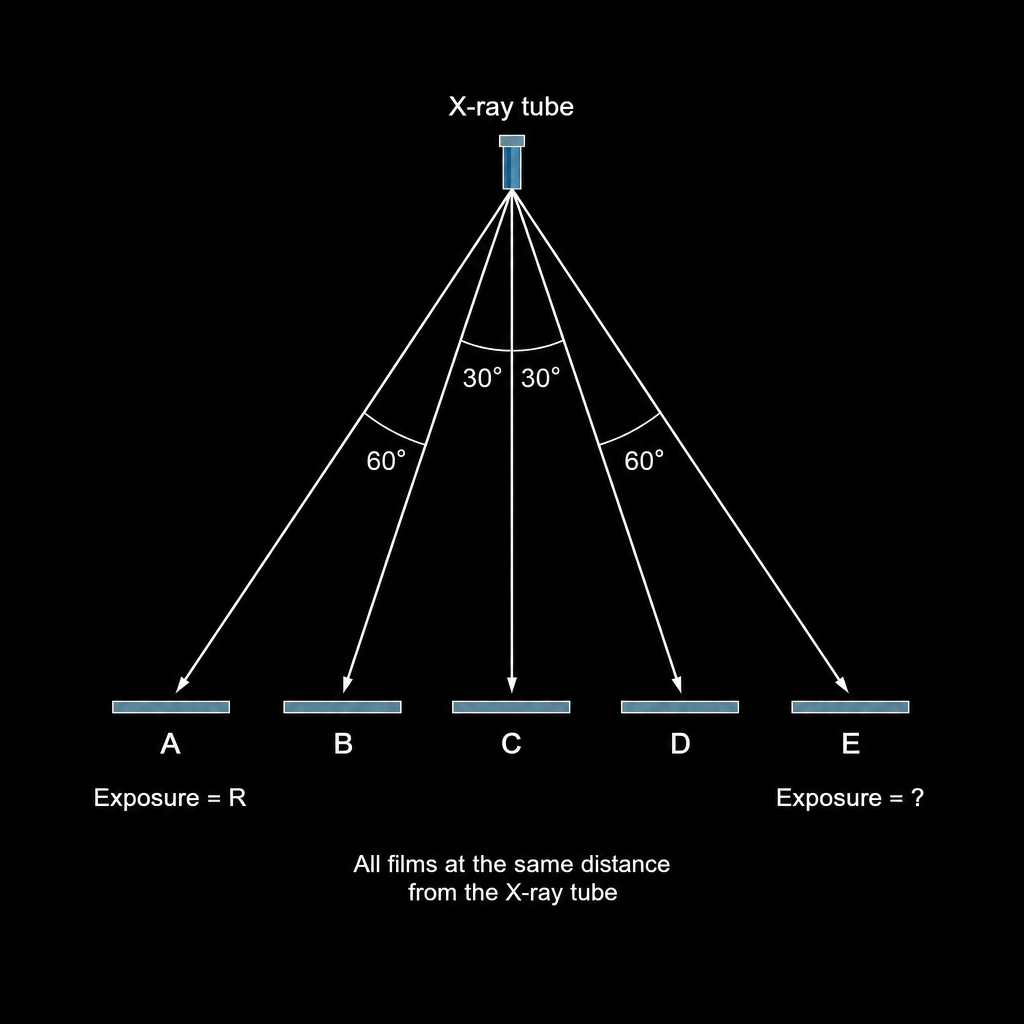
Explanation: ### Explanation **1. The Inverse Square Law (The Correct Concept)** The intensity of radiation is governed by the **Inverse Square Law**. This physical principle states that the intensity (I) of radiation from a point source is inversely proportional to the square of the distance (d) from that source ($I \propto 1/d^2$). As X-rays or gamma rays emerge from a source, they diverge and spread over a larger area. Since the total amount of energy remains constant but the area it covers increases with the square of the distance (Area of a sphere = $4\pi r^2$), the concentration of radiation (intensity) must decrease accordingly. For example, if you double the distance from the source, the intensity drops to one-fourth ($1/2^2$) of its original value. **2. Analysis of Incorrect Options** * **Option A:** While intensity does decrease with distance, stating it is simply "a function of distance" is incomplete. It specifically follows a geometric square relationship, not a linear one. * **Option B & D:** These are fundamentally incorrect. Radiation spreads out as it travels; therefore, intensity can never increase as one moves further away from the source. **3. Clinical Pearls & High-Yield Facts for NEET-PG** * **Radiation Protection:** The Inverse Square Law is the most effective and simplest method of radiation protection for healthcare workers. Increasing distance is often more effective than increasing lead shielding. * **ALARA Principle:** "As Low As Reasonably Achievable." Distance is one of the three pillars of ALARA (Time, Distance, Shielding). * **Practical Application:** During fluoroscopy or mobile X-rays, stepping back just two meters from the patient (the primary source of scatter) reduces the operator's dose to negligible levels compared to standing at one meter. * **Formula for Calculations:** $I_1 \times (d_1)^2 = I_2 \times (d_2)^2$. This formula is frequently used in numerical questions to calculate the new dose at a different distance.
Explanation: **Explanation:** The biological effect and penetrative power of X-rays are determined by their energy, which is inversely proportional to their wavelength ($E = hc/\lambda$). **1. Why Long Wavelength X-rays are most harmful to tissues:** X-rays with **long wavelengths** have **low energy** (often called "soft X-rays"). Because they lack the energy to penetrate through the body to reach the film/detector, they are instead **absorbed by the superficial tissues** (skin and subcutaneous layers). According to the Law of Bergonie and Tribondeau, absorbed radiation causes ionization within cells, leading to DNA damage and potential tissue injury. **2. Analysis of Incorrect Options:** * **B. Short Wavelength X-rays:** These are "hard X-rays" with high energy. They have high penetrative power, meaning they pass through the tissues to reach the detector, resulting in less energy deposition (absorption) within the patient. * **C. Filtered X-rays:** Filtration (usually using Aluminum) is specifically designed to **remove** low-energy, long-wavelength X-rays from the beam before they reach the patient. This "hardens" the beam, reducing the patient's radiation dose and injury risk. * **D. Central rays:** This refers to the theoretical center of the X-ray beam. While the central ray is the most perpendicular and least divergent, its wavelength determines its absorption, not its position in the beam. **High-Yield Clinical Pearls for NEET-PG:** * **Beam Hardening:** The process of removing long-wavelength X-rays using filters to reduce skin dose. * **Aluminum (Al):** The most common material used for filtration in diagnostic radiology. * **Inverse Square Law:** Radiation intensity is inversely proportional to the square of the distance from the source ($I \propto 1/d^2$); doubling the distance reduces the dose by a factor of four. * **ALARA Principle:** As Low As Reasonably Achievable (Time, Distance, Shielding).
Explanation: ### Explanation The **Anode Heel Effect** is a fundamental concept in X-ray physics describing the uneven distribution of X-ray intensity along the cathode-anode axis. **Why the Correct Answer is Right:** X-rays are produced at a depth within the target material of the anode. Because the anode is angled (usually 6° to 20°), X-rays emitted toward the **anode side** must travel through a greater thickness of the target material compared to those directed toward the cathode. This results in increased **self-absorption** of X-rays by the anode itself, leading to a **lower intensity** on the anode side. Conversely, X-rays directed toward the **cathode side** undergo less attenuation, resulting in a **higher intensity** (up to 120% of the central ray). Therefore, both statements in Option C are correct. **Analysis of Incorrect Options:** * **Option A:** While true, it is incomplete. The heel effect is a gradient; it describes both the decrease at the anode and the relative increase at the cathode. * **Option B:** Similarly, this is only half of the phenomenon. * **Option D:** Incorrect, as the physics of the anode angle dictates this specific intensity distribution. **High-Yield Clinical Pearls for NEET-PG:** * **Clinical Application:** Always place the **thicker part of the patient's body toward the cathode side** to ensure uniform image density (e.g., in a Chest X-ray, the diaphragm/upper abdomen should be at the cathode end; in a Foot X-ray, the heel should be at the cathode end). * **Factors Increasing Heel Effect:** 1. **Smaller Anode Angle:** The steeper the angle, the more pronounced the effect. 2. **Shorter Source-to-Image Distance (SID):** Moving the tube closer to the film exaggerates the intensity difference. 3. **Larger Field Size:** Using a larger film/detector captures more of the peripheral beam where the effect is strongest. * **Mnemonic:** **"FAT-CAT"** — Place the **Fat** (thicker) part of the patient at the **Cat**hode side.
Explanation: **Explanation:** In the study of radiation physics, subatomic particles like protons and neutrons are classified as **hadrons**, which are composed of smaller elementary particles called **quarks**. Quarks carry fractional electric charges: the **Up (u) quark** has a charge of **+2/3**, and the **Down (d) quark** has a charge of **-1/3**. **Why Option A is Correct:** A proton is composed of **two up quarks and one down quark (uud)**. To determine the total charge of a proton, we sum the fractional charges: $(+2/3) + (+2/3) + (-1/3) = +1$. This resultant charge of +1 defines the electrical identity of the proton, which is essential for atomic stability and interactions in diagnostic imaging (like MRI). **Analysis of Incorrect Options:** * **Option B:** A combination of 2 up and 2 down quarks does not exist in stable nucleons; it would result in a charge of +2/3, which does not correspond to a known stable baryon. * **Option C:** This describes a **neutron (udd)**. The charge calculation is $(+2/3) + (-1/3) + (-1/3) = 0$. Neutrons are neutral particles found in the nucleus. * **Option D:** A combination of one quark and one antiquark forms a **meson**, not a baryon like a proton or neutron. **High-Yield Clinical Pearls for NEET-PG:** * **Baryons:** Particles made of three quarks (e.g., Protons and Neutrons). * **Strong Nuclear Force:** This is the force mediated by **gluons** that holds quarks together within the proton. * **MRI Physics:** The single proton in the Hydrogen nucleus is the primary source of the signal in MRI due to its net spin and magnetic moment. * **Mass Comparison:** Neutrons are slightly heavier than protons, which is why a free neutron can undergo beta decay into a proton.
Electromagnetic Radiation
Practice Questions
X-ray Production
Practice Questions
Interaction of Radiation with Matter
Practice Questions
Radiation Measurement Units
Practice Questions
Radiation Detectors
Practice Questions
Radiobiology Fundamentals
Practice Questions
Radiation Protection Principles
Practice Questions
Personnel Monitoring
Practice Questions
Shielding Design and Calculations
Practice Questions
Radiation Dose Optimization
Practice Questions
Regulatory Requirements
Practice Questions
Radiation Accidents Management
Practice Questions
Get full access to all questions, explanations, and performance tracking.
Start For Free