Hutchinson's secondaries in the skull are due to tumors in which organ?
Time sector scanning of neonates is preferred because of which of the following reasons?
What is the primary method for the antenatal diagnosis of hydrocephalus?
A newborn male child presents with respiratory distress in the neonatal unit. His X-ray shows a left hemithorax with multiple air-filled structures and mediastinal shift to the right. Which of the following represents the most likely diagnosis?
"Corner sign of Park" is a feature of which of the following conditions?
What is the imaging modality of choice for neonatal hypertrophic pyloric stenosis?
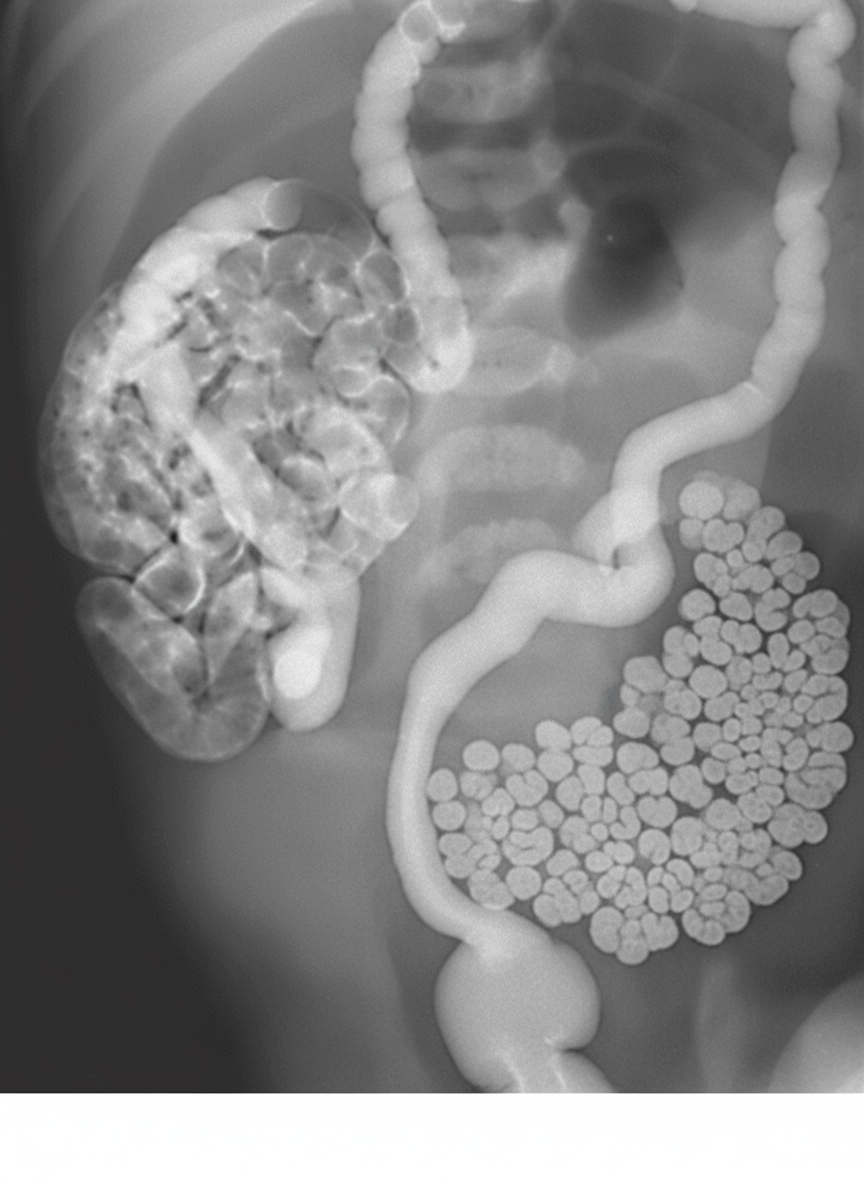
Pneumatosis Intestinalis is associated with which of the following conditions?
Which of the following is NOT a cause of respiratory distress in a newborn with ipsilateral shift of the mediastinum?
The 'egg on its side' appearance of the heart on a radiograph is characteristic of which congenital heart anomaly?
A patient presented to the OPD with a sudden onset of shortness of breath. Identify the condition with the radiological image given below.
Explanation: **Explanation:** **Hutchinson’s secondaries** refer to metastatic deposits in the skull and orbit, specifically originating from a **Neuroblastoma**. In children, the most common site for a primary neuroblastoma is the **Adrenal Medulla** (derived from neural crest cells). 1. **Why Adrenals are Correct:** Neuroblastoma is the most common extracranial solid tumor of childhood. It has a unique propensity for hematogenous spread to the bones. When it involves the skull and orbit, it leads to characteristic clinical features like **proptosis and periorbital ecchymosis ("Raccoon Eyes")**. Radiologically, these secondaries often cause "sunray" spicule formation and sutural widening due to increased intracranial pressure. 2. **Why Other Options are Incorrect:** * **Lungs & Breast:** These are common primary sites for bone metastasis in **adults**. In the pediatric age group, primary lung or breast carcinomas are extremely rare. * **Liver:** While neuroblastoma can metastasize to the liver (known as **Pepper’s syndrome**), the term "Hutchinson’s secondaries" is specifically reserved for bone/skull involvement. **Clinical Pearls for NEET-PG:** * **Hutchinson’s Type:** Metastasis to the skull, orbit, and long bones (common in older children). * **Pepper’s Type:** Massive involvement of the liver (common in infants). * **Smith’s Type:** Metastasis to the cervical lymph nodes. * **Radiology Sign:** On X-ray, look for the **"Sunray appearance"** of the skull and widening of cranial sutures. * **Biochemical Marker:** Elevated urinary VMA (Vanillylmandelic acid) and HVA (Homovanillic acid).
Explanation: **Explanation:** **1. Why "Open Fontanelles" is correct:** In neonatal imaging, **Time Sector Scanning** (Cranial Ultrasonography) is the gold standard for evaluating the brain. The primary reason is the presence of **open fontanelles**, specifically the **anterior fontanelle**, which serves as an "acoustic window." Since ultrasound waves cannot penetrate the thick, mineralized adult skull, the unossified gaps in a neonate's skull allow the ultrasound beam to pass through and visualize the intracranial structures (like the ventricles and germinal matrix) with high clarity. **2. Analysis of Incorrect Options:** * **B. Inexpensive:** While ultrasound is cost-effective compared to MRI or CT, this is a logistical advantage, not the technical reason why sector scanning is specifically *preferred* or *possible* for brain imaging in this age group. * **C. Children are more cooperative:** This is clinically false. Neonates are often uncooperative and move frequently. However, ultrasound is preferred because it is bedside-portable and does not require the strict sedation often needed for CT or MRI. * **D. Better resolution:** While high-frequency probes offer good resolution, MRI actually provides superior spatial and contrast resolution. The preference for USG is based on the accessibility provided by the fontanelle and the lack of ionizing radiation. **3. Clinical Pearls for NEET-PG:** * **Primary Window:** The **Anterior Fontanelle** is the most common window used. The posterior and mastoid fontanelles can be used to visualize the cerebellum and posterior fossa. * **Clinical Utility:** It is the investigation of choice for screening **Intraventricular Hemorrhage (IVH)** in preterm infants and **Periventricular Leukomalacia (PVL)**. * **Closure Timing:** The anterior fontanelle typically closes by **18–24 months**, after which this technique is no longer feasible. * **Safety:** It is non-invasive, involves **no ionizing radiation**, and can be performed at the bedside in the NICU.
Explanation: **Explanation:** **1. Why Ultrasound (USG) is the Correct Answer:** Ultrasound is the **gold standard and primary modality** for screening and diagnosing fetal structural anomalies, including hydrocephalus. It is non-invasive, cost-effective, and lacks ionizing radiation. The diagnosis is typically made by measuring the **atrial width of the lateral ventricles**. A measurement **>10 mm** at any gestational age is considered ventriculomegaly, which may progress to hydrocephalus. USG can also identify the underlying cause, such as Aqueductal Stenosis or Dandy-Walker malformation. **2. Why the Incorrect Options are Wrong:** * **Alpha-fetoprotein (AFP) estimation:** Elevated AFP levels in maternal serum or amniotic fluid are markers for **Neural Tube Defects (NTDs)** like Anencephaly or Spina Bifida, but they do not directly diagnose hydrocephalus. * **Foetoscopy:** This is an invasive endoscopic procedure used for fetal surgery or direct visualization. It is not a screening or primary diagnostic tool for hydrocephalus due to high procedural risks. * **Amniocentesis:** While used to detect chromosomal abnormalities or infections (which may be associated with hydrocephalus), it cannot visualize the ventricular system to provide a structural diagnosis. **3. High-Yield Clinical Pearls for NEET-PG:** * **Normal Atrial Width:** <10 mm. * **Mild Ventriculomegaly:** 10–15 mm; **Overt Hydrocephalus:** >15 mm. * **Dangling Choroid Sign:** A classic USG finding in fetal hydrocephalus where the choroid plexus falls dependently within the enlarged lateral ventricle. * **Fetal MRI:** Used as an adjunct to USG for better characterization of posterior fossa anomalies or cortical development issues, but it is not the *primary* method.
Explanation: ### Explanation **Correct Answer: D. Congenital diaphragmatic hernia (CDH)** **Why it is correct:** Congenital diaphragmatic hernia (most commonly the **Bochdalek** type, occurring posterolaterally on the left) results from a defect in the pleuroperitoneal membrane. This allows abdominal viscera (bowel loops, stomach) to herniate into the thoracic cavity. * **Radiological findings:** The "multiple air-filled structures" described are actually gas-filled bowel loops within the chest. These displace the heart and mediastinum to the contralateral side (right), leading to a **scaphoid abdomen** (due to lack of abdominal contents) and severe respiratory distress from secondary **pulmonary hypoplasia**. **Why the other options are incorrect:** * **A. Cystic Fibrosis:** Typically presents later in childhood with chronic cough, malabsorption, or meconium ileus. X-ray findings usually show bronchiectasis and hyperinflation, not bowel loops in the thorax. * **B. Streptococcal Pneumonia:** While it can cause respiratory distress, it presents with opacification (consolidation) or pleural effusion, not multi-cystic air-filled structures and significant mediastinal shift in a newborn. * **C. Congenital Tumour of Lungs:** Rare; while a Congenital Pulmonary Airway Malformation (CPAM) could mimic this, CDH is far more common in neonates presenting with immediate distress and a shifted mediastinum. **High-Yield Clinical Pearls for NEET-PG:** * **Most common site:** Left side (80-85%) through the Foramen of Bochdalek ("Bochdalek is Back and Left"). * **Key X-ray sign:** Bowel loops in the hemithorax and an absence of the normal abdominal gas pattern. * **Management Tip:** Avoid bag-and-mask ventilation as it distends the herniated bowel, further compressing the lungs. **Immediate endotracheal intubation** is the preferred management. * **Prognostic factor:** The degree of pulmonary hypoplasia and pulmonary hypertension determines survival.
Explanation: **Explanation:** **Corner Sign of Park** (also known as the Wimberger sign of scurvy) refers to a small marginal metaphyseal fracture or "beaking" seen at the edges of the zone of provisional calcification. **1. Why Scurvy is Correct:** Scurvy is caused by Vitamin C deficiency, which leads to defective collagen synthesis. This results in weakened capillary walls (leading to subperiosteal hemorrhages) and brittle osteoid. The **Corner Sign** occurs because the zone of provisional calcification is calcified but brittle; under mechanical stress, the edges of this zone fracture, creating a "corner" defect. This is often seen alongside the **Pelkan Spur**, which is the healing/ossification of the periosteum at these corners. **2. Why Other Options are Incorrect:** * **Rickets:** Characterized by a failure of mineralization. Key findings include cupping, splaying, and fraying of the metaphysis, and an increased growth plate width, but not discrete marginal fractures. * **Battered Baby Syndrome:** While it involves metaphyseal fractures (Bucket-handle or Corner fractures), these are traumatic avulsions of the metaphysis. The "Corner Sign of Park" is a specific eponym reserved for the metabolic pathology of Scurvy. * **Sickle Cell Disease:** Radiographic features include "H-shaped" vertebrae (Reynold’s sign), dactylitis (hand-foot syndrome), and bone infarcts, but not specific metaphyseal corner signs. **3. High-Yield Clinical Pearls for Scurvy (NEET-PG):** * **Wimberger Ring Sign:** A thin, sclerotic rim surrounding a lucent epiphysis. * **Frankel’s Line:** Dense, sclerotic line at the zone of provisional calcification. * **Trummerfeld Zone:** A lucent (scorbutic) band proximal to Frankel’s line representing a zone of debris. * **Subperiosteal Hemorrhage:** Leads to lifting of the periosteum, which becomes visible as "cloaking" upon healing/calcification.
Explanation: **Explanation:** **Ultrasound (USG)** is the gold standard and imaging modality of choice for Neonatal Hypertrophic Pyloric Stenosis (HPS). It is preferred because it is non-invasive, avoids ionizing radiation in neonates, and allows for real-time dynamic visualization of the pylorus. The diagnosis is confirmed by measuring the pyloric muscle thickness and length. **Why the other options are incorrect:** * **X-ray (A):** While it may show a "gasless abdomen" or a dilated stomach with a "single bubble" appearance, it is non-specific and cannot visualize the hypertrophied muscle directly. * **CT Scan (B) & MRI (C):** These are unnecessary, expensive, and time-consuming. CT involves high doses of radiation, while MRI often requires sedation in neonates. Neither offers the real-time benefits of USG for this condition. **High-Yield Clinical Pearls for NEET-PG:** * **Classic Presentation:** A 3–6 week-old male infant with **non-bilious, projectile vomiting** and a palpable "olive-shaped" mass in the epigastrium. * **Ultrographic Criteria (The "Rule of 3 and 14"):** * Pyloric muscle thickness **>3 mm** (most sensitive). * Pyloric channel length **>14 mm**. * Pyloric diameter **>11 mm**. * **Key Signs:** * **USG:** "Target sign" (transverse) or "Cervix sign" (longitudinal). * **Barium Swallow (if USG is inconclusive):** "String sign," "Beak sign," or "Shoulder sign." * **Metabolic Profile:** Hypochloremic, hypokalemic metabolic alkalosis (Paradoxical aciduria). * **Treatment:** Ramstedt’s Pyloromyotomy (after correcting electrolyte imbalances).
Explanation: **Explanation:** **Pneumatosis Intestinalis** refers to the presence of gas within the wall of the small or large intestine. It is the pathognomonic radiographic finding for **Necrotizing Enterocolitis (NEC)**, the most common gastrointestinal emergency in neonates (especially premature infants). In NEC, mucosal injury and bacterial invasion lead to gas production (hydrogen and methane) by gas-forming organisms within the bowel wall. * **Option A (Correct):** NEC presents with the triad of abdominal distension, bloody stools, and pneumatosis intestinalis. On X-ray, it appears as linear or curvilinear lucencies outlining the bowel wall. * **Option B:** Gallstone Ileus is characterized by **Rigler’s Triad** (small bowel obstruction, ectopic gallstone, and **pneumobilia**—gas in the biliary tree), not gas in the bowel wall. * **Option C:** Diverticulosis involves outpouchings of the mucosa through the muscularis; while it can lead to pneumoperitoneum if perforated, it is not typically associated with intramural gas. * **Option D:** Hirschsprung Disease presents with distal bowel obstruction and a "transition zone" on contrast enema. While it can lead to enterocolitis (HAEC), the primary radiographic feature is dilated proximal loops and a lack of air in the rectum. **High-Yield Clinical Pearls for NEET-PG:** * **Bell’s Staging:** Used to classify the severity of NEC. * **Portal Venous Gas:** A sign of advanced NEC, indicating gas has migrated from the bowel wall into the mesenteric veins. * **Football Sign:** Indicates massive pneumoperitoneum (perforation), seen as a large oval radiolucency on a supine abdominal X-ray. * **Most common site for NEC:** Terminal ileum and proximal colon.
Explanation: In neonatal radiology, the position of the mediastinum is a critical diagnostic clue. An **ipsilateral shift** (shift toward the side of the pathology) indicates a loss of lung volume or a failure of lung development on that side. ### Why Hyaline Membrane Disease (HMD) is the Correct Answer: **Hyaline Membrane Disease (RDS)** is a diffuse, bilateral condition caused by surfactant deficiency. Radiologically, it presents with bilateral "ground-glass" opacities, air bronchograms, and low lung volumes. Because the pathology is **symmetrical and generalized**, there is no pressure differential between the hemithoraces; therefore, the mediastinum remains **central**. ### Why the Other Options are Incorrect: * **Atelectasis & B. Lung Collapse:** Both involve the loss of air in a portion of or the entire lung. This creates negative pressure on the affected side, "pulling" the mediastinum toward the lesion (**ipsilateral shift**). * **Pulmonary Hypoplasia:** This is the incomplete development of the lung. The resulting empty space in the thoracic cavity causes the mediastinum to shift toward the underdeveloped side (**ipsilateral shift**) to compensate for the volume deficit. ### NEET-PG High-Yield Pearls: * **Ipsilateral Shift (Pull):** Think volume loss (Atelectasis, Agenesis, Hypoplasia, Post-pneumonectomy). * **Contralateral Shift (Push):** Think volume addition (Tension Pneumothorax, Massive Pleural Effusion, Congenital Diaphragmatic Hernia, CPAM). * **HMD Key Sign:** "Ground-glass" appearance + Air bronchograms + Central mediastinum. * **Congenital Diaphragmatic Hernia (CDH):** Most common cause of a **contralateral** shift in a distressed neonate with a scaphoid abdomen.
Explanation: ### Explanation The correct answer is **Transposition of the Great Arteries (TGA)**. **1. Why TGA is correct:** The "egg-on-a-string" or "egg-on-its-side" appearance is the classic radiographic sign of D-TGA. This morphology occurs due to two main anatomical changes: * **The "Egg":** Represents the globular enlargement of the right atrium and right ventricle (cardiomegaly). * **The "String":** Represents the **narrowing of the superior mediastinum (vascular pedicle)**. This happens because the aorta and pulmonary artery are positioned anteroposteriorly (stacked) rather than side-by-side, and there is often thymic atrophy due to neonatal stress. **2. Why the other options are incorrect:** * **TAPVC (Option A):** Characteristically shows the **"Snowman sign"** or **"Figure-of-8"** appearance (in the supracardiac type) due to a dilated vertical vein and superior vena cava. * **ASD/VSD (Options C & D):** These typically present with non-specific cardiomegaly and increased pulmonary vascular markings (plethora) but do not produce the specific "egg" configuration. **3. High-Yield Clinical Pearls for NEET-PG:** * **TGA** is the most common cyanotic heart disease presenting in the **first 24 hours of life**. * **Boot-shaped heart (Coeur en Sabot):** Seen in Tetralogy of Fallot (TOF) due to right ventricular hypertrophy and an upturned apex. * **Box-shaped heart:** Seen in Ebstein’s Anomaly due to massive right atrial enlargement. * **Sitting Duck sign:** Also associated with TGA. * **Management:** Prostaglandin E1 (to keep the ductus open) followed by the **Arterial Switch Operation (Jatene procedure)**.
Explanation: ***Laryngotracheobronchitis*** - The AP neck radiograph displays the classic **"steeple sign,"** which is a tapered narrowing of the subglottic trachea (indicated by the arrow) due to inflammation. - This condition, also known as **croup**, is typically caused by a viral infection (most commonly **parainfluenza virus**) and presents with a characteristic **barking cough** and inspiratory stridor. *Epiglottitis* - This condition is characterized by the **"thumb sign"** on a *lateral* neck X-ray, which shows a swollen epiglottis, not the subglottic narrowing seen here. - Patients typically present more severely with high fever, **drooling**, dysphagia, and assume a **"tripod" posture**, which differs from the presentation of croup. *Bronchitis* - Bronchitis is an inflammation of the larger airways (bronchi) and would not produce findings in the subglottic region of a neck X-ray. - The primary symptom is a productive cough, and a **chest X-ray**, not a neck X-ray, would be the relevant imaging, which is often normal. *Laryngomalacia* - This is a congenital condition causing inspiratory stridor due to the collapse of soft laryngeal structures; it is not an acute infectious process. - The diagnosis is typically confirmed with **flexible laryngoscopy**, and plain radiographs are usually normal and do not show a steeple sign.
Normal Pediatric Developmental Anatomy
Practice Questions
Neonatal Imaging
Practice Questions
Pediatric Chest Imaging
Practice Questions
Pediatric Abdominal Imaging
Practice Questions
Pediatric Musculoskeletal Imaging
Practice Questions
Pediatric Neuroradiology
Practice Questions
Congenital Heart Disease Imaging
Practice Questions
Pediatric Oncology Imaging
Practice Questions
Child Abuse Imaging
Practice Questions
Pediatric Interventional Radiology
Practice Questions
Radiation Protection in Pediatrics
Practice Questions
Sedation in Pediatric Imaging
Practice Questions
Get full access to all questions, explanations, and performance tracking.
Start For Free