Neuroblastoma differs from Wilm's tumor radiologically by all EXCEPT?
The "snowman" sign is seen in which of the following conditions?
What is the first and most prominent radiological sign of raised intracranial tension in infants and children on plain x-ray?
Which of the following is NOT a radiological feature of ileal atresia?
A 6-year-old boy presents with acute onset abdominal pain and a history of blood in his stool. On examination, no obvious mass is palpated. Ultrasound has been advised. What is the probable diagnosis?
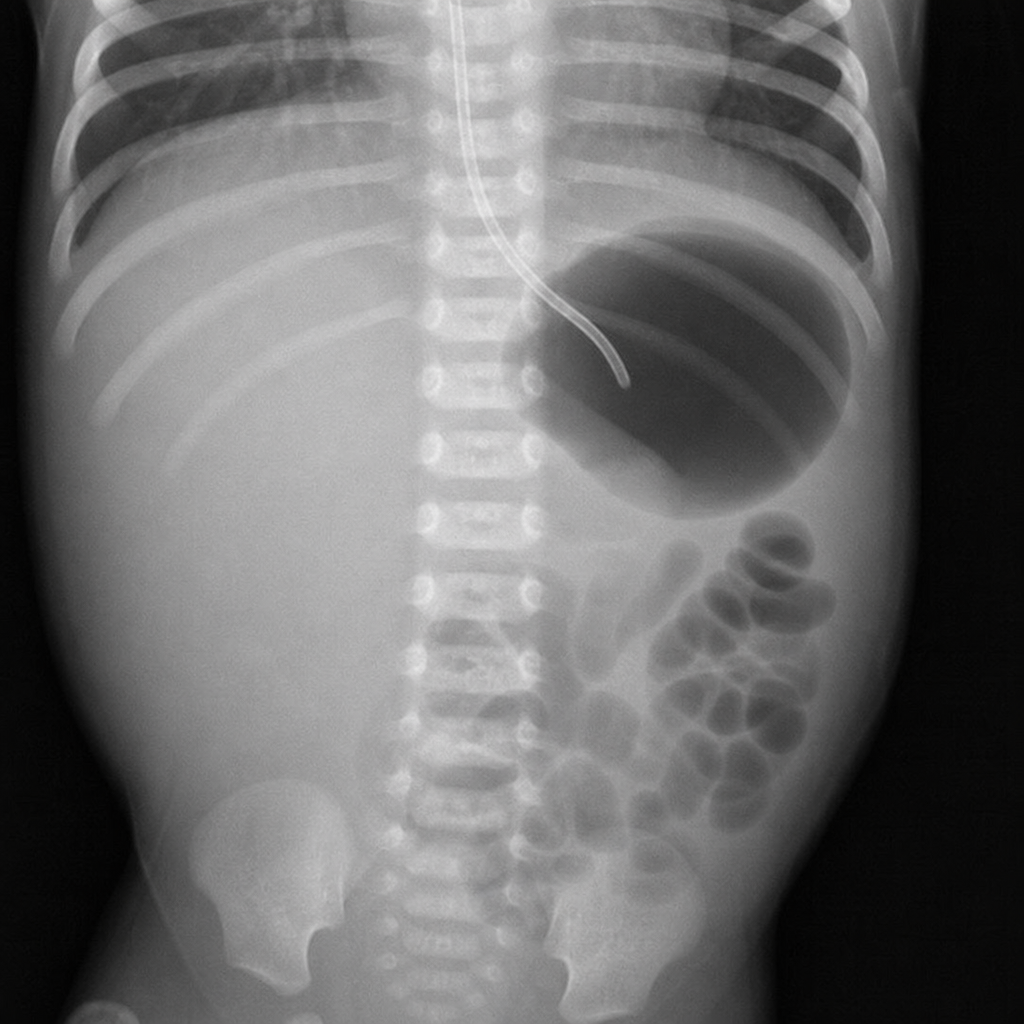
What is indicated by the double bubble sign?
Which of the following is NOT an X-ray finding of retinoblastoma?
What is the investigation of choice for pyloric stenosis?
What is the characteristic radiological finding in ileal atresia?
Which tumor is shown in the image?

Explanation: ### Educational Explanation **1. Why "Same location" is the correct answer:** Neuroblastoma and Wilms’ tumor do **not** share the same anatomical location. **Neuroblastoma** is an extra-renal tumor, most commonly arising from the adrenal medulla (though it can occur anywhere along the sympathetic chain). In contrast, **Wilms’ tumor (Nephroblastoma)** is an intra-renal tumor arising from the kidney parenchyma itself. This is a fundamental radiological distinction: Wilms’ tumor displaces the pelvicalyceal system (claw sign), whereas Neuroblastoma displaces the entire kidney (usually downward and laterally). **2. Analysis of Incorrect Options:** * **A. Calcification:** This is a major differentiator. Calcification is very common in Neuroblastoma (80–90% of cases, often stippled) but rare in Wilms’ tumor (only 10–15%). * **B. Aorta and IVC displacement:** Neuroblastoma is notorious for **encasing and displacing** major vessels (Aorta/IVC) without invading them. Wilms’ tumor, however, is more likely to **invade** the renal vein and IVC rather than just pushing them aside. * **D. Intraspinal extension:** Neuroblastoma frequently extends through the neural foramina into the spinal canal (dumbbell-shaped tumor). This feature is virtually never seen in Wilms’ tumor. **3. Clinical Pearls for NEET-PG:** * **Age Factor:** Neuroblastoma typically presents earlier (median age 2 years) than Wilms’ tumor (median age 3–4 years). * **Midline Crossing:** Neuroblastoma frequently crosses the midline; Wilms’ tumor usually remains confined to one side. * **The "Claw Sign":** Present in Wilms’ tumor (indicates the tumor originates from the kidney). * **Metastasis:** Neuroblastoma often spreads to bones (Orbit - Proptosis/Raccoon eyes); Wilms’ tumor primarily spreads to the lungs (Cannonball secondaries).
Explanation: **Explanation:** The **"Snowman" sign** (also known as the **Figure-of-8 appearance**) is a classic radiological finding in **Supracardiac Total Anomalous Pulmonary Venous Connection (TAPVC)**. **Why it occurs:** In supracardiac TAPVC, the pulmonary veins drain into a common pulmonary vein, which then drains into the **left vertical vein**. This vertical vein connects to the **left innominate (brachiocephalic) vein**, which eventually empties into the **Right Superior Vena Cava (SVC)**. * **The "Head" of the snowman:** Formed by the dilated left vertical vein (left), the left innominate vein (top), and the dilated right SVC (right). * **The "Body" of the snowman:** Formed by the enlarged right atrium. **Analysis of Incorrect Options:** * **Transposition of Great Arteries (TGA):** Characterized by the **"Egg-on-a-string"** appearance due to a narrow mediastinum (atrophy of the thymus and stress) and an abnormal relationship of the great vessels. * **Tetralogy of Fallot (TOF):** Characterized by the **"Boot-shaped heart" (Coeur en sabot)** due to right ventricular hypertrophy (lifting the apex) and a concave pulmonary segment. * **Aortic Dissection:** Classically shows **mediastinal widening** on a chest X-ray, but not a snowman configuration. **NEET-PG High-Yield Pearls:** * **TAPVC Types:** Supracardiac (most common, shows Snowman sign), Cardiac (drains to coronary sinus), and Infracardiac (most severe, often presents with neonatal respiratory distress due to obstruction). * **Scimitar Sign:** Seen in **Partial** Anomalous Pulmonary Venous Return (PAPVR), where an anomalous vein drains the right lung into the IVC. * **Box-shaped heart:** Seen in **Ebstein’s Anomaly** due to massive right atrial enlargement.
Explanation: ### Explanation In pediatric radiology, the skull's response to raised intracranial pressure (ICP) varies significantly based on age and the status of the cranial sutures. **1. Why Suture Diastasis is Correct:** In infants and young children (typically up to age 10–12), the cranial sutures are not yet fused. When intracranial pressure rises, the skull expands to accommodate the volume, leading to the **widening of the sutures (Suture Diastasis)**. This is the **earliest and most reliable sign** of raised ICP in this age group. A suture width of >2 mm is generally considered abnormal. **2. Analysis of Incorrect Options:** * **Copper Beaten Appearance (Option A):** Also known as "silver beaten" skull, this refers to prominent convolutional markings from gyri indenting the inner table of the skull. While associated with chronic raised ICP (like craniosynostosis), it is **not specific** and can be a normal finding in healthy children during periods of rapid brain growth (ages 4–10). * **Erosion of Dorsum Sellae (Option B):** This is the **most common sign of raised ICP in adults**. Because adult sutures are fused, the pressure is transmitted to the bony sella turcica. In children, suture diastasis occurs long before pressure can erode the bone. * **J-shaped Sella (Option D):** This is a morphological variant where the sella is elongated anteriorly. It is classically associated with **Mucopolysaccharidosis** (e.g., Hurler syndrome) or optic chiasm gliomas, not primarily with raised ICP. **Clinical Pearls for NEET-PG:** * **Sequence of signs in adults:** Erosion of the floor of the sella → Erosion of the dorsum sellae → Blurring of the posterior clinoid processes. * **Macewen’s Sign (Clinical):** A "cracked pot" sound on percussion of the skull, which is the clinical correlate of suture diastasis. * **Most sensitive imaging:** While X-rays show these signs, **Non-Contrast CT (NCCT)** is the gold standard for acute evaluation of raised ICP (looking for midline shift or effacement of cisterns).
Explanation: **Explanation:** **Ileal atresia** is a common cause of neonatal intestinal obstruction. The correct answer is **C (Double bubble sign)** because this radiological sign is the hallmark of **Duodenal atresia**, not ileal atresia. 1. **Why "Double bubble sign" is the correct answer:** The double bubble sign represents air in the stomach and the proximal duodenum, with no distal gas. This indicates a proximal obstruction at the level of the duodenum. In contrast, ileal atresia is a distal small bowel obstruction, which typically presents with multiple dilated bowel loops and air-fluid levels on an abdominal X-ray. 2. **Analysis of other options:** * **Obstruction on barium meal (A):** While not the first-line investigation, a barium meal/upper GI series in ileal atresia would show dilated proximal small bowel loops with a complete cutoff (obstruction) in the distal ileum. * **Microcolon on barium enema (B):** This is a classic finding in distal small bowel obstructions like ileal atresia. Because the colon has not been used during fetal life (due to the upstream obstruction), it remains small in caliber (disuse atrophy). * **Apple-peel appearance (D):** This is a specific morphological subtype (Type IIIb) of jejunoileal atresia where the distal bowel twists around a single marginal artery (the ileocolic artery), resembling an apple peel or Christmas tree. **High-Yield Clinical Pearls for NEET-PG:** * **Duodenal Atresia:** Associated with **Down Syndrome** and the "Double Bubble" sign. * **Jejunoileal Atresia:** Usually caused by a **vascular accident** in utero (ischemic necrosis). * **Triple Bubble Sign:** Characteristic of **Jejunal atresia**. * **Ground-glass appearance/Soap bubble sign:** Suggestive of **Meconium Ileus** (associated with Cystic Fibrosis).
Explanation: **Explanation:** The clinical presentation of acute abdominal pain and **"red currant jelly" stools** (blood and mucus) in a child is the classic triad of **Intussusception**, which is the most common cause of intestinal obstruction in children aged 6 months to 3 years. It occurs when a proximal segment of the bowel (intussusceptum) telescopes into a distal segment (intussuscepiens). **Why Intussusception is correct:** While a "sausage-shaped mass" is often palpable, its absence does not rule out the diagnosis. **Ultrasound** is the gold standard for diagnosis (sensitivity ~98%), typically revealing the **"Target sign"** or **"Donut sign"** in the transverse plane and the **"Pseudokidney sign"** in the longitudinal plane. **Why other options are incorrect:** * **Midgut Volvulus:** Usually presents in the neonatal period with bilious vomiting. Ultrasound shows the **"Whirlpool sign"** (vessels wrapping around the SMA). * **Ascariasis:** While common in children, it usually presents as subacute obstruction. Ultrasound shows the **"Spaghetti sign"** or "railway track" appearance of worms. * **Appendicitis:** Presents with migratory pain to the right iliac fossa and fever. Ultrasound would show a non-compressible, blind-ended tubular structure >6mm. **High-Yield Clinical Pearls for NEET-PG:** * **Most common site:** Ileocolic. * **Lead point:** In children >2 years, look for a pathological lead point like **Meckel’s diverticulum**, polyp, or lymphoma. * **Treatment:** Non-operative reduction using **Hydrostatic (saline) or Pneumatic (air) enema** under fluoroscopic or USG guidance is the initial treatment of choice if there are no signs of perforation or peritonitis.
Explanation: The **Double Bubble Sign** is a classic radiological finding seen on an abdominal X-ray (erect film). It represents the simultaneous gaseous distension of the **stomach** and the **proximal duodenum**, with a complete absence of gas in the distal bowel. ### Why Duodenal Atresia is Correct: In duodenal atresia, there is a congenital failure of recanalization of the duodenum. This creates a complete obstruction. On X-ray, the first "bubble" is the air-filled stomach, and the second "bubble" is the dilated proximal duodenum. Because the obstruction is complete, no gas passes into the distal small or large intestines, resulting in a "gasless abdomen" beyond the duodenum. ### Why Other Options are Incorrect: * **Jejunal Atresia:** Typically presents with a **"Triple Bubble Sign"** or multiple dilated loops of small bowel, as the obstruction is further down the gastrointestinal tract. * **Pyloric Stenosis:** Characterized by a large single gastric bubble. Diagnosis is primarily made via ultrasound (showing "target" or "doughnut" signs), not by a double bubble. * **Hirschsprung Disease:** A distal large bowel obstruction. X-rays show multiple dilated loops of both small and large bowel with a lack of air in the rectum. ### NEET-PG High-Yield Pearls: * **Association:** Approximately 30% of infants with duodenal atresia have **Down Syndrome (Trisomy 21)**. * **Antenatal Finding:** Polyhydramnios is common due to the fetus's inability to swallow and absorb amniotic fluid. * **Differential Diagnosis:** A "partial" double bubble (with some distal gas) can be seen in **Malrotation with Midgut Volvulus** or **Annular Pancreas**. * **Management:** Initial management involves nasogastric decompression and IV fluids, followed by surgical repair (Duodenoduodenostomy).
Explanation: ### Explanation **Retinoblastoma** is the most common primary intraocular malignancy of childhood. Understanding its radiological presentation is crucial for NEET-PG, as it often involves identifying the extent of tumor spread. **Why "Intracerebral calcification" is the correct answer:** While **calcification** is the hallmark of retinoblastoma (occurring in approximately 90% of cases), it is characteristically **intraocular** (within the globe). Retinoblastoma spreads via the optic nerve to the brain or via hematogenous routes to bones. While the tumor can spread to the brain (leptomeningeal dissemination), it does not typically present as primary "intracerebral calcification" on X-ray. Intracerebral calcifications are more characteristic of conditions like TORCH infections, Sturge-Weber syndrome, or Tuberous Sclerosis. **Analysis of Incorrect Options:** * **Intraocular calcification:** This is the most common radiological feature. On X-ray or CT, fine or chunky calcification within the soft tissue mass of the orbit is highly suggestive of retinoblastoma. * **Widening of the optic canal:** This indicates **retrobulbar extension**. If the tumor invades the optic nerve and extends toward the chiasm, it causes pressure erosion and subsequent enlargement of the optic foramen. * **Secondaries in cranial bones:** Retinoblastoma can metastasize hematogenously. Distant spread often involves the bone marrow and the skeleton, particularly the skull (cranial bones) and long bones, appearing as osteolytic or mixed lesions. **High-Yield Clinical Pearls for NEET-PG:** * **Most common presentation:** Leukocoria (white pupillary reflex). * **Imaging Modality of Choice:** **MRI** is preferred to evaluate optic nerve involvement and to rule out **Trilateral Retinoblastoma** (bilateral RB + Pineoblastoma). * **CT Scan:** Highly sensitive for detecting calcification but avoided when possible due to radiation risk (especially in heritable cases with *RB1* mutations). * **Pathology:** Look for **Flexner-Wintersteiner rosettes** (pathognomonic).
Explanation: **Explanation:** **Infantile Hypertrophic Pyloric Stenosis (IHPS)** is a common cause of gastric outlet obstruction in infants (typically aged 2–6 weeks). **Why Ultrasound (USG) is the Investigation of Choice:** Ultrasound is the gold standard because it is non-invasive, avoids ionizing radiation, and allows for real-time visualization of the pyloric muscle. It has a sensitivity and specificity approaching 100%. The diagnostic criteria on USG are: * **Pyloric muscle thickness:** >3 mm (most sensitive) * **Pyloric canal length:** >14–16 mm * **Pyloric volume:** >1.5 cm³ * **Target sign:** Seen on transverse view (hypoechoic hypertrophied muscle surrounding echogenic mucosa). **Why other options are incorrect:** * **Upper GI Series (Barium Swallow):** Previously the standard, it is now reserved for cases where USG is inconclusive. It shows the **"String sign"** (narrowed canal) or **"Beak sign."** It is avoided as a first-line due to radiation and aspiration risk. * **CT Scan (C) and MRI (D):** These are not indicated for IHPS. CT involves high radiation doses, and MRI is time-consuming and expensive. Neither offers superior diagnostic value over USG for this condition. **High-Yield Clinical Pearls for NEET-PG:** * **Clinical Presentation:** Non-bilious, projectile vomiting in a "hungry vomiter." * **Physical Exam:** Palpable **"olive-shaped" mass** in the epigastrium. * **Metabolic Abnormality:** Hypochloremic, hypokalemic metabolic alkalosis (with paradoxical aciduria). * **Treatment:** Ramstedt’s Pyloromyotomy (after correcting electrolyte imbalances).
Explanation: **Explanation:** **Ileal atresia** is a common cause of neonatal intestinal obstruction. The characteristic radiological finding is a **microcolon** (also known as "unused colon") seen on a contrast (barium/Gastrografin) enema. 1. **Why Option A is correct:** In ileal atresia, the obstruction occurs early in intrauterine life. Because the distal bowel (colon) does not receive the usual flow of succus entericus, amniotic fluid, and debris, it fails to expand and remains small in caliber. A contrast enema reveals a tiny, ribbon-like colon, which confirms the diagnosis and helps differentiate it from meconium ileus. 2. **Why other options are incorrect:** * **Option B (Double bubble sign):** This is the classic radiological hallmark of **Duodenal Atresia**. It represents air in the stomach and the proximal duodenum. * **Option C (Coil spring appearance):** This is a classic sign of **Intussusception** seen during a contrast enema, caused by the contrast material tracking between the intussusceptum and the intussuscipiens. **High-Yield Clinical Pearls for NEET-PG:** * **X-ray findings:** Ileal atresia typically shows multiple dilated loops of small bowel with air-fluid levels (distal obstruction). * **Vascular Insult Theory:** Unlike duodenal atresia (which is a failure of recanalization), jejunoileal atresia is usually caused by an **in-utero vascular accident** (e.g., volvulus or intussusception) leading to ischemic necrosis. * **Differential Diagnosis of Microcolon:** Includes Ileal atresia, Meconium ileus (associated with Cystic Fibrosis), and Total colonic aganglionosis (Hirschsprung disease). * **Triple Bubble Sign:** Characteristic of **Jejunal atresia**.
Explanation: ***Sacrococcygeal teratoma*** - **Sacrococcygeal teratomas** are the most common **congenital tumor** in newborns, arising from the **coccyx** and presenting as a large **external mass** at the base of the spine. - They contain **mixed tissue elements** (ectoderm, mesoderm, endoderm) and are classified by the **Altman classification** based on internal vs external components. *Meningocele* - A **neural tube defect** where the **meninges** protrude through a **spinal defect**, typically appearing as a fluid-filled sac without solid tissue components. - Usually located more **dorsally** along the spine and lacks the **heterogeneous appearance** with calcifications seen in teratomas. *Not recalled* - This is not a diagnostic option and represents **incomplete knowledge** rather than a specific pathological entity. - In medical practice, uncertain cases require **further evaluation** and consultation rather than defaulting to "not recalled." *Infantile fibrosarcoma* - A **malignant soft tissue sarcoma** that typically presents as a **firm, growing mass** in extremities or trunk, not specifically at the sacrococcygeal region. - Shows **homogeneous soft tissue density** on imaging without the **mixed echogenicity** and **calcifications** characteristic of teratomas.
Normal Pediatric Developmental Anatomy
Practice Questions
Neonatal Imaging
Practice Questions
Pediatric Chest Imaging
Practice Questions
Pediatric Abdominal Imaging
Practice Questions
Pediatric Musculoskeletal Imaging
Practice Questions
Pediatric Neuroradiology
Practice Questions
Congenital Heart Disease Imaging
Practice Questions
Pediatric Oncology Imaging
Practice Questions
Child Abuse Imaging
Practice Questions
Pediatric Interventional Radiology
Practice Questions
Radiation Protection in Pediatrics
Practice Questions
Sedation in Pediatric Imaging
Practice Questions
Get full access to all questions, explanations, and performance tracking.
Start For Free